Category Archives: Officer Corps

‘Virtual’ Apartments and the Army’s Protest Mood

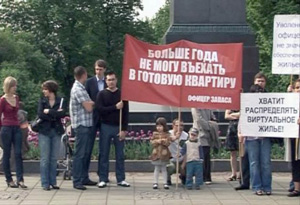
Ex-Military Men Protesting 'Virtual' Apartments (photo: RIA Novosti)

In Monday’s Nezavisimaya gazeta, Vladimir Mukhin described a 15 May demonstration outside the Defense Ministry by former officers who were allocated ‘virtual’ apartments in Balashikha six months ago, but have been unable to occupy them due to slow paperwork.  Their demands are simple:  these retirees want bureaucratic obstacles removed.  

The protest was not covered by the media, or received only scant coverage.  However, the Defense Ministry’s promise to fix the problems for former servicemen from Balashikha was reported widely in the press. 

Mukhin’s subtitle for the article reads, “Unfulfilled Presidential housing program for the military leading to protest actions.”  He concludes that military demonstrations have been so rare in post-Soviet history that, if they occur, they have to be symptomatic of something.  He says similar protests have happened in other regions with large military garrisons. 

Everyone remembers Defense Minister Serdyukov’s reports about fulfilling the military housing program in 2009.  However, it’s becoming clear that this didn’t happen.  New military housing and construction chief Grigoriy Naginskiy not long ago announced that of 45,000 permanent apartments handed out in 2009, less than half have been occupied.  So the plan wasn’t achieved.  This has provoked a protest mood in the army, and the authorities, it seems, prefer not to notice it.  

Mukhin cites similar situations and actions in Bashkiriya, and elsewhere in  Moscow’s far suburbs.  The All-Russian Professional Union of Servicemen (OPSV or ОПСВ) tells Mukhin it’s pretty simple.  A garrison is drawn down, and officers who don’t want to relocate are put out of their apartments (sometimes into the street).  The garrison is then sold by Defense Ministry officials with a direct interest in this.  Mukhin concludes, that’s the ‘new profile’ army for you. 

OPSV Chairman Oleg Shvedkov told Mukhin several thousand retired officers and servicemen participated in May 1 protests around the country.  They protested not just housing, but also pension and pay problems.  But, of course, active-duty servicemen are prohibited from participating in political actions under the law. 

Viktor Baranets also addressed the plight of former officers in Balashikha in a 12 May article. 

According to ITAR-TASS and RIA Novosti, a Defense Ministry housing official promised on 15 May that the problem of 80 retired servicemen and the apartments allocated to them in Balashikha would be resolved before the end of June.  He said the process of preparing all the necessary documents would be complete by that time. 

A Defense Ministry spokesman said a meeting with an ‘initiative group’ [i.e. the protesters] was held in the ministry.  He also indicated the Defense Ministry is trying to speed up and smooth out the process of preparing and registering survey and property ownership documents.

Victim of the ‘New Profile’

Obvious individual suffering from Serdyukov’s ‘New Profile’ military reforms hasn’t been readily apparent until now.

Russian media today carried sad news about a 34-year-old lieutenant colonel, one Aleksey Kudryavtsev, serving in Udmurtiya, who hung himself in the forest upon learning his unit would be disbanded.

Press said he served in v/ch 93233, which Yandex shows is the military commissariat [draft and mobilization office] for Igra Rayon of the Udmurt Republic.  Kudryavtsev must have been one of the few remaining uniforms in the commissariat since most military men were early victims of Serdyukov’s cut in the officer corps.  Some officers have been able to serve on as civilians.

Despondent on finding out about his imminent dismissal, the lieutenant colonel stood to lose not only his post, but also his service apartment.  He wrote his wife a note saying not to look for him and to start a new family, and then disappeared last September.  His body was finally located in a remote wooded area.  He left sons of 4 and 8 behind.

Newsru.com and Argumenty nedeli covered the story.

Who Defends Officers?

On 13 April, Svpressa.ru made the point that officers don’t have a place to turn for help or protection against abuse in the army, unlike conscripts who have the Committee of Soldiers’ Mothers of Russia (KSMR or КСМР).

In response to the suggestion that officers need a “Committee of Officers’ Wives and Mothers” to help them with problems in the service, KSMR Chairwoman Tatyana Znachkova said:

“There’s no one to defend officers, and many of them live unhappily, not better than conscripts.  So their wives could create a committee for their defense.  Officers or their wives actually have come to us very often in recent times.”

Asked what their complaints are, she says:

“Legal violations in the unit, low wages, problems with obtaining housing.  But we can’t help them.”

“So I advise them to create their own organization because their problems are so very great.  But they are silent.  It’s understandable why the officers themselves are silent, they’re not allowed to gripe, but why are their wives silent?  No one can prohibit them.  If the family is without housing, without work, without money, what’s to lose . . .”

Svpressa continues, many of the officers cut have been thrown overboard, without housing, without work.  So in Voronovo, near Moscow, where a unit was closed a year ago, residents say former colonels and lieutenants go around to nearby dachas offering to do repairs or any kind of work on the houses.  They do it to feed their families since they don’t have any other work.

Anatoliy Tsyganok tells Svpressa:

“Officers have now been thrown to the whims of fate.  There’s really no where for them to complain.  Their problems are resolved well only in words.  Look for yourself, in just the last year, more than 3 thousand officers discharged into the reserves without housing and deceived by the state about the payment of monetary compensation have turned to the European Court . . .  The main part of complaints concerns nonpayment to servicemen of money for participation in this or that combat action or peacekeeping operation.  Part of the complaints are collective.  And the quantity of such complaints will increase since there is more and more of a basis for them.”

Asked about the basis of complaints, Tsyganok says:

“Some officers are outside the TO&E, receiving a fifth of their usual pay for several years, although they are supposed to be in such a situation not more than half a year.  They are waiting for apartments from the Defense Ministry.  They have every basis for placing law suits in Strasbourg.  In the framework of armed forces reform almost all billets in voyenkomaty at different levels were cut.  And 90 percent of former voyenkomat officers, dismissed without apartments, will also appeal to the ECHR [European Court of Human Rights in Strasbourg].  These are educated people who understand they won’t get the truth in a Russian court.  And their only hope is the European Court.  Today there are very many officers left without apartments.  They don’t know in what order, when and who will give them apartments.  These people have a direct road to the ECHR.”

Tsyganok goes on to mention how President Medvedev has promised to house officers, and claimed that an unprecedented 45,000 apartments were acquired for them last year.  Tsyganok believes the number was actually less than 30,000.  He notes that in St. Petersburg officers are being offered prefab housing, fit only for summer living, built for the Defense Ministry at a vastly inflated price (5-6 million rubles vs. 1.25-1.35 million market price).  Officers with apartments in abandoned military towns have to hope the nearest municipality will take them over and assume responsibility for services, but they usually don’t want to.

Tsyganok describes the difficulty in employing former officers.  Businesses generally don’t want anyone new over 40.  An initiative to use officers as teachers didn’t get off the ground.  So, according to Tsyganok, many officers choose between working for security firms or criminal groups.

He repeats his familiar lament that Russia is losing its well-trained, well-educated military intelligentsia—officers who completed 4-6 years in a VVUZ, mid-career branch-specific training, and 3 years in the General Staff Academy.  He concludes:

“So I presume, Russia is flashing back to the former Red Army.  In case, heaven forbid, of some conflict, I believe the current Russian Army won’t survive.  In these conditions, I think it doesn’t compare even with Georgia . . .”

Tsyganok says it’s absurd for an officer to have to repair dachas like a guestworker to feed his family.  It’s even more absurd for him to choose between security guard and criminal.  But the saddest thing in this situation is there’s no place from which to expect help.  So maybe officers need an organization to protect their rights, and in light of the current military reform, the need is very acute.

Organizations and institutions that exist, or have existed, to help officers are like most civil society in Russia—weak or eventually dispersed or coopted by the authorities.  There are ones that come to mind—the All-Russian Professional Servicemen’s Union (OPSV or ОПСВ), the Movement in Support of the Army (DPA or ДПА), and the All-Russian Officers’ Assembly that last met in 2005 or so.

On 14 April, Viktor Baranets picked up some similar themes, saying today’s reformist thinking from Defense Ministry and Genshtab chiefs is generally incomprehensible to Russian Army commanders.  For many years, they inspired the troops by telling how superior contract manning would be, and these serious intentions were underscored by hundreds of billions of rubles.  But the result was fewer contractees than before.  And now the Genshtab has said it’s changed its mind about more professionals and is reversing course.

Similarly, for years there’s been talk of ‘raising the prestige of the officer corps.’  And what does Baranets see in reality:

“And the fact is a large number of majors and even lieutenant colonels have started to be put in sergeant billets.  I’m not talking about captains and senior lieutenants.  Because, do you see, there aren’t enough professional junior commanders.  They’ve only just begun to train them.  But why do we need to ‘pay’ for the tactical calculation of reformers at the expense of downgrading people?  Putting officers in lower positions by every army canon is a form of punishment.  And no kind of service expedience can justify this violation.  And where is the logic even?  With one hand the chiefs give such officers impressive premiums for good service, and with the other they write orders on a transfer to a position which is not seldom even 4 steps lower than the one they occupy!  The rampage of personnel abuse has already gone to the point that they’ve already warned cadet-graduates of the Voronezh Military Aviation University [sic] (tomorrow’s lieutenants):  only those who graduate with a gold medal and distinction will get officer’s positions, the rest—sergeant’s.  In such confusion I don’t exclude that soon General Staff Academy graduates will command platoons.  It’s time for the Main Military Prosecutor to sort it out:  but how do these reform outrages accord with the demands of our laws?  But does it even make sense to put a specialist with higher education, whose 4-5 years of preparation cost the state millions of rubles, in a position yesterday still occupied by a junior sergeant who has secondary school and 3-months of training behind him?”

Viktor Litovkin noted this morning that Serdyukov’s Military Education Directorate Chief, Tamara Fraltsova, told Ekho Moskvy that the VVUZ system will again produce an overabundance of lieutenants this year for a shrinking number of junior officer posts in platoons, companies, and batteries.

Fraltsova said:

“Today the army has the right to pick the most worthy officers from the number of VVUZ graduates.  We’ve tightened the rules for passing examination sessions.  Now a cadet can be put out of the military-education institution for one 2, an unsatisfactory evaluation received in the course of a session.”

Litovkin says the overproduction of lieutenants (and decline in officer posts) led to young air defense officers being assigned to sergeants’ duties last summer.  A similar thing happened with VVS pilots; not every graduate-pilot could find an operational aircraft.  So great resources—3-6 million rubles per pilot—were poured into the sand.  Litovkin sees it as indicative of an armed forces reform in which great resources are expended in vain.  Not to mention the trauma to lieutenants who, against the law, are placed in lower-ranking duties.

Second Half of General Staff Chief’s Interview

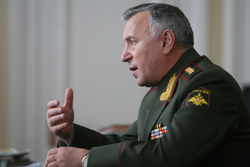
General Staff Chief Makarov (photo: Viktor Vasenin)

Rossiyskaya gazeta published the second, less substantial, half of Nikolay Makarov’s interview yesterday.

On speculation that the one-year conscription term will be raised, Makarov said:

“No one intends to increase the conscript service term.  But in the Defense Ministry they are thinking of measures to tighten accountability for evading military service.  Today no serious sanctions are applied against evaders.”

Regarding the supply of young men for the army:

“. . . after the transition to 12-month conscript service the callup increased about two times.  But from 2012 the complex demographic situation in the country will add to the problem of manning the armed forces.”

So this is why the military is thinking about clamping down on evasion, which Makarov puts at about 200,000 for all draft-age men.

Asked about measures to make the life of military school and institute cadets more like that of other students, Makarov said changes in the order of the day will have cadets go to classes and exercises in the mornings, and they will be free in the afternoons.  He continues:

“Why do we have to lock cadets in the barracks?  We understand if a person consciously picked the military profession, this means he will study.  If he’s not sure of his choice, he’ll simply get filtered out.”

Makarov indicated the Defense Ministry is looking at having its new state-owned rear services corporation Oboronservis supply militarized security guards for garrisons.  Privatized security companies would relieve servicemen of all guard duty functions and allow them to stop taking personnel away from combat training.  He cites U.S. and Israeli experience in using hired security for these purposes.

Makarov reaffirmed that only professional contract soldiers will serve in Abkhazia and South Ossetia.  He added:

“Even brigades in immediate proximity to the borders will be manned by professional soldiers to the greatest degree.”

That’s a lot of confidence to express in a professional contract service program that he’s deemed a failure.

Makarov indicated the ranks of generals have been trimmed from 1,200 to about 700, but he insisted all combined arms brigades with 3,000 personnel would be led by general-majors, not colonels.  He said generals had been cut in the Defense Ministry’s central apparatus, its main and central directorates, including the Genshtab, and the main commands of the services.  He concluded, “Now to become general, you need to serve with the troops.”

Makarov discussed the evolving training and promotion system for officers:

“Now a system has been built out where an officer after [commissioning] school can occupy at most a company commander position without supplementary training.  They can only be appointed higher through specialized courses.  Candidates for promotion need to complete them, take corresponding examinations.  And then they will pick the best on a competitive basis.  They will appoint them to higher positions.”

Under the old Soviet and Russian system, mid-career education and training didn’t usually come into play until an officer had commanded a battalion and was preparing to move into regimental command or staff positions.

Makarov said the new specialized courses might run 3 weeks for battalion chief of staff positions, or maybe several months for other positions.  He said the army would not be looking at keeping officers in certain posts for obligatory periods.  Some might master their duties in one year, others might not in five, he said.

Asked about whether Russia would accept French helicopter carrier Mistral as a ‘shell’ without weapons and electronics, Makarov said:

“The country’s leadership and the Defense Ministry have an absolutely clear position on this subject.  If a final decision on Mistral is made, then we’ll accept this ship only in a fully equipped form–with all command and control systems, navigation, and armaments.  The only exception is helicopters.  They will be ours.  Everything else must be done to their standards in full form.”

Asked whether the army would conduct reservist assemblies and even callup reservists for short periods, Makarov said no, conscripts are covering Russia’s manpower requirements, and reservist training assemblies would be kept at the level of about 10-15,000 men for the whole country.

State of the ‘New Profile’ in One District

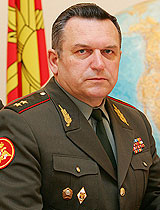
General-Lieutenant Bogdanovskiy

Leningrad Military District (LenVO) Commander, General-Lieutenant Nikolay Bogdanovskiy held a news conference today and, along with talking about the upcoming Victory Day parade on St. Petersburg’s Palace Square, he talked about his district’s ‘new profile.’

Firstly, following General Staff Chief Makarov, Bogdanovskiy said contractees will be reduced and conscripts increased.

Specifically, he stated:

“. . . the number of contractees will be signficantly reduced, many of those who showed themselves incapable of serving will need to be dismissed.”

The LenVO needs 25,000 draftees from this spring’s consription campaign beginning on 1 April. But he said this won’t create problems because, last fall, 100,000 young men came through the LenVO’s voyenkomaty and 25,000 were deemed fit to serve.

The LenVO Commander said, in the process of ongoing personnel cuts, 1,600 officers and 1,200 warrants have been ‘placed at the disposition’ of their commanding officers, but only 346 and 284 respectively have been discharged from the service.

These are surprisingly small numbers.

So, in the LenVO at least, only 22 percent of the officers destined for dismissal could actually be dismissed with the benefits and apartments owed them.  The other 78 percent remain in limbo, without duty posts and living on their rank pay [perhaps one-fourth of their former total monthly pay].  And 24 percent of warrants could be sent home with benefits and housing while the other 76 percent wait for these things.

Bogdanovskiy has also asked St. Petersburg’s governor to resolve a situation with owners of garages located on land the Defense Ministry claims near the village of Yukki, where the LenVO now wants to build apartments for servicemen.  But that one will be hard; the Defense Ministry’s old nemesis Rosimushchestvo says the property doesn’t belong to the military.  The builder and construction equipment have already been out to the site with the intention of knocking down the garages.  Boganovskiy says the plan is to put 50 apartment houses on this territory.

The LenVO Commander also acknowledged problems with military housing built in the district:

“I’ve more than once tried to sort out the quality problem in the housing in Pushkin.”

He indicated the problems started small, but failure to fix them in a timely manner means ten times the amount of money must be spent to repair them now.  But he promised to do so by the end of spring.

On the force structure front, he says the LenVO’s reforms were largely completed in 2009.  Ten brigades and other units were formed or reformed in the process [the district has 3 combined arms brigades–the 25th, 138th, and 200th].

Regarding problems with the command and violence in the 138th Independent Motorized Rifle Brigade at Kamenka, Bogdanovskiy said:

“. . . we haven’t managed to complete fully tasks connected with discipline–in particular, in the 138th Kamenka Brigade the commander, chief of staff, and assistants for armaments and socialization work were dismissed because of events there.  Now the situation is normalizing, we are trying not to repeat past mistakes.”

Interesting insights into what the Serdyukov’s reforms have meant for one, albeit small and not particularly significant, district.  But, if such a large percentage of officers are being left ‘at the disposal’ of their commanders, can one believe Serdyukov’s assertion that 65,000 officers were put out of the armed forces last year?  Does this include a small number of dismissed and a much larger number of those left ‘at the disposal’ of commanders?  On an issue closely tied to officer cuts, can one believe that the Defense Ministry really obtained 45,000 apartments last year if so many soon-to-be-ex-officers are ‘at the disposal’ awaiting them?

It would seem that, if Serdyukov has failed, or been unable, to move as speedily on officer reductions as he wanted, the door might be left open for someone to reverse this policy, especially if a large number of potentially angry officers remains for a long time in the limbo of being neither in, nor out of, the army.

Collapsing Contract Service, the Draft, and Professional NCOs

General Staff Chief Makarov’s recent death pronouncement for contract service means, as he said, more conscripts in the near future (or an attempt to conscript more soldiers).

In the longer run, however, the collapse of contract service means the Russian Army faces several manpower policy choices, each unpalatable for its own reasons.  The army will likely be less combat ready, and less combat capable, than desired.

Think back about where the army’s been, and how it reached the current predicament.

The armed forces were reportedly 1.13 million men, but probably more, in recent years.  At any moment, they had four distinct draft contingents of about 130,000 conscripts, totaling 520,000 draftees.  Next, they had a layer of perhaps 300,000 contractees and warrant officers.  The contractees included probably 90,000 long-term enlisted, NCOs, and females as well as no more than 80,000 contract soldiers from 2002 and later.  There were probably about 130,000 warrants.

So, let’s count 520,000 conscripts and the middle layer of 300,000, for a total of 820,000.  Lastly, on top, let’s add nearly 400,000 officers. 

What did this manpower structure mean for the Russian Army’s force structure?

With practically the same number of conscripts and officers, the force structure was hollow–few units or formations were fully manned and many low-strength (cadre) units had officers and equipment, but only small numbers of soldiers–conscript or contract–and they existed only to be fleshed out with mobilized reservists in the unlikely event of a big war.

This structure didn’t work well in little wars like Chechnya or more recently Georgia in which the army had to piece together regiments by finding combat ready battalions and capable commanders wherever they could be found.

In 2006, Putin said of the military dilemma at the outset of the second Chechen war:

“. . . we needed to gather a force of at least 65,000 men.  And yet the in all of the Ground Troops there were only 55,000 in combat ready units, and even they were scattered all around the country.  The army was 1.4 million strong, but there was no one to do the fighting.  And so unseasoned lads were sent to face the bullets.”

And in late 2008, Medvedev emphasized the need for 100 percent combat ready units as the number one lesson of the August conflict over South Ossetia:

“Overall, these changes aim to make the Armed Forces more combat ready.  We talked about the war in the Caucasus, where our armed forces demonstrated their best qualities, but this does not mean that there were not also problems that became apparent.  We need to continue improving our Armed Forces. What steps does this require?  First, we need to move over to a system of service only in permanent combat ready units.”

So, after the August war with Georgia, Serdyukov moved to eliminate the huge, big-war mobilization base, hollow units, and unneeded officers, and to use the savings to man and outfit 85 Ground Troops brigades in a permanently combat ready condition.

Given a nominal strength of 3,000 men in them, the army needs roughly 260,000 troops to man these new combat brigades.  And this doesn’t count conscripts needed elsewhere in the Ground Troops, Rear Services, VVS, VMF, RVSN, VDV, or KV.

With the commencement of the one-year draft in 2008, Moscow doubled its induction of conscripts from 130,000 to 270,000 every six months.  And the Ground Troops need fully half the 540,000 conscripts present in the armed forces at any given moment.

Like any country, Russia has a real and an ideal army, the army it has and the army it wants (a la Rumsfeld).  Moscow’s ideal army by 2012 has one million men, including 150,000 officers, a layer of 64,000 professional NCOs, and conscripts as the balance, perhaps 800,000.

But the Arbat military district hasn’t articulated it this clearly for several reasons.  First, shedding officers and (warrants) year after year isn’t an easy task.  Second, the number of professional NCOs desired or available in the future is in doubt given General Staff Chief Makarov’s and Defense Minister Serdyukov’s statements on the failure of contract service and the apparent withdrawal of funding for the current contract sergeants program.  And third, it’s unclear if Moscow can draft 400,000 young men semiannually to put 800,000 soldiers in the ranks.

The army Russia has is messier than the vision stated above.  Serdyukov says they are at 1 million already.  There were a reported 355,000 officers at the outset of the current reform in late 2008.  About 40,000 officer billets were vacant and 65,000 officers were released in 2009, putting them at 250,000 officers today.  Serdyukov has set about the elimination of almost all warrant officers, but he hasn’t said what they’ve done in this regard yet. Let’s guess 30,000 have been dismissed, leaving 100,000 warrants.  Let’s also make reasonable guesses that 60,000 recent contractees and 70,000 longer term ones remain in the troops.

So what is there?  Armed forces with 540,000 conscript soldiers and about 480,000 officers, warrants, and contract enlisted.  Moscow will have to revitalize its military education system to get the smaller number of quality officers needed in the future.  Getting the requisite numbers of conscripts will be a challenge given the country’s well-known demographic problems which are biting hard right now.  But obtaining the noncommissioned officer layer of military unit leadership is also proving difficult.  The layer is presently a jumble of perhaps 230,000 warrant officers, contract sergeants, and even officers and warrants who’ve accepted downgraded positions rather than dismissal.  It is not the army’s ideal, but this middle layer fulfills some functions.

With all this said, what are the Russian Army’s manpower options for the future?

If Moscow actually reduces the officer corps to 150,000 by 2012 and the contract sergeant program is not put on track, the balance of its 1 million man army could be 800,000 or 850,000 conscripts (including conscript-sergeants trained for only 3 or 6 months).  Drafting 400,000-425,000 men every six months would be practically impossible.  Of the current cohort of maybe 900,000 18-year-olds, maybe 300,000 can be inducted, leaving the army to find 500,000-550,000 conscripts among men who are 19-27 and have not already served, but can be difficult to induct for various reasons.

Even if manned fully, a 12-month force has to make Moscow wonder whether this mass of conscripts with this amount of training really meets its definition of a modern, combat-ready, and combat-capable army.

Reducing the manpower requirement by cutting the army’s overall size would reduce the draft burden, but it would contravene the decreed million-man army policy.  There would be howls of protest that the army is too small to cover Russia’s borders (as if one million is even enough to do it).

Extending conscription back even to 18 months would ease this task considerably.  Moscow could take just slightly more than the 270,000 it is conscripting now for 12 months, and by keeping them an extra six months, it could work its way up to a conscripted force of nearly 850,000 in the space of a year and a half.  An increased draft term would be unpopular but Russians would swallow it.  It’s not like it would lead to a Medvedev (or Putin) defeat at the polls in 2012.  The real problem might be the draft’s similarity to taxes–the longer (or higher) they get, the more incentive for people to avoid them.

So that brings us back to the central point.

The way to reduce the number of conscripts needed for a million-man army, keep the draft term at 12 months, and have a reasonably well-trained and capable force is the one path that has been abandoned–developing a large and professional NCO corps that has the right material incentives to serve for a career.

The slow-to-start, small-scale, and apparently recently eviscerated Federal Goal Program to train only 64,000 professional sergeants is not enough.  The current ranks 230,000 of former officers turned sergeants, warrant officers, warrants turned sergeants, contract sergeants, and enlisted contractees is a stew that could theoretically be converted to a professional NCO corps, but it would be far from easy.  In terms of size, however, it’s more like what’s required to do the job, lighten the conscription load a little, and impart some professionalism to a mass, short-term draftee army, if these NCOs become professionals themselves.

What professional NCOs demand in return is pretty basic (higher than median income wages, family housing, and guaranteed off-duty time outside the garrison), but they haven’t gotten it since the most recent contract experiments began in the early 2000s.  In many cases, even officers haven’t got these things.  But the pay promised in the contract sergeant program (up to 35,000 rubles per month after graduation) is more like what’s needed to attract men.

The sergeant program seems to be the army they want, but the Defense Ministry appears to have pulled the financial plug on it.  The flotsam and jetsam is the army they have and might be turned into something, but there’s no move in this direction as yet.  Meanwhile, recall that Serdyukov’s plan for mass officer reductions was partly justified by the thinking that many officer tasks would go into the hands of capable NCOs.  And as recently as the 5 March Defense Ministry collegium, Medvedev said:

“Particular attention also should go to sergeant personnel. Sergeants need to be capable, if the situation demands it, of replacing their tactical level officers.”

A Dismissed Colonel’s View of the Collegium

Sunday’s Svobodnaya pressa ran an interesting interview on the just-completed Defense Ministry collegium.  Svpressa talked to a named, and recently dismissed, colonel who had worked in proximity to the collegium. 

This colonel said the session left participants, to put it mildly, depressed.  He said, “. . . from the first minutes the conference hall had such a blatant odor of stagnation [Brezhnevian] that it was clear there’d be no talk of any reform.”

President Medvedev had apparently attended the General Prosecutor’s collegium and asked why there were so few women attending that meeting.  So, according to Svpressa’s colonel, the organizers of the Defense Ministry’s collegium flooded the hall with women in shoulderboards and without them.  The zeal of the reformers went so far that some generals from Genshtab directorates were asked to surrender seats for ladies and return to their offices.  The colonel says that, not being a strictly men’s affair, the severe talk needed didn’t occur.

Practically no one in attendance honestly considered analyzing the course of military reform.  Serdyukov said that part of reform connected with cutting the army is going forward (the other directions of reform have practically collapsed).  He reported on the rout (if, the colonel says, we call things by their real names) of officer training.  But sergeants will replace dismissed officers under Serdyukov’s plan [but what happens when officers are gone and the contract sergeants never appear?].

According to the interviewee, Serdyukov simply sweetened the pill for Medvedev–in reality, everything is significantly worse than he described it.  He asks how brigades can be combat ready if contract service is a failure. About 80 billion rubles went toward this and it’s unknown where the money ended up.

But at the collegium, there were no speeches analyzing the contract program’s failure or identifying people who are to blame for it.  Everyone was silent.  The Supreme CINC simply would be admitting failure on his part and the part of all authorities.  Who wants that?

Svpressa asked the colonel why not a single formation commander wouldn’t stand and really say what’s happening out in the forces.

He answered that, like the old days, most of the generals attending are Arbat generals, and their main professional traits are caution and the inability to put their noses to the wind.  The collegium was a litmus test for army reforms which don’t really exist and never have, according to him.  There’s just the same ‘money grab’ that goes on everywhere in Russia.

Serdyukov’s Post-Collegium TV Interview

After last Friday’s Defense Ministry collegium, Serdyukov was interviewed on Rossiya 24.

He probably fielded more pointed questions than normal, but he easily navigated them.  At times, he answered partially and the interviewer didn’t follow up with the next logical question.

Asked about officers dismissed in 2009, he said the armed forces shed 65,000 of them, who retired on age or health grounds, requested dismissal, or violated their contracts.  There was no mention of those put in limbo outside the TO&E, without duty posts and only their rank pay to live on.  These are the officers who can’t formally be dismissed because they don’t have housing, and are living at their ‘commander’s disposal.’  There was also no mention of how many warrant officers were put out in 2009.

Serdyukov said some officers accepted civilianized posts, and 4,000 received job retraining–a pretty small number against the large need for it.

The Defense Minister said dedovshchina was officially down 15 percent, and he doesn’t want only platoon and company commanders punished when it happens in their units.  He wants to see all levels of command take more responsibility for the problem.  Not sure what he’s insinuating, but it could be a warning to higher ups that they could suffer too when big time violence cases hit the news and make the Arbat military district look bad.

Serdyukov talked about higher officer training and appraisals, mentioning the assembly for 550 officers from the military districts and army commands.  He said we tried to make them understand what it is we’re trying to do.  But many lacked the knowledge and necessary skills–presumably to continue in the service.  See today’s Nezavisimaya gazeta.  Viktor Litovkin writes about generals and senior officers dismissed under Serdyukov.  Military district and fleet staffs which used to number 500-700 officers have been cut to 300.  Trimming the ‘bloated egg’ is generally a good idea, but as Litovkin says, it really depends on the quality of those left behind.

Back to Serdyukov’s interview . . . in cutting the military educational establishment from 65 to 10 mega-institutions, he said fewer officers will be needed but the quality of their training must be improved.  The 10 left standing have or will have their faculty members assessed for fitness to serve and they’ll get facility improvements.

On contract service which General Staff Chief Makarov has pronounced dead, Serdyukov said:

“The results of the program were not satisfactory.  In reality, we underestimated the situation somewhat, as regards who should switch to contract service and on what terms, or with what pay.”

“. . . the next program should be revised in an attempt after all to think it out regarding what specific positions should be filled by contract service personnel.  Of course, this applies to complex skills, where expensive equipment is operated.”

Nevertheless, he noted that he expects the contract sergeant program [albeit small-scale and apparently no longer funded] to succeed.

He said the army borrowed from foreign military experience in deciding on the shift from divisions to brigades.  He said the latter’s potential is virtually the same or even greater in some cases than that of the former.

Serdyukov said the Defense Ministry has reported to the Supreme CINC on its view of how it would like to reequip over the next 5-10 years.  He repeated that cuts to R&D and maintenance had allowed for bigger buys of new arms in 2008 and 2009.

He admitted Bulava hasn’t been successful, but he expects this system to be put right and completed.

He addressed possible foreign arms purchases:

“. . . in some areas we are lagging behind quite badly.  This relates not just to the Navy but also other services.  We are buying things in single numbers right now.  They are things like UAVs, all kinds of sights, night vision equipment–it is a very broad spectrum where we are specifically lagging.”

Despite reports that Moscow would be negotiating only with Paris on Mistral, Serdyukov claimed Russia is talking to the Netherlands and Spain.  He denied it was no more than a glorified cruise ship, saying it could perform many roles and had many different capabilities.

Medvedev Speaks at Defense Ministry Collegium

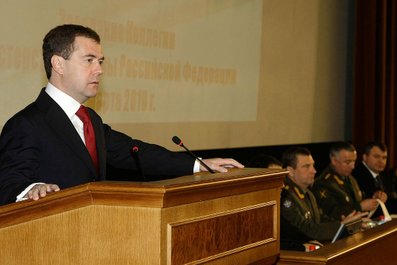
President Medvedev (photo: kremlin.ru)

In his remarks [text and video], President Dmitriy Medvedev reviewed the results of 2009 and talked about future plans for the armed forces.

He focused first on the international situation, noting that, “. . . today we have no requirement to increase further our strategic deterrence potential,” although it remains a determining factor in Russia’s conduct of independent policies and the preservation of its sovereignty.

He noted Moscow’s new law authorizing the use of force to protect Russian citizens abroad, and he pointed to unresolved conflicts on Russia’s borders [where presumably the new law could be used].

Medvedev acknowledged some positive tendencies such as work on a new strategic arms control agreement and renewed Russia-NATO contacts.  But he called the West’s reaction to Russia’s draft treaty on European security a barometer of relations with the U.S. and NATO.  He said it could prevent conflicts like Georgia-South Ossetia.  Medvedev asserted that, unfortunately, far from all countries and politicians drew the correct lessons from the August 2008 events.  And, unfortunately, he said the reestablishment of Georgia’s military potential continues with external assistance.

Then Medvedev turned more to the exact points of his speech.

He said the main goal is the qualitative improvement of the armed forces, the creation of a modern army and fleet equipped with the newest weapons.  He said last year the organizational base for this was established, as planned, without expending additonal resources.

In 2009, Moscow got its authorized personnel down to 1 million, and, according to the President, the Defense Ministry largely achieved its task of getting to the military’s future combat composition.  Medvedev said the results of Osen-2009 confrmed this, and more exercises like it are needed and need to have a ‘systematic character.’  Because, “Without this there simply are no armed forces.”

Medvedev called the training of officers the ‘most important task. Motivated, high-class specialists are needed, but the recently degraded military educational system and its material base need improvement. Medvedev said particular attention also needs to go to sergeants.  They need to be capable of replacing front-line officers when needed, according to the Supreme CINC.

On to rearmament . . .

Medvedev called the task of reequipping the troops with new armaments ‘extremely complex and very important.’  He said last year Russia stabilized the condition of its arms and equipment, despite the financial crisis, and fulfilled the GOZ, although not without problems.

He called the contracting mechanism for arms purchases ‘not effective enough,’ and said we are  working on this, but it’s slow.  This year the State Armaments Program, 2011-2020 will be written.  Medvedev gave the government the task of renewing arms and equipment at an average rate of 9-11 percent annually to allow Moscow to reach 70 percent modern armaments by 2020.  Reequipping has to be supported by full and timely financing.  He referred to his Poslaniye list of  priority systems and arms to be acquired.  He said this task will not be adjusted, and old weapons need to be decommissioned [He seems to have gotten it into his head that new means good and old bad which is not necessarily the case with Russian weapons.  What happens if you scrap lots of stuff, but you don’t succeed in producing new stuff?]. 

Medvedev said, as he’s already said more than once, steps are needed to bring order to the use, storage, and upkeep of missiles, ammunition, and explosives.  The events of the last year have shown there are problems here [alluding to Ulyanovsk, Karabash, etc.].

Medvedev noted another issue, providing the armed forces with automated command and control, and information systems, and transferring the military to digital comms by 2012, as put forth in the Poslaniye.  He said Zapad-2009 worked on mobile automated C2, but this was only a beginning to the work, which needs to be intensified, because “the communications situation is problematic.”

The President said forces will increase their combat readiness in their new TO&E structures [aren’t they 95 or 98 percent combat ready already?].  The main effort will be forming and training inter-service troop and force groupings, and supporting nuclear deterrence forces.  Medvedev said he’ll attend the main, key phases the coming Vostok-2010 operational-strategic exercise.

Medvedev obligatorily cited increasing the prestige of military service and improving the social defense of servicemen as a priority task.  

“I’d like to note that all obligations of the state to current and released servicemen will be fulfilled unconditionally, I will not accept any amendments for budget changes, or for other reasons.”

Medvedev said the government has the clear task to guarantee that all servicemen needing permanent housing have it by the end of this year, and service housing by the end of 2012.

“The realization of this task is not going badly, I will also take this under my personal control.”

Finally, Medvedev spoke for a moment to pay issues.  Increasing pay, and instituting a new pay system for active duty troops from the beginning of 2012, and increasing pensions to retired military men [but nothing specific promised].

He said he thinks premium pay or the well-known Order 400 brought respectable results, and it will be important to preserve ways of rewarding servicemen with extra money under the new pay system, and he expects proposals on doing this.

Defense Minister Serdyukov had some comments after Medvedev’s speech, but they’ll have to wait until tomorrow.

Happy Defender’s Day

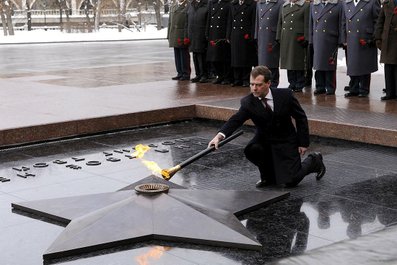
Medvedev Lights Flame at Tomb of the Unknown Along Kremlin Wall

In his Defender’s Day eve address on Monday, President Dmitriy Medvedev said:

“The defense of native land, service in the army and fleet has always been considered our holy duty.  And those who chose the military profession as the business of their entire lives command great respect among our people.”

Apparently, not too holy since Medvedev didn’t serve, even though he would have been due for conscription at the zenith of the mass mobilization Soviet Army and one of the coldest points of the Cold War [1983].  Of course, there are lots of presidents who didn’t serve in their countries’ armed forces.

Medvedev went on to thank Russia’s veterans with the 65th anniversary of the Great Victory fast approaching [9 May].

Then he noted:

“. . . strengthening the defense capability of our country–this, absolutely, is the fundamental basis for our development.  Our strategic goal is the formation of an effective army and navy, adequate for the level of modern threats, capable of withstanding any level of aggression and being a real factor in guaranteeing international stability.”

“Before us stands the main mission–to reequip the army and fleet with the newest armaments.  It is essential to concentrate resources, all our best forces, and our country has done this more than once, in order to create new quality types of military equipment and finally escape from a system of “patching holes” in old armaments.  Some has already been accomplished here, but this is a basic task for the near future.”

“Strengthening Armed Forces personnel will also remain a priority.  People who have received a modern quality education answering the demands of the time need to be occupied with military affairs.  People who are prepared to complete contemporary combat missions, to complete them in the most effective way and, absolutely, physically and morally prepared.”

“The most important condition for the successful modernization of the Armed Forces–this is increasing the quality of life for servicemen.  The current military labor stimulus system (I have in mind the so-called order 400) is already giving positive results today.  From 2012 new salaries will be paid to all our country’s officers.”

“Everything necessary is being done so that this year all military men needing permanent housing will receive it.  I am keeping this issue under my personal control.”

“By the end of 2012 the issue of providing servicemen with service housing will be fully resolved.  I am sure that such guarantees will increase the wellbeing of your families and the prestige of military service as a whole.”

“Next it is important also that all measures to transfer the army and fleet to a new quality should be fulfilled efficiently and on schedule.  I am expecting precisely this from the Defense Ministry.”

On Tuesday, Medvedev participated in reigniting the eternal flame on the grave of the unknown soldier below the Kremlin wall.  The flame had been moved temporarily to Victory Park on Poklonnaya gora during the renovation of the tomb of the unknown.

Medvedev also visited a military unit in the Moscow suburbs and had tea with a senior lieutenant and his family in their new apartment.

The KPRF and its leader, Gennadiy Zyuganov, played the lead in presenting an opposite point of view on Defender’s Day.  The KPRF faithful marched from Triumfalnaya ploshchad to Teatralnaya ploshchad for a rally.  The party predicted 10,000 attendees, the police said there were 1,500, and Ekho Moskvy reported 4,000.

One KPRF leader said his party was coming out in defense of the army and fleet, their history, their power and against this senseless reform which Defense Minister Anatoliy Serdyukov is conducting.  He said the KPRF would hold rallies in 8 regions where elections are being held on 14 March.  Those demonstrations, however, were focused on more ‘bread and butter’ issues like communal service rate increases.

Zyuganov himself was in vintage form, saying:

“The army is currently in an exceptionally poor state.  A totally useless man is today in charge of the army.  He has no right to hold this office.  Not a single military man would want to pronounce the family name of Serdyukov properly, without adding some insult.  This means that Mr Putin and Mr Medvedev have put in charge of the army a man who is incapable of teaching servicemen, rallying them together or setting key objectives concerning military security and army training and equipment of our armed forces.”

He continued, saying Russia has “no possibility not only to produce, but even to reform its existing military complex.”  He claimed Russia is 10 years behind NATO in military potential, and he said Russia’s strategic forces are “on their last legs.”  Addressing Prime Minister Putin, he asked why a minister like Serdyukov was being retained.

IA Regnum reported on a rally in support of army reform and modernization led by United Russia youth wing Molodaya gvardiya and the local branch of veteran’s organization Combat Brotherhood in Ulyanovsk.  Press reports said attendees were looking forward to restarting An-124 transport aircraft production at Aviastar, and having OPK enterprises serve as a locomotive for the rebirth of local industry.