An Ordinary Conflict

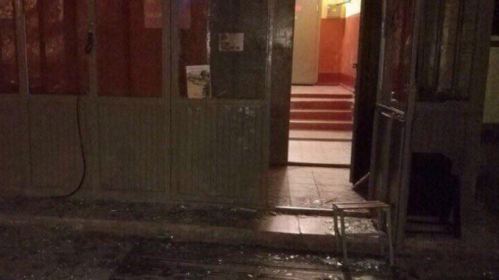
Broken glass in the barracks (photo Ura.ru)

Broken glass in the barracks (photo: Ura.ru)

Some may have seen this picture of the aftermath of a massive brawl which occurred on August 2 between 60 Tuvan contractees and 100 soldiers at the Russian Army’s 437th District Training Center (v/ch 31612). The incident says much about the Russian military effort to recruit large numbers of volunteers to serve as soldiers on contract.

The center is near the village of Yelan, 200 km east of Yekaterinburg, and belongs to the Central MD. It trains junior specialists — conscripts and contractees — to be NCOs or operate particular weapons systems.

According to Ura.ru, the Tuvans just completed three months of survival training at the center and got booze to celebrate the occasion. That particular training course comes early, so the men were relatively new contractees.

At some point, their party turned into a rampage with drunken Tuvans wielding knives and other sharpened implements and fighting 100 contractees permanently assigned to the Yelan garrison.

In the end, one officer and 13 contractees from the garrison were hurt and required hospitalization. So the Tuvans got the best of them in the melee.

What started the fight is fairly unclear. Vzglyad postulates possibilities including revanche for insults or mistreatment or a dispute between a single Tuvan and Russian officer with the rest of the Tuvans intervening for their coethnic and the garrison’s 6th company for the latter.

For its part, the MOD officially denies alcohol or knives were involved. According to TASS, several unidentified soldiers received light injuries and scrapes. But Lenta.ru point out that the MOD didn’t deny it was a large-scale fight, and it subsequently admitted that two soldiers are in serious condition.

Deputy commander General-Lieutenant Khasan Kaloyev heads the Central MD’s investigation into the disturbance. The Central MD says the disturbance wasn’t massive and calls it an “ordinary conflict.” But the district military prosecutor has opened a large investigation of his own.

Vzglyad reports that Tuvan troops were involved in a fight with a Spetsnaz unit near Irkutsk in 2015.

The news portal also cites former Main Military Prosecutor Sergey Fridinskiy who said, as early as 2010, investigators first observed the phenomenon of servicemen from the same ethnic group, or from the same locality, imposing their rule on the everyday life of certain military units.

Recall a 2012 post in which a newly-demobbed soldier described something worse than dedovshchina:

“The non-Russians, Tuvans and Dagestanis, in the unit and their petty exactions were worse.  Even officers feared them, according to Ufimtsev.”

Vzglyad spoke with long-time observer of the situation inside the Russian military Sergey Krivenko, who’s also a member of the RF Presidential Council on Human Rights.

Krivenko said it’s difficult to monitor the observance of the rights of servicemen inside a closed organization like the military. But he believes the level of army violence is still very high, but significantly lower now than in the 1990s and early 2000s.

He notes that soldiers come from the same regions, republics, oblasts, and cities and unite on this foundation, then act like they are welded together in any conflict. In this way, zemlyachestvo has replaced dedovshchina to some degree.

Zemlyachestvo

Zemlyachestvo (землячество) means belonging by birth or residence to one republic, oblast, or village.

It can refer to a group of natives from one place living outside its borders. The term also describes a “foreign” community or society for mutual aid somewhere other than its members’ place of origin. It is a group of Russian Federation citizens of the same nationality (in the internal RF sense) living as a minority among people of a preponderant nationality, usually ethnic Russians.

In an American sense, think of a bunch of homeboys joining a gang to defend themselves from a perceived or real external threat.

Contrast this with dedovshchina — the rule of the “grandfathers” — senior conscripts nearing demobilization lording it over younger, newer draftees, generally without much regard to ethnicity.

Krivenko blames commanders who fail to work with subordinates arriving from various cultural levels, regions, and societies. He concludes:

“If the commander worked professionally with them, he would succeed in avoiding such excesses.”

He recalls similar problems with conscripts from the North Caucasus:

“So here our command, to avoid this, simply cut sharply the call-up from the regions of the North Caucasus. This again shows there haven’t been structural changes in working with personnel.”

Despite the presence of psychologists, sergeants, and deputy commanders for personnel work, the commander ultimately has to do everything in indoctrinating his charges properly. According to Krivenko:

“The commander answers for everything. Really now among the troops there is no one to work with personnel in maintaining discipline, in the prevention of similar violations. If the commander is good, he manages to do all this, then such incidents don’t happen in his unit.”

But some of the problem may lie with attitudes toward contractees:

“Often officers treat men on contract service like conscripts. They almost see them as serfs.”

Krivenko says officers are currently trained to deal with a mass of conscripts, not large numbers of contractees.

The commander often ends up investigating incidents and he has little incentive to find something wrong in his own unit. He asks where the newly-created Military Police are in all this since it seems to be a perfect mission for them. There is always the issue of why senior NCOs and warrant officers can’t be responsible for good order in battalions and lower-level units.

Krivenko concludes the brawl reflects the existence of a criminal attitude among some contractees on one hand, and the fact they don’t feel safe in their units on the other. It’s the commander’s task to make sure this isn’t the case.

From this incident, two broad conclusions might be drawn.

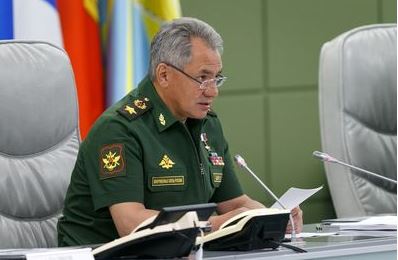
First, the whole thing is bad for Defense Minister Shoygu who, though thoroughly Russified and one of the Moscow elite, is still Tuvan. Tuva got the 55th OMSBr (G), and possibly considerable infrastructure as well, with Shoygu at the helm of the military. Troops from the 55th were almost certainly the ones involved in the fight at Yelan. It’s possible the brigade is mono-ethnic, so this would highlight recent MOD laxness on the old Soviet practice of extraterritoriality — sending conscripts and recruits far from home to serve and not overloading units with men of the same ethnicity (unless they’re Russians). One can imagine Tuvans “feeling their oats” with a Tuvan as Defense Minister and some Russians perhaps resenting their new impudence as a result.

Second, the brawl also reflects the state of the massive effort to enlist contractees. As the MOD searches for more volunteers, the more marginal the candidates are likely to be. The military may be increasingly reliant on less qualified men. It could be recruiting more non-Russians than in the past. Finally, what happened at Yelan demonstrates simply that many Russian Army contractees are professionals in name only. It’s often hard for a 24-year-old junior lieutenant to handle a platoon of 19-year-old conscripts let alone an unruly assortment of older and tougher would-be contractees.
More MOD Graphics

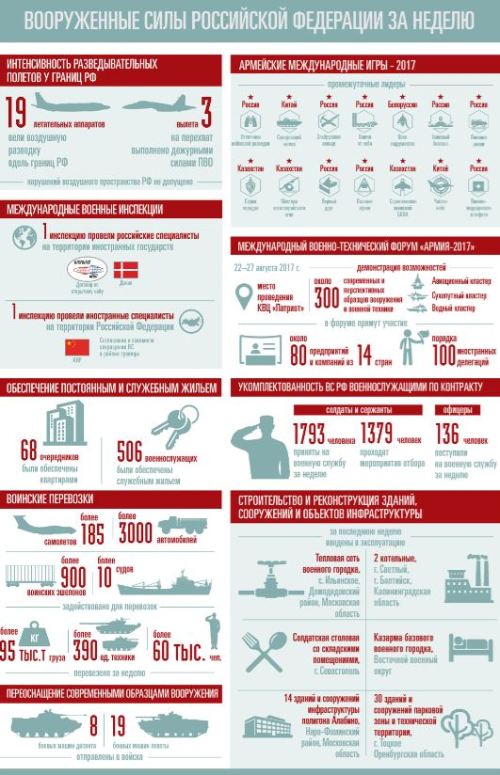
This week, the Russian MOD reported 1,793 individuals accepted on contract service and 1,379 going through the selection process.

For military transportation, 185 aircraft, 3,000 vehicles, 900 trains, and 10 ships delivered 95,000 tons of cargo, 390 pieces of equipment, and 60,000 personnel. The large number of personnel transported reflects the end of the conscription campaign and the final deliveries of new soldiers to their duty stations.

The VDV received eight BMDs (presumably BMD-4Ms) and the MOD also got 19 unspecified BMPs.

This Week.jpg

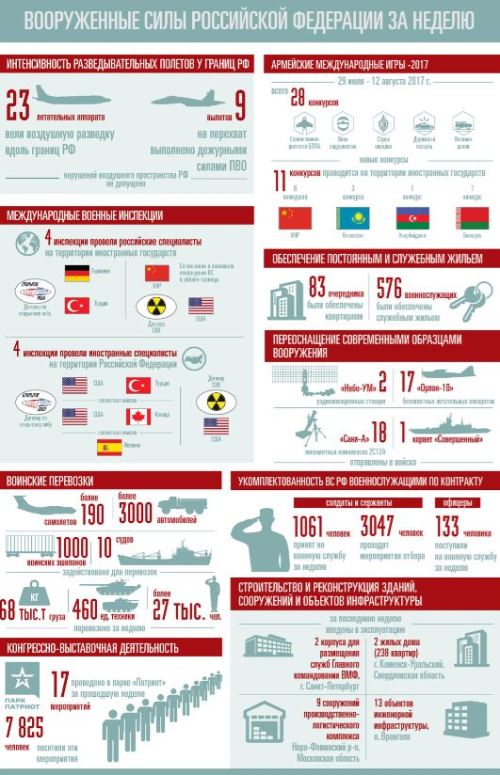
The week prior, the MOD reported receiving two Nebo-UM radars, 17 Orlan-10 UAVs, 18 2S12A Sani-A mortars, and proyekt 20380 frigate Sovershennyy from the Amur Shipbuilding Plant.

It announced that 190 aircraft, 3,000 vehicles, 1,000 trains, and 10 ships delivered 68,000 tons of cargo, 460 pieces of equipment, and 27,000 personnel.

For contract service, 1,061 individuals were accepted and 3,047 were undergoing the selection process.

The MOD also reported nine buildings or facilities at the PLK in Naro-Fominsk were accepted for use.

Week Prior

Military Acceptance Day

On July 26, Defense Minister Sergey Shoygu presided over the latest “unified day of acceptance of military production.” The review (mostly) covered the second quarter of 2017. According to Krasnaya zvezda, the Ministry of Defense received 600 new and 300 repaired weapons systems and other equipment.

Defense Minister Shoygu

Defense Minister Shoygu

The Ground Troops acquired 35 new and 155 repaired tanks and armored combat vehicles, 4 new artillery reconnaissance systems, 10 self-propelled howitzers, a brigade set of Iskander-M, 38 new and 68 repaired communications systems, 500 new and 273 repaired vehicles, and 9,000 munitions of various types.

Three Khrizantema-S ATGM launchers were accepted. They are reported to have a new domestic optical sight replacing one previously supplied by Ukraine.

The air forces got nine new and 45 repaired and modernized aircraft, as well as six new Mi-8MTV-5-1 helos and 11 repaired and modernized helos, 9 new and 10 repaired and modernized radars, one Pantsir-S gun-missile system, four repaired SAMs, and four Vitebsk EW systems. The VKS also received nine R-441-LM SATCOM systems and one mobile R-423-PM troposcatter comms station.

For the Navy, the just-commissioned proyekt 20380 Sovershennyy frigate was mentioned first, even though it’s a third quarter acquisition not second. Repairs to three submarines, two roadstead boats, a “large anti-sabotage boat,” and a floating pier for Borey-class SSBNs were also cited. Naval air obtained two Su-30SM fighters.

The Defense Minister said the Navy received 60 Kalibr missiles, presumably reloads to replace those expended on targets in Syria. It also got 42 torpedo systems including some Fizik-1 weapons. The Black Sea Fleet is supposed to get 20 Fizik-1 torpedoes before the end of July.

Titan-Barrikady reportedly delivered nine launchers for the Yars-S ICBM. That’s a full regiment’s worth.

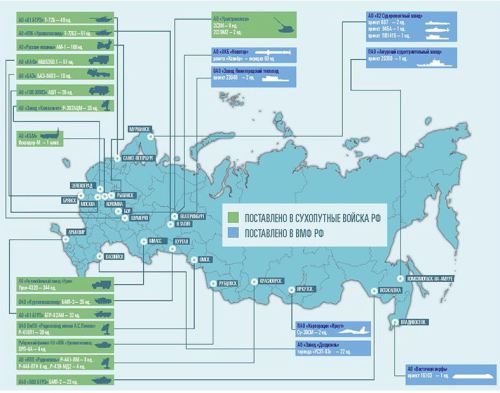
KZ’s report also included a new graphic giving more detail on MOD procurement in the second quarter.

Second quarter 2017 procurement

Second quarter 2017 procurement

It’s not easy to read, but it may be worth trying.

New Industrial-Logistical Complex

Moscow region’s Telekanal 360 station recently reported on Defense Minister Sergey Shoygu’s tour of the Russian military’s first “industrial-logistic complex.”

The first PLK [ПЛК] is located in Naro-Fominsk, not far from Moscow. The 450-acre facility reportedly will store 120 thousand tons of spare parts, to include vehicle engines, transmissions, treads, and tires, as well as other supplies.

The MOD is planning for throughput of 230 thousand tons of freight annually. The PLK will have a centralized dispatch service to provide more streamlined ordering for troop units.

Its first section — two 20,000-square-meter warehouses — was built in seven months. The second section is due for completion in September.  The MOD plans to construct more than 20 PLKs throughout the RF.

The first report on the military’s effort to build “industrial-logistic complexes” appeared in 2014. The initial complex was touted as being a public-private partnership including some commercial space. It was supposed to be finished before the end of 2015.

Announcing the effort, MOD rear services chief Army General Dmitriy Bulgakov said 24 new complexes would be erected before the end of 2018 to replace 400 obsolete military depots and warehouses. He also indicated that construction of one in Armavir (Krasnodar territory) had begun, and work on another in Khabarovsk was to start imminently.

Weekly MOD Graphics

Here’s a link to a spreadsheet with some data from the RF MOD’s new weekly infographics. It doesn’t have everything, just the data that seems like it can be followed over time.

This Week’s MOD Graphic

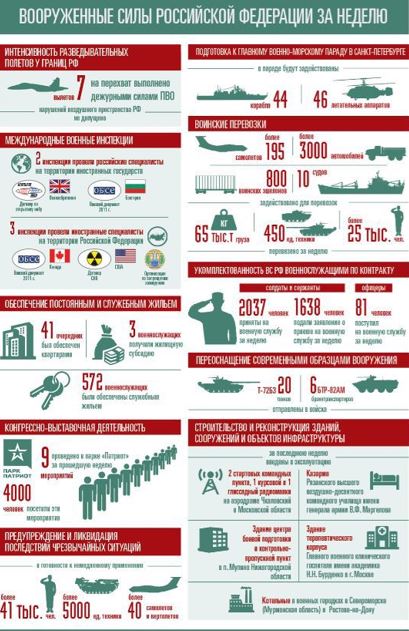
This week’s Russian MOD graphic shows 195 aircraft, 3,000 trucks, 800 trains, and ten ships delivered military cargo amounting to 65,000 tons of freight, 450 pieces of equipment, and more than 25,000 troops.

This Week

Regarding contract service, 2,037 individuals were accepted and 1,638 applied.

Twenty T-72B3 tanks and six BTR-82AM armored vehicles were delivered to units.

Mil.ru has three graphics posted but yet to be summarized here. They provide the following data:

  • 35,000 tons of cargo, 500 pieces of equipment, and more than 8,000 troops delivered;
  • 1,129 individuals accepted into contract service;
  • More than 20 T-72B3 tanks and 200 armored and other vehicles delivered to units;
  • 7 BMD combat vehicles, 7 radars, and 272 vehicles delivered;
  • 25,000 tons of cargo, 400 pieces of equipment, and more than 10,000 troops;
  • 1,612 individuals accepted into contract service;
  • More than 180 aircraft, more than 2,000 trucks, 700 trains, and ten ships delivered military cargo;
  • 35,000 tons of cargo, 400 pieces of equipment, more than 20,000 troops delivered;
  • 1,474 individuals accepted into contract service and 1,460 applied;
  • 30 R-149MA-1 command-staff vehicles and 1 Mi-26 heavy transport helo delivered to units.

The MOD graphics contain other items of interest which aren’t quite as easily digested. They’re also coming rapidly — six so far in the first month rather than one per week as their name suggests.

Not Necessarily New

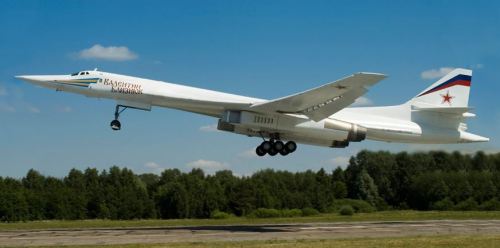
Rossiyskaya gazeta reports the first Russian Tu-160M2 airframe has reached final assembly at Tupolev’s Kazan Aircraft Plant (KAZ). But it may not necessarily be new or significantly different from the last Tu-160 / Blackjack produced at KAZ.

RG picked up the story of the first Tu-160M2 from Kazan-based news service Biznes Online which follows plant newspaper Vpered.

The fourth series Tu-160 Valentin Bliznyuk (photo PAO Tupolev)

The fourth Tu-160 Valentin Bliznyuk (photo: PAO Tupolev)

Assembly of bombers at KAZ ended in 1992 with four airframes “in reserve” in various stages of production. Two were completed in 2000 and 2008 with two left unfinished at the factory.

The “Reserve”

For many years, Russian defense industries depended on their Soviet “reserve” [задел]. The “reserve” could be anything from materials to parts to money to technical know-how that helps an enterprise survive lean times. In many instances, they were wartime mobilization supplies. The “reserve” grew out of the Soviet command economy in which a factory would hoard extra resources to use against future production plans. But, over the years, defense industries steadily depleted whatever Soviet-era “reserve” they had. Another classic case of the “reserve” is Sevmash using unfinished Akula-class SSN hull sections to build the first three Borey-class SSBNs.

KAZ management readily admits the bomber bearing factory number 804 is not a full-blooded Tu-160M2. It’s a chance for the factory and its personnel to prove they can renew production of what is surely one of the most complex Russian weapons systems.

The plant has reestablished its vacuum annealing and electron beam welding processes to fabricate Tu-160 airframes. But the Tu-160M2 will depend on many subsystems, components, and parts from a large number of suppliers.

New avionics, navigation, weapons control, and electronic warfare systems aren’t due until series production. The bomber’s principal weapon, a new long-range, high-speed “smart” cruise missile known as Kh-BD, remains in development.

Production of updated NK-32-02 turbofan engines, which has only just begun at PAO Kuznetsov in Samara, could be the most difficult task. In early 2016, Biznes wrote that the company needed to make five engines that year, and 22 per year starting this year. However, it reported that Kuznetsov is “not in very good condition.”

For these reasons, KAZ workers themselves are skeptical about successfully resurrecting bomber production, according to Biznes.

RG indicated Trade and Industry Minister Denis Manturov stated in early 2017 the initial Tu-160M2 would come from the factory’s “reserve” and be ready for flight testing in 2018. Deputy Defense Minister and arms tsar Yuriy Borisov has also said early 2018. According to Interfaks-AVN, Tupolev announced an “experimental” Tu-160M2 would fly in 2019.

Biznes indicated completely new Tu-160M2 bombers — not Soviet legacy airframes — might not appear until 2020, reaching a rate of three per year by 2023. 

Interviewed by Krasnaya zvezda while visiting KAZ in early May, Borisov fully reiterated Russia’s plans for its strategic bombers: all existing Tu-160, Tu-95MS, and Tu-22M3 will be modernized, 50 Tu-160M2 will be produced, and the prospective PAK DA will fly in 2025-2026 and enter production in 2028-2029.

For its part, in its recent “Russia [sic] Military Power” publication, U.S. military intelligence notes:

“. . . all existing Tu-160s will be upgraded to Tu-160M1 or M2. Russia has announced that it will resume production of Tu-160M2 bombers and complete development of a new generation bomber (Russian designation: PAK-DA) within a decade . . . .”

The report allows that “timelines for both programs may slip if financial difficulties arise.”

But such troubles arose two or three years ago and Moscow’s economic woes make ambitious, if not grandiose, strategic bomber programs unaffordable. The burden of upgrading every existing bomber while developing a new one like the B-2 will be incompatible with declining defense budgets.

Yet strategic nuclear forces are an undeniable priority for the Kremlin and bombers figure as something of a hedge against U.S. missile defense systems.

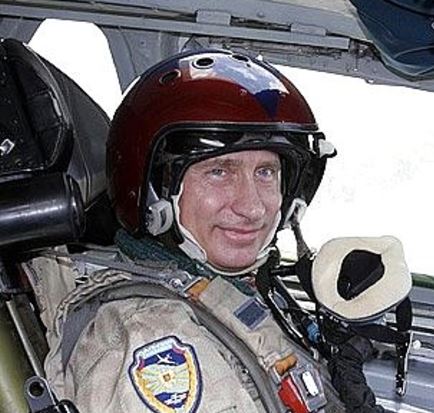
Russian President Vladimir Putin loves the impression bombers make. In 2007, he restarted regular strategic bomber patrols along NATO borders to signal Russian intent to become more assertive abroad.

Well-worn shot of Putin before his 2005 flight in a Tu-160 (photo Kremlin.ru)

Well-worn shot of Putin before his 2005 flight in a Tu-160 (photo: Kremlin.ru)

He has also sent Tu-160 bombers to Venezuela and Nicaragua in a show-the-flag campaign. The Tu-160 flew its first combat mission over Syria in 2015.

Army Commanders

Time to update the leadership lineup for Russia’s army-level ground formations. Few commanders remain in place since last look in early 2016.

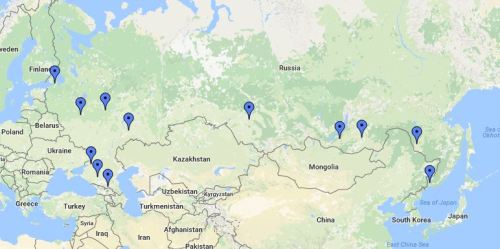
Russia's twelve ground armies

Russia’s twelve ground armies

The Russian Army expanded from seven to ten ground armies in 2010 by resurrecting or adding the 6th, 49th, and 29th CAAs.  More recently, it went to 12 by standing up the 1st TA and 8th CAA.  The process of filling out these armies with personnel and equipment is likely a challenge for their commanders.

The rundown of armies, headquarters, MD/OSK, and commanders looks like this:

1st TA…Bakovka…Western…General-Lieutenant Aleksey Avdeyev.

6th CAA…Agalatovo…Western…General-Lieutenant Andrey Kuzmenko.

20th CAA…Voronezh…Western…General-Major Aleksandr Peryazev.

8th CAA…Novocherkassk…Southern…General-Lieutenant Sergey Kuzovlev.

49th CAA…Stavropol…Southern…General-Lieutenant Sergey Sevryukov.

58th CAA…Vladikavkaz…Southern…General-Major Yevgeniy Nikiforov.

2nd CAA…Samara…Central…General-Major Gennadiy Zhidko.

41st CAA…Novosibirsk…Central…General-Major Aleksey Zavizon.

36th CAA…Ulan Ude…Eastern…General-Major Dmitriy Kovalenko.

29th CAA…Chita…Eastern…General-Major Yevgeniy Poplavskiy.

35th CAA…Belogorsk…Eastern…General-Major Sergey Chebotarev.

5th CAA…Ussuriysk…Eastern…General-Lieutenant Valeriy Asapov.

After his long tenure in the Transbaykal, General-Lieutenant Avdeyev replaced General-Lieutenant Chayko as commander of the new 1st TA.  Chayko is now Chief of Staff, First Deputy Commander of the Eastern MD.

General-Major Zhidko was acting commander of the 2nd CAA, but he now appears to be permanent.

General-Major Chebotarev replaced Avdeyev in the 29th CAA.

Only General-Lieutenants Kuzmenko and Sevryukov and General-Major Kovalenko remain where they were 18 months ago.

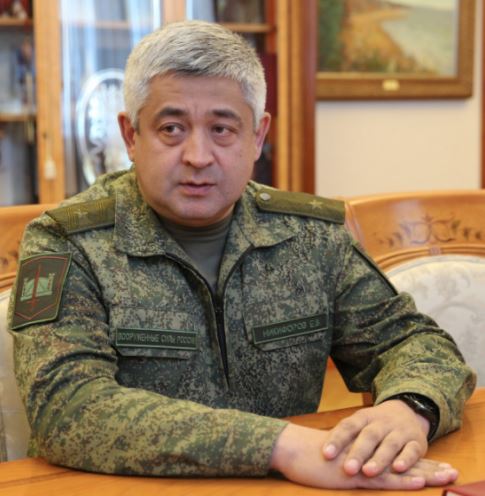
General-Major Yevgeniy Nikiforov

General-Major Yevgeniy Nikiforov

Numerous former army commanders made the next traditional career step as deputy MD commanders.  Currently, they include General-Lieutenants Tsilko, Romanchuk, Gurulev, Seritskiy, Kaloyev, Solomatin, and Turchenyuk.

Others may have fallen off the promotion track.  General-Colonel Tonkoshkurov got his third star at the General Staff’s Main Organization-Mobilization Directorate (GOMU). He’s likely to remain a long time, but it’s usually a terminal post.  General-Lieutenant Yudin is the chief of the Organization-Mobilization Directorate (OMU) of the Western MD staff. General-Lieutenant Salmin is now reportedly serving in some capacity under Admiral Avakyants in the Pacific Fleet.

The jump from one- to two-star rank is not so difficult for these senior Russian officers. They’ve already held important field commands.  It’s expected that they should make general-lieutenant.

Their third star, however, is not so routine. They have to be tapped, or in line, for more significant responsibilities.  Responsibilities that are strategic or operational-strategic in essence or that concern the defense of the entire country.  

Besides MD commander, some include chief, chief of staff, or deputy chief of an armed service, chief of a major service branch, or chief of an MOD or General Staff main directorate.

This Week’s MOD Graphic

The MOD’s graphic shows four BMD-4M and six multipurpose vehicles reached the troops this week.

Capture

On the contract service front, 1,013 new soldiers were accepted and 861 applied.

More than 150 aircraft, 2,000 vehicles, 800 trains, and 10 ships delivered men and materiel to units.  The large number of trains reflects the delivery of new conscripts to their posts.

The construction and infrastructure portion is a tad busy, but two things are worth noting.  Some 102 permanent apartments were commissioned in the Moscow suburb of Nakhabino.  “Tent-mobile shelters” (ТМУ or TMUs) were erected somewhere in Moscow and Nizhegorod Oblasts.

TMUs are associated with the recent or pending deployment of high-value vehicle-mounted weapons (e.g. Iskander-M and S-400).

More on the Conscription Campaign

The Russian military press has published relatively little on this spring’s draft which is set to end in just a few days.  There are, however, data points worth examining against what was written here.

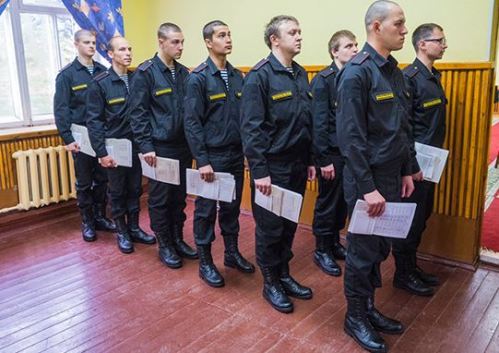
Northern Fleet draftees lined up with their paperwork in hand

Northern Fleet draftees lined up with paperwork in hand

On June 21, Mil.ru noted that Russia’s Western MD is getting 48,000 of this spring’s conscripts.  That’s a pretty enormous 34 percent of all draftees.

Mil.ru also reported the Black Sea Fleet has gotten 1,700 of 2,600 new men it’s expecting.

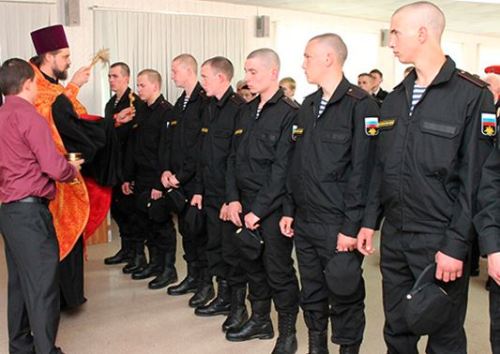
Russian Orthodox priest blesses Black Sea Fleet draftees

Russian Orthodox priest blesses Black Sea Fleet draftees

We already heard that the Baltic and Northern Fleets were getting 5,000 and 2,500 conscripts respectively, putting the Navy over 10,000 without counting the Pacific Fleet’s share.  If we guess the latter gets 3,000, this puts the Navy at 13,000 for the spring campaign.  That would be nine percent of all draftees, not the predicted six percent.  A similar number from last fall would make 26,000, and conscription would account for perhaps 19 percent of Navy manpower.  

On May 21, the Russian military indicated that 8,000 draftees were going to the RVSN.  That’s six percent of the spring cohort rather than the estimated eight.  About 26 percent of RVSN personnel might be conscripts.

The MOD website reported on May 7 that the VDV will take more than 6,000 draftees.  That gives the Russian airborne four percent of the current allocation of conscripts, about as predicted.  A roughly similar number in the fall would mean the VDV are 30 percent conscript-manned.

Mil.ru added:

“Few conscripts are fortunate enough to get to serve in VDV sub-units.  The competition for those wishing to serve in the VDV in some military commissariats reaches 30 men per spot.”

The VDV get to pick the best available young men:

“The main selection criteria for the VDV are excellent health and physical preparedness, a high level of neuropsychological stability, [and] positive social and moral characteristics.”