What’s It Cost? (Addendum)

There’s reason this week to return to the issue of what the S-400 system costs. Specifically, what it might cost China.

Vedomosti reported Wednesday that Russia has signed a deal with China to sell it the S-400 / Triumf.

The business daily’s defense industry source claims the agreement inked by Rosoboroneksport and the Chinese military will send off not less than six battalions of the advanced SAM system for more than $3 billion.

That would be at least $500 million per battalion (against the previously ventured guess of about $320 million).  Or in excess of $80 million per TEL.

The Russian Defense Ministry has consistently maintained that the S-400 won’t go abroad before 2016.

Vedomosti notes China’s last big purchase was 15 battalions of S-300PMU-2 completed in 2010.

RIA Novosti pretty quickly reported that an official of Russia’s Federal Service for Military-Technical Cooperation (FSVTS) said an S-400 contract hadn’t been signed with China as yet.

Rosoboroneksport and Almaz-Antey just declined comment.

S-400 Deployments

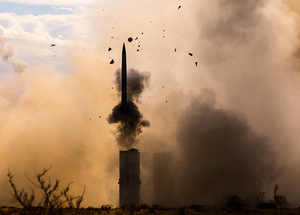
S-400 Firing (photo: Interfaks-AVN / Andrey Stanavov)

S-400 Firing (photo: Interfaks-AVN / Andrey Stanavov)

Last week Interfaks-AVN wrote that the Russian military just received two “regimental sets” of S-400 / Triumf SAMs.  They make numbers seven and eight.

One became the fourth “regimental set” of the 4th Aerospace Defense Brigade around Moscow and the other is bound for the 1st Aerospace Defense Brigade on the Kola near Northern Fleet headquarters at Severomorsk.

The Kola brigade is the first in the Western MD to have the S-400.  It falls under the Western MD’s 1st Air Forces and Air Defense Command.

The other three of the eight are the 3rd (Kaliningrad), 7th (Novocherkassk), and 12th (Nakhodka) Aerospace Defense Brigades.

Almaz-Antey General Director Yan Novikov told the Interfaks-AVN that, for the first time, the Defense Ministry will get three S-400 “regiments” in a single year in 2014.

TASS reported even earlier last week that Almaz-Antey will deliver the ninth “regiment” will before the end of December.  It will be the first three-battalion regiment, and is destined for Kamchatka, or the 14th Aerospace Defense Brigade (Yelizovo).

In September, the commander of PVO and PRO for VVKO, General-Major Andrey Demin told TASS that 12 “regimental sets” of S-400 and 72 Pantsir-S would be procured by 2020.

Defense Sector Wages

Interesting item on wages in Russia’s defense industrial sector in NG on November 11.

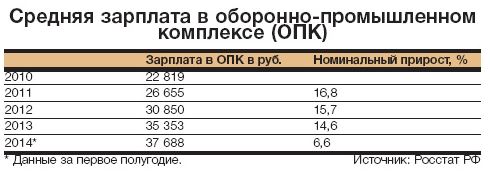
Alina Terekhova reports average monthly pay in the OPK is 17 percent higher than the country as a whole.  However, defense industry salaries lag employee earnings in other key sectors (i.e. railroads, oil, finance).  Yet they are likely to grow while wages elsewhere will probably begin to fall.

Minpromtorg [rather optimistically] forecasts that the earnings of OPK workers will double over the coming five years.

Defense industry pay grew 13 percent last year [not entirely consistent with the table below] against almost 12 percent in other areas.

Average Pay in the OPK

Average Pay in the OPK

Earlier this year, workers in Russia’s mining industry made nearly 57,000 rubles per month, oil workers 83,000, railroads 41,000, and finance 67,000.  Pay in the defense industries averaged about 38,000 rubles per month during the first half of 2014, according to Rosstat.  Nationwide it was about 32,000.

That 38,000 seems to fit in the context of other salaries (e.g. 30-35,000 for junior officers and contractees).

Rising inflation, Terekhova reports, could reduce real earnings for everyone next year.

She quotes a couple experts, neither of whom expects a decline in OPK wages. Despite the stagnation evident in the economy, the Kremlin will likely continue funding the GOZ generously given increased tensions with the West.  This will keep upward pressure on defense sector salaries.

It’s interesting that the oft-mentioned “cadre famine” in defense industry hasn’t bid wages higher.  But some enterprises report the average age (and presumably the pay grade) of their workers is dropping with the arrival of new and younger employees.

The NTsUO Chief

The Defense Ministry announced in late October that Russia’s new National Defense Command and Control Center (NTsUO or НЦУО) in the old ground troops command building on Frunzenskaya embankment will be fully operational by December 1.  It has operated on an “experimental combat duty” basis since April.

You can read about the NTsUO here and here.  Or you can look at General Staff Chief Valeriy Gerasimov’s description of what it will do.  It’s an incredibly expansive list of oversight, monitoring, and decision-support functions for state defense in accord with the Defense Plan.  As Gerasimov indicates, the NTsUO will inform Russia’s leadership about what’s happening in the world, the country, and the Armed Forces, and propose alternative courses of action in response to changing situations.

The NTsUO will be the apex of the military command and control system. Military includes not just Defense Ministry forces, but also Russia’s numerous militarized ministries and agencies — FSB, FSO, SVR, MVD, MChS, etc.  And more besides.  But it’s not clear to what extent heavyweights like the FSB and MVD have invested themselves in the NTsUO thus far.

Overlooked in the NTsUO is an intent to give supreme commander-in-chief Vladimir Putin better control over his various siloviki in the event of a genuine internal threat to his rule, i.e. coup, “colored revolution,” Bolotnaya march, Maidan, etc.  The NTsUO appears to be something Gorbachev, Yeltsin, or even Yanukovych would have envied during their political crises.

The NTsUO and its chief may have usurped the role of spokesman for the MOD (which retains its official press-service).

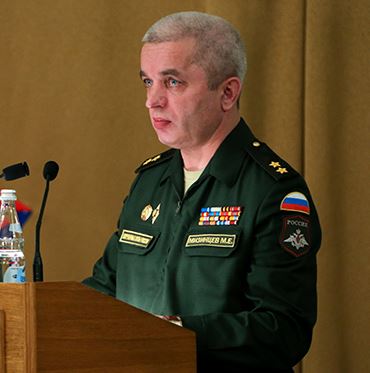
Alongside Defense Minister Shoygu, newly-minted NTsUO chief, General-Lieutenant Mikhail Mizintsev took the lead in briefing the MOD’s Public Council on October 28.  His published report was widely replayed by Russian news agencies.

General-Lieutenant Mikhail Mizintsev (photo:  Mil.ru)

General-Lieutenant Mikhail Mizintsev (photo: Mil.ru)

So what about the NTsUO chief?

Mizintsev is a career staff officer with considerable time spent in tactical reconnaissance.  He was born in rural Vologda oblast on September 10, 1962.  He graduated from the Suvorov premilitary school in Tver in 1980, and the Kiev combined arms command school in 1984.

He commanded reconnaissance or motorized rifle troops up to battalion-level in the GSFG / WGF and Group of Russian Forces in the Transcaucasus.

He finished the mid-career Frunze Military Academy in 1996, and served as a “senior officer-operator” [watch officer] in the General Staff’s Main Operations Directorate (GOU) until 2001.  He returned to the schoolhouse and graduated from the senior-level General Staff Academy in 2003.

Mizintsev served as the chief of an unidentified GOU group through 2007. He then became chief of the operations directorate and deputy chief of staff for the Moscow Military District.  He likely came to the attention of Valeriy Gerasimov at this point.  Gerasimov commanded the district starting in 2009.

From 2010 to 2012, Mizintsev occupied the same post in the North Caucasus / Southern MD.

In August 2012, he became chief of the General Staff’s Central Command Post (TsKP or ЦКП) until it disbanded and he took over the NTsUO.

Mizintsev’s rise from O-6 was quick; he became a one-star in December 2011, then put on two-star general-lieutenant rank barely two years later.

Contract Euphoria

Vadim Koval offered words of caution and perspective on contract service in an October 31 NVO op-ed.  Until 2012 or so, the retired colonel was the official spokesman for the RVSN.

Koval suggests you can’t measure contract service by numbers alone, which merely represent “start-up capital” for the professionalization of the armed forces.

He was prompted a recent official announcement that the MOD has signed up an historically high number of contractees this year — more than 70,000 already — with two months left on the calendar.

The MOD reports, for the first time, the number of soldiers and sergeants serving on contract exceeds the number of conscripts in the ranks.  That means something more than 305,000 — based on fall 2013 and spring 2014 draft campaign target numbers.

Success in finding contractees, Koval writes, is due, in no small part, to an aggressive MOD advertising and recruitment drive this year.  But the greatest attraction for young men is increased training, new arms and equipment, and the overall improved condition of the armed forces.  None of which “remain unnoticed among potential candidates for contract service.”

Still, Koval concludes, even in light of record recruiting numbers, it’s obvious “the defense department’s main work with this category of servicemen is still ahead.”  Defense Minister Sergey Shoygu didn’t fall into euphoria over the numbers, and ordered his subordinates to concentrate on the quality of contractee training, according to Koval.

He writes:

“Even statistics graphically confirm that problems with the quality of recruited contractees exist:  the quantity of contract servicemen dismissed from the Armed Forces in 2014 was 18 thousand.”

Koval finishes noting that much depends on the clarity of the MOD’s response to the challenge of getting and keeping suitable and well-trained soldiers in the military.

It’s surely difficult (well, impossible) to make that 305,000 number jibe with numbers we’ve already seen.  If Moscow had 225,000 or 205,000 at the end of 2013, this year’s 70,000+ would make 295,000 or 275,000 contractees.  Neither of those is 305,000.

It could be that Koval’s very interesting 18,000 number plays into this . . . if that many contractees quit or were drummed out this year, maybe that’s why the numbers don’t equal or exceed 305,000. Perhaps the MOD isn’t counting its attrition — only the manpower it added.

If 18,000 is the number of contractees who left the service, that’s pretty low attrition — about 6 percent.  Last year that percentage looked to be 12 or more.

A Couple Jokes

Courtesy of Anekdot.ru, here’s a sample of recent Russian military humor . . .

The best color for army camouflage is purple.  Has anyone ever seen a purple army?

The Mongolian Army’s been called the world champion in maskirovka.  To this day, no one’s ever seen it.

A general heard an old saying:  “Whoever has served in the army doesn’t laugh at the circus.”  Voyenkomat workers went around to circuses looking for those who weren’t laughing.  The country’s armed forces were populated with thousands of soldiers.

When the young man learned that the girl was still waiting for his return from the army [on conscript service], he signed up on contract.

Only a country which first builds roads to move its army can go to war with Russia.

– If they ban profanity in the army, the country’s combat readiness would be threatened.  – Why?  – You try to explain to a soldier with just particles, conjunctions, and prepositions how he has to defend the Homeland.

It’s possible to do everything three ways:  correctly, not so correctly, and like they do it in the army.

There’s reinforcement in the RF Army:  into the inventory have come pilotless aircraft, turretless tanks, and brainless generals.

Russia is a unique country, it has a gun which has never fired (Tsar Cannon), a bell which has never rung (Tsar Bell), and an army general who has never served in the army (Shoygu).

They go on forever . . . alas, we cannot.  Enjoy.

The Next China Deal

IA Regnum military observer Leonid Nersisyan recently took a stab at preparing Russian public opinion for the eventual sale of S-400 SAMs and Su-35S fighters to China.  A major arms deal with China should be expected, especially given Moscow’s turn further east in the wake of Western sanctions.

Nersisyan aims to refute usual complaints about exporting Russia’s most advanced weaponry to China, i.e. that Beijing will quickly copy and sell it more cheaply.  He dials back to the early 1990s.

The sale of S-300 SAMs began in 1993, amounting to something between 24 and 40 battalions of three variants.  Along the way, China developed a copy, the HQ-9, similar but less capable than the original in many performance parameters.  If it had been a really good knock off, Nersisyan argues, the HQ-9 would be found in many of the world’s armies, but it isn’t.
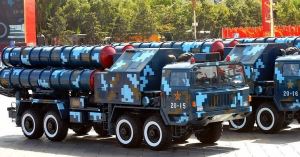
China's S-300, Whitewalls on a TEL?

China’s S-300, Whitewalls on a TEL?

The S-300 has grown old, and the money earned from China went into S-400 development and saved Almaz-Antey from bankruptcy at a time of little, if any, Russian military procurement.  Nersisyan concludes that:

“. . . the deal was successful — the system was copied (with deficiencies) only two decades after the first deliveries, when it had already grown old, and Russia had more modern analogues.”

Nersisyan points also to the Su-27 sale.  First Russia sold Beijing 24, then 200 kits for assembly in China.  But the Chinese stopped the transfer at 100, and began producing a copy, the J-11B.  However, its engine proved unreliable in comparison with Russia’s AL-31F, which the Chinese opted to buy for their domestic fighters.  Similarly, China bought nearly 100 Su-30 variants beginning in 2000 before producing a copy, the J-16, which also lacks a reliable engine. China’s difficulty, according to various reports, is manufacturing turbine blades and plates.

Neither the J-11B nor the J-16 is being produced in volume, and Russian aircraft remain the foundation of Chinese fighter aviation.

So, concludes Nersisyan, it will take China 20 years to copy the more complex S-400, while Russia is deploying the S-500.  Copying the generation 4++ Su-35S will be complicated by its more advanced thrust-vectored AL-41F1S engine, and Russia will be fielding the PAK FA / T-50 in the meantime.

Nersisyan writes that becoming a real competitor in the global arms market requires original RDT&E, not copying.  He sums up in three maxims:

  • Modern technologies don’t lend themselves to quick copying.
  • Copiers always lag behind.
  • The copy is often worse than the original.

What do others say about the threat of Chinese copying?

CAST’s Vasiliy Kashin agrees that fears are exaggerated because people don’t understand the obstacles to successful copying or that China’s military modernization is directed against the U.S. (something that, he adds, benefits Moscow).  He also blames much of the copying of Russian fighters on Ukrainian technical cooperation with China.

Vasiliy Sychev has written that S-400 and Su-35S sales to China will be straight sales without any technical or production licenses.  Moscow typically wants to sell more, and Beijing buy less, but the sides have worked toward the middle.  A new deal (or deals) will be for 2-4 SAM battalions and 24 fighters ($1.5 billion, or $60 million per).

Nor does Viktor Murakhovskiy see anything critical because Russian capabilities will be ahead of what China gets.

More Sinophobic, Aleksandr Khramchikhin says there’s an active and effective pro-China lobby in Moscow’s power ministries and OPK, and he believes Russia needs to understand it faces a grave threat from China.

Sorry, Not a Victor

Sorry, Not a Victor (photo: Reuters / Yuriy Maltsev)

Sorry, Not a Victor (photo: Reuters / Yuriy Maltsev)

What great fun when the general press covers Russian military issues!  Business Insider ran this pictorial presuming to show an outdated Victor-class SSN headed for scrap.

In fact, it’s two not-quite-so-old Pacific Fleet Akula submarines headed for overhaul.

But what great pictures!  

One supposes this is how the hull looks when it hasn’t seen a drydock in many years.

Su-35 Deliveries

Su-35

Su-35

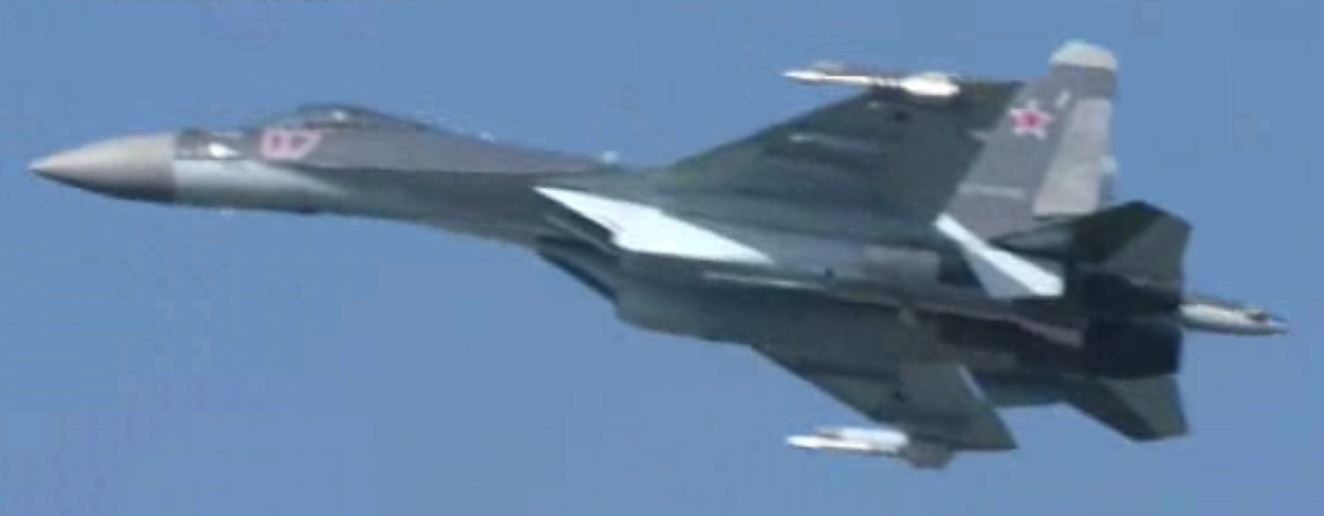
RBK-TV ran a short segment on 3 October indicating that OAK, Sukhoy, and KnAAZ (aka KnAAPO) will deliver (or will have delivered) 22 Su-35 aircraft to the Air Forces by the end of 2014.

Twelve Su-35 were reportedly delivered in 2013, so 22 plus delivery of 14 more in 2015 would fulfill Sukhoy’s 2009 contract for 48.  There’s been talk all along about a follow-on contract.

The report briefly covered the aircraft’s capabilities and noted that China would be the primary foreign customer for it.  However, according to RBK, the export variant will not carry the same avionics as the domestic version.

The video features OAK President Mikhail Pogosyan saying that the corporation’s military production is fully independent of foreign suppliers (and therefore unaffected by Western sanctions).

The broadcast ends noting that more than 12 billion rubles have been invested in Sukhoy’s modernization over five years.  More than 3 billion from targeted state programs have gone into financing Su-35 development.

Russified Dokdo

It is, by no means, clear that the first Russian Mistral won’t be delivered when it’s due at the end of October 2014.  Maybe it will be just quiet enough on the eastern front of Ukraine for Paris to fulfill its contract with Moscow.

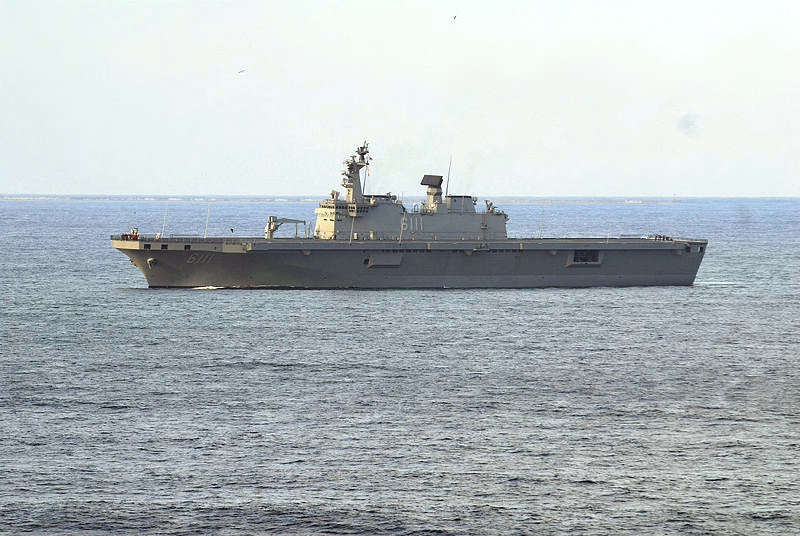
But CAST’s Andrey Frolov suggests in a recent VPK article that, if the first Mistral isn’t delivered, Russia could team with South Korea to build its own LHD at Zvezda shipyard in Komsomolsk.

South Korea's Dokdo

South Korea’s Dokdo

Frolov says:

“If we leave parenthetical the question about the need to have a UDK [multipurpose assault ship] in our Navy and accept as an axiom that our fleet needs them, next the question arises about the possibilities of Russian defense industry for import substitution for such a class of ships.”

Then he turns to what it would take and the rather large obstacles Moscow faces:

“Obviously neither Russian nor Soviet shipbuilders had experience in similar construction, especially on such a technological level.  Those large assault ships [BDK], which entered the USSR Navy and were inherited by the contemporary fleet, represent a completely different direction conceptually and technologically.  Taking into account the fact that, according to well-known data, in the post-Soviet period the design of an UDK has not been ordered from a Russian KB [design bureau], it is possible to suppose:  in the best case, only draft drawings, done on initiative, exist.  That is, in the event of a possible order from the Defense Ministry, several years would be needed just to prepare a design.  The experience of developers of designs like aircraft carriers by OAO Nevskoye PKB as well as a ship of less displacement in the destroyer class (the design has been in the works for several years already) speaks eloquently about the possible difficulties on this path.”

“It is possible to trace the pitfalls in the construction of our own forces in the history of the modernization of CVHG project 11434 Admiral Gorshkov for India, in the serial frigates of project 22350, and also in the lead unit of large assault ship project 11711 Ivan Gren, which we note, is much simpler to build than Mistral.”

Russia’s shipyards are so busy with naval and civilian orders that laying down even two LHDs seems improbable, according to Frolov.

Nor, with sanctions in place, does Frolov think it’s realistic to believe that Russia can obtain all the dual-use technology it needs for such ships.  It’s also doubtful it can develop its own.  And the cost of these ships is a large issue.

But, says Frolov, the possibility of foreign cooperation remains.  European partners are already irrelevant because of sanctions.  Daewoo Marine Shipbuilding and Engineering (DSME), however, already partnered with Zvezda in an effort to land the contract Mistral won.

Frolov believes Russia and South Korea have similar views for an LHD:  a ship for littoral operations close to home rather than for transoceanic expeditionary warfare.

Russia would have to develop some equipment, components, and systems for a Russified Dokdo to replace U.S. ones that Washington would certainly not permit the South Koreans to provide to Moscow.

Frolov reminds that Russia already has a record of weapons development cooperation with Seoul.  For example, the Russian radar developed for the ROK’s KM-SAM will be used on Russia’s new Vityaz SAM.

He concludes that a Russian-Korean LHD could become “a more threatening player on the world arms market” and fill Zvezda’s construction program.