Where’s My Sub Base

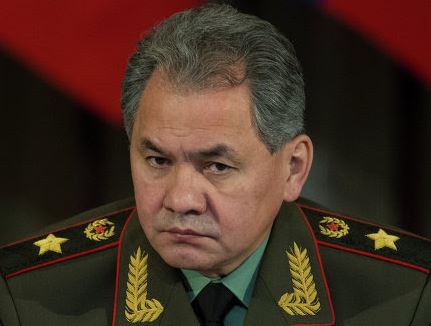
Not His Happy Face (photo: RIA Novosti / Sergey Guneyev)

Not His Happy Face (photo: RIA Novosti / Sergey Guneyev)

Now they’ve done it.

They’ve failed to finish new facilities for Borey-class SSBNs on Kamchatka expeditiously, and they’ve forced Defense Minister Sergey Shoygu to demand “strict control” over their work.

But who “they” are isn’t exactly clear.

According to Mil.ru and RIA Novosti, the annoyed Shoygu said:

“These things are too serious to joke about the time period for their construction.  The joking is over.”

As regards the current plan to base Borey units 2 and 3 at Rybachiy (presumably in 2015):

“At that time everything must be ready.”

Mil.ru reported that the Defense Minister was also dissatisfied with the quality of the construction he observed.

Shoygu laid responsibility on General Staff Chief, Army General Valeriy Gerasimov and Eastern MD Commander, General-Colonel Sergey Surovikin, ordering them to take the work at Rybachiy under “strict control” and to give him a weekly progress report.

Shoygu should have turned to his old friend and subordinate from MChS days, Aleksandr Volosov, who directs the Federal Agency for Special Construction (Spetsstroy).  Spetsstroy is building the new pier zone at Rybachiy.  It used to be known as the Main Directorate for Special Construction (GUSS) in the old days when it fell squarely under the MOD.
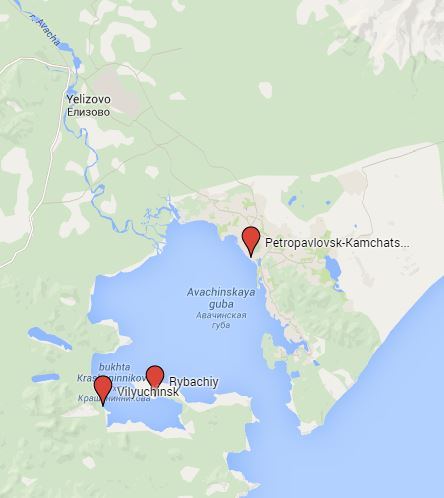
Rybachiy and Environs

Rybachiy and Environs

The current Defense Minister’s not the first to ask when his sub base will be ready.

In 2012, President Vladimir Putin revealed that he arranged significant financial assistance from two Russian oil companies to keep the Pacific Fleet strategic sub base open in 2002.

He visited periodically to check progress in modernizing its naval and social facilities.  He was usually unhappy with what he found.

Speaking from Vilyuchinsk in 2004, Putin said:

“They told me here in the past two years an improvement [in military living conditions] was being felt, but I didn’t see this.  The material base of public facilities here is in a pathetic state.  This situation is absolutely intolerable.”

By 2007, according to Izvestiya, he saw some improvement, but still said officials were “just picking their noses” instead of getting Gazprom to gasify Kamchatka.  Army General Anatoliy Grebenyuk, chief of the MOD’s billeting and construction service, and the chief of the Main Military-Medical Directorate were unceremoniously retired for failing to finish their respective work on the remote peninsula.

Gazprom reports that Petropavlovsk-Kamchatskiy was gasified in 2010, but it’s unknown if local gas lines have, as yet, reached the sub base.

As it has long planned, Moscow intends to homeport four Borey-class SSBNs on Kamchatka, starting with Aleksandr Nevskiy and Vladimir Monomakh.  But first it wants a fully functioning system in place to support their operations.

In March, a Navy Main Staff source told ITAR-TASS that the complete system for basing the new submarines – piers, utilities, logistical support, weapons storage facilities, and other infrastructure – still needs to be finished. Consequently, neither SSBN will arrive in the Pacific Fleet earlier than the fall of 2015.
Simmering War

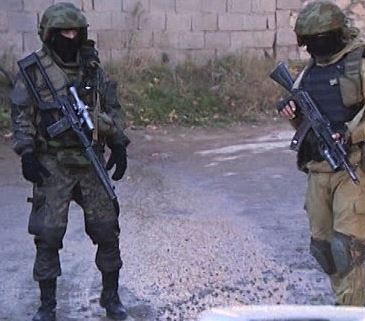
Not Crimea, the North Caucasus (photo: RIA Novosti)

Not Crimea, the North Caucasus (photo: RIA Novosti)

Russian news agencies marked the 15th anniversary of the Unified Group of Troops (Forces) — OGV(s) or ОГВ(с) — in the North Caucasus on September 23.

The OGV(s) was, and is, the inter-service headquarters established at Khankala, Chechnya to command all Russian “power” ministry (MOD, MVD, FSB) operations at the start of what became the second Chechen war in 1999.

The war that would bring Vladimir Putin to prominence and the presidency, and preoccupy him during his first years in power.

The ITAR-TASS headline proclaimed:  “The OGV in the Caucasus has killed more than 10,000 fighters over 15 years.”

Fighters means insurgents or terrorists from Moscow’s perspective.

That’s a lot.  On average, even through today, over 600 per year, or at least a couple every day.  Earlier this year, a news headline read “Russian MVD has killed more than 350 fighters in 4 months.”

Six Killed in Makhachkala (photo: ITAR-TASS)

The body count isn’t the only metric.

The MVD noted that OGV(s) units have conducted more than 40,000 “special measures,” destroyed 5,000 bases and caches, confiscated 30,000 weapons, and disarmed 80,000 explosive devices.

The Hero of the Russian Federation has been awarded to 93 MVD servicemen in the OGV(s) (including 66 posthumously).  More than 23,000 MVD troops have received orders and medals.

And the disparate North Caucasus insurgency still simmers.

Putin Launches GPV 2016-2025

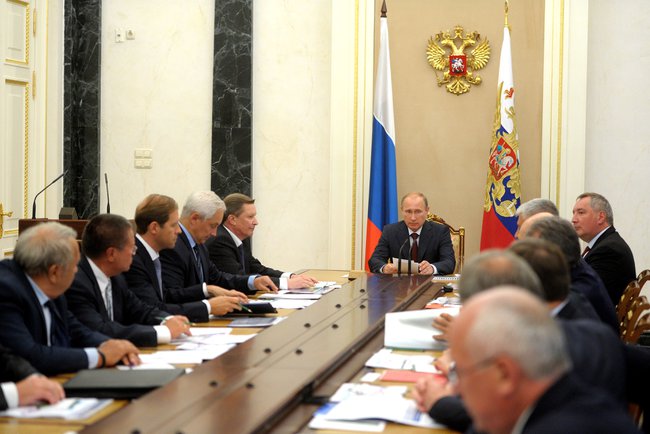
Putin Addresses Session on GPV 2016-2025 (photo:  Kremlin.ru)

Putin Addresses Session on GPV 2016-2025 (photo: Kremlin.ru)

On 10 September, Kremlin.ru posted President Putin’s opening remarks to a session on developing the draft State Program of Armaments (GPV) 2016-2025.

Putin’s speech can be divided into several themes:  financing, the arms race, threats, particular weapons systems, and other tidbits.

A critical question is how will funding for a new GPV compare with the approximately 20 trillion rubles laid out or earmarked for GPV 2011-2020. But Putin took pains to stress only that financing for the new GPV will be based on the government’s macroeconomic forecasts.  He noted:

“The government has prepared two variants [not good and possibly worse?] of such a preliminary macroeconomic development forecast, and today, we will hear about it in a meeting with the government, and talk more about this.  We will proceed exclusively from realities, from our possibilities, and we will not inflate our military expenditures.”

“I ask you to choose and present the most balanced variant of resource support for the new state program of armaments before the end of October 2014.  It must fully account for missions in the area of military organizational development and still be realistic, and proceed, as I already said, from the country’s financial-economic possibilities.  But I am sure we can find a variant acceptable both according to financial support and to the quality of those weapons systems which we will discuss more today.”

This seems consonant with his statement last December that the OPK and military should not expect future procurement budgets to match what was laid out in recent years.

In this September 10 session, Putin eschewed interest in a new arms race, but stressed that Moscow has no choice but to take “countermeasures” against U.S. and NATO threats.  A few examples:

“[modernizing the armed forces and defense industry] is not connected to any kind of arms race . . . .”

“And we already many times said and warned that we will be forced — exactly forced — to take adequate countermeasures to guarantee our security.”

“We have spoken many times, and very much hope that there will not be excessive hysteria [from the U.S. and NATO?] when these decisions [about the GPV?] are finally made and begin to be realized.  I want to note that everything we are doing are only countermeasures.”

“Sometimes the impression is created, I just talked about this, that someone wants to launch a new arms race.  We will not, of course, be dragged into this race, it is simply absolutely excluded . . . .”

The Russian president also laid out at length his view of the threats requiring countermeasures:

  • U.S. missile defense;
  • U.S. Prompt Global Strike;
  • Militarization of space [?];
  • Conventional strategic weapons;
  • Prospective build-up of NATO forces in Eastern Europe.

He restated the official Kremlin narrative explaining why that alleged NATO build-up will happen:

“The crisis in Ukraine, which was actually provoked and created by some of our Western partners, is now being used to reanimate this military bloc.”

A regime that wants to prevent a Maydan on Red Square pretty much has to declare that the revolutionary impetus came from outside.  It also has to overlook that it was the seizure of Crimea and the start of Moscow’s war in eastern Ukraine that awakened NATO.

Look for a more detailed exposition of Moscow’s new threat assessment when the updated Military Doctrine appears in December.

What did Putin say about what will be purchased under the new GPV?  In short, not too much new:

“. . . our fundamental systems:  both of a defensive nature and strike systems have simply already reached or are reaching the end of their service lives.  And if we need to replace them, then replace them, of course, with prospective, modern ones having a future of long use.”

“I note that for the draft GPV-2025 there is already a unified system of preliminary data which confirmed the basic directions of arms and equipment development for the period to 2030 and formed a list of types determining the future profile of weapons systems.”

“Most of all we are talking about the creation of a rational list of strike means, including the guaranteed resolution of nuclear deterrence missions, about rearming strategic and long-range aviation, and continuing formation of an aerospace defense [VKO] system.”

“Further.  In coming years, it is already essential to support the breakthrough development of all components of precision weapons, to create unified types of general purpose arms and equipment, and for the Navy — new ship projects, standardized in armament, command and control systems, and communications.”

Overall, continuing the course and priorities — such as they are — of the current GPV.

Now, the tidbits . . . .

Putin seemed to say the 2015 goal of more than 30 percent modern arms and equipment has already been reached.

According to the president, more than 3,600 items of “fundamental weapons” (68% of the contracted quantity) have already reached the troops this year, along with 241,000 other items [presumably procurement not part of a major weapons system].

Putin gave only the briefest acknowledgement that, with looming sanctions, defense industry must be ready to manufacture its own critically important equipment, components, and materials.  Industry, he said, should also be looking to produce important civilian machinery in the future.

He only slightly criticized work on past GPVs, saying:

“It goes without saying we must carefully analyze the experience of realizing the previous programs, including the problems and oversights which led to delays in placing and fulfilling orders, and at times even to tasks not being completed.”

However, Putin also took the chairmanship of the Military-Industrial Commission (VPK) on himself, indicating that he thinks the GPV could use some “manual control.”

That’s about 950 words describing what Putin said in roughly 1,200.  One hopes his speech has been deconstructed and reconstructed in such a way that it illuminates more than the original.

Pacific Fleet Akulas Bound for Severodvinsk

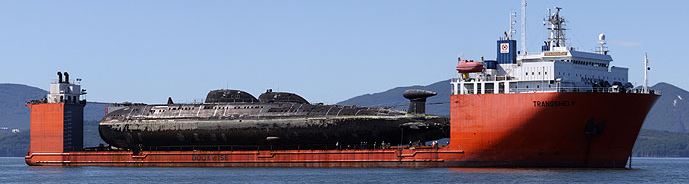
Akulas Loaded on Transshelf (photo: www.dockwise.com)

Akulas Loaded on Transshelf (photo: http://www.dockwise.com)

On 9 September, ITAR-TASS reported two Pacific Fleet Akula-class submarines had begun a three-week Northern Sea Route (NSR) transit to Severodvinsk for a “deep modernization” at Zvezdochka.  They will reach the shipyard during the last ten days of the month, according to the Defense Ministry press-service.

Pacific Fleet proyekt 971 / Shchuka-B SSNs Bratsk and Samara were loaded on Dockwise’s heavy transport Transshelf at Avachinskaya Bay on 23 August.

This is the first time two submarines have been transported together. Nuclear-powered icebreakers will accompany Transshelf along the NSR.  Until now, Pacific Fleet Akulas were repaired at Vilyuchinsk or Bolshoy Kamen in the Far East.

Zvezdochka publicized the boats’ imminent departure back on 20 August. Buried in this item is a reported RF government decision on a shipyard division of labor, under which Zvezdochka will modernize Akulas and Zvezda (Bolshoy Kamen) will work on Oscar II-class SSGNs (proyekt 949A / Antey).

But it looks like Zvezdochka already worked on the Northern Fleet’s Oscar IIs in previous years; Pacific Fleet units remain for Zvezda.

Zvezdochka has a contract for four Akula modernizations.  Two Northern Fleet units — Leopard and Volk — are already there.  According to Flot.com, the 21-year-old Improved Akula Leopard arrived in 2013 and will return to the fleet in 2016.  22-year-old Volk got to Zvezdochka this year.  Both were built by Sevmash in Severodvinsk.

Akula II Bratsk and Samara — 24 and 19 years old respectively — were both built at Komsomolsk in the Far East.

Zvezdochka’s “deep modernization” reportedly includes a recore and replacement of all electronic, control, and weapons systems.

Mistrals Not Needed

It’s possible the endgame for the Russian Mistrals is approaching.

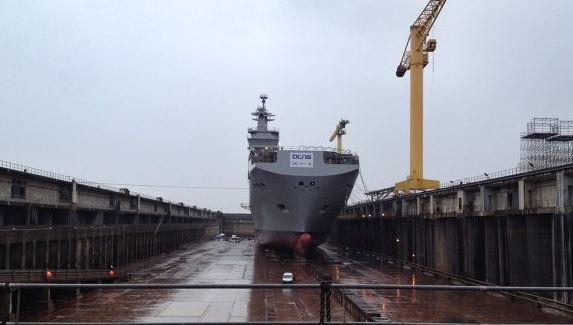
First Russian Mistral at DCNS (photo: RIA Novosti  / Daniil Nizamutdinov)

First Russian Mistral at DCNS (photo: RIA Novosti / Daniil Nizamutdinov)

But Moscow’s not sad.  Officials have already said it’s not a tragedy.

Mikhail Nenashev — not an official, but a former Duma member and well-informed commentator — has called into question the need for the Mistrals. He’s a former Captain First Rank who chairs the All-Russian Movement for Support of the Navy.

According to RIA Novosti, he said the Mistrals have no utility but political.  The news agency quotes Nenashev:

“These ships are no kind of necessity for the navy — we don’t intend to land troops in such a way.  As I recall, the French themselves earlier and now are searching for how to deploy these ships — for a decade of fulfilling these missions by the French Navy there were few places where these ‘Mistrals’ were deployed in reality.”

That’s a bit of an exaggeration.  The most cursory look shows that the French contributed the Mistrals to the NATO Response Force, and deployed them during unrest in Lebanon and Cote d’Ivoire, among other places.

Nenashev and others (including Minister of Industry and Trade Denis Manturov) say Russia can build ships like to the Mistrals since it was already participating in their construction, and providing the internal command and control systems for the ships.  It would take longer (3-4 years) but cost less (€150-200 million vs. €1.2 billion).  The French, he says, can build it in a year because they have a smooth production process for these ships.

The former officer suggested that Sevmash or Baltic shipyard could construct such a ship if desired.  But he fails to note that these builders are already absolutely chockablock with orders today, and every new ship type is taking substantially more than 3-4 years to build.

But Nenashev willingly admits there are “acute questions” about the shipbuilding industry.  Specifically, issues of components, parts, technology, and skilled labor are a “little rough” and require coordination.

It’s exactly what Moscow will miss — a chance to see first-hand how fairly robust and modern French shipbuilders do their work.  No doubt there are things the Russians could have learned and taken home.

For their part, the French carefully note that the delivery of the first Russian Mistral has not legally and finally stopped. But President Hollande signaled Moscow that, if the situation in Ukraine does not improve, he will not approve the ship’s transfer in November.  That final decision will actually come at the end of October.

Improvement in Ukraine is defined by a relatively high bar of an effective ceasefire and agreement on a political resolution of the conflict.

The Elysee is quick to repeat that the Mistral sale remains unaffected by EU sanctions on Russia, and is a decision for Paris to make.  Hollande adopted his current stance in the last couple weeks as unavoidable evidence of direct Russian participation in the fighting (i.e. POWs and KIAs) in eastern Ukraine surfaced.

As of 9 September, RIA Novosti reported that planned at-sea training for the first Russian Mistral and its 400-man crew-in-waiting in Saint-Nazaire was put off for “technical reasons” having nothing to do with the French President’s current stance on the sale (or no sale).

Through the Public’s Eye

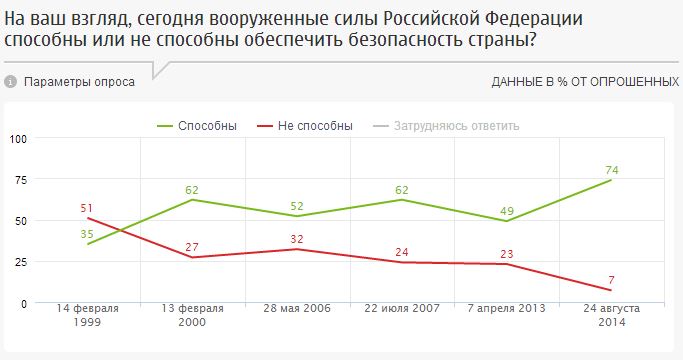
How does the Russian military look in the public’s eye?  The Public Opinion Foundation (FOM) asked recently, and the answers showed a fairly substantial improvement in the average citizen’s view of the capabilities of the armed forces.

The poll indicates the constant Russian media drumbeat on rearmament has affected public perceptions of the military’s capabilities.  Its unopposed march through Crimea this spring probably contributed as well, but no survey questions addressed this.

FOM asked, if extra government funding were available, would respondents use it on military or civilian needs. Those polled still strongly prefer civilian uses (55% vs. 61% in early 2012).

Seventy-four percent of those surveyed now think the armed forces are capable of ensuring the country’s security (vs. only 49% in early 2013).  Those who think not dropped to seven percent (vs. 23% in 2013).

Are They Capable?

Are They Capable?

In response to an open follow-up question, 21 percent said the military is capable because it has all combat equipment it needs.

Asked if the military’s combat capability is increasing, decreasing, or not changing, 64 percent said increasing (vs. 38% in 2013).  Only 12 percent said not changing (vs. 30% in 2013).

In an open follow-up, 20 percent said expedited outfitting, development of defense industry, and new weapons are all necessary for increasing the combat capability of the armed forces.

At the same time, 63 percent indicated Russia has a sufficient amount of modern arms and equipment (vs. 43% in 2013). Sixty-five percent think the share of modern weapons is increasing; 41 percent thought so in 2013.

The survey also asked respondents to rate their knowledge of the situation and problems in the armed forces.  These numbers were basically unchanged.  In this survey and in 2013, less than 30 percent said they knew them “well” or considered themselves “not badly” informed.  Slightly less than 70 percent said they didn’t know much or were poorly informed.

But, as the saying goes, opinions are something everyone has.

About one-third reported having relatives, friends, or acquaintances in the military; about two-thirds said they don’t.

The poll was done on 23-24 August with responses from 1,500 participants in 43 regions and 100 populated areas.  Its margin of error is not greater than 3.6 percent.

FOM also offers a complete breakdown of its survey results from the webpage for those who’d like to download them.  It shows them by age, sex, political preference, education, income, etc.

A Year Does Not a Soldier Make

Krasnaya zvezda always has interesting Internet polling.  Yes, Internet.  Not a scientific opinion survey based on valid sampling and a mathematically acceptable margin of error.

We’re talking about Russia here.  We take what we can get.

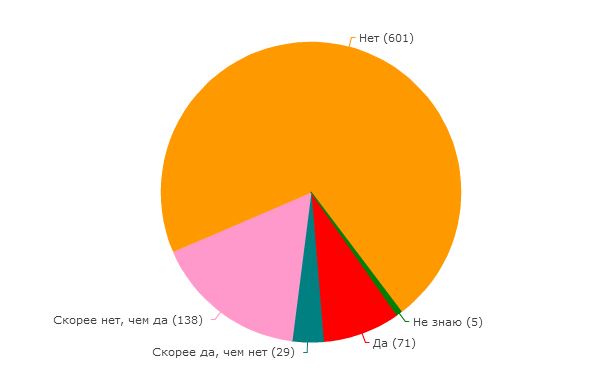
KZ asked its readers whether the current year of conscript service is sufficient to make a real soldier.  Not surprisingly, 601 of more than 800 respondents said no, it isn’t.  Only 71 said unequivocally yes, it’s enough.

KZ's Results

KZ’s Results

Being the MOD’s daily paper, KZ’s readership is mostly those in the Russian armed forces, or those somehow interested in them.

The MOD wasn’t happy about the shift to the one-year draft several years ago. But it had no alternative facing the twin pressures of rising draft evasion and increasing violence and other abuse in military units.  At least 12-month conscription helped alleviate both of those problems if it didn’t do anything for the military’s readiness.

Hence, the great renewed stress on trying to sign up contract enlistees.

Health of the Force

The confluence of recent news stories makes an update on the health of Russian military forces opportune.  As elsewhere in the armed forces, the military’s medical situation seems generally better compared with two or three years ago.

According to Izvestiya, the chief of the Main Military-Medical Directorate (GVMU), General-Major Aleksandr Fisun told the Defense Ministry’s Public Council that illnesses in the army declined 13 percent in 2013.  The illness rate in 2012 had been 40 percent higher than 2011.

The MOD attributes the improvement to better living conditions for soldiers. These include heated barracks, washing machines, shower facilities allowing troops to clean up more than once a week, and socks replacing foot wrappings.

Fisun said, among conscripts, 60 percent of illnesses were respiratory in nature, while about 14 percent involved skin conditions.

Better training for commanders was another factor in cutting the number of sick soldiers.  An MOD spokesman told the paper:

“Work in early identification of illnesses was reinforced — commanders were strictly ordered to send subordinates for initial observation on just the suspicion of an illness.  The condition of everyone hospitalized was reported to [military] district commands.”

Valentina Melnikova of the Committee of Soldiers’ Mothers (KSM) told Izvestiya commanders have been the problem.  However, she said Defense Minister Shoygu has said any soldier not allowed to see a doctor can now turn to military prosecutors for help.

Bmpd.livejournal.com published Fisun’s pie charts from his presentation to the MOD’s Public Council.

Disease Incidence Among Servicemen

Disease Incidence Among Servicemen

There are separate pies for conscripts and contractees.  Respiratory diseases, however, were the largest problem for both groups, accounting for half or more of illnesses.

Fisun also presented data on fitness for service among this spring’s conscripts.

Health of Conscripts in the Spring 2014 Draft

Health of Conscripts in the Spring 2014 Draft

The tabular data shows an increasing number of young men are fit, or fit with insignificant limitations, to serve in the armed forces (73.4%).  Most of that improvement apparently comes directly from decreasing the number of potential soldiers considered to have limited fitness for service (21.6%).

Reasons for “liberating” citizens from serving were pretty evenly distributed among, in order, muscular-skeletal and connective tissue diseases, psychiatric disorders (drug addiction, alcoholism), digestive system diseases, circulatory diseases, nervous system diseases, and other.

KSM’s Melnikova told Interfaks-AVN that illness was still the major issue for young men facing the spring draft.  She indicated 80 percent of complaints coming into KSM concern unfit men who were drafted.

In Moscow, some conscripts with documented health conditions  were deferred until fall under additional medical observation, but others were told they have to serve now, and had to turn to the courts for relief.

Meanwhile, the GVMU is reportedly amending physical standards for Russian Spetsnaz and VDV soldiers.  It’s lowering the height requirement by 5 cm (2 inches), and increasing the weight limit by 10 kg (22 pounds), according to Izvestiya.

Spetsnaz and VDV may soon be as short as 165 cm (5’4″) and weigh 100 kg (220 pounds).  The new standards will apply for conscripts, contractees, and military academy cadets.

Physical Standards for Airborne Troops Will Be Relaxed Somewhat (photo: Izvestiya / Kirill Zykov)

Physical Standards for Airborne Troops to be Relaxed Somewhat (photo: Izvestiya / Kirill Zykov)

Izvestiya was told a Defense Ministry order officially putting these standards into effect is expected in 2-3 months.  Its VDV source said the increased weight limit is related to use of the newer D-10 parachute which can bear up to 120 kg, so it can support a heavier jumper along with 20 kg of gear.

Perhaps the last, best word comes from Ruslan Pukhov, independent expert and Public Council member.  According to Izvestiya, he recommends increased spending on rear support and logistics, even if it means less expenditure on armaments:

“It’s worth sacrificing a couple nuclear submarines or refraining from construction of corvettes , but don’t economize on people — on their food, medical care and pay.  Iron doesn’t fight, people fight.”

More on the 55 OMSBr (G)

Krasnaya zvezda wrote last week about Tuva and its connections to Russia’s military.

The paper indicated that the “organizational nucleus” of a new Tuva-based motorized rifle brigade (mountain) under Colonel Andrey Shelukhin is now working in the republic which borders Mongolia.  Shelukhin and his staff came from the 201st Military Base in Tajikistan.

It notes that the brigade’s infrastructure is under construction, and recruiting has begun.

A year ago, Shelukhin was a lieutenant colonel, and chief of staff of the 201st, according to KZ.

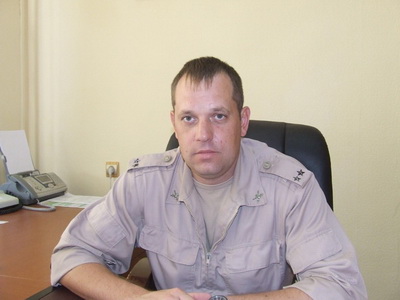
LTC Shelukhin (photo: Krasnaya zvezda)

LTC Shelukhin (photo: Krasnaya zvezda)

Before that, he was a battalion commander in the former Siberian MD.

Manning the Northern Fleet

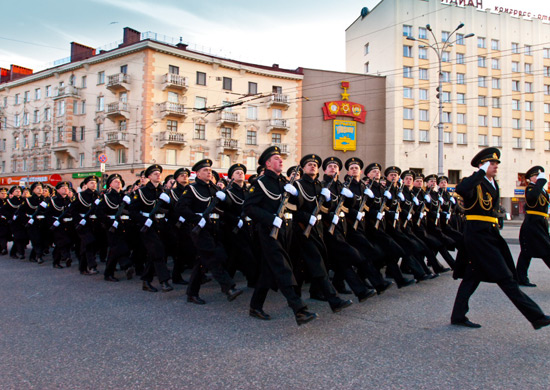
Parade in Murmansk (photo: Mil.ru)

Parade in Murmansk (photo: Mil.ru)

Krasnaya zvezda recently reprinted a column from the Northern Fleet newspaper about manning and contract service.

It’s an interview with the chief of the sailor and NCO manning section in the fleet’s Organization-Mobilization Directorate (OMU), a Lieutenant Colonel Verbov.  It’s funny (perhaps suspicious) because his name is the root of the word verbovat (вербовать) — to hire, enlist, or recruit.

In any event, this LTC Verbov says his priority is manning the fleet’s submarines, and several years ago, submarines were manned at 98 percent — or “practically fully” with contractees.  Since then, conscripts sent to the submarine force have served only ashore.

The manning of billets which should be occupied by contractees is about 90 percent for the fleet as a whole.  He adds, however, that officers lacking officer billets hold some of these contract enlisted positions.  But the situation varies.  In the Kola Mixed Forces Flotilla, third-rank ships are “practically fully” manned with contract sailors and NCOs, but first- and second-rank ships only 50-65 percent.

Contractees are needed for those ships, and for Coastal Troops, Naval Infantry, and Naval Aviation units.  Some 200-250 recruits are accepted on contract service every month.  But this isn’t enough to solve his TO&E manning problems.

So, the interviewer asks, what’s the problem?  Verbov answers:

“. . . many wish to serve, but there are a number of factors, let’s say, negatively impacting organization of the selection of citizens for military service on contract.  Here’s an example, a young man comes into the military commissariat [voyenkomat] and says:  ‘I want to serve on contract in the Northern Fleet.  How much do they pay here?’  They tell him:  ‘Initially 27 thousand rubles [per month].’  ‘That’s not much,’ — says the potential recruit and he leaves.”

“But 27 thousand is really just the starting pay.  Then polar supplements, time served, sea duty begin to ‘grow’ — the salary will begin to grow by leaps and bounds.  But they didn’t explain this to someone, someone who didn’t want to wait, as a result they are left without a contractee.”

“A second factor is poor living conditions.  Unfortunately, they can’t give service housing in all garrisons to every citizen who concludes a contract with the Ministry of Defense.  Initially, a recruit has to live in the unit [usually a barracks], on a ship.  Such a situation doesn’t suit very many, and they break the contract.”

“Non-compliance with the regulation on working time on some ships and in some units forces some contract servicemen to leave military service.  One has to confess, occasions arise when the ‘needs of the service’ deprive people of normal rest.  Not everyone can withstand a regimen of two days off per month.”

Nevertheless, our Verbov says the Northern Fleet filled its quota of contractees at 96 percent in the last year.

So ends a micro-level look at Russia’s military professionalization problem.  Let’s see what the MOD is saying about the issue at the macro-level.

The basic idea was to add 50,000 contractees per year, reaching a total of 425,000 in the armed forces before 2018.

By the end of 2013, the MOD overfulfilled its plan by 27 percent, accepted more than 81,000 new recruits, and had more than 225,000 men serving on contracts, according to the annual report on Action Plan 2020.  The goal for 2013 had been 240,000.

According to Deputy Defense Minister Pankov, the MOD had 186,000 contractees at the beginning of 2013.  If it added 81,000, it would have reached 267,000.  So it must have failed to retain 42,000 contractees during the year, if it ended with 225,000.

For completeness, we should note Defense Minister Shoygu said that the armed forces had more than 205,000 in November 2013.  In December, President Putin said 205,100 (just to be precise).

By early May 2014, the MOD said it had 237,000 contractees.  That’s a good start for about four months.  It wants to reach 280,000 by year’s end.

For argument’s sake, assume it had 205,000, adds another 80,000, but also loses another 40,000.  That leaves the MOD at 245,000 at the end of 2014 (i.e. the same number as the endyear goal for 2013).

Again, ultimately, what matters for the success or failure of contract service is how many guys stay or leave the service.