Some Cracks in Air Forces’ Stonewall (Part II)

Returning to the latest on Igor Sulim . . . in a late July Nezavisimoye voyennoye obozreniye article, Oleg Vladykin summarized the GVP’s various recent press releases about rising crime in the Armed Forces.  He provided insight into how senior officers view Sulim and premium pay extortion at Lipetsk.

A colonel, a deputy formation commander speaking anonymously told Vladykin:

“Almost the entire service of many senior officers came to twenty years in which they constantly humiliated, deprived the army whenever possible, and generally kept it in a miserable state.  But at the same time they used it regularly.  Senior officers carried all this gloom on their shoulders.  And here now, as if in gratitude, they promise to raise their pay three times!  Colonels will receive the same as junior managers in some public company, whose peaceful labor the army successfully defended in spite of everything.  Many have only a year or two left to serve, then dismissal in connection with reaching the age limit.  And what then?  And then also an increased, but still laughable pension.  It will be two times less than a lieutenant’s pay.  Therefore, senior comrades confidently tell younger officers:  ‘Boys, you still have everything ahead of you.  Somehow, you’ll manage to make a more or less decent living.  We here won’t…’  You know the majority understand this.  And those like Senior Lieutenant Sulim from the Lipetsk Center are the exceptions.  I’m not judging them, no, but I’m sure that after 1 January the prosecutors won’t easily locate those who’ll agree to talk about their contributions to their senior colleagues.”

Vladykin says he can’t agree with this argument, but it’s impossible not to note some logic in it.  He concludes:

“The psychology of men in shoulderboards has changed very powerfully in the course of recent Armed Forces transformations.”

In his Moskovskiy komsomolets blog Friday, Sulim highlighted an article posted on Lipetsk’s Gorod48.ru.  The article reviewed the shady, semi-criminal past of Hero of the Russian Federation, General-Major Aleksandr Kharchevskiy.

Then Sulim asks (rhetorically) how Kharchevskiy can be silent, and how could he not know about the criminal activities of his deputy, of his cousin, or of his subordinates who extorted money from their subordinates.  He sums it up:

“It’s shameful and disgusting that in the space of twenty years they’ve turned an elite flying unit into an elite business for stuffing pockets, hiding all this under a mask of love for the Motherland and swearing on officer’s honor.”

Perhaps there’s some kind of behind-the-scenes three-way struggle between the Defense Ministry, Air Forces, and military prosecutors over premium pay extortion.  Or maybe it’s a negotiation to agree on how, and how far, to pursue the Lipetsk case and ones like it.

But the Defense Ministry seems paralyzed.  The unit checks ordered by Serdyukov rather improbably failed to turn up similar crimes in services or branches besides the Air Forces.  As the colonel quoted above says, the Defense Ministry may believe the scandal will die down after the new, higher military pay system goes into effect.

The cracks in the Air Forces’ stonewall on the Sulim case are only tiny fissures.  Those immediately involved in extorting money and pressuring officers at Lipetsk are finally in trouble with the law, but no one above that immediate level.  As an institution, the VVS appears unworried for now.

The prosecutors apparently can’t even name the officers they “hold accountable” in the VVS Glavkomat.  This isn’t to belittle Sergey Fridinskiy, his organization, and their efforts.  He and his prosecutors sometimes seem to be the only people looking honestly at the state of the Russian military.  There are clearly only so many battles they can fight. 

And preoccupied as they are with their own positions, skirmishes, and the fast-approaching election season, Russia’s political and government leaders aren’t likely to devote more time or attention to untangling what’s happened at Lipetsk.
Some Cracks in Air Forces’ Stonewall (Part I)

An update on the Igor Sulim case . . . on Tuesday, Moskovskiy komsomolets’ Olga Bozhyeva reported there may finally be some pressure on the alleged extortionists.  Colonel Kovalskiy and one Captain Artemyev decided (in fine Russian tradition) to go the hospital to avoid arrest, but a former 4th squadron chief of staff and Kovalskiy relative, Mikhail Zakurdayev was arrested on July 30. 

Bozhyeva wrote about related crimes at Lipetsk including forgery and extortion from civilian workers receiving premiums to the tune of 10 million rubles.

She reported that, despite the Defense Ministry’s promise to check all units, systemic extortion of premium pay was only found in Lipetsk, Sevastopol, Syzran, and Michurinsk.

The case at the Syzran generated some media attention starting on July 29.  The press reported the chief of the helicopter pilot training center, Colonel Nikolay Yartsev, and a former training regiment commander have allegedly been “taxing” pilots five percent of their premium pay, taking a total of four million rubles from 43 officers last year.  The Saratov garrison commander has opened a criminal case against them.

According to Bozhyeva, military prosecutors say the command in Lipetsk is still creating obstacles instead of establishing order in the ranks.  It transferred a primary witness and Sulim ally — Major Anton Smirnov — to Chelyabinsk.  Another officer whose wife complained in a letter to the president was removed from flight duty for “poor morale.” 

Bozhyeva ends with an excerpt from Sulim’s blog where he says officers are quizzed several times a day on the most obscure military topics.  Failing the tests justifies not paying their premium pay.

According to RIA Novosti, on Wednesday, Sergey Fridinskiy announced that unnamed VVS Glavkomat officers have been held to account for violating the rights of Lipetsk pilots facing extortion from their own commanders. 

The Main Military Prosecutor apparently responded to queries from Duma deputies interceding on behalf of Senior Lieutenant Sulim.  Fridinskiy indicated his prosecutors checked on Sulim’s complaint that his rights were violated during the initial [Air Forces] investigation. 

The head prosecutor claimed, as a result of these checks, several criminal cases were launched, and steps were taken to prevent further violations.  The GVP also announced that:

“The officials, including those in the VVS Glavkomat, who committed them have been brought to account on the GVP’s demand.”

The GVP found that, in the investigation, no active steps were taken, and conditions were created for continued illegal activity by dishonest officers.  They obstructed the investigation, and pressured officers prepared to cooperate with investigators.

According to RIA Novosti, Sulim’s main antagonists, Colonels Kovalskiy and Sidorenko, were removed from duty, but continued to have regular, unfettered access to the base.  But the pilots and navigators who gave evidence were removed from flight duty and given menial duties.  Several times the command’s given Sulim tasks without informing him to provide the basis for reprimands for not fulfilling assigned duties.

The Duma deputies who went to Fridinskiy think the Lipetsk command’s dragging out the case and using “administrative resources” to pressure those who spoke out.  The deputies believe the Tambov garrison military prosecutor isn’t interested in closing the case, and to them, this means higher-ranking officials will have to be made accountable.

More tomorrow.

Where’s the Logic?

A “highly-placed” Navy source has told RIA Novosti that S-400 / Triumf surface-to-air missile systems are arriving in the Baltic Fleet.  The source claims fleet air defense personnel are going to Ashuluk for training.

The news agency said a “highly-placed Baltic Fleet staff representative” confirmed announcements from several media outlets about the fleet receiving two S-400 battalions before the end of 2011.

Perhaps some healthy skepticism is in order.

The S-400 isn’t exactly bursting out the factory gates.  A second S-400 regiment hasn’t appeared at Dmitrov, and a third has already been promised for Moscow’s outskirts. 

There’s also a little matter of earlier spurious reports about where the S-400 would appear.  Recall General Staff Chief Makarov’s remark that it was deployed in the Far East in 2009.  Since then, there was talk of using it to defend the Kurils or Kamchatka, but Air Forces generals have spoken of the system strictly in terms of protecting Russia’s “central administrative and industrial zones,” i.e. Moscow and adjacent oblasts. 

Maybe it would make some sense to protect the country’s northwestern approaches from ever-dangerous Germans, Swedes, Finns, etc.  But it’s not really logical to do so until Moscow’s air defenses are modernized.

And it’s certainly not logical (from a bureaucratic viewpoint) for the VVS or VKO Troops (VVKO?) to let these precious new systems slip from their hands into the Navy’s control.  A second service operator at this point would complicate training and maintenance.

Maybe it’s another tactic for negotiating with the U.S. over missile defense in Eastern Europe (like deploying Iskander SSMs in Kaliningrad).

For its part, Interfaks (according to TsAMTO) reported the Navy S-400s would be placed in Russia’s Baltic exclave.

At any rate, there would seem to be few persuasive arguments and little sense behind a deployment of the S-400 in the Baltic Fleet any time soon.

Some World-Class Competitors

Despite problems with its state defense order and defense-industrial complex, Russia clearly has world-class defense producers.  This is apparent not just from their arms exports, but it’s also evident in their defense-related revenue.

Eight Russian companies just made the Defense News list of the Top 100 defense corporations worldwide.  They are Almaz-Antey, Helicopters of Russia, Sukhoy, Irkut, United Engine-building, Tactical Missiles, KB Instrument-building, and RTI Sistemy.

With 2010 defense revenue of nearly $4 billion, Almaz-Antey has appeared in the list since 2005 (Antey appeared alone prior to that).  Yet its revenue’s only about half that of Thales, a fourth of EADS, perhaps reflecting that those companies are more diversified in their defense and non-defense business. 

Helicopters of Russia vaulted into the middle of the Top 100 list with 2010 defense revenue of nearly $2 billion (a gain of 134.1% over 2009).  Consolidation of its helo design and manufacturing capabilities seems to have put Russia on the map (or at least on the Top 100).  Still, Helicopters of Russia has about half the defense revenue of Textron, and half as much diversification in its business.  The difference is more pronounced when comparing to United Technologies.

Sukhoy and Irkut need no introduction, but it’s a little surprising that their defense revenue was lower than Helicopters of Russia.

United Engine-building (ODK) is an interesting case.  Not huge defense revenue, but more diversified than other Russian corporations in the Top 100.

A number of Russian companies have fallen out of the Top 100 over the years.  They include submarine and shipbuilders Sevmash, Admiralty Wharves, and Northern Wharf (the United Shipbuilding Corporation — OSK — hasn’t appeared in their place), RSK MiG, Uralvagonzavod, and Aerospace Equipment.  It’s hard to say why they’ve fallen off; it could be their financial reporting — still sketchy at times — has made it hard to evaluate their revenue claims. 

Still, eight Russian companies in the Top 100 is a long way from 1999 when only Rosvooruzheniye (remember it?) made the list.

The Russian firms in the Top 100 are strong weapons and military equipment exporters, but the lesson for them from abroad seems to be that greater diversification and more civilian business makes a defense company more profitable.

VDV Day

Today was the 81st anniversary of VDV’s establishment . . .

VDV Commander, General-Lieutenant Vladimir Shamanov is looking for 20 new An-124 transport aircraft to support his troops by the end of GPV-2020, according to ITAR-TASS

Shamanov told Rossiyskaya gazeta he plans to return to jumping next year, despite injuries received when his vehicle was hit by a truck last fall.

He’s  disappointed the BMD-4M hasn’t completed its evaluation; armor testing remains.  And Shamanov admitted:

“There’s still no firm agreement on the schedules for testing and supplying this equipment to the troops.”

Shamanov’s first deputy and chief of staff, General-Lieutenant Nikolay Ignatov also told Ekho Moskvy a final decision on the BMD-4M’s readiness for combat employment will come after upcoming tests at Kubinka.

Ignatov talked to Ekho about the VDV’s plans for professional sergeants.  He said the VDV will start getting contractees from professional NCO training next fall, and will have only professional sergeants by 2016.  They will be “high class” specialists, and platoon and deputy platoon commanders to compensate for officer reductions.  The chief of staff said base [rank] contract pay will be 15-25,000 rubles per month, supplemented by a range of duty-related bonuses. Contractees will sign up initially for three years, and their units and divisions will decide if they’re offered a second contract.

Ignatov spoke disparagingly of the 2004-2007 contract service experiment, in which the 76th DShD served as test bed.  He said low pay and the lack of service housing for married soldiers bedeviled the program, and the government should have taken responsibility for pay and benefits rather than leaving them to the division.

About conscription, Ignatov said flatly:

“. . . today’s conscript servicemen simply won’t have a chance, he won’t be capable of mastering this equipment [new armaments] fully in all its characteristics.”

Ignatov also spoke at length about a new VDV automated C2 system called Andromeda-D, developed by the Scientific-Research Institute of Communications and Command and Control Systems (NIISSU or НИИССУ).

He describes Andromeda-D as a division-to-soldier system, with stationary points for commanders down to battalion, and vehicle-mounted systems for tactical units.  Andromeda-D has passed troop testing, has been deployed in the 76th DShD, and is in the GOZ to buy it for the 7th DShD, 98th VDD, and 31st DShBr, according to Ignatov. 

He told Krasnaya zvezda the existing Polet-K system will be integrated into the new Andromeda-D system.

He also says the VDV plans to deploy GLONASS receivers in its vehicles as part of its C2 system.

Bulava News

Today Navy CINC, Admiral Vladimir Vysotskiy announced four more tests of the Bulava SLBM this year.  According to Interfaks, Vysotskiy said plans call for a salvo launch either this year or next, depending on the state commission overseeing the Bulava’s testing.

Last Wednesday, a defense sector source told Interfaks to expect the next Bulava test in a month.  Originally, the source said, it was supposed to be a salvo launch a month after the successful June 28 test from Yuriy Dolgorukiy.  But analysis of the June flight test and preparation for the next took longer than expected.  This source said the 16th test will be in late August, or possibly even fall.  He said Dolgorukiy will fire two Bulava SLBMs, one after another. 

On June 30, Vysotskiy claimed the second proyekt 955, Borey-class SSBN Aleksandr Nevskiy will finish sea trials, and test fire a Bulava this year.  But he didn’t repeat the claim today.

Navy Day

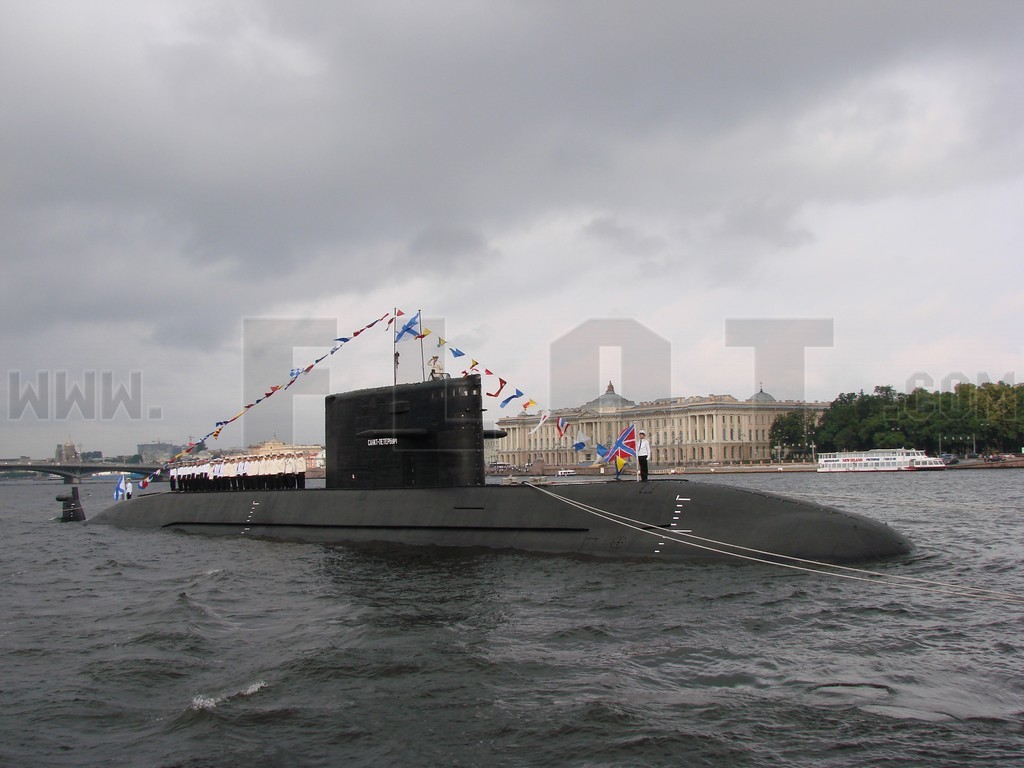
Sankt-Peterburg Submarine in the Bolshaya Neva (photo: http://www.flot.com)

In honor of Navy Day — the 315th anniversary of the Russian Navy’s establishment — here are this week’s sound bites from Navy CINC, Admiral Vladimir Vysotskiy.  RIA Novosti will publish a complete interview with him tomorrow.

Vysotskiy says the Navy expects “not less than eight” proyekt 885 SSNs by 2020.  Some sources maintain the number is six.

Unit 1 Severodvinsk is preparing for sea trials in August, and unit 2 Kazan is expected by 2015.  They’ll have to pick up the pace to get eight by 2020.

Vysotskiy says work on a new destroyer will begin in 2012, and be completed in 2016.  This is the one he suggested might be nuclear-powered.

The CINC’s other comments covered the Black Sea Fleet. 

He claimed the BSF will get six proyekt 636 diesel-electric submarines in the coming years.  Its sole submarine now, proyekt 877 Varshavyanka-class SS Alrosa is currently in the Baltic for repair.

RIA Novosti recalled Vysotskiy’s past comments about obtaining 15 frigates and diesel submarines for the BSF by 2020 in a 60-30 proportion.  He also said a frigate and submarine were specifically laid down for the BSF in 2010, and would be every year henceforth.  He claimed the fleet would be renewed by 2020 through new construction rather than inter-fleet transfers.

Moskovskiy komsomolets and Newsru.com reported on the BSF’s drastic ten-fold decline since 1997.

This week TsAMTO cited a Baltic Fleet press release saying it expects to get the Neustrashimyy-class FF Yaroslav Mudryy, proyekt 20380 Steregushchiy-class FFLs Steregushchiy, Soobrazitelnyy, and Boykiy, proyekt 677 Lada-class SS Sankt-Peterburg, as well as assault ships and other craft.  The BSF may be expecting to get some of these ships as well.

Three-Month Combat Training

Three-and-a-half years after it started phasing in one-year service, the Russian Army’s condensing combat training into three months so it can put draftees in line units for their remaining months.  One wonders what they’ve tried to this point, or if they’re just now addressing the implications of the shortened draft term.

Twelve weeks of basic training is about the norm by world standards for draftee armies.  But the Russians have compressed what they previously taught over a longer period, so the question is how well conscripts absorb, retain, and employ their lessons.

Officially, Russia’s three-month accelerated combat training program is experimental.  Krasnaya zvezda reports, since June, the 19th Independent Motorized Rifle Brigade in North Ossetia, has been trying a new program to take new draftees and turn them into professionals, ready to serve in combat sub-units [подразделения], in three months.

The army daily claims these new conscripts focus exclusively on the combat training course, which now reportedly includes 1.5-2 times more “practical exercises” than in the past.  The course covers 90 days (536 hours).  It retains the traditional first month of individual training, and the last two consist of training and coordination [слаживание] of sections, platoons, and companies (batteries).  The course ends with several days of test exercises, sub-unit combat firings, and company-tactical exercises.

The brigade’s deputy commander says:

“In the new program, theory has been practically thrown out, the stress is on the practical part.  In connection with cutting the conscript service term to one year, the task of preparing, in three months, a coordinated sub-unit, ready to fulfill missions in various conditions, stands before us.”

The choice of the 19th IMRB wasn’t accidental.  As KZ notes, the formation saw action in the five-day war with Georgia.  It has a “reinforced company-tactical group” of BMP-3s fueled for a 500-kilometer roadmarch ready to depart garrison within 30 minutes, according to KZ.

KZ then describes how outsourcing repair and support work has enabled draftees to focus entirely on combat training.

This week, Mil.ru updated the experiment.  It said the brigade is currently finishing platoon coordination and beginning company coordination, which will continue until mid-August.  The Defense Ministry says the Ground Troops’ Main Combat Training Directorate is monitoring the accelerated program.  In late August, it will oversee the company tactical exercises, and determine their capabilities for action under combat conditions.  Conclusions about the three-month combat training program will come in September.

Writing in Nezavisimaya gazeta yesterday, Vladimir Mukhin questions whether it’s possible to train professionals in three months.  He notes the Southern MD was supposed to be 70 percent contractee-manned by now, according to the Defense Ministry old contract service plan.  Parents of green soldiers feel like their sons are serving in a “hot spot,” according to Mukhin.  Conscripts from this formation died in the Georgian conflict.  The onus is on the political leadership, says Mukhin, rather than military commanders to explain why units here aren’t manned with professionals.

Mukhin quotes former Ground Troops’ Chief, General-Colonel Yuriy Bukreyev:

“If a conscript soldier has basic military training, then it’s possible to give him the skills to employ him in combat conditions in the North Caucasus.  I’m giving the same conclusion from the Soviet Afghan experience again, when I headed the staff of the Turkestan Military District.  But then soldiers served two years.  At first, they were in training sub-units, they underwent additional mountain training in special training centers.  Only afterwards, that is when they’d served in the troops a year or more, were they sent to Afghanistan.  Today conditions are a little different.  The conscript soldier’s service term’s been shortened to 12 months.  And this means the intensity of combat training should increase.  The Ground Troops’ Glavokomat is just conducting an experiment in training first-year soldiers to carry out missions under the conditions of an armed conflict.  We’d like to hope that raw soldiers won’t be drawn into resolving such missions.  Professional sub-units would appear more effective here.  But, unfortunately, in our Armed Forces reliable conditions for the mass recruitment of contractees into the troops still haven’t been established.”

Who Will Own VKO (Part II)

Returning to former General-Major Tazekhulakhov’s article in NVO . . . to make VKO an integral organism under unitary leadership and command and control, with personal responsibility for solving the tasks laid on the system, Tazekhulakhov believes it best, in the current Armed Forces structure, to concentrate troops (forces) and VKO system resources in one service or troop branch.

The ex-Deputy Chief of VPVO then reviews five possibilities:

  1. Give VVS PVO (including air defense aviation) to KV, and turn KV into a new branch called VVKO.
  2. Disband KV, give RKO to the VVS and space launch, monitoring, and other supporting structures to RVSN.
  3. Using KV as the base, create a new branch VVKO by including those VVS forces and resources currently in OSK VKO (the old KSpN, Moscow AVVSPVO, Moscow Air Defense District, etc.).
  4. Without transferring or resubordinating any of VVS or KV, establish a Strategic Command of VKO (SK VKO), and designate a commander to whom every MD / OSK, and every PVO, RKO, and REB resource would be subordinate for VKO missions in peace and wartime.
  5. Divide VKO along the existing MD / OSK lines with each of the four commanders responsible for the mission with common command and control exercised by the RF Armed Forces Central Command Post (ЦКП ВС РФ).

Tazekhulakhov says none of these possibilities is ideal.  Currently, VKO elements belong to different services, troop branches, Armed Forces structures, and even civilian departments.  PVO and RKO forces and resources aren’t evenly distributed throughout the RF.  And some are operationally subordinate to regional MD / OSK commanders and others (RKO and REB) to the center.  Triple subordination — administrative, operational, and support — violates one-man command for the VKO system.

Tazekhulakhov says the first three variants ask service or branches to perform missions outside their traditional competence.  Variant four would require agreement on the authorities of the VVS CINC, MD / OSK commanders, and the SK VKO commander.  Variant five makes it hard to find one commander responsible for VKO.

Of all variants, Tazekhulakhov finds variant two best.  It keeps the current integrity of VVS, and cuts one branch and reduces command and control organs.

But he’s found another problem not yet addressed — how to treat operational-tactical PVO and PRO of the MDs and fleets.  For it to operate on the same territory and with the same missions as strategic VKO, reconnaissance and warning information exchange and command and control and REB coordination has to be worked out.  And MD / OSK commanders won’t want to subordinate their forces, plans, and responsibilities to a VKO commander.

Lastly, Tazekhulakhov steps back to look at a bigger picture.  Why develop VKO?  With whom and how is Russia preparing to fight?  He concludes, from all appearances, U.S. missile defense won’t seriously impede Russian strategic nuclear forces, and, to some extent, Moscow has wasted time worrying about it:

“Russians need to stop getting harnessed, it’s time to get moving, and not simply waddle, but race full speed.  The result of our procrastination is obvious:  Russia is still trying through negotiations to find a compromise between its and NATO’s positions on missile defense, under cover of the protracted negotiating process, the American missile defense system in Europe is already approaching very close to Russia’s borders.  Evidently, it doesn’t do to waste time, hope and focus on NATO.  It’s essential to take serious military-political decisions and do what’s needed and useful for Russia, without looking at others.  No one, first and foremost the U.S., will give us anything, especially in the armaments area.  We have to rely only on ourselves.  Russia, undoubtedly, has no other way.”

Latest on Sulim and Premium Pay Extortion

The Tambov military garrison prosecutor has told Kommersant charges have been lodged against Sergey Sidorenko, deputy commander of a unit at the elite Lipetsk pilot training center.  Sidorenko and others allegedly extorted 3 million rubles of premium pay from other officers at Lipetsk since the beginning of 2010.

According to Senior Lieutentant Igor Sulim, who wrote about the situation at Lipetsk in his blog in May, the training center’s chief of staff, Colonel Eduard Kovalskiy and his deputy Sergey Tereshin organized the scheme, and Sidorenko carried it out.  Sulim maintains the entire leadership of the unit [center?] and local law enforcement knew about the extortion racket.

After Sulim went public, investigators substantiated his accusations, and the Defense Ministry reportedly began to check premium pay distribution in other military units.

Last week, Main Military Prosecutor Sergey Fridinskiy acknowledged that extortion in the distribution of supplementary pay in army units is ubiquitous, “beginning in company sub-units and ending with higher staffs.”  He continued:

“Criminal cases on the facts of extortion are being investigated in practically every district and fleet.”  

He also criticized the Air Forces for pressuring the victims:

“Instead of conducting rapid checks and adopting severe measures toward bribe-takers, VVS Glavkomat officials, essentially, began pressuring the personnel for bringing situation out of the shadows.”

For his part, Sulim says:

“The center’s leadership headed by General Aleksandr Kharchevskiy is trying to dissociate itself from this story.  Kharchevskiy, for example, announces he didn’t know anything about extortion from pilots.  At the same time, he tries to sully me, publicly calling me first deranged, then a homosexual.  Meanwhile, they’ve hardly let me fly since May 14, and this means soon essentially I’ll have to learn to fly again.”

During the Defense Ministry’s check for similar problems elsewhere, the only other situation to receive press attention was a case involving some Black Sea Fleet aviation units.  See Komsomolskaya pravda and Novyy region.