Tag Archives: Anatoliy Serdyukov

Serdyukov and Baranets

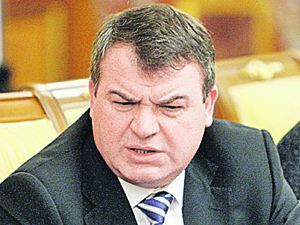
Anatoliy Serdyukov (photo: Vladimir Belengurin)

Komsomolskaya pravda’s Viktor Baranets got to prompt Defense Minister Anatoliy Serdyukov for a few statements on various topics in today’s paper.  It doesn’t seem like he really got to ask questions.

Serdyukov claims all but about 3% of GOZ-2011 has been placed, and 100% advances to the defense sector for 2012 will make for a smooth year of orders and production.  He “dodges the bullet” on not ordering Kalashnikovs.  He returns to the possibility of giving serving officers and contractees money to rent their own apartments, but this never worked well in the past.

Serdyukov says the first phase of military reform involved changing the Armed Forces’ org-shtat (TO&E) structure.  Now, he says, the second phase has begun, and it’s connected with rearming the troops.

On the state defense order (GOZ), Serdyukov says:

“During the formation of the Gosoboronzakaz, we had two issues with the defense sector — the price and quality of armaments.  We got them to open up their production “cost history.”  That is, they showed us everything transparently.  We needed to understand what they were getting and from where.  After long arguments, a compromise was found in the end.  We settled on quality criteria.  The Gosoboronzakaz is almost completely placed.  Of 580 billion rubles a little more than 20 billion was left ‘to settle.’  But we’ve also drawn conclusions from the lessons of this year.  Now the next Gosoboronzakaz will be formed in the Defense Ministry before December with such calculation that they will begin to fulfill it in January.  At the same time, we’re trying to make the Gosoboronzakaz 100% paid in advance to the defense sector.  Not another country in the world has such comfortable conditions for its VPK.”

Serdyukov says the Defense Ministry is still working on MPs, their regs, missions, training, structure, and size.  They’ll be responsible for discipline and order in garrisons and investigations.

The Defense Minister opines that Russia’s Israeli UAVs aren’t bad, but they are looking at Italian ones while domestic development continues.

Serdyukov confirmed that two new factories for producing the S-400 system will be built.  They are designed, and, he hopes, will begin production by 2015.

On tanks, the Defense Minister says they’ve taken the position that they can modernize T-72s to the level of a T-90 or better for 38 million rubles.  He believes it’s cost effective.

On the AK-74, Serdyukov claims they aren’t rejecting it, but they have depots overflowing with 17 million automatic rifles.  He says they’ll be used or modernized, some will be sold, and others transferred to other power ministries.

Serdyukov believes the draft military pay law now in the Duma will raise pensions by 50 or 60 percent.  Active military pay will be as advertised:  a lieutenant is supposed to get 50,000 or more rubles a month.  Contract enlisted will start at 25,000 or more depending on their duties.

Serdyukov hopes the problem of housing for retired servicemen will be concluded in 2013.  Then he can focus on service housing for contractees.  He proposes paying contractees to rent apartments while the Defense Ministry acquires or builds service housing.  “Apartment money” is a possibility but it has to be thought out.
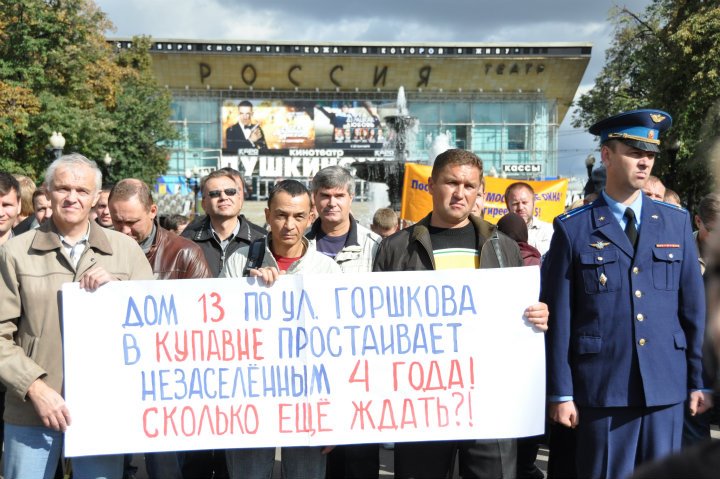
Sunday on Pushkin Square

Waiting to Occupy Finished Apartments in Kupavna (photo: Mikhail Pavlenko)

Sunday’s “Army Against Serdyukov” demonstration took place as planned on Pushkin Square.  About 500 people attended, but organizers hoped for as many as 1,500.  The participants were orderly, and the police presence was light and relaxed compared with more overtly political protests.  Novyye izvestiya claimed there were similar meetings in Arkhangelsk, Murmansk, Severodvinsk, Stavropol, and Samara but the press reported only on protests in the latter city.

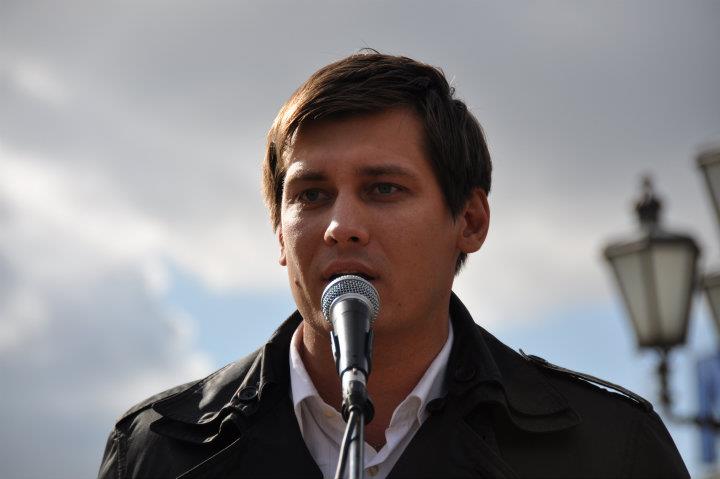
Dmitriy Gudkov used the occasion to publicize the Public Council for the Defense of Legal Rights of Servicemen’s appeal to President Medvedev.  Besides demanding Defense Minister Serdyukov’s resignation, the appeal calls for an end to violations of servicemen’s housing rights and to the collapse of the military education system and defense industry.

Dmitriy Gudkov (photo: Mikhail Pavlenko)

Gudkov told NI:

“We need to unite servicemen who today are dissatisfied with the state of affairs in the army.  There is a failure of all army reform, collapse of the defense sector . . . .  The breakdown of the military housing program.  Two hundred thousand officers’ families around the country who haven’t received apartments.  Military pensioners who today have a pitiful allowance.”

In remarks to Radio Svoboda, he said deceived servicemen may form their own, alternative list of those officers who are still waiting for their promised apartments.

Gudkov also claimed there were attempts to prevent the gathering:

“On the Internet, information was put out that the meeting would occur on Saturday.  Instructions went to all military units that anyone seen at the meeting would be dismissed.  The Defense Ministry did everything to disrupt this action.  But in vain.”

Hero of the Russian Federation, Cosmonaut Sergey Nefedov gave the introductory speech to the crowd on Pushkin Square.

Gudkov gave an account of Sunday’s event on his ЖЖ in which he said the protestors insist on their legal rights, and refuse to be silent although the authorities want to ignore them completely.  He called military reform not reform, but the collapse of the army.  Gudkov said the meeting wasn’t just against Serdyukov, but against all who don’t know how to manage the state in a professional manner, and those who are not up to their duties.  He concludes:

“Demonstrations, meetings – this is only the tip of the iceberg of the people’s agitation.  The number of those who’re ready to go in December to the polls and express their distrust in this government is growing larger.”

The Public Council is considering establishing a tent camp outside the Defense Ministry during the run-up to the elections, according to Gudkov.

Gudkov said television covered Sunday’s meeting, and cameras and microphones were visible in photos, but there were no TV news reports on the event.  There are, however, lots of videos and photos on Mikhail Pavlenko’s ЖЖ.

Two last items deserve mention.  Radio Svoboda talked to a retired Northern Fleet major, a military lawyer, named Igor Chuykov from Murmansk who spoke at Sunday’s anti-Serdyukov rally.  Chuykov described the situation among military men in his city:

“The movement in Murmansk is very serious.  Thanks just to this movement, those who participated in pickets in Murmansk, in Murmansk Oblast are now really getting apartments –those who were dismissed after 2005.  Those dismissed before 2005 are being given [state housing] certificates.  Somehow on these certificates it’s even possible to buy something.  The Kola Peninsula – this could be the only place where there are considerably more military men than MVD.  The smallest conflict between the military and police would lead simply to an uncontrollable escalation of violence.  The authorities quickly understood what this could lead to.  Therefore, the authorities’ priority task now is to pacify families.  People simply have no recourse.  It’s the fault of the state:  it forced people into open acts of disobedience by its own irresponsible, unprofessional actions.”

Radio Svoboda also quoted Viktor Baranets:

“In the army, there are many professionals who understand that military reform is going, to put it mildly, very badly.  Genshtab chief Makarov even attested to this when he honestly admitted at an officers’ assembly that we began military reform without any kind of scientific basis and calculations.  The most important social problem is housing.  They constantly fool the army, constantly change the rules of the game.  Here we need to observe a single very serious point – military men are beginning to organize.  The government must turn attention to this, but it stubbornly doesn’t want to do it.  I have the impression that they either are afraid of criticizing Serdyukov or afraid of openly recognizing that military reform has failed.  And just people who go to the demonstration, who announce their disagreement with Serdyukov’s methods of conducting reform, — they also want to get through to the Kremlin, to the government, to the state, to the Duma so that, in the end, some kind of decision will be made.”

Army Against Serdyukov

To a Wagner soundtrack, the video shows the miserable life of some military, or ex-military, men.

Dmitriy Gudkov and the Public Council for the Defense of the Legal Rights of Servicemen have organized what they believe will be a 1,000-person demonstration against Defense Minister Serdyukov’s reforms for Sunday afternoon on Pushkin Square.  The rally’s advertised as “The Army Against Serdyukov.”

Nakanune.ru provided some sound bites about the protest (although it also gave the wrong day).  The protest’s a reprise of a May 22 demonstration.  Gudkov claims it’s not a party action, and participants will be “average people and their family members.” 

The meeting organizers accuse Serdyukov of causing the collapse of the army, breakdown of the state defense order, genocide of military pensioners, and sabotage of the military housing program as a result of which 200,000 officers and their families remain without apartments.  They further allege that:

“The country’s defense capability level under Serdyukov has declined catastrophically, such that in the long-term it could bring a threat of the loss of Russia’s sovereignty.”

Participants will call on President Medvedev to fire the Defense Minister and his team.

Protests against Serdyukov will also be held in Murmansk, Yekaterinburg, Samara, and Kaliningrad.  The Naval Sailors’ Union, the Initiative Group of the Forum for Servicemen’s Mutual Legal Aid, and Deceived Shareholders from the Defense Ministry (i.e. servicemen whose housing rights have been violated) will join in the meeting.  Nakanune also listed the Airborne Union as a supporting organization.

Gudkov’s an interesting character.  He’s the son of Gennadiy Gudkov, a deputy leader of Just Russia (SR) and Duma member. 

Older Gudkov is Deputy Chairman of the Duma’s Security Committee, and member of Duma commissions overseeing budget expenditures on defense and state security, and legislative support for counteracting corruption.

Younger Gudkov leads the youth wing of SR, and he’s a member of the MVD’s Public Council.  His ЖЖ is here.   The September 15 entry announces the Sunday protest meeting.

It’ll be interesting to see what transpires Sunday — what kind of turnout, what kind of reaction, how much media coverage, etc. 

There’s a clear protest mood in the military, active and retired.  Vlast monitors it, and occasionally sees a need to assuage it. 

Recall the discontent from the VDV last fall over Serdyukov’s alleged high-handed treatment of a professional military officer at Seltsy.

There’s a new spate of promises recently to solve, once and for all, the military’s housing problems.  This time they come against a backdrop of fast-approaching elections and tighter budgets.

Other usual sore points for vlast will be winter heating in remote garrisons, and the ever-present headache of administering a still-large number of semi-derelict military towns (or monotowns) that regions don’t want.

Of course, unexpected sore points can appear too.

The GOZ This Week

Putin at the Conference (photo: RIA Novosti / Aleksey Nikolskiy)

At United Russia’s interregional conference in Cherepovets on Monday, Prime Minister Putin reported on the Defense Ministry’s failure to conclude all its GOZ contracts by his most recent September 1 deadline.  Putin said, despite Defense Minister Serdyukov’s assurances that only OSK contracts need to be finished, agreements with MIT and OAK are still not finalized.

According to RIA Novosti and the stenogram, Putin told the United Russia audience:

“Unfortunately, full agreement between the Defense Ministry and producers by 1 September didn’t happen, as we arranged.  Disagreements continue there in several areas.”

“I want to direct the attention of all sides to this process:  firstly, we have a colossal amount of money being allocated for strengthening the country’s defense capability.  We’ve generally never allocated such money, well, in Soviet times, when they threw everything at the defense sector, there were comparable figures, but in recent history never, — 20 trillion to 2020.  We are constrained in other places – very many – either to stop or cut our expenditures, but we need to do this to guarantee our defense capability.  But we don’t need to absorb these billions and trillions, we need to provide items quantitatively and qualitatively.”

“At the same time, of course, the profitability of enterprises should also be guaranteed.  The obvious fact is a minimum of 15 percent.  It’s necessary to get this profitability so there are resources for development, for worthy wages for the workers.  I hope that soon, in the course of a week, this process will be concluded in shipbuilding, in missiles, and in aviation.”

“In 2012, orders, advances and other payments should be sent in full measure to enterprises not later than March.  I’m counting on this very much.”

Vedomosti’s source close to the Defense Ministry admitted a week won’t be enough to close contracts worth 500 billion rubles with Sevmash and tens of billions with MIT.

Kommersant’s source familiar with the course of negotiations with MIT confirmed that the process isn’t complete.  Another source said a contract for Yak-130 trainers is almost complete, but one for MiG-29K fighters isn’t.  Konstantin Makiyenko told Vedomosti the MiG-29K doesn’t matter since the Kuznetsov aircraft carrier is headed for repairs.

Most striking is Putin’s call, a plea almost, not to “absorb” the GPV’s 20 trillion rubles without supplying the new weapons and equipment the army needs.  He’s well aware the situation could be like water in sand.

Serdyukov’s New First Deputy

Aleksandr Sukhorukov

As rumored in mid-summer, President Medvedev announced today former KGB and FSB officer Aleksandr Sukhorukov, most recently Director of the Federal Service for the Defense Order (Rosoboronzakaz), will be First Deputy Minister of Defense.

According to ITAR-TASS, Defense Minister Serdyukov introduced the 55-year-old Sukhorukov during a working meeting with Medvedev in Stavropol.

Medvedev and Serdyukov noted Sukhorukov will be responsible for arms procurement and the beleaguered state defense order.

He’ll be sitting in the hot seat right away.  Medvedev told him:

“. . . this is a very delicate process:  on one side, you need to understand the realm of the Armed Forces, the field of modern military technology, on the other, you need to build relationships with suppliers correctly.  But it’s not always simple to do, the current history of concluding contracts shows this.” 

RIA Novosti elaborated:

“Last night, RF Prime Minister Vladimir Putin’s deadline for concluding all Gosoboronzakaz-2011 contracts expired.  On Thursday, the media reported that this task was not completed.”

Sukhorukov takes the post vacated by Vladimir Popovkin, who took over the Russian space agency Roskosmos.

Sukhorukov was with Serdyukov at the Federal Tax Service.  He followed the Serdyukov team to the Defense Ministry, becoming Deputy Director of Rosoboronzakaz in mid-2008, and Director a year later.  But he kept a low public profile at that agency.

He was born November 11, 1955 in Kasli, Chelyabinsk Oblast.  He graduated from the Chelyabinsk Higher Tank Command School in 1977, and later a KGB Higher School.  He apparently worked for the KGB in the Armed Forces, retiring as an FSB lieutenant colonel in 1996.   

From 1996 to 2004, he was deputy director, then director for the Finance Ministry’s northwest regional center for hard currency and export control.  He was a deputy director and director of a territorial directorate (probably northwest again) of the Federal Service for Finance-Budget Oversight in 2004-2006. 

In 2006-2007, he worked for then-Federal Tax Service Director Anatoliy Serdyukov as Chief of the Organizational-Inspectors Directorate.

In 2007, Sukhorukov followed Serdyukov to the Defense Ministry as an advisor.  He became Chief (not surprisingly) of its Organizational-Inspectors Directorate.  Serdyukov made reference to this directorate in his 2010 year-ender when he described how he checks on implementation of his policies. 

But, in late 2007, Sukhorukov jumped ship to the government, becoming assistant to then-Prime Minister (and Serdyukov’s father-in-law) Viktor Zubkov, and then Director, Department for Control and Verification of Fulfillment of RF Government Decisions.

In mid-2008, he arrived at Rosoboronzakaz.

You can find bio data here, here, and here.

In the Russian context, Sukhorukov seems like someone who knows how to find out if people are getting things done, and presumably what to do to them if they’re not (shoot them, send them to work in the fresh air, or fire them).  He seems very much a Putin man, an archetypal silovik.

He doesn’t, however, seem like someone who can help people figure out how to get things done.  Perhaps the Defense Ministry could have used someone with not just investigative, accounting, or legal experience, but maybe with an engineering, industrial, scientific, or technical background in the OPK.

It’d be interesting to know what Sukhorukov did in the army / KGB / FSB . . . he might have been a run-of-the-mill osobist, a “special section” guy monitoring some unit’s reliability and loyalty, or helping secure its secrets.  But he might have served in a defense plant, or been detailed to work in anti-corruption efforts.

Unlikely Sacrifice

Writing in Moskovskiy komsomolets, Mikhail Rostovskiy examines the possibility that the government might be shaken up, or ministers turned into political human sacrifices in the runup to the December 4 Duma election.

We’ve been on this topic before when Aleksey Makarkin tiptoed around it, examining only the possibility that Defense Minister Serdyukov or Health and Social Development Minister Tatyana Golikova might be sacrificed to appease angry Russian voters.

About Serdyukov’s chances, Rostovskiy writes:

“Victim No. 4.  They say that Defense Minister Anatoliy Serdyukov is not liked very much by his subordinates.  On the other hand, they value him very much up above.  Here they believe that Serdyukov is achieving what his predecessor Sergey Ivanov couldn’t manage.  They say, for example, that under the current minister the real battle to introduce elementary administrative and financial order in the army began.  Therefore I would rate Anatoliy Serdyukov’s chances of surviving a ritual ministerial sacrifice as high.”

Is Serdyukov better than Ivanov?  Vote here.

Just to round it out, here’s Rostovskiy’s full list, from most to least likely to be sacrificed:

  1. Minister of Education and Science Andrey Fursenko
  2. Minister of Health and Social Development Tatyana Golikova
  3. Minister of Transportation Igor Levitin
  4. Minister of Defense Anatoliy Serdyukov
  5. Minister of Sports Vitaliy Mutko
  6. Minister of Internal Affairs Rashid Nurgaliyev
  7. Minister of Finance Aleksey Kudrin

What issues have brought Serdyukov political heat?

Most recently, the prime minister and government — Deputy PM, VPK Chairman, and Serdyukov predecessor Sergey Ivanov in particular — really want to tag the current defense minister with the GOZ-2011 mess.

The dustup between Serdyukov and the commander of the VDV training center at Seltsy last fall became a political faux pas for Anatoliy Eduardovich.

Last summer’s fires around military bases, and seemingly perpetual ammo dump explosions were and are weak points for the defense minister.

The bottom line is Serdyukov was always and remains part of Team Putin.  He’ll see his fifth anniversary on the job early next year.  What happens to him after the presidential election depends (obviously) on the outcome of the election.  But he will probably find himself with a bigger, better, possibly somewhat less troublesome portfolio.

Latest on GOZ Woes (Part II)

To review this week . . . Prime Minister Putin’s current deadline for completing GOZ contracts is August 31, but it’s unlikely to be met, even by loyal Deputy PM and OSK Board Chairman Igor Sechin.  Deputy Finance Minister Siluanov said Defense Ministry contracts are being made on credits and government-backed financing rather than cash.  Putin said the price tag for GOZ-2011 is 750 billion rubles, but 30 percent of projected procurement still isn’t covered by contracts as the final third of the year begins.

How did the government, Defense Ministry, and OPK arrive at an August 31 deadline that’s unlikely to be met?

The latest round of this year’s GOZ woes started in early July when MIT General Designer Yuriy Solomonov told Kommersant that GOZ-2011 was already broken, and Russia’s strategic missile inventory is not being renewed as necessary.  He said there’s no contract for the RS-24 / Yars ICBM, and the late arrival of money makes it impossible to salvage 2011.

President Dmitriy Medvedev responded by calling Defense Minister Anatoliy Serdyukov on the carpet.  According to RIA Novosti, he told him:

“Sort out the situation.  If there’s information that the state defense order is broken, it’s true, organizational conclusions are needed in connection with those who are responsible for this, regardless of position or rank.”

“If the situation is otherwise, we need to look into those who are sowing panic.  You know how according to law in wartime they dealt with panickers — they shot them.  I’m allowing you to dismiss them, do you hear me?”

RIA Novosti reported Serdyukov’s opinion on the “wild growth” in the price of military products, especially from MIT and Sevmash.  He said MIT is asking 3.9 billion and 5.6 billion rubles respectively for Topol-M and Yars ICBMs.  Serdyukov put GOZ-2011 at 581 billion rubles [different from Putin’s figure!], and added that only 108 billion, or 18.5 percent, was not yet under contract.  He said everything would be done in 10 days.

At virtually the same time, Deputy PM and VPK Chairman, Sergey Ivanov told ITAR-TASS 230 billion rubles were not yet contracted out.  OSK piled on Serdyukov, claiming contracts for 40 percent of the Navy’s share of the GOZ weren’t finalized.

In late July, it looked like Northern Wharf (which reportedly produces 75 percent of Russia’s surface ships, and is not part of OSK) might be made into an example for other “GOZ breakers.”  While prosecutors talked vaguely about the misuse of GOZ money, the shipbuilder’s representatives apparently mounted a vigorous defense, asserting that the enterprise has been right on time, even though it’s underfinanced by the Defense Ministry.

Main Military Prosecutor Sergey Fridinskiy said prosecutors uncovered 1,500 GOZ-related legal violations during the preceding 18 months.  He indicated there were 30 criminal convictions, and state losses amounted to millions of rubles in these cases.  The most egregious example  was the theft of over 260 million rubles given to OSK’s Zvezdochka shipyard to repair Kirov-class CGN Petr Velikiy.  Fridinskiy indicated the enterprise director and his close associates apparently had 40 million of the money in their own names.  Recall Fridinskiy earlier said 20 percent of defense procurement funding is stolen.

According to Rossiyskaya gazeta, Defense Minister Serdyukov claimed he was on the verge of signing contracts with MIT for Topol-M and Yars production.  Once again, he said all contracting would be finished in two weeks.

In mid-August, OSK enterprises Sevmash, Admiralty Wharves, and Zvezdochka said they would soon be forced to cease work unless the Defense Ministry signed contracts with them.  Putin, Sechin, and Serdyukov met and launched a special interdepartmental commission to set prices for the Navy’s remaining 40 billion rubles in GOZ contracts.  And, according to Kommersant, everyone was once again reassured that all contracts would be completed in two weeks.

And it’s not just all ICBMs, ships, and submarines . . . Kommersant wrote that the Defense Ministry eschewed contracts for 24 or more MiG-29K and more than 60 Yak-130 trainers at MAKS-2011.

So what does the mid-year GOZ picture look like? 

The president and prime minister have fumed and set a series of deadlines, not met thus far.  And the defense minister and deputy prime ministers have assured them they would meet each deadline in turn. 

More interesting, and somewhat unnoticed, is the fact that the prime minister and defense minister (among others) seem to be consistently working from different sets of numbers on the size of the GOZ, and how much has been placed under contract.  The GOZ hasn’t captured this kind of leadership attention at any time in the past 20 years.

Producers are being honest when they say late state contracts mean they can’t do anything (or at least what the Defense Ministry wants them to) in what remains of the year.

Picking up the pieces of GOZ-2011, and trying to put GOZ-2012 on a better footing will occupy the rest of this year.

Lost in everything is what will the Russian military get eventually by way of new hardware, and when will they get it?  And how good will it be?

Off With Their Pogonies!

Friday's Security Council Session

Dmitriy Medvedev’s asked again for the heads (or pogonies) of the guilty.  A couple weeks after his government delivered several of those allegedly responsible for breaking the GOZ, he’s ordered Defense Minister Serdyukov to tear the pogonies (officer’s shoulderboards or погоны) off those to blame for massive munitions depot explosions in Udmurtia and Bashkortostan.

It is, of course, quite a presidential thing to do.

Let’s look at how the fairly one-sided conversation went.

In the published opening moments of Friday’s Security Council session at Gorki, Medvedev had to forego mentioning anything about the G8, missile defense, and Libya in order to focus instead on the depot explosions:

“. . . I would like to turn the Defense Minister’s attention to the fact that we are for the second time recently experiencing ‘doomsday’:  shells exploding, there are injured, missing.  We conducted a special meeting on this issue the year before last I think.”

“Afterwards the situation was on the whole, in my view, under control:  we succeeded in arranging the work of supervisory structures, naturally, after dismissing a whole row of Defense Ministry colleagues.  But everything’s come loose again, some problems have arisen again.”

“Two times — this is already systemic, Anatoliy Eduardovich.  Prepare a proposal for me on who should answer for this and how.  They still don’t understand well — for two years everything was OK, — this means we have to take somebody’s shoulderboards off again.”

“Conduct an investigation.  Naturally, the Investigative Committee [under the General Prosecutor] and other units [FSB] are conducting an independent investigation, and together present me with proposals and organizational conclusions.”

For its part, the Defense Ministry insists it’s not being hasty.  Its spokesman told ITAR-TASS:

“Aiming for a full and objective investigation of the circumstances which have occurred in the TsVO, a Defense Ministry commission under the leadership of Deputy Chief of the RF VS General Staff, General-Colonel Valeriy Gerasimov has been sent.” 

“Based on the results of the conduct of the entire complex of verification measures by the military department’s commission jointly with investigative organ representatives and the military prosecutor, the causes of what happened will be established and the responsibility of officials will be determined.  Only after the checks are finished will concrete decisions, including personnel ones, regarding the guilty be adopted.”

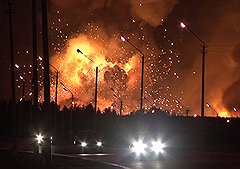
Explosions at the 102nd Arsenal (photo: NTV)

Of course, today’s papers were full of speculation about who might get the blame and the boot for these disasters.  But, as usual, it’s not likely any dismissals will reach highly-placed officers and officials who are truly responsible for the sloppy, breakneck campaign to destroy Russia’s massive stockpiles of old shells and ammunition.

There’s lots more interesting commentary relevant to these most recent arsenal explosions.  Unfortunately, your patience will be required.

The Good, the Bad, Etc.

PR firm Р. И. М. Porter Novelli has just completed the first-ever rating of government ministers using comments from Russian-language blogs, social networking sites, and discussion forums.  Gazeta.ru and Argumenty i fakty covered this electronic beauty contest.  However, the firm’s press-release on its work wasn’t posted for first-hand examination.

The rating puts Finance Minister Kudrin, Emergency Situations Minister Shoygu, and Transport Minister Levitin at 1-2-3 in “popularity,” while Kudrin, Foreign Minister Lavrov, and Interior Minister Nurgaliyev are said to be tops in sheer mentions.

The firm also generated a rating of “good” and “bad” ministers.  Defense Minister Anatoliy Serdyukov, Economic Development Minister Nabiullina, and Nurgaliyev head the so-called “white” list.

However, Nurgaliyev, Serdyukov, and Kudrin are also 1-2-3 on the “black” list of those most vilified on Ru.net.  Health and Social Development Minister Golikova and Education Minister Fursenko are No. 6 and 7 on the “black” list.

For a traditional monthly opinion poll on what Russians think about top members of the government, check out VTsIOM’s monthly poll.  You get a different picture here.  For example, routinely about a quarter of the people are up on Serdyukov, a quarter are down, and half are unchanged.  You can compare Nurgaliyev’s one-third, one-third, and one-third, or look at unpopular Fursenko’s generally negative rating.

Of course, the polling is very different from the PR firm’s rating.  Internet penetration in Russia continues to grow; maybe 50 percent of Russians under 35 use the Internet every day or almost every day. 

All this is just more data in the mix on how Russians (in this case, ones connected to and savvy about the Internet) regard Serdyukov and his military reforms.

Could Serdyukov Go?

Svpressa.ru asked yesterday if it’s possible Defense Minister Anatoliy Serdyukov might be dismissed in the runup to the presidential election.

It asked political analyst Aleksey Makarkin if any ministers might be dismissed to appease angry voters.  Svpressa noted the Kremlin has something of a tradition of firing some high-ranking officials to garner the electorate’s good will.  The media outlet asked him which current ministers might be sacrificed.

Makarkin answered:

“Society is pretty calmly inclined toward the current ministers.  But the people and the elite have different irritants.  If, let’s say, in the elite, great attention is given the role of Deputy Prime Minister Igor Sechin, then the populace is poorly informed about what he’s doing.  It happens that there’s what they write in the business press, and there’s what they show on television.  And the public, on the whole, watches television.”

“I think if ministerial dismissals happen, they will be connected not with an allegeric reaction among the people.  There are ministers that have complicated relations with the bureaucratic structures they direct.  These relations have formed in the course not of decades, but of centuries.  Now problems are notable in two such bureaucracies.”

“The first is the Defense Ministry which from the very beginning was very critical of Anatoliy Serdyukov — a strictly civilian person without a general’s rank.  The second is the Ministry of Health and Social Development.  It’s true the situation there is somewhat different.  It wasn’t initially negative for Tatyana Golikova.  But she isn’t a doctor, and she’s running up against a sufficiently cohesive medical community.”

“The difference [between Serdyukov’s and Golikova’s situations] is that Serdyukov has military men as his subordinates.  They aren’t inclined toward opposition demonstrations, and military retirees don’t have real influence on army processes.  There was the situation when Serdyukov had a conflict with the VDV Academy in Ryazan.  But General-Lieutenant Vladimir Shamanov, a well-known army figure, thought it best not to exacerbate the affair — the brakes were quickly put on the conflict.”

“Of course, internal dissatisfaction with Serdyukov is strong in the military.  Whereas at first this was dissatisfaction with the minister’s persona itself, the details of his biography (Serdyukov was once in the furniture business), but later with his activity in seriously reforming the army (that is the work to which they assigned Serdyukov).”

“Yes, it’s possible to recall the army reform under Aleksandr II — one of the greatest reforms of that time, together with freeing the serfs.  Then Milyutin’s military reform was also met very critically by a significant part of the military corporation.  They accused him of being a professor who didn’t have sufficient military experience.  And his accusers were famous combat generals . . .”

“Serdyukov’s situation is more complex, because he’s an outsider.  Naturally, the reforms he’s conducting — cutting the army as a whole, cutting generals, restructuring the military district system, taking the shoulderboards off some representatives of the military corporation, whose duties civilians can fulfill — are causing serious disapproval.”

It’s interesting to hear a purely political perspective on where Serdyukov and the Defense Ministry stand.  But it seems unlikely the Defense Minister would be cut loose when this would be a more public admission of failure than the recent reversal of several of his policies.  Serdyukov is more likely to be moved aside under cover of an ostensible elevation.

Makarkin’s right when he points out that army problems almost exclusively concern and affect the military caste.  They are routinely low on the list of worries of average Russians.   

But Makarkin shouldn’t dismiss the significance of unhappiness among military veterans and retirees.  True, they don’t necessarily have influence.  Their attitudes toward defense policymaking roughly mirror the moods of active duty military men who can’t attend political demonstrations or speak out in public.  Most Moscow commentators, like Makarkin, have probably gotten used to not pausing long to ponder what Russian military men think about politics.