Tag Archives: Anatoliy Serdyukov

Deputy Defense Minister Shevtsova

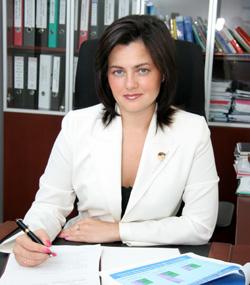
Tatyana Shevtsova at the FNS

Last Friday, Tatyana Shevtsova became the newest deputy defense minister – the ninth overall, seventh civilian, second female.  By all accounts, Shevtsova will oversee and audit Defense Ministry spending and other activities.  Kommersant calls her an ‘oversight and monitoring specialist.’  The Defense Ministry’s spokesman has said as much, according to Vedomosti (read it in Moscow Times as well).  Shevtsova’s another member of Defense Minister Serdyukov’s former team at the Federal Tax Service (FNS or ФНС).  Kommersant describes her as a ‘trusted individual’ who will help Serdyukov supervise all but the Defense Ministry’s purely military functions.  In particular, several commentators believe Shevtsova will track outsourced service and support activities paid for in the state defense order (GOZ).

The 41-year-old Shevtsova was born in Kozelsk, Kaluga Oblast, and graduated from the Leningrad Financial-Economic Institute in 1991.  She’s a candidate of economic sciences (Ph.D.). 

She started in the tax service in 1991 as an inspector in the central rayon of St. Petersburg, eventually heading the tax service’s St. Petersburg directorate.  Kommersant reminds that Serdyukov was a deputy director in the St. Petersburg directorate during Shevtsova’s time there in the early 2000s. 

Shevtsova went to Moscow to head the tax service’s large taxpayer department in early 2004.  In mid-2004, Serdyukov became Director of the FNS, and Shevtsova became one of his deputies. 

Shevtsova stayed at the tax service under Mikhail Mokretsov after Serdyukov left for the Defense Ministry in early 2007.  She was in charge of the oversight directorate and all nine inter-regional inspectorates for large taxpayers.

When Mokretsov and others members of Serdyukov’s FNS team departed for the Defense Ministry in mid-2010, Shevtsova did likewise, becoming an advisor.  According to one official who spoke to Kommersant, she spent the last few months ‘studying the situation’ in the Defense Ministry.

A former Defense Ministry official told Vedomosti Shevtsova is “a talented economist as well as an exacting official, whose subordinates at the Federal Tax Service were very afraid of her.”  She reportedly will turn ten Defense Ministry oversight bodies into a system.

Kommersant said Shevtsova will direct oversight organs for administrative, organizational, and financial activities as well as military housing.  The paper’s source says this could translate into oversight over everything except military command and control and operations.  The ninth deputy minister will reportedly gain some responsibilities once discharged by the chiefs of the ministry’s apparatus, Rear Services, and Housing and Construction Service.

Radio Svoboda was kind enough to interview Aleksandr Golts who concluded:

“It’s more or less obvious Anatoliy Eduardovich Serdyukov rapidly gathers his team in those areas important to him.  As we know, at present a so-called second civilian branch of the Defense Ministry is being formed.  Operational troop command and control, combat training remain with the Genshtab.  At the same time, a very strong area which will withdraw from the ministry a great number of functions connected with service and support of all Defense Ministry units and formations is being formed.  This is very complex work in the realm of the state defense order and the like.  Evidently, Ms. Shevtsova will work in this area.”

 Asked about her first steps, Golts commented:

 “If there will be first steps, we haven’t found out anything about them.  The Defense Ministry very precisely hides the most important directions of its activity from any public scrutiny.  Everything happens very quietly.”

Radio Svoboda also asked Viktor Baranets about ‘civilianization’ and the appointment of a reported 50 women to high posts under Serdyukov:

“They are already sarcastically joking  in the army about the ‘feminization’ of the Defense Ministry leadership.  A large number of women who’ve appeared in key Defense Ministry posts, at various times crossed paths with Serdyukov, and with Putin, and with Medvedev.  Of course, they’re Petersburg natives . . . .  There are unofficial reports that [Shevtsova] actively assisted Serdyukov in destroying Khodorkovskiy’s empire.”

Baranets’ sources in the Defense Ministry also say Shevtsova will be responsible for large sums of service and support funding being directed to contractors.  His general and colonel friends joke:

“We only have one vacant post left – deputy defense minister for corruption.  Because all the other jobs are filled.”

 Or anti-corruption one supposes . . . .

Igor Korotchenko told Vedomosti the Defense Ministry’s growing civilian component is designed to supervise the generals’ spending and accounting, especially in the GOZ.  Ruslan Pukhov calls the ‘invasion’ of former tax officials perfectly normal since Western defense ministries are full of civilian auditors who scrutinize massive military budgets.
President’s Tough Talk to Defense Minister Serdyukov

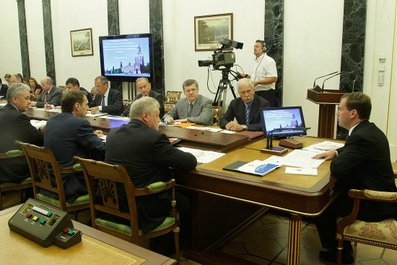
Medvedev at Security Council Meeting

Let’s look at President Dmitriy Medvedev’s criticism of the Navy and the Defense Ministry, his warnings and dismissals of some Navy officers.  It looks somewhat like a script torn from Vladimir Putin’s ‘tough guy’ handbook. 

Kommersant recounted the details of what sparked the President’s ire.  On 29 July, a fire burned the 2512th Central Aviation-Equipment Base of Naval Aviation and Air Defense near Kolomna, several dozen kilometers southeast of Moscow.  The Prosecutor’s Investigative Committee (SK) said the blaze destroyed the staff headquarters, finance unit, club, two bays of vehicle parking, 13 warehouses with various items of aviation equipment, and 17 open equipment storage stands with vehicles on them. 

Medvedev addressed yesterday’s Security Council meeting: 

“I instructed the Defense Ministry to take part in the firefighting effort and help to protect the civilian population, but sadly, in a number of cases, the ministry has proved unable to protect itself.  A fire took place in Moscow Oblast that has caused very serious damage.  The ministry has already carried out a preliminary internal investigation, and the investigation will continue of course.  The evidence so far indicates that this is quite simply a case of neglect of duty and criminal negligence, when personnel failed to bring under control a fire that was not spreading particularly fast, and no one even knew where the base’s commanders had gone.  I have therefore taken the following decision.”      

“Regarding the Navy’s senior command:  Navy CINC Admiral Vysotskiy has been warned about not fulfilling his duties; Chief of the Navy Main Staff and First Deputy CINC  Tatarinov has been warned about not fulfilling his duties; Deputy Chief of Navy Rear Services Sergeyev is dismissed; Chief of Naval Aviation Kuklev is dismissed; Deputy Chief of Naval Aviation Colonel Rasskazov is dismissed; Acting Deputy Chief of Naval Aviation Rear Services Monakov is dismissed; the chief of base 2512 is dismissed.”  

“I am also instructing the Defense Ministry to dismiss a number of other officers and personnel for disciplinary violations.  If anything similar happens in other places and other departments I will do exactly the same again, and without the slightest regret.” 

After discussing the fire situation with other ministers, Medvedev turned back to Defense Minister Serdyukov later in the meeting: 

“Now the Defense Ministry.  I already announced certain decisions.  The Minister needs to take everything under direct control.  Conduct a meeting today with the Ministry’s leadership and say that, if anything else like this burns, everyone will answer for it.” 

“Are there any concerns about the current situation?” 

Serdyukov responded saying plans have been made, operational groups established at all command levels.  Personnel and equipment have been put at the disposal of MChS and regional authorities.  And he noted that Deputy Defense Minister, General-Colonel Dmitriy Bulgakov is his point man for the fire emergency. 

Medvedev chided Serdyukov because the Vladimir Oblast governor had to go to the Defense Ministry for help instead of suitably empowered local commanders. 

Serdyukov said ‘corresponding’ orders have gone to all commanders and garrisons.  He continued with the Defense Ministry’s support of MChS — 11,000 servicemen, thousands of pieces of equipment, 33 kilometers of water pipelines laid in four rayons.  After Bulgakov’s visit to the Federal Nuclear Research Center in Sarov yesterday, another two battalions and special equipment were allocated to efforts there.  Serdyukov said another 28,000 troops can be brought into firefighting in the Central Federal District within 3-12 days. 

Serdyukov concluded: 

“We are taking all steps in full measure, we reinforced all facilities (there are 164 of them, but in immediate areas where there are fires there are 22) behind every responsible commander.  We are conducting all measures there:  increased volumes of water reserves for extinguishing fires, equipment has been brought in, extra personnel, everything literally transferred into a barracks condition, therefore all necessary steps for this, in fact, have been accomplished.  Therefore I submit that this sad incident that happened at base 2512 will not be repeated.” 

Kommersant helped out with a full run-down on the ranks and names of the lesser known Navy officers:  Rear-Admiral Sergey Sergeyev, General-Major Nikolay Kuklev, Colonel Sergey Rasskazov, Colonel Sergey Monakov, and Base Chief Colonel Viktor Biront. 

RIA Novosti covered Serdyukov’s firing of other officers at the base.  They included:  Deputy Base Chief Major R. Gidayatov; Deputy Chief Main Engineer Lieutenant Colonel V. Marchenko; Support and Security Company Commander Major A. Yermolov; Chief of the Material-Technical Support Department V. Karandak; and Chief of the 7th Storage Department V. Melsisidenkov. 

Today the SK said a criminal negligence case has been initiated.  Gazeta ru said, per usual Russian practice, top officials have blamed lower-ranking ones, in this case Navy officers, allowing the ‘untouchables’ to demonstrate their toughness and avoid responsibility.  Kommersant noted that the warnings for Vysotskiy and Tatarinov are just a step from dismissal.  But history shows other general and flag officers have gotten such warnings and still moved forward in their careers. 

Gzt.ru broached the subject of whether this could provide Medvedev an occasion to purge the Defense Ministry and fill it with his ‘own people.’ Konstantin Sivkov and Aleksandr Konovalov agree that he could use this opportunity.  But one has to ask, does this make sense in the scheme of tandem politics?  Medvedev has changed few in the cast inherited from Putin, and he’s very unlikely to start with a stolid Team Putin guy like Serdyukov.  Especially when he appears to be the first man to make some real headway in fixing the post-Soviet military.

Disappearing Deputy Defense Minister Portfolios

Or who will answer for what?

On Tuesday, Kommersant and Rossiyskaya gazeta described, even if they can’t explain, Deputy Defense Minister portfolio changes.  The shuffling began in early July, when Grigoriy Naginskiy was ‘freed’ from his responsibilities as Chief of Housing and Construction but remained a Deputy Defense Minister.

According to a decree known, but not published, Medvedev removed General-Colonel Dmitriy Bulgakov from his post as Chief of Rear Services, while retaining him as a Deputy Defense Minister without specific duties.  It’s widely believed, of course, Bulgakov has taken charge of a new Material-Technical Support (MTO) empire that will encompass not only logistics but also arms and equipment supplies.

For his part, Defense Ministry Apparatus Chief Mikhail Mokretsov formally became a Deputy Defense Minister (no longer holding just informal ‘Deputy Minister status’).

Kommersant points out there are still eight Deputy Ministers (six are civilians).  A Defense Ministry source told the paper, however, that Bulgakov might be civilianized.  And his MTO organization will be part of the Defense Ministry’s ‘civilian component’ as opposed to its ‘military component.’  Kommersant says the ‘military component’ (planning and operational troop command and control) will just be the General Staff when the current Defense Ministry reorganization is complete.

Bulgakov has apparently indicated that MTO will have a planning and coordination department, a resource and transportation support department, Main Automotive-Armor Directorate (GABTU), and also repair-refurbishment and metrological directorates.  As announced elsewhere, ten new MTO brigades are to be established in the four new OSKs.  Recall that, in the same presidential decree on Naginskiy, Bulgakov’s rear services chief of staff Sergey Zhirov became Chief of the Planning and Coordination Department (read staff).

One should really look at Mil.ru’s ‘Leadership Structure’ page here.  In it, you’ll see Vera Chistova retains her clear responsibility for finance-economic work.  Bulgakov’s biography notes he became simply Deputy Defense Minister in July.  Naginskiy’s contains no similar notation though it could.  Then comes the oft-forgotten Dmitriy Chushkin who followed Defense Minister Serdyukov from the Federal Tax Service in late 2008.  He has no portfolio spelled out in his title, but his bio reads:

“Responsible for forming and conducting the Defense Ministry’s united military-technical policy in the information and telecommunications technology area which aims to increase the effectiveness of the command and control system, as well as supporting and developing its foundations.”

Mokretsov’s bio has a note that he added Deputy Defense Minister to his title in July.

The ultimate plan behind these moves isn’t clear yet.  But it does seem to go back to late June’s replacement of Kolmakov with Popovkin in one of the Defense Ministry’s two First Deputy slots.  More support functions were and are being consolidated under civilians, while purely military training, planning, and operations may now be more solidly under General Staff Chief, First Deputy Defense Minister Nikolay Makarov.

Medvedev Opens Discussion on Conscription Changes

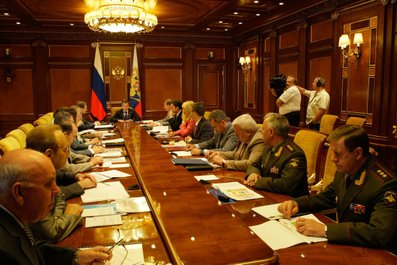
Presidential Meeting on Conscription (photo: Kremlin.ru)

Talk of military conscription changes has swirled in recent months.  Many potential changes have been attributed to General Staff Chief Makarov or his deputy, GOMU Chief Vasiliy Smirnov.  

While they talked about extending the draft age to 30, or tightening deferments, Defense Minister Serdyukov played ‘good cop,’ launching initiatives to ‘humanize’ military service, and make more men willing to serve.

In the last week, the press has published favorable reports on the just-concluded spring draft campaign.  But, meeting with PA officials and ministers in Gorki yesterday, President Medvedev sounded a different note, indicating that a deeper look at Russia’s military manpower resources and policies is needed. 

The meeting included relevant ministers, but not Prime Minister Putin.  Along with Makarov and Smirnov, Defense Minister Serdyukov and ROSTO / DOSAAF Chief Sergey Mayev attended.  Smirnov appears in uniform (bottom right of the picture), though it’s been thought he retired and put on civilian clothes.  He’s already 60, so he’s beyond the age limit for a general-colonel.  He’s served in the General Staff since 1982.  He was a GOMU directorate chief in the mid-1990s, then Deputy Chief, and Chief since August 2002.  Few Russian military officials should know their issues as well as Smirnov.

The key points in Medvedev’s meeting kickoff are that (a) Armed Forces’ manpower requirements are not being met; (b) no decisions on conscription changes have yet been taken; and (c) the public is supposed to get at least some kind of input on the issue.

Kremlin.ru’s coverage of the beginning of the meeting follows.

“Dmitriy Medvedev spoke of the need to conduct a rigorous analysis of the situation with military conscription and draw up proposals for its improvement.”

* * *

“D. MEDVEDEV:  Good day, colleagues!”

“We have an important issue for the life of our state — the issue of military conscription.  It’s clear that the overall effectiveness of the state, and ensuring security in the country depends on how we man our Armed Forces, and our law enforcement organs.”

“It’s clear that now there are complications:  army and navy requirements for conscripts are not being fully met.  This is connected to the demographic component, to demographic problems; this is connected to the health problems of young people.  All these issues have been discussed more than once both in meetings, and in the mass media.  We have to talk conceptually about what to do next.”

“There’s a range of proposals.  I want to say right off that all these proposals are still just proposals.  They need careful analysis.  Not a single one has any kind of preliminary approval, and we need to discuss them.”

“At first we’ll discuss them with the participation of the leadership of the Government, Presidential Administration, Armed Forces leaders, law enforcement structures, and special services.  Subsequent to such a type of decision all the same it needs to be discussed with the broader circle of society.  It’s essential to take public opinion into account in any case  because this concerns a sufficiently significant number of people in our country.”

Bulava SLBM Test Next Month

Bulava

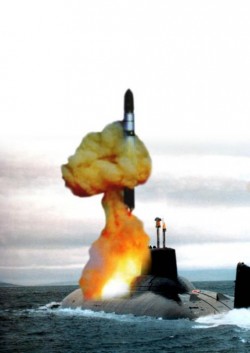
This afternoon a Navy Main Staff source told Interfaks the next Bulava SLBM test will occur in mid-August from modified proyekt 941 Akula (Typhoon-class) SSBN TK-208 Dmitriy Donskoy.  This is earlier than previously announced.  The Navy source also claimed that the new proyekt 955 SSBN Yuriy Dolgorukiy will be the launch platform for one of this year’s three planned Bulava tests.  He also reiterated that Russian military men are committed to Bulava, seeing no alternative to it as the Navy’s nuclear deterrent for the future.

In May, Defense Minister Serdyukov said three identical Bulava missiles are being assembled in the hope of discovering a common flaw in their construction.  Serdyukov said the next Bulava launch wouldn’t occur before November at the earliest.

Kramnik on Vostok-2010 and Military Reform

This is complete finally.

Ilya Kramnik’s RIA Novosti piece about the exercise has been quoted by others, but it hasn’t gotten attention as a whole on its own.

So what does Kramnik think?  He cites Makiyenko to the effect that Vostok-2010 showed that reform has been positive for the army, but there are, of course, problems.  Troops aren’t uniformly well-trained, and the failure of contract service has really hurt.  But Kramnik gives Defense Minister Serdyukov a lot of credit, on the order of being a 21st century Milyutin.  But back to the problems again.  Things like contract service, tension over officer cuts and premium pay, military education cuts, and the failure to deliver new weapons have to be fixed.  But Kramnik believes Serdyukov is the kind of guy who’ll go back and fix what he didn’t get right or get done.  Then Kramnik shifts to the type of conflict the military reform is preparing the Russian Army to fight.  Obviously [?] not a nuclear one, but rather, again turning to Makiyenko, a Central Asian local war scenario that might threaten the RF’s internal stability.  The conclusion is that, if reform stays on track and occurs quickly, the army will be able to meet this challenge.  Some, however, might well argue that even a properly and rapidly reformed Russian Army might not be enough to contain and damp down the kind of conflagration Makiyenko describes.  Finally, Kramnik concludes that even the U.S. front isn’t secure; an American regime in 2012 or 2016 might take to renewed active support of new ‘color revolutions’ in Moscow’s back (or front) yard.

Here’s a verbatim text:

“The official results of the just ended ‘Vostok-2010’ exercise are still being reckoned, and this will be done by the Defense Ministry.  Meanwhile, it’s already possible to make some conclusions.” 

“‘Vostok-2010’ was the largest of all in the post-Soviet period of Russian history.  More than 20 thousand men, 75 aircraft, 40 combat and auxiliary ships took part on the ground, in the air, and at sea in maneuvers conducted from Altay Kray to Vladivostok.”

“The aim of the exercise was to check the three-level command structure — operational-strategic command – operational command – brigade, and other new elements in the Armed Forces command and control and support system, and to uncover deficiencies needing correction.  An expert of the Russian Center for the Analysis of Strategies and Technologies Konstantin Makiyenko expressed his opinion on the recent maneuvers:  ‘The recent maneuvers fully refuted the propagated myth about how the army is being destroyed as a result of the actions of the current Defense Ministry leadership.  It’s obvious the army is alive and developing.  Units participating in the exercise demonstrated their combat capability, despite the fact that they are not in the ranks of the best military districts, and scarcely armed with the most modern equipment.'”

“‘It’s especially worth focusing on the good morale of the officer personnel — it’s not possible to speak of general enthusiasm, of course, but I didn’t see dim eyes among the officers.  As a group, they are interested in the success of the current reform and hope for its success.'”

“While agreeing with this point of view, one has to note that the situation with soldiers looks a little different, both RIA Novosti’s reviewer [Kramnik] and Konstantin Makiyenko have also noted this.  Very much depends on the branch of troops and the basic training of the soldiers themselves.  Contract-servicemen in a ‘Tochka-U’ operational-tactical missile launch battery look and are trained much better than conscript-soldiers in motorized rifle units.  In the words of motorized rifle officers up to the battalion commander level, the reduction in the number of contractees has negatively affected platoon and company training.  Ideally, the service term of a specialist-soldier (mechanic-driver, weapons system operator, etc.) needs to be three years, that is achievable only on the contract manning principle for these positions.”

“Speaking about the attainability of the announced goals of the reform, one can say the following:   the will of the military leadership which certainly exists, is the main component of success, a firm understanding of the goal is also obvious, and the possession of authority — it’s not possible to doubt this.  As a result, the current Defense Ministry leadership needs only time to realize its ideas.  Overall, the military reform being conducted is the most significant event of Russian history in the last ten years — since the suppression of the separatist rebellion in the North Caucasus.  The Serdyukov-Makarov reform in the military sphere is the most radical and deepest since the time of Mikhail Frunze’s reforms in the 1920s, if not since Dmitriy Milyutin in the 1860s and 1870s.”

“As proof, it’s possible to note the fact that the Defense Ministry leadership is constantly searching and ready to correct those steps which, when checked, turn out to be incorrect or unattainable in real political-economic conditions.  So, the current principles of manning the army will undergo a serious correction:  it’s obvious that neither the organization of contract service, nor, even more, the existing format of conscript service corresponds to the demands of the time.”

“Evaluating the correspondence of the Defense Ministry leadership to its missions, it’s possible to say, that at present Russia has the most appropriate military leadership since the collapse of the USSR.  At the same time, it’s obvious that the radicalism of the reform, the compressed time of its implementation, unavoidable resistance in the environment and hard economic conditions didn’t allow for avoiding a large number of mistakes and excesses.  Among the most fundamental failures it’s possible to name the collapse of the army’s transition to the contract manning principle, serious social tension arising in connection with the rapid reduction of officer personnel, the ambiguous situation with the scale of servicemen’s complaints after the introduction of the differential pay system [premium pay or Serdyukov’s Order No. 400?], the hurried and not completely thought out reform of military education and many, many other things.  It’s  particularly worth focusing on the implementation of the state armaments programs which fail one after another, not being executed in a significant part.  As a result, the lag of Russia’s Armed Forces behind the most developed countries in the level of  technical equipping continues to grow such that in conditions of a quantitative lag it could become very dangerous.  All these mistakes have to be corrected, since they impact on rudiments of the army’s combat capability.”

“For what type of wars does Russia’s new army need to prepare?  Obviously, the time of long wars between the great powers has gone into the past — nuclear weapons haven’t left chances for such a development of events.  The most probable type of conflict in which the Russian Army will be involved is a local conflict on Russia’s borders and the territory of the former USSR, in the course of which there could be clashes with the most varied enemy:  from a regular army to many bandit formations and terrorist groups.”

“In Konstantin Makiyenko’s opinion, Central Asia presents the greatest danger in the future of a possible hot conflict with Russia’s direct participation:  ‘The U.S. and NATO, obviously, are less and less controlling the Afghanistan situation, and it’s not excluded that in the foreseeable future they may have to abandon this country.  The return to power in Afghanistan of the ‘Taliban’ movement looks most realistic in the event of such a development of events.  The arrival of Islamic radicals in power would unavoidably be a catalyst for conflicts on the territory of former Soviet republics of the region already riven by contradictions.  Weak authoritarian regimes in Tajikistan, Turkmenistan and Uzbekistan, not to mention what’s become the ‘failed government’ in Kyrgyzstan, could be easy prey for the Taliban.  As a result, Russia might be forced to consider the likelihood of a large Asian conflagration which it would have to prevent, or if it didn’t succeed — extinguish, at a minimum with the aim of preserving its own internal stability.  One very much wants to believe that the reform will bear fruit before the described situation becomes a reality.'”

“Besides the described scenario it follows to study also the probability of another development of events:  as experience has shown, on the territory of former USSR republics, the rise of openly anti-Russian regimes with external support at their disposal can’t be excluded.  For today, such a situation is a low probability due to the fact that the current administration in the U.S. — the main sponsor of ‘colored revolutions,’ is clearly not inclined to continue the policy of George Bush.  However by 2012, if President Obama loses the election, the situation could change, and this risk is even greater in 2016 when the administration will change in any case.  Meanwhile, you have to note that even the Democrats remaining in power in the U.S. is not a guarantee of a peaceful life:  Obama’s point of view on a coexistence format with Russia is hardly shared by all his fellow party members.  In the worst case, a return to the next variant of Cold War and new spiral of the arms race isn’t excluded.”

“The coming decade isn’t promising Russia an easy life.  The success of military reform is all the more important.”

There Will Be Professionals, But Later

In Thursday’s Vedomosti, Aleksey Nikolskiy wrote about Defense Minister Serdyukov’s remarks on contract service to the Federation Council.  Serdyukov and General Staff Chief Makarov have cited different figures on the current number of contractees (150,000 vs. 190,000), but agree they’ll be cut.  Professionals will come not only later, but in a smaller numbers.  And contractees will occupy only certain duties.

Nikolskiy cites a figure of only 50,000 contractees signed on during Russia’s failed 2003-2007 attempt to set up a professional enlisted force.

A future smaller number of contract NCOs could receive pay equivalent to that of junior officers.  Except that junior officer pay is supposed to increase dramatically toward 2012 under the new pay system.

According to Nikolskiy’s interlocutors, a new table of organization will soon spell out exactly where contractees will serve, i.e. there will reportedly be few driver-mechanic contractees, while the number of senior NCO billets will increase.

While contract soldiers decrease, how will Moscow manage its commitment to keep conscripts out of ‘hot spots’ (i.e. potential combat zones)?  As recently as April, the Defense Ministry had to reassure the public it had no intention of stationing draftees in Chechnya.

Here’s Nikolskiy verbatim:

“In the long run, contractees in the army will increase from 150,000 to 250,000, but first they will cut them to pick the best and pay them more.”

“Defense Minister Anatoliy Serdyukov told reporters in the Federation Council yesterday there are no plans to abandon contractee servicemen and their number in the future will increase to 200,000-250,000. The day before in the defense committee of the upper chamber, the Genshtab chief Nikolay Makarov said the number of contractees will be significantly reduced compared with the current 190,000.  According to him, contractees will occupy only duties in the Navy, Air Forces and Air Defense requiring good professional training, and also in permanent readiness units.  Only conscript soldiers will serve in the remaining posts.”

“An officer from the Defense Ministry central apparatus explains that Serdyukov’s and Makarov’s statements don’t contradict one another.  In the long run, depending on developing financial conditions, the number of contractees will grow, but first they will reduce them to get rid of ballast which got into these posts during the first attempt at professionalization of the army.”

“In 2003 the FTsP “Transition to Manning with Soldiers Conducting Military Service on Contract in Some Formations and Military Units” was adopted at a cost of more than 20 billion rubles.  According to it, by 2007, the number of contractees in soldier and sergeant duties in permanent readiness units should have gotten to 150,000.  However, they began to fulfill this program from the wrong end, said an officer, having simply mechanically increased the number of contractees in posts not worrying about their training or paying a normal wage.  As a result, they took less than 50,000 and the program collapsed, as the Defense Ministry’s leaders confirmed this year.  Now, after their reduction, the number of contractees will be increased carefully, take well trained people into posts and pay them wages equivalent to salaries of junior officers, said Vedomosti’s source.  At President Dmitriy Medvedev’s meeting on Monday [7 June], increasing wages was discussed and a figure was named—from 25,000 rubles [monthly].”
 
“In the words of an officer from one of the Ground Troops’ motorized rifle brigades, the latest order about contractees came to the unit at the beginning of the year and it indicated there should be no more than 5 percent of them among the number of soldiers and sergeants in driver duties, though more posts for contract sergeants as company and battery sergeant-majors were introduced.”
 
“According to him, you can’t judge where exactly contractees will serve until the introduction of new tables of organization which they’ve promised to do in coming months.”

Serdyukov on Contract Service

Wednesday Defense Minister Anatoliy Serdyukov appeared before a closed session of the Federation Council’s ‘government hour,’ and answered 30 prepared questions. 

ITAR-TASS reported the upper legislative chamber’s Speaker Sergey Mironov summarized Serdyukov’s presentation as follows:

“Objectively speaking, we received exhaustive explanations on several positions, some answers explained the situation which had called forth serious questions from the senators.”

Mironov added that Serdyukov’s answers:

“. . . did not completely satisfy FC members.  Personally I and many of my colleagues remained with our own opinions about what is happening in the armed forces.”

Defense and Security Committee Chairman Viktor Ozerov delivered the gist of Serdyukov’s answers to the Russian media, although Serdyukov answered some direct press questions after his session with the legislators.

According to RIA Novosti, Serdyukov said:

“We talked about the transition to the new profile, the numerical composition of the armed forces, the new structure, military units which are being created, draft legislation on pay and proposals concerning the provision of housing to servicemen.”

The major news out of Serdyukov’s parliamentary appearance was the report that he denied Russia is abandoning professional contract service or returning to Soviet-style, all-conscript armed forces.  This contrasted with the recent Newsru.com report saying contractees will soon be drastically cut everywhere except in permanent readiness units, as well as with General Staff Chief Makarov’s February admission that contract service has failed. 

Several media sources reported that Serdyukov indicated contractees would increase 50 percent from a current level of 150,000 to between 200,000 and 250,000.  ITAR-TASS reported his words as:

“In the future it [the number of contractees] will grow, there is potential for this.  In the future the number of contractees will grow to 200-250 thousand, such conditions will be created for them so that they can fulfill their duties as real professionals.”

However, BFM.ru and Regions.ru heard it quite differently.  They reported:

“The Russian Army has not abandoned contract service.  Now in the Armed Forces of Russia there are 150 thousand contractees.  At minimum, this number will be preserved.  If the financial potential of the government allows, we will broaden this component.  Ideally, according to our calculations, the quantity of contractees should be about 200-250 thousand.  They should occupy duties demanding good training and knowledge, service experience.”

According to Ozerov and press sources, Serdyukov addressed other miscellany.

The Defense Minister said the LDPR’s recent draft law proposing to allow young men to buy their way out of the draft for 1 million rubles “raises a whole series of issues.”  He claimed this would interfere with the country’s mobilization potential.  He apparently didn’t say how many guys he thought could afford that much, but he must think a lot can, if it could affect Russia’s human mobilization resources.

Despite recent press indicating a strong presumption that Serdyukov is ready to euthanize premilitary Suvorov and Nakhimov schools (much as VVUZy have been paired back), he told the Federation Council that Suvorov schools will be preserved and strengthened.

Serdyukov demurred from the possibility of more Russian bases abroad, calling them an “expensive pleasure.”

He said the military’s 8,000 plus military towns will be reduced and consolidated into only 184, and those cut would be turned over to the oblasts and republics in which they are located.  The Defense Ministry will discuss with RF subjects and local governments the transfer of housing and other social infrastructure in military towns to their jurisdiction. 

This harks back to the late April announcement about constructing new, large ‘core military towns.’  The smaller number of garrisons sounds more appropriate for a million-man army than 8,000, but taking care of those left stranded without utilities and other services in former garrisons is much more troublesome than simply transferring them to the control of oblasts or local governments.

Serdyukov said the Defense Ministry will acquire 51,000, rather than 45,000 permament apartments for servicemen this year.  He doesn’t see any problem with providing service apartments to every military man by the end of 2012.

He regrets that the Defense Ministry’s request for indexing military pay and pensions has not been approved, but he said this issue is not decided yet.

On the Black Sea Fleet, Ozerov said Serdyukov said the fleet’s personnel will be less than the 24,000 stationed there earlier.  He said Serdyukov said he expects the new Ukrainian government to be much more amenable to discussing deliveries of new weapons and equipment of the Russian fleet.

Three Identical Missiles

The Defense Ministry’s inter-departmental commission didn’t make any announcement about its work or the causes of Bulava SLBM test failures as had been anticipated on 20 May.  If this commission has clues about the missile’s problems, it didn’t reveal them.  But Kommersant concludes that the Defense Ministry hasn’t reliably determined the causes of previous failed launches.

However, on 21 May, Defense Minister Serdyukov announced a new approach to Bulava testing.  The Russians will make three identical missiles and launch them in hopes of pinpointing the same problem in each.  It’s a gamble, but it could work.

RIA Novosti quoted Serdyukov:

“The problem of the unsuccessful ‘Bulava’ missile launches lies in the assembly process.  We do not see any other violations there.  The whole matter is missile assembly quality.  Each unsuccessful launch has its own causes.  They are all different.”

“Now we are working on making three absolutely identical missiles.  We believe that this will allow us to precisely locate the mistake, if there is one, since it must be repeated in all three missiles.  Now we are working on how to control the assembly process in order to know that all the missiles are identical.  Toward November, I think, we can begin launching the missiles.  After this we will be able to identify the cause precisely.”

Earlier reports had said the next Bulava test would occur in June, but Serdyukov now says November at the earliest.  Over six years, only 5 of 12 Bulava launches have been successful or ‘partially successful.’  The missile launched on 9 December 2009 self-destructed after a third stage engine problem.  Grani.ru recalled that other recent problems included steering system and stage separation malfunctions.  Moscow had intended to put the Bulava on its new Borey, or Proyekt 955, SSBNs starting in 2007.

Gzt.ru describes the new three missile approach as an expensive “hit or miss” method.  The Defense Ministry hopes launching identical missiles will point to the same problem in each, if there is one.  But if they still manifest different problems, Moscow will be no closer to pinning them down.  The risk is another year without getting any closer to a new SLBM.

Gzt.ru concludes:

“Serdyukov didn’t specify what will happen if in the November series of launches of ‘Bulava’ each time a different component of the missile fails.  Apparently, this possibility isn’t being considered.”

Also in Gzt.ru, Defense Ministry critic Konstantin Sivkov describes the three missile plan as absurd and expensive.  With each missile costing 300 million rubles, it’s a 1 billion ruble effort and there’s no guarantee the bug, or bugs, will be identified.  He believes the designers will have to conduct stand tests where all components can be checked under controlled conditions.  He blames defective parts allowed into the system due to inadequate production controls.

Gazeta.ru cited one Andrey Ionin, a missile designer, who agrees the problem lies in the absence of technological discipline in the enterprises of the Russian OPK.  He says:

“Cooperation by several hundred enterprises, working under different forms of ownership, in different parts of the country, without observing all rules of technological discipline is pointless.” 

Nevertheless, simultaneous assembly of three missiles could be a way of searching for mistakes in Bulava.

MIT missile designer Yuriy Solomonov has said repeatedly it’s defective materials, production process breakdowns, and the lack of quality control, but neither he nor military men are saying which materials or processes they suspect.  He’s also said Russia lacks 50 materials needed for solid-fuel missile production.

In Kommersant, former RVSN general Viktor Yesin claims the Defense Ministry’s inter-departmental commission investigating Bulava has determined that enterprises didn’t cooperate and provided poor quality parts for the missile.  Still he sees no alternative to Bulava and believes its design is workable.

Serdyukov Looks at IVECO Light Armored Vehicles

Defense Minister Serdyukov indicated today that, although Russia is interested in foreign light armored vehicles, it won’t buy any, and wants to produce its own.

During last week’s visit to Italy, IVECO put on a demonstration for Serdyukov at Moscow’s request.

According to RIA Novosti, Serdyukov said:

“The Defense Ministry is actively studying modern tendencies in arms employment.  Particularly in transporting personnel, medical personnel, and also reconnaissance in light armored vehicles.  The experience of Afghanistan and Iraq and our experience (in the regions), where explosions often occur, shows it’s essential to transport Defense Ministry sub-units in armored vehicles.”

Maybe Serdyukov should have said we already transport troops in armored vehicles, but we need to transport them in good, modern ones.

Serdyukov also noted that Germany is actively studying armor protection for troops, and Russia’s Defense Ministry is interested in similar production of its own.  He called Germany the leader in armor, and noted that German armor is mounted on Italian vehicles.  Serdyukov continued:

“We’re not talking about purchases of these vehicles in Italy or another country.  The main thing is to organize production of such equipment in Russia.”