Tag Archives: GOZ

Government Hour (Part II)

There was plenty of interesting media coverage of the Defense Minister’s meeting with the Duma on Wednesday, and plenty of criticism of what he said or didn’t say.  Plenty worth covering in a Part II, especially regarding Serdyukov’s effort to shift the blame for another failing GOZ.

Radio Svoboda quoted KPRF deputy Vladimir Ulas putting all the blame for the army’s current state right at Anatoliy Serdyukov’s feet:

“The public clearly understands that the situation in the Armed Forces is far from favorable.  Constant scandals which rock this department, the morale-psychological situation in which personnel, first and foremost, the officer corps, find themselves, both the material condition, and the lack of modern armaments – all these problems are completely real.  I also hoped to hear answers to questions, how the Defense Ministry intends to solve them, from the minister.  But, to my greatest regret, the biggest, in my view, problem of today’s Armed Forces is the absolutely dense incompetence of the military leadership.  With people like Serdyukov still heading our Armed Forces, and he, unfortunately, is far from the only one, hoping for some kind of positive shifts is absolutely senseless.”

There was plenty more to be said about problems with the GOZ, the OPK, and the VPK and Defense Ministry blaming each other for what looks like a failing GOZ-2011.

KPRF deputy Anatoliy Lokot told Nakanune.ru:

“I have the impression that these sessions are ‘closed’ to hide the bitterness of the questions and negative results of the work of Military-Industrial Commission (VPK) and Defense Ministry leaders.”

United Russia’s Igor Barinov reiterated what he said he told President Medvedev a year ago:

“I noted then that the lack of competition and incomprehensible system of price formation in the VPK is a deadend path.  We’re reaping the fruits of this now.  Judge yourself:  one, well, a maximum of two enterprises produce this or that type of our armament or military equipment.  Meanwhile, enterprises getting money from the federal budget dispose of it as they wish.  Prices simply come from the ceiling.  No one bears any responsibility for quality.  No one invests money in improving types of military equipment, in the end it goes that even in infantry weapons we’ve fallen behind.  Our legendary automatic weapon Kalashnikov, the value of which everyone recognized before, now lags the best Western types in tactical-technical characteristics.  And so it is in almost every area, with rare exceptions in the areas of missiles and some aircraft.”

“The Defense Ministry announced it won’t buy airborne combat vehicles [BMDs] and infantry combat vehicles [BMPs] from ‘Kurganmashzavod.’  This enterprise was one of the guilty in breaking the Gosoboronzakaz.  And here’s the thing in this.  ‘Kurganmashzavod’ is part of the United ‘Tractor Plants’ Corporation.  Budget money is shared out with ‘Kurganmashzavod’ in a targeted way for the purchase of equipment, but the corporation’s directors dispose of it according to their discretion, and, naturally, BMP and BMD production is the last thing of concern for the owners of this holding company.”

“If they understand that they can be deprived of budget resources, then this enterprise will be forced to invest in quality, and in cutting defects, and in the improvement of product types.  In addition, strict supervision is needed.  Money was allocated but no one asked anyone about this money, and the result was zero.”

The KPRF’s Lokot also dwelled on the GOZ:

“It’s obvious that if the Gosoboronzakaz isn’t formed in the first half of the year, then nothing will be accomplished in the remaining part of the time since money will only begin coming in at the end of the year.  Serdyukov acknowledged that today 13.4% of all contracts in the plan have been formed.  Some time ago, Sergey Ivanov gave us other numbers.  But I think that this number juggling was caused by competition between the Defense Minister and the Military-Industrial Commission.  Ivanov lumps all the blame on the Defense Ministry, Serdyukov – on the defense-industrial complex.  He even began his [Duma] speech with this, saying that the military-industrial complex is guilty of everything.  They have poor qualifications, technology losses, poor production and so forth.  But really at a minimum the Defense Ministry itself bears 50% percent of the responsibility for such a situation.”

“I have given the example of Novosibirsk proving the obvious guilt of the Defense Ministry in breaking the order.  One of the enterprises – the Lenin Factory, which puts out very important products for infantry weapons, became a victim of Defense Ministry officials.  In January this year, Serdyukov opened a state order tender with his signature, but closed it in March.  Now half the year is gone, and there are no results.  The enterprise isn’t working, products aren’t coming out, 211 million rubles spent on reequipping won’t bring any returns, and now they’re generally talking about cutting part of the work force.

“Right in Novosibirsk at the Comintern Factory the S-400 surface-to-air missile system is being produced on the enterprise’s own money, and not with government resources.  Serdyukov says:  ‘I don’t see anything terrible in this, let the enterprise do it on its own money.’  But where does it get its capital resources?  What world is Serdyukov living in?”

Vedomosti talked to a former Defense Ministry official who basically said the threat of arms purchases abroad really didn’t scare anyone.  And, according to him, although Serdyukov considers defense industry leaders lazy and prone to stealing, everyone understands imports can never replace domestic production.  Finally, a source close to the PA told the business daily that Serdyukov himself opposes the Mistral acquisition because of the large expenditures required to build its base infrastructure.

Government Hour (Part I)

Yesterday Defense Minister Anatoliy Serdyukov appeared for his latest “government hour” to discuss the state of Russia’s defenses with parliamentarians.  One gets the sense his opponents were more on the offense this time than in the past.

The KPRF pushed to have his Duma meeting opened to the press, but its motion failed.  The faction noted Serdyukov’s yet to have an open session.  It’s first deputy chairman, Sergey Reshulskiy said:

“In all the previous closed ‘government hours,’ I never once heard and no one has proven to me that we are discussing anything secret here.”

“What will he [Serdyukov] tell us?  That they are supplying ‘Mistral’ without its full equipment?  This isn’t a secret.  That servicemen sent into retirement aren’t getting housing, this isn’t a secret either.”

Faction member Vladimir Fedotkin said:

“The West knows a hundred times better than we deputies what’s being created in our army.”

United Russia supporters thought Serdyukov’s answers exhaustive, but others were dissatisfied with his presentation.  Reshulskiy said he heard nothing concrete in Serdyukov’s statements about the recent depot explosions, fulfilling the GOZ, or resettling servicemen from the far north.

LDPR member Sergey Ivanov [not to be confused with Serdyukov’s predecessor] said he had counted on having a different conversation with the Defense Minister, and Serdyukov answered questions like a partisan politician.  Ivanov continued:

“In particular, Serdyukov didn’t give any concrete answer why Russia is buying ‘Mistral’ helicopter carriers from France and where they will be deployed.”

Just Russia’s Svetlana Goryacheva said her party “heard very sad things:  everything’s either not completely financed, not fulfilled, not completely fulfilled.  The Gosoboronzakaz is practically broken.”

Serdyukov apparently called the 102nd Arsenal disaster in Udmurtia a “remnant” of the Soviet era.  The munitions located there arrived during the early 1990s pullout from Germany and Hungary.  He blamed the “human factor” as well as “inadequate storage capabilities.”

Serdyukov also reportedly denied any retaliation against the Lipetsk pilots who blew the whistle on premium pay extortion at the base.  He said the scandal would not reflect on them in any way, and they would continue to serve.

The Defense Minister said Russia won’t be buying German Leopard tanks [recall Postnikov’s suggestion that they might be cheaper than a reworked T-72].  Nor is NATO standardization in the offing.

After the ‘government hour,’ United Russia’s Igor Barinov, deputy chairman of the Duma defense committee, told the press the Mistral deal is complete except for formalities, but most deputies believe buying the ships is a mistake:

“I myself am a little skeptical about the possibilities for combat employment of these types of weapons.”

Nakanune.ru had good coverage of the session.  It’s description said problems with the GOZ were front and center.  When Serdyukov explained how officials and factory directors were punished for breaking the GOZ, several deputies suggested that Serdyukov should resign if his qualifications don’t enable him to solve defense production problems.

Barinov also addressed this saying:

“I won’t cite concrete figures, since this could be secret information, but it’s possible to call the situation lamentable.”

Look for Part II tomorrow.

New SAM for Troop Air Defense?

Last Thursday, a Ground Troops’ spokesman told ARMS-TASS the army is testing a new portable surface-to-air missile system (PZRK):

“Tests are being conducted at the 726th Training Center on a new portable surface-to-air missile system, the tactical-technical characteristics of which surpass those of other types in the armament of formations and units.”

The spokesman said it’s planned to complete experimental-design work (OKR) on the new system this year, and procure up to 250 of them under this year’s state defense order.  He said the systems will go into the SAM batteries of air defense battalions of independent motorized rifle and SAM brigades.  The new SAM will be deployed on mobile platforms that support automated remote launches.

The army representative also said:

“All together in the framework of the state defense order for 2011, it’s planned to buy more than 400 pieces of missile-artillery armament for Troop PVO units and to conduct capital repair with modernization of nearly 100 pieces of equipment.”

In his estimation, as a result of this, an increase in the combat capabilities of PVO troop groupings of up to 40 percent, according to a number of indicators, is expected.

A Third S-400 Regiment

According to Interfaks, Air Forces Deputy CINC, General-Major Viktor Bondarev told journalists yesterday that another air defense regiment will be reequipped with the S-400 this fall. 

He didn’t mention a deployment location, or exactly when the regiment would go on combat duty.  This would be Russia’s third operational S-400 regiment.

The second regiment reportedly started combat duty on 15 May at Dmitrov, north of Moscow.

The first two regiments have four battalions between them, each battalion with 8 or more launchers.

In 2010, the Defense Ministry said it was buying 5 battalions of S-400s.  This seems to make sense with two battalions entering service in the first half of 2011, and two more possibly in the second half.  The first two S-400 battalions – at Elektrostal – were likely bought in 2006-2007. 

The plan is to buy 56 battalions worth of S-400s under GPV-2020.

It’s interesting to note that the previous, abandoned GPV-2015 (designed by Defense Minister, then Deputy Prime Minister, Sergey Ivanov) called for  acquiring 23 S-400 battalions by 2015.  The press often reports these 23 battalions as a pared-down 18, but the original goal was in fact 23.

So who’s really responsible for breaking the GPV (and GOZ)?

Shamanov on the VDV’s GOZ

General-Lieutenant Shamanov (photo: RIA Novosti / Petr Chernov)

Last Thursday VDV Commander, General-Lieutenant Vladimir Shamanov returned to a bit of media spotlight for the first time since returning to duty following serious injuries in a collision with a truck last fall.

Shamanov said the VDV’s part of the state defense order (GOZ) isn’t necessarily proceeding well.  But he claims the BMD-4M was ordered.  He lobbied for a piece of the Arctic defense mission.  And he repeated past calls for his own helicopters.

RIA Novosti and ITAR-TASS reported Shamanov saying he’s satisfied “on the whole” that the rearmament of the VDV:

“. . . is going according to the strict parameters which were established.  First of all, this concerns the modernization of BMD-1 and BMD-2 and ‘Nona’ self-propelled artillery with automation means.”

But he added:

“The issue of fulfilling the 2011 state defense order for 10 BMD-4M and for 10 standardized ‘Rakushka’ armored personnel carriers, built on a BMD-4M base, is not completely resolved.  The thing is Kurganmashzavod didn’t give a guarantee it would produce them.  Presently, Kurganmashzavod’s financial situation is causing concern.  There are no guarantees that, if all the money comes, the order will be met.” 

Last year Shamanov said the firm was developing and producing the first BMD-4M models on its own to the tune of 200 million rubles.

Still he hopes the problem with fulfilling the 2011 GOZ for the VDV will be resolved soon.  He said there are negotiations, and the problem should be resolved in week or two.

The VDV Commander indicated he’s sending the Genshtab a proposal under which his branch would participate in defending Russia’s Arctic shelf jointly with the Ground Troops.

He told journalists he gave his deputy, General-Major Aleksandr Lentsov,  the task of developing options for VDV units to work with the Ground Troops and Navy in the Arctic.  Shamanov invited the commanders of Naval Infantry brigades and Ground Troops’ air-assault brigades to the VDV’s operational conference in Ryazan the week before last.

Shamanov opined that establishment of an inter-service grouping for the Arctic is “fully possible” but how it might happen remains a topic of discussion.

The press services said Shamanov resurfaced his previous calls for a helicopter regiment co-located with the VDV brigade in Ulyanovsk or division in Pskov.  He said he plans to submit two variants of such a proposal to the Genshtab when it is finished.  

Press sources said he requested the same thing at this time last year.  The Ground Troops-dominated Genshtab apparently frowns on an idea that would eat resources and possibly duplicate the capabilities of the army’s own air-assault brigades.  For his part, maybe Shamanov benefits by repeatedly laying down a marker indicating that the VDV lacks something he considers essential.

Kicking the Defense Ministry and OPK

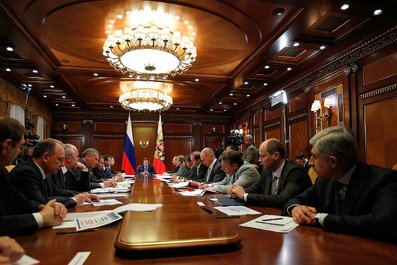
President's Meeting on the OPK

President Medvedev is irritated as ever that the Defense Ministry and OPK aren’t moving out smartly to rearm and reequip the Armed Forces.  He’s trying to kick them into gear, but can he get results where his predecessors either didn’t care or simply failed?

According to Kremlin.ru, Medvedev met this afternoon in Gorki with a host of government officials and industrial chiefs.  They included, inter alia, Sergey Ivanov, Anatoliy Serdyukov, Vladimir Popovkin, Nikolay Makarov, Denis Manturov, Yuriy Borisov, Sergey Chemezov, Sergey Nikulin, Mikhail Pogosyan, and Roman Trotsenko.

Medvedev’s opening monologue enumerated what’s been done for defense industry — providing a full state defense order and financial support, creating integrated development and production structures [OSK, OAK], etc..

Then the President says:

“However, despite all adopted measures, the state of defense production cannot be called good, all attending understand this.  There are objective reasons:  the deterioration of enterprises’ basic capital is nearly 70 percent (on average), in some enterprises it’s all much worse.  We still have not even managed to establish effective mechanisms to attract innovation and off-budget resources to the defense-industrial complex.”

Medvedev goes on to say that all relevant documents, including the GPV 2011-2020, have been signed, but the assembled group still needs to think about how to implement the GPV.  He reviews how he talked at the Defense Ministry Collegium in March about balancing producer and buyer interests, about justifiable and understandable prices.

But in many areas, says Medvedev, this has already become moot, and he intends to increase responsibility for the fulfillment of these obligations.

First, he wants a Federal Goal Program for OPK Development in 2011-2020.  Its focus is to be “real readiness” of the OPK to produce actual weapons and equipment.

Second, he wants the Defense Ministry to finish placing GOZ-2011 completely by the end of May, and advance payments issued to producers in accordance with the 2011 and 2012-2013 plans.

Work to date, he says, is going poorly and slowly.  He reminds the assembled that he told them about the failure of previous state armament programs:

“Today I want to hear from all present why this happened:  both from government leaders, and from industry leaders, who was punished for this and how.  Report proposals to me, if they still aren’t implemented, with positions, with the types of responsibility, completely concretely.  If such  proposals aren’t reported, it means [industrial] sector leaders and government leaders have to answer for it.”

It’s unacceptable, he says, that high-level decisions have been made, money allocated, but a product isn’t supplied.  He recalls his late 2009 Poslaniye in which he said 30 land- and sea-based ballistic missiles, 5 Iskander missile systems, nearly 300 armored vehicles, 30 helicopters, 28 combat aircraft, 3 nuclear submarines, one corvette, and 11 satellites would be delivered in 2010.  

Everyone here, says Medvedev, agreed with this, so why wasn’t it done.  He is, he says, waiting for an answer, and:

“. . . we have to answer for the duties we’ve taken on ourselves, we look simply in this sense absolutely unacceptable.”

Medvedev finishes by saying he knows military production is profitable, and it’s possible to attract strategic investors.  He says he wants to talk about how to stimulate investment.  The goal for the day is concrete reports on what’s been done on the level of those responsible for organizing work and correcting the situation in defense industry.

Where’s this leave things?

Not exactly throwing down the gauntlet, just another warning that he’s getting serious.  But it’s doubtful the government or defense industry will take Medvedev seriously until he fires a minister, other high-ranking official, or an important enterprise director.  And it’ll probably take more than a couple dismissals to get anyone’s attention.  Medvedev is running out of time on this account (as well as others).  Those he’d like to make responsible or punish will just take the tongue-lashings and wait him out.

Pavel Baev on Politics and the Military

Last week BFM.ru interviewed Pavel Baev of Peace Research Institute Oslo about Russia’s military reforms.  Baev’s view of the reality of ongoing reforms is captured in one word — catastrophic. 

Now Baev doesn’t get everything exactly.  Some military policy changes — like the one-year draft and a new, higher military pay system — were made some time ago, not necessarily for the 2012 presidential election. 

But he’s right about lots of other things.  Some decisions made in Defense Minister Serdyukov’s reforms haven’t meshed, or even been antithetical.  Decisions like higher pay have become, like it or not, part of the electoral picture, and the leadership has to follow through.

Baev believes the army might not be combat capable due to personnel cuts.  He allows for the possibility that Serdyukov might be sacrificed by his political masters.  The Kremlin and White House are using pay and apartments to keep serving officers politically quiescent.  But Baev thinks these aren’t enough; at some point, the army will insist on having its combat capability restored.  He hints later that the state and inclinations of the army were factors in the recent Arab revolutions that overturned long-time rulers.

The interviewer asks Baev to reconcile Prime Minister Putin’s Duma session last week in which he emphasized using the defense budget at home to create good, high technology jobs in Russia with President Medvedev’s [and Putin’s] statements about the failure of the state defense order:

“It seems to me that on the whole in the realm of military reform, and the Gosoboronzakaz in particular, there are very many concealed problems which Putin generally didn’t talk about.  The speech [Putin’s Duma speech], in large measure, on the whole was very unproblematic.  Somehow everything was more about achievements, future developments, very little about problems.  In the military arena, many problems have accumulated, and in the course of military reform not a few new ones were created.  The situation is very complicated, and attempts to correct the situation somehow largely lead to problems becoming even more acute, particularly problems with personnel.”

Baev went on to say that the Gosoboronzakaz and the problems of buying new military equipment have reached a critical point because of the aging of current weapons systems.  There is, he says, an undercover battle over what to buy and, especially, what should be bought abroad.  The situation around Mistral has become so complicated and political that it’s now more a “special operation” than an export contract.

Baev says the Russian Navy didn’t really want such ships, but went with the idea when it was foisted on them.  The real struggle and lobbying over Mistral concerns which shipyard in Russia will build units 3 and 4, according to Baev.  He suggests the whole deal might have been French President Sarkozy’s way of placing a bet on President Medvedev to be Russia’s future leader, and organizing the “political climate” in Europe toward this end.  But right now, of course, the Mistral deal looks very uncertain.

BFM.ru asked Baev for his interim assessment of the military reforms begun in late 2008:

“Purely catastrophic.  In every reform, there’s such a moment when the old thing is no longer working, and the new one isn’t working yet.  At this critical moment for any reform, we have a situation when nothing is working; where to move — either forward along the path of reforms or to try to work back, — is in large measure a political question.  Just in the area of Armed Forces personnel policy, an unknown number of things have been botched.  The initiatives advanced, — cutting the officer corps, contract service, sergeant training, cutting the conscription term — each of them has its own basis, but they’re absolutely mismatched.  That is, we now have a situation with military personnel when the army is in fact not combat capable.”

Asked about military pay raises planned for next year, Baev says:

“I think the main sense of this initiative is still to lift the officer corps’ very obvious dissatisfaction with all these reforms.  Great potential dissatisfaction has built up in the army, it is focused more or less on the minister, which, they most likely will sacrifice.  But this isn’t enough to lift this dissatisfaction, but the promised money plus the long ago promised apartments, and they are still gradually giving them out, — this is somewhat capable of  damping down this dissatisfaction.  And the fact that they are promising lieutenants, — for young officers it sounds completely improbable, and, most likely, they are prepared to wait for such money.”

“It’s perfectly obvious that very many political initiatives are aimed at this critical electoral sector — to lift the tension now, to make so that the army sits quietly in its barracks, not speaking out, waiting for its money and apartments, — and everything.  These are purely short-term things, which can help get through a complex electoral period.  It seems no one particularly looks after this [military] sector, inasmuch as, generally, for officers money is money, but they are people of service.  If even in addition they pay the money, service doesn’t go because they aren’t succeeding in reforming the Armed Forces so that they become combat capable, then this is a more serious source of dissatisfaction than simply a lack of money.”

“. . . the Armed Forces are the only area where genuinely serious and deep reforms are going on.  But with reforms, problems always take on a new character, change.  Here some kind of forward dynamic is occurring, it isn’t going in circles.  But the lack of resolution of these problems in the absence of political will is very evident, and all political will is going now to electoral projects which aren’t clear how they will be implemented because it’s not clear to anyone who in the end will be Supreme CINC, that is also a question of no small importance for the Armed Forces.”

Baev sees a lesson for Russia and the Russian Army in the Arab revolutions:

“But it’s clear that several conclusion flow from the Arab revolutions, and not just in relation to missile systems, but in the fact that the army is a serious political force.  This is more the conclusion of events not in Libya, but of the situation in Egypt.  And attempts somehow to neutralize the politicization of the army grow more from here [Egypt], than from Libya, where the army was in a pitiful condition, from here [Libya] also, in large measure, there is a civil war.  If there were a powerful army there, such a thing [civil war] wouldn’t have occurred.”

He finishes by talking about obsession with ultra-modern weapons when existing systems are perfect for today’s armed warfare.  His discussion leads to an open question about the fit between Russia’s military doctrine and its future armament plans:

“Therefore, the conversation about how we realistically need to outfit the Russian Armed Forces depends largely on whom we intend to fight, where we intend to employ these Armed Forces, against what kind of potential enemies, — answers to all these questions don’t exist, the doctrine doesn’t provide these answers.  It’s essential to replace weapons systems which have already outlived their time, but whether it’s necessary to replace them with the most super modern systems, — this is still a question.”

Rosoboronpostavka Understaffed, Ineffective?

This author has written several times that Rosoboronpostavka – the Federal Agency for Supplies of Armaments, Military, Special Equipment and Material Resources – is supposed to be key to making the GOZ and GPV work.  It’s supposed to take responsibility for negotiating, contracting and taking deliveries out of the hands of military men, so they aren’t tempted by bribes and kickbacks from manufacturers, and can concentrate on the specific requirements for weapons and equipment that needs to be made and bought.

In mid-2010, erstwhile Putin ally Viktor Cherkesov (who once warned of infighting and corruption among high-ranking security service veterans) was unceremoniously booted from Rosoboronpostavka.  President Dmitriy Medvedev criticized the agency (and Cherkesov) for not accomplishing much, and he moved it under the Defense Ministry, declaring that it would become a reinvigorated part of the effort to rearm the Armed Forces during the next decade.

Nadezhda Sinikova

With great fanfare, Defense Minister Serdyukov’s confidant, Nadezhda Sinikova took over at Rosoboronpostavka.  This all fit pretty well with Serdyukov’s general intent – to establish strict control over the Defense Ministry’s “financial flows,” and to civilianize Defense Ministry functions that aren’t clearly military in nature.

It’s seemed that Sinikova’s Rosoboronpostavka has remained stillborn, much like it was prior to mid-2010.  At least, nothing was heard from or about it until a 3 March article in Rosbalt.ru.  Now we have to be wary — Cherkesov’s wife, Natalya Chaplina is Rosbalt’s General Director.  Be that as it may, the article seems pretty solid.

According to Rosbalt.ru, Rosstat published data on salaries in the federal executive organs, and experts were surprised the highest average paychecks — 135,000 rubles per month or more than 1.6 million rubles per year — are in Rosoboronpostavka, an organization not even really functioning.  The average 12-month federal salary is 728,000 rubles, about 60,000 per month.
 
Rosoboronpostavka is working only in a technical sense.  The different power ministries and departments haven’t hurried to hand over authority to conclude contracts for them, and they’ve tried to sabotage the agency’s work, according to Igor Korotchenko. 

Rosoboronpostavka’s supposed to have 1,100 professional employees, 980 in the Moscow headquarters.  A source close to Rosoboronpostavka claims that, prior to mid-2010, not more than 10 people worked for the agency, and it didn’t have its own office.  They worked in a room in Rosoboroneksport on Moscow’s Ozerkovskiy Embankment. 

The Rosstat data says Rosoboronpostavka has the lowest staffing level of any executive structure, only 15.5 percent or 152 people against an authorized level of 980.
 
Before the mid-2010 changes, Rosoboronpostavka salaries had been 50-70,000 per month; the director got 70,000 and he reported to Prime Minister Putin.  Now, with its status downgraded and reporting to the Defense Minister, the agency’s pay has increased several times.
 
Experts think the pay’s kept high because the country’s leadership wants to deter corruption in the state defense order (GOZ), but deputy editor-in-chief  the journal “Armaments and Economics,” Professor Sergey Vikulov says this high pay comes “from the naive belief of our leaders that high pay will deter bureaucrats from bribery.” 

One notes Vikulov’s journal is the professional publication of the 46th TsNII, not exactly an objective voice since it used to form the GOZ (and probably collect the bribes) pretty autonomously before Rosoboronpostavka was established.
 
Korotchenko believes even bureaucrats who earn millions will be tempted to “saw off” part of the billion-ruble contracts they oversee.  He goes on to say  corruption in the Defense Ministry directorates occupied with the GOZ and the OPK already caused the failure of the two previous state programs of armaments (GPVs).
 
Rosbalt.ru also claims the Audit Chamber has said GOZ-2009 was only 50 percent completed.  Then it cites NG‘s (Mukhin’s) 70 percent fulfillment figure for GOZ-2010.

Although one expert hopes higher pay at the agency is tied to greater productivity in processing contracts, a Rosbalt.ru source says as before only a small number of contracts are being completed.  The expert is just about ready to give up searching for a logical explanation for the lack of elementary order in Russia’s management structures. 

But Korotchenko thinks it might be early to judge Rosoboronpostavka, since it’s still establishing itself.  Perhaps at the end of this year or the beginning of next, it will take over all power ministry arms and equipment procurement contracting, he says.

Ground Troops and the GOZ

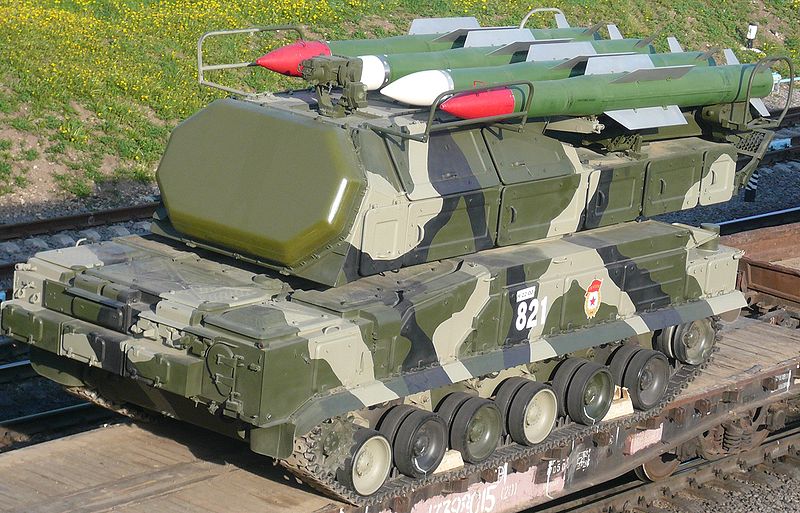
Buk-M2 (SA-17 / Grizzly)

Discussions of service wish-lists for State Armaments Program (GPV) 2011-2020 have tended to overlook the Ground Troops.  It seems they don’t enjoy the same priority as other services.

But in late February and early March, there was a flurry of press detailing what the land forces intend to procure, at least in the short term. 

Arms-expo.ru, Lenta.ru, and other media outlets put out brief items on Ground Troops’ acquisition.  They indicated the Ground Troops will emphasize air defense, command and control, fire support, and BTRs and support vehicles.

But the best run-down of all came from Ground Troops CINC General-Colonel Aleksandr Postnikov himself in Krasnaya zvezda.

Postnikov told the Defense Ministry daily that the main feature of GOZ-2011 is the transition from the repair and modernization of existing systems to the purchase of new, modern ones to reequip Ground Troops formations and units completely.

First and foremost, according to the CINC, the Ground Troops will buy modern digital communications equipment and tactical-level automated command and control systems (ASU), like Polyana-D4M1 for air defense brigades.  He said Ground Troops’ Air Defense will also receive modernized S-300V4 systems, Buk-M2 and Buk-M3, short-range Tor-M2U(M) SAMs, and manportable Igla-S and Verba SAMs.

Postnikov says they will continue equipping missile and artillery brigades with the Iskander-M, new MLRS, self-propelled Khosta and Nona-SVK guns, Khrisantema-S antitank missiles and Sprut-SD antitank guns.

The Ground Troops CINC says he foresees purchases of a new modification of the BTR-82A, BREM-K armored recovery vehicles built on a BTR-80 base and BREM-L on a BMP-3 base, Iveco, Tigr, and Volk armored vehicles, and new KamAZ trucks from the Mustang series.

NBC defense (RKhBZ) troops will get the heavy flamethrower system TOS-1A, RPO PDM-A thermobaric missiles with increased range and power, and VKR airborne radiological reconnaissance systems.  Engineering units will get the newest water purification system on a KamAZ chassis (SKO-10/5).

In the longer term, Postnikov sees rearmament as one of his main tasks, and he repeated President Medvedev’s statement that the Ground Troops should have 30 percent modern equipment by 2015, and 70 percent by 2020.  He laid special stress on getting YeSU TZ into the troops.  Postnikov’s Glavkomat has a Concept for the Development of the Ground Troops Armament System to 2025 emphasizing standardization, multi-functionality, modular construction, and electronic compatibility across several general areas:  armor and military vehicles, tube artillery and MLRS, SSMs, antitank systems, air defense, reconnaissance-information support, UAVs, communications, automated command and control, and soldier and close combat systems.

Nikolskiy on GOZ-2010 Failures

On Tuesday, Vedomosti’s Aleksey Nikolskiy wrote about breakdowns in last year’s State Defense Order (GOZ).  He notes that concern about failures started with Roskosmos, but it isn’t limited to that part of the defense sector.

Nikolskiy recounts Deputy Prime Minister Sergey Ivanov’s session with the Roskosmos collegium.  The space industry only produced five of 11 satellites specified in GOZ-2010, and 6 civilian launches were postponed.  The three GLONASS satellites lost to a “childish mistake” [in filling the rocket’s tanks] cost 2.5 billion rubles.  But we’ll return to Russia’s space woes another day. 

A Defense Ministry source tells Nikolskiy GOZ failures are constant. 

Bulava SLBM delays kept Yuriy Dolgorukiy from entering service [remember the new SSBN itself had to return to Sevmash for work while it awaits the next Bulava test].  Introduction of the new Severodvinsk SSN has been put off until much later because of construction defects.  A United Shipbuilding Corporation (OSK) source tells Nikolskiy the Defense Ministry has stopped financing completion of a proyekt 677 diesel-electric sub, and work on two others laid down at Admiralty Wharves is in question.

Nikolskiy says the Air Forces’ assimilation of Yak-130 trainers is delayed by last March’s crash.  And there’s a serious delay in the testing of the Su-35 fighter, according to a Defense Ministry officer [Sukhoy was reportedly testing two Su-35s last August].  One enterprise manager claims reforms in the Defense Ministry purchasing system are holding back contracting for aircraft deliveries this year. 

CAST’s Konstantin Makiyenko says government and Defense Ministry criticism of industry for its GOZ failures could be followed by personnel changes.  In Roskosmos’ case, the situation is almost “overripe.”  But Makiyenko defends other Russian arms producers by noting that delivery delays are common even for U.S. and European manufacturers.