Tag Archives: Nikolay Makarov

Not Decembrists

Returning to the three generals’ resignations . . . the Defense Ministry press-service came out quickly denying any “scandalous” general officer discharges. 

The press-service said General-Lieutenant Andrey Tretyak, General-Lieutenant Sergey Skokov, and General-Major Oleg Ivanov requested discharges for health reasons at different times.  But it also indicated the Central Attestation Commission (TsAK, or ЦАК) is reassigning generals to duties in the military districts under Defense Minister Serdyukov’s policy of rotating officers through different posts, and away from Moscow in particular.

A Defense Ministry source told ITAR-TASS the generals’ discharges are not part of any mass dismissal of officers from the Defense Ministry’s central apparatus.

The press was skeptical about three young and vigorous generals suddenly seeking a medical discharge, and it focused on their intent to avoid undesirable reassignments.  Newsru.com and Moskovskiy komsomolets reported in this vein. 

A Defense Ministry source told news agencies one in three requests for early retirement involves officers who are being reassigned from Moscow to a military district post.  The source claimed these cases are usually incorrectly characterized as opposition to military reforms.  Tretyak himself told Interfaks his resignation is not connected with Armed Forces reforms or disagreements with the leadership.

Then Deputy Defense Minister Nikolay Pankov talked to Rossiyskaya gazeta, giving a version of events varying from the press-service’s initial report of  discharges for health reasons.

Pankov told the paper Skokov and Ivanov were offered several good options including troop command duties or General Staff Academy positions, but chose retirement.  In Tretyak’s case, health was the issue, according to Pankov.  And Pankov called any thought of them leaving over dissatisfaction with army reform “farfetched,” or dissatisfaction with General Staff Chief Makarov “utter stupidity.”

What did military commentators say?

In IA Regnum and Gazeta.ru, Anatoliy Tsyganok said the generals’ resignations show things aren’t quite right in the Defense Ministry, but also called reports of problems with Makarov a falsehood.  He said the incident shows it’s not just military retirees who bring attention to poorly thought out reforms.  At the same time, he doesn’t get the focus on Makarov when he just implements Serdyukov’s plans.

Also in Gazeta.ru, Aleksandr Khramchikhin asks where this ‘opposition’ to reform has been:

“But where were they earlier?  Reform’s already been going on for three years.”

Svpressa.ru wrote that no Decembrists remain in the army.  It quoted Konstantin Sivkov:

“The thing is in the Defense Ministry and Genshtab generally there are no longer any people capable of standing up for their opinion, if it diverges from the leadership’s viewpoint.  They still existed several years ago.  Recall General Rodionov, Ivashov.  They slowly disposed of them.  The only ones remaining are those who loyally hang on the words of the minister and Genshtab chief.  A negative selection has occurred.  And what remains . . .  Only those that agree with everything.”

Viktor Baranets told Vesti FM:

“The Genshtab chief proposed to all three figures that they leave Moscow, smell the powder a little, become greater practitioners.  My sources don’t deny that all of the generals’ troyka requesting retirement had relations with Makarov that weren’t very simple.  But all issues were decided behind closed doors, without cursing and throwing down reports [retirement requests] on the table.”

General Resignation

Tomorrow’s Nezavisimaya gazeta reports Defense Ministry sources claim several young, promising generals have tendered their resignations because of problems with General Staff Chief, Army General Nikolay Makarov.  NG says they include Deputy General Staff Chief and Main Operations Directorate Chief, General-Lieutenant Andrey Tretyak, First Deputy Ground Troops CINC and Main Staff Chief, General-Lieutenant Sergey Skokov, and Genshtab Electronic Warfare Directorate Chief, General-Major Oleg Ivanov, and others.

The paper describes these guys as the Russian Army’s future leaders.  So why do they want to quit?  The reasons, unfortunately, haven’t been advertised (yet).

NG points out that, if Tretyak leaves, the GOU (the cerebral cortex of the “brain of the army”) will have its third chief in four years.  Skokov has been a key man working on automated C2 (YeSU TZ or ЕСУ ТЗ).  A “highly-placed” anonymous officer says it’s because of their disagreement with army reform steps taken by Makarov.  And explicitly not because of any problem with Defense Minister Serdyukov, whom they regard as an effective manager. 

They feel the Armed Forces, during Makarov’s tenure, have been in a provisional, experimental state, living on projects and according to unconfirmed directives (basic instructions and combat regs).  And after three years of “development,” the Genshtab Chief still can’t determine their final shape.  There are no confirmed decisions on service or branch TO&E structures, or their basing areas.  NG’s anonymous contact says the condition of the troops, and their “fantastic” combat training about which Makarov likes to talk, is “a fiction, which could be the topic of a separate conversation.”

The source implies time, money, and other resources have been wasted trying to develop automated C2 for old-fashioned, World War II-type operations.  And this is why Skokov requested his discharge.

NG’s sources believe this “scandal” will have political consequences.  The paper wonders whether President Medvedev will choose to get involved.  A source claims Deputy Defense Minister Nikolay Pankov is supposed to meet with the generals who want to quit, and discuss their problems with Makarov “from the point of view of the state’s interests.”

Walking Back Contract Service (Part I)

Anatoliy Serdyukov’s 18 March pronouncement on relaunching contract service was another painful Defense Ministry policy reversal.  He said:

“One of the important directions of Armed Forces reform is improving the manning system.  The Russian Federation President approved the Defense Ministry’s proposal to have 220 thousand officer positions and 425 thousand servicemen serving on contract in the Armed Forces.  The given changes in  numerical strength are viewed as long-range and connected with keeping a missile army and four missile divisions in the Armed Forces order of battle, increasing the number of formations in the Ground Troops, and establishing the Air-Space Defense Troops.  It is planned to increase the share of contract-servicemen by creating attractive military service conditions.  In the near future, soldier and sergeant duties will be manned on a mixed [i.e. conscript and contract] basis.”

Serdyukov’s words in 2011 sound very much like former Defense Minister Ivanov’s when he launched contract service nine years ago.  We’ve come full circle.  Russia tried professional enlisted service, declared it a failure, and returns to it as something essential and unavoidable.  The inevitability of contract service springs from the insoluble problem of the draft.  Moscow can’t man its Armed Forces with the right number and kind of conscript soldiers.

Early last year, Serdyukov was careful in his criticism of contract service.  He consistently pointed to inadequate funding as the reason for failure.  He didn’t indict the concept.  The Defense Minister said contractees would be cut, and eventually brought back up to the level of 200 or 250 thousand.  The current target of 425 thousand indicates something’s changed significantly over the past year. 

For his part, General Staff Chief Nikolay Makarov categorically condemned contract service.  In early 2010, he said:

“We are not switching to a contract basis.  Many mistakes were allowed, and that task which was given—construction of a professional army—was not completed.  Therefore a decision was made that conscript service needed to remain in the army.  Moreover, we are increasing the draft , and decreasing the contract part.”

One can hear sand crunch under Makarov’s boot as he about faced in his Academy of Military Sciences speech last week:

“You know about the recent decisions of the Supreme CINC to have 425 thousand contractees and 220 thousand officers.  We will be implementing this literally starting today.”

“We understand that these Armed Forces are created for servicemen-contractees.  Only with their training can we have a well-prepared and professional army.”

So we understand that do we?  It’s not how Makarov understood things a year ago.

Let’s summarize where we are . . . a year ago, contract service was cast off and the Defense Ministry said henceforth it would rely on conscript manpower with far less training and experience than contractees that apparently didn’t meet its needs.  Serdyukov and Makarov declared the central military personnel policy of the 2000s — Putin’s years as Supreme CINC — to be a complete and utter disaster. 

Now barely 13 months later, these men have recognized the basic reality that there simply aren’t enough conscripts and they aren’t the kind of manpower that can operate a modernized Russian Army.  So the turn back to contractees.

But still questions remain.  How will Russia create these professionals?  How will it craft a contract service policy that works?  How will it differ from what was tried previously? 

So far the answers sound familiar.  Good pay, service conditions, housing . . .  will they be more successful getting these things for contractees this time around?  Can they afford them more?  What is different this time?

Walking Back the Draft

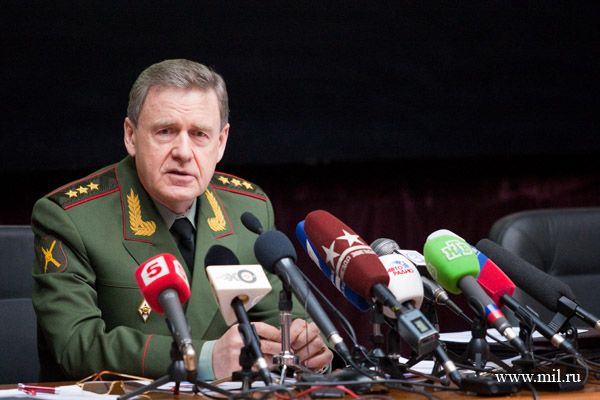
General-Colonel Vasiliy Smirnov

Reversing decisions made in the context of Defense Minister Anatoliy Serdyukov’s military reforms is apparently necessary, no matter how painful.  In early 2010, Serdyukov and General Staff Chief Nikolay Makarov announced their intention to curtail professional contract service and rely on the one-year draft to man the Armed Forces.  Scarcely more than a year later, they’ve been forced to retreat from this plan.

Yesterday Deputy General Staff Chief, General-Colonel Vasiliy Smirnov said Moscow will draft only about 200,000 young men in this spring’s callup.  See Mil.ru’s transcript of the press-conference.

The Russian military has tried to conscript in excess of 270,000 men in every draft campaign since one-year service started.  But General-Colonel Smirnov said the military will now induct only 203,720 men this spring, and (not mentioning problems with numbers) he attributed the reduction to a Defense Ministry and General Staff decision to raise the quality of the callup contingent.  He added that coming drafts would also aim for about 200,000 new soldiers, plus or minus 3-5 percent.

The Russians are also refraining from measures to round up more men.  Newsru.com noted the spring callup will run only until July 15, not August 31 which would have allowed for drafting more men before they enter higher educational institutions (VUZy).  President Medvedev decided not to make technicum (post-secondary trade school) graduates liable to the draft so they can attend VUZy if they choose.  Other ideas, such as extending the upper age limit for the draft from 27 to 30, or raising the service term back to 18 months or 2 years, remain off the table.

So Moscow is facing its manpower limitations head-on.

The simple fact is a million-man Russian Army was never going to have 600,000 or 700,000 conscripts, perhaps not even 540,000 at any given moment.  Vladimir Mukhin already reported in January on the fall callup’s failure, and approximately 20 percent undermanning in the ranks.  That would put draftees at about 430,000, or at what Smirnov says they now plan to conscript each year.  Mikhail Lukanin wrote last June that the military’s conscription targets were unrealistic when the number of 18-year-olds alone won’t reach 600,000 during the next couple years.  Army General Makarov said it himself back in September when he noted that only about 13 percent of draft-liable manpower serves in the army.  His 13 percent of 3 million 18- to 27-year-olds is 390,000.

Where does all this leave Russian Army manpower?

Taking recent pronouncements on the intention to have 220,000 officers and 425,000 contractees in the future, conscripts might number 355,000 at some point in a million-man army.  Smirnov’s statement yesterday indicates they intend to have somewhat more than 400,000 at any given time for now.  Where they are today is harder.  If there are 181,000 officers and 174,000 contractees (as Smirnov said yesterday), and there are no more than 540,000 conscripts presently serving, the Armed Forces are comprised of less than 900,000 men.  How much less depends on the actual number of conscripts.  That’s at least ten percent below their authorized level.  If there are only 500,000 conscripts, that’s about 850,000, or 15 percent under one million, and so on.

VKO Game On

Yes, it’s game on in the fight for control over Russia’s future unified aerospace (air-space) defense or VKO.

General Staff Chief Nikolay Makarov’s recent statements sound like he’s hard over on putting VKO under the General Staff’s immediate control.  But the Space Troops (KV) definitely aren’t out of the game, and even the Air Forces (VVS) – running third right now – are still in the competition to own VKO.

Say VKO falls under the General Staff, is it up to the job of running what will amount to a service or major command?  This at a time when it’s been cut back, and refocused on strategic planning?  And, entirely aside from organizing or reorganizing for VKO, there’s an issue how much a unified VKO will actually improve current Russian capabilities.  Acquiring new capabilities is a different problem altogether.

But let’s recall how we reached this point.  In late 2010, President Dmitriy Medvedev set the task of unifying the command and control of VKO under a single strategic command by 1 December 2011.  He cited this as his third major task for the military in his 18 March speech before the expanded Defense Ministry collegium:

“This year a unitary air-space defense system must be established.  It is necessary to unite existing anti-air and anti-missile defense, missile attack warning, and space monitoring systems under common command and control.  Moreover, this needs to be done not in the abstract, on paper or in electronic form, but in the context of the current situation, including the decision of the issue of our participation or nonparticipation in the system of European anti-missile defense which is being established.  It is necessary to form several large air bases, taking into account the deployment of units.  This will increase the mobility of sub-units, and allow for the establishment of military infrastructure echeloned along main strategic axes.”

Medvedev sounds like he’s saying he won’t be fooled by bureaucratic paper lash-ups or procedures.  He wants blood drawn — forces and systems taken from one command and given to the new VKO command, whatever its shape or subordination.  The real sticking point, of course, is anti-air defense assets now under the VVS.

Friday’s Rossiyskaya gazeta reported Army General Makarov and Defense Ministry Serdyukov are currently studying proposals on VKO.  But they’re keeping them within a small circle, and don’t intend to create public debate on the issue.  And the paper thinks the form and control of VKO will be revealed in the next months, if not weeks.

Let’s turn for a moment to what Makarov’s been saying.

Interfaks reported Saturday that the General Staff Chief said flatly:

“Air-space defense will be created in the General Staff, under the General Staff’s leadership, and the General Staff will command and control it.”

Vesti.ru said he dismissed the idea of the KV running VKO:

“The Space Troops are only one element of all the components of this air-space defense.”

Well, you can say that, but they also appear to have three of VKO’s four cited components.

At any rate, Makarov continued, saying VKO:

“. . . has to be multilayered, by altitude and by range, and has to integrate all forces and means that exist, but are very few of now.  We are counting on production taking off, beginning literally next year.”

He also noted:

“No one will take back those means which are now transferring to the districts [MD / OSKs].  This [VKO] will be implemented in Troop PVO.”

The chief of Ground Troops’ Air Defense (ПВО СВ) also said as much in late December.

None of this is very different from what Makarov’s said all along.

Rossiyskaya gazeta summed Makarov up this way on 15 December:

“The thing is various military structures are involved in securing the skies at present.  The Space Troops answer for orbital reconnaissance and the work of missile attack warning stations.  The Air and Air Defense Armies with the aid of radar companies and border posts inform staffs about approaching enemy aircraft.  The Special Designation Command covers the Moscow Air Defense Zone.  Air defense troops and fighter aviation cover other important facilities.”

“The system is built on the service [видовой] principle and is therefore uncoordinated.  We need to make it integrated and place it under the Genshtab’s command.”

Despite Makarov’s strong words, Rossiyskaya gazeta has been told that the leadership is still studying putting VKO under the KV’s control.  Especially since, as noted, it already has 3 of 4 of its components – PRO, SPRN, and KKP.  But, the paper thinks, no one is talking about putting SAMs (ZRK) or Air Defense Aviation (APVO) under the KV.  However, the KV might get independent radar brigades and some SAM units equipped with the S-300, S-400, and the future S-500.

On 24 March, the KV’s spokesman repeated earlier statements from its commander, General-Lieutenant Oleg Ostapenko, saying basic documents setting out the establishment of VKO on the basis of KV have been prepared and presented to the Defense Ministry and General Staff.

On 27 January, Ostapenko told RIA Novosti:

“There’s already a decision that the system of VKO will be built on the base of the Space Troops.”

It might also be worth noting Vedomosti’s Defense Ministry sources were, at least at one point, reporting that KV had the upper hand in the VKO sweepstakes.

Lastly, the VVS remains a possible home for VKO.  The Air Forces might not have much to recommend them over the Genshtab or KV, but they operate the existing VKO prototype in the Moscow region’s Special Designation Command (KSpN).

General Staff Chief Makarov’s Retirement Rumored

On Thursday, Argumenty nedeli said its source claims Defense Minister Serdyukov will soon send some well-known generals into retirement.  The Defense Ministry press service, of course, denies it.

AN’s source says the departure of these generals isn’t due to conflict between them and Serdyukov, but rather to the latter’s policy of “rejuvenating” Russia’s high command.  Among those who will allegedly be retired:

  • General Staff Chief, Army General Nikolay Makarov (61).
  • Deputy Defense Minister for Rear Services, General-Colonel Dmitriy Bulgakov (56).
  • Air Forces CINC, General-Colonel Aleksandr Zelin (57).
  • Navy CINC, Admiral Vladimir Vysotskiy (56).
  • Space Troops Commander, General-Lieutenant Oleg Ostapenko (53).

It’s interesting because none of them is really up against the legal age limit for leaving military service.  And Makarov apparently already has a service term extension from President Medvedev. 

One presumes, according to AN’s information, that the Ground Troops CINC, and RVSN and VDV Commanders are safe for now.

AN also expects some of the newly appointed MD commanders to be dismissed or moved to new posts.

There are other angles to AN’s story besides more rotation in cadres.

First, it repeats earlier press on trouble in finding a replacement for “key military department figure,” former Deputy Defense Minister for Finance-Economic Work Vera Chistova who left her post three months ago. 

An AN source in the Finance-Economic Service claims the lack of a replacement puts in doubt Prime Minister Putin’s promise to deliver a 6.5 percent increase in military pensions on 1 April.  Budget resources weren’t allocated for this.  And there’s still no candidate to replace Chistova.  And without one such issues simply won’t be resolved. 

AN doesn’t mention also that as active duty officer pay is reformed this year, the Defense Ministry will have to figure what to do about retiree pay.  If, as expected, they break the long-standing link between active pay and military pensions, the vets aren’t going to be very happy just before the 2011 and 2012 elections.  Putin just courted representatives of veterans’ organizations about a week ago.

According to AN, the Defense Minister has offered the military finance portfolio to more than one official at different levels in the Finance and Economic Development Ministries, but all of them declined.

The military department’s officers are also talking loudly about the coming appointment of a new Serdyukov deputy who will be called in to “correctly”  track the military’s political preferences ahead of the fast-approaching legislative and presidential elections.  

A high-ranking but unnamed military man tells AN

“He will be an important civilian and definitely a member of ‘United Russia.’  It goes without saying this is connected with the upcoming parliamentary and presidential elections.  The negative mood of officers is great, it is directed against the minister, his assistants and the party of power which is conducting the reforms without considering the human costs.”

Makarov’s Year-Ender

On Tuesday, General Staff Chief Nikolay Makarov provided his year-end wrap-up on the ‘new profile’ of the Armed Forces in the form of a press-conference featuring a videolink with the four new MD / OSK commanders.

It was pretty much a self-congratulatory celebration of how Makarov and company have turned everything in the Russian military around for the better.  As Moskovskiy komsomolets put it, “Nikolay Makarov told the media how bad it was in the army in the past, and how good it will be in the future.”

Rossiyskaya gazeta paraphrased Makarov’s remarks, giving only a couple direct quotes.  First up was President Medvedev’s call for unified aerospace defense (VKO) before the end of 2011.

RG says Makarov said VKO will be fully operational in 2020 when new reconnaissance and weapons systems have been deployed.  He said its purpose is to defend the state [interestingly the state, not the country] from ballistic and cruise missiles.  It needs to be an umbrella against any kind of threat, including low-altitude ones.

Makarov said different military structures have been occupied with the security of the skies.  Space Troops do orbital reconnaissance and ground-based missile early warning.  The air forces and air defense armies (АВВСиПВО or АВВСПВО) and radar troops monitor air space for approaching hostile aircraft.  The Special Designation Command (КСпН) covers the Moscow air defense zone [didn’t this long ago change its name to the OSK VKO?].  Air defense troops (ЗРВ) and fighter aviation cover other important facilities.  The system was set-up on a service (видовой) basis and that’s why it was uncoordinated.  It needs to be made integrated and put under the command of the General Staff [of course – this sounds like Olga Bozhyeva in MK].  In the Defense Ministry, they understand unification won’t be quick and will require a lot of resources, but there’s simply no other way.

Izvestiya proffered a quotation on this one:

“If we look at how this system was built earlier, then it’s possible to see that it acted separately by services and branches of troops, and also by regions.  So, Space Troops answered for space reconnaissance, the work of missile attack warning stations.  The Ground Troops for the activity of radar units.  Now we are uniting all these separate organizations in a unitary whole.  We need to establish the foundation of this system in 2011.  To finish its formation completely by 2020.”

According to RG, Makarov said a modern army would be useless without a new command and control system for the Armed Forces.  Russia’s move to a unified information environment will cost 300 billion rubles, and will be phased, with the initial phase being the replacement of all analog equipment with digital systems by 2012.  Command and control systems will be developed and produced in Russia, but other weapons will be bought abroad.  This is when he broke the news about Mistral winning the amphibious command ship tender.

RG concludes Makarov called for a fully professional Armed Forces, but the words it quoted aren’t particularly convincing:

“Now we can’t do them like this.  But year by year we’ll increase the selection of contract servicemen with commensurate pay.”

However, Moskovskiy komsomolets quoted the General Staff Chief this way:

“We are aiming for a contract army.  Now we can’t make it so instantly, but year by year the number of contract servicemen, with commensurate pay, will increase.”

Olga Bozhyeva viewed this as a total reversal of Makarov’s earlier rejection of contractees and insistence on conscripts as the backbone of the army.

Makarov also talked about efforts to create ‘human’ service and living conditions.  He referred, as always, to outsourcing and civilianizing mess hall and other housekeeping duties.  He repeated that, starting in 2012, officer pay will increase by several times.  According to Krasnaya zvezda, Makarov said 50 percent of officers now receive higher pay through premiums and incentives.  Officers and their families will be moved from remote garrison towns to oblast centers where their children can get a better education and wives can find work.  About the large cut in military towns, he said:

“We had about 22 thousand of them, approximately 5,500 remain, but in all, we’re taking the number of military towns to 180.”

Of course, he didn’t mention who will take care of large numbers of retirees left behind in that archipelago of abandoned military towns.

KZ gave its own recap of Makarov’s press-conference, and it’s interesting to hear his rehash of why the army needed a ‘new profile.’  His remarks blow up any lingering myth about the 2000s, at least the Putin years, as the time of the Russian military’s rejuvenation.  He said:

“Before 2009, 87 percent of the Armed Forces consisted of formations and military units with abbreviated personnel and cadres, practically not having personnel.  They almost didn’t conduct operational and combat training.  The army didn’t just degrade.  During this time, we grew an entire generation of officers and generals who ceased to understand the very essence of military service, they didn’t have experience in training and educating personnel.”

KZ paraphrases more of Makarov.  The personnel training system caused complaints.  VVUZy were teaching the Great Patriotic War.  Low pay and poor prospects for housing made the officer’s profession a low-prestige one.  In units, personnel weren’t occupied with combat training, but serving themselves, and military discipline fell as a result.  On the whole, the Armed Forces stopped fulfilling the missions for which they are intended, and could scarcely react to threats and challenges beyond the state’s borders and inside the country.

Makarov addressed how the MDs were changed to meet future threats and challenges:

“Planning and troop employment happened with significant difficulties, since each of six military districts had a series of missions where one often contradicted another.  Moreover, four air forces and air defense armies were established, as a result, the zones of responsibility of the military districts and these armies didn’t coincide at all.  This led to confusion in employing air defense forces.  At the same time, experience showed that military actions in recent decades are conducted, as a rule, by unified force groupings and forces under a unitary command.  Each of our districts and each of our four fleets existed independently. Each had its own zone of responsibility, not matching the others.  In order to organize any kind of joint actions, it was necessary to establish temporary commands, temporary structures, which, as a rule, were poorly prepared, didn’t have corresponding experience.  All this led to unsatisfactory results.”

Izvestiya quoted him:

“In the bounds of the ongoing transformations, full-blooded troop groupings have been established on all strategic axes.  Four full-blooded commands have appeared for us which, having in their composition and immediately subordinate to them all forces and means, can react adequately to all challenges and threats to the borders of our districts.  Changes in the Armed Forces command and control structure are a necessary occurrence since the old administrative-territorial division had stopped answering the challenges and threats of the time.”

New MDs (photo: ITAR-TASS)

Then Makarov brought in MD commanders over the video so they could attest to how it’s going.  They remarked on how cutting intermediate, redundant command levels has made their jobs easier.  Western MD Commander, General-Colonel Arkadiy Bakhin said 40 percent of his formations and units have outsourced some support functions. 

KZ says earlier MD commanders answered only for Ground Troops, and when they needed forces from another service or branch, they had to get permission from above.  Southern MD Commander, General-Lieutenant Aleksandr Galkin claims making these requests cost the commander time, but now all forces and means are in one command, the fundamentally new unified strategic command (OSK).  Galkin also says freeing soldiers from support tasks means there are now 20-22 training days per month instead of 15-16.

Surprise, Mistral Wins

According to ITAR-TASS, General Staff Chief Nikolay Makarov told journalists today the decision to buy French Mistral helicopter carriers has been made.  He said:

“Today agreement on necessary price parameters is proceeding, and I think all documents will be ready this year.”

There are no technology transfer issues related to Mistral, according to the French Prime Minister.  He said a Russian high-level expert group has been in France talking about price and several technical issues.

The more cautious Prime Minister Putin, for his part, preferred to wait until the official end of the Defense Minister tender, but reiterated that specialists were working in France yesterday to clarify all issues of interest to Russia, and the report will appear later.

The military says the Mistral will appear in the Russian Navy in a year or two, according to the news service.

Army Outsourcing

Defense Minister Anatoliy Serdyukov conducted another extramural collegium Wednesday, this time in Khabarovsk.  Serdyukov and company congratulated themselves for completing the ‘large-scale work’ of forming the Eastern Military District (VVO or ВВО), and the other three new districts, ahead of schedule.  This reshuffling was done in less than a year, so it probably really doesn’t count as ‘large-scale work.’

General Staff Chief Nikolay Makarov reported the VVO has operated since 1 October.  For his part, Serdyukov noted:

“The Eastern Military District is the largest in combat composition, area, and length of ground and maritime borders.”

The VVO sports the Pacific Fleet, an air and air defense army, and four combined arms armies, leading the Defense Minister to conclude:

“Unifying all forces and means under a single commander allowed for a substantial increase in the combat possibilities and potential of the district.”

Possibly, yes, but it remains to be realized and proven . . . since the very same forces have just been aggregated in a new way.  Is this new whole more than the sum of its parts, or not?

Attendees discussed unified logistics as well as unified combat forces.  Reports said along with unified commands a unified system of material-technical support (MTO) is being established in the military districts.  As previously reported, it is supposed to unite arms supply and logistics in one function and organization.

At any rate, the collegium had new or semi-new business as well . . .

Serdyukov, Makarov, and other attendees also discussed Defense Ministry outsourcing.

Before the meeting, Makarov told wire services the issue of delimiting spheres of activity between the military department and outside organizations that will provide support functions for servicemen and military towns, including heating, electricity, and food service, would be discussed.  According to Rossiyskaya gazeta, Makarov said:

“We need to clearly determine the bounds within which structures should work to support the everyday life of military bodies.”

Speaking like an old-hand, Makarov said the outsourcing system will take care of noncore tasks like feeding the troops and providing utilities to military towns.  The Defense Ministry’s board of directors discussed transferring responsibilities and corresponding property to these contractors.  Are they going to operate or own these assets?

RG reminded readers 340,000 troops are supposed to be fed by civilian firms by year’s end.  They include students in cadet corps, Suvorov schools, military VUZy, and patients in Defense Ministry hospitals.  The paper said outsourced food service would be coming soon to permanent readiness units.  And laundry services, part of military transportation, and equipment supply, including aviation, POL, and support for all deployed Navy ships, will be outsourced.

Finally, Army General Makarov said the collegium discussed in detail the issue of replacing or scrapping worn out equipment.  According to RIA Novosti, Makarov indicated there’ll be a major inventory and weeding out of what’s usable and what isn’t:

“In the course of 2011, everything that’s inoperable, particularly, in the aviation and ship inventory, we will manage to restore and put back on the line.  That which has outlived its time according to its parameters should be withdrawn from service.  This is quite a solid sum which could be redirected to acquiring new types of equipment and armaments.”

Not sure how much they make on this scrap sale.  Not so long ago the Defense Ministry said it was cutting repairs (as well as RDT&E) to focus more money on buying new systems.

Officer Discontent on Poklonnaya Gora

Reviewing the press on Sunday’s VDV meeting on Poklonnaya Gora, one could say there’s an inclination to dismiss it as the howling of old cranks who don’t constitute an organized challenge to anything or anyone.  But behind that initial take, some media saw palpable discontent among officers, both retired and active duty.  Nezavisimaya gazeta suggested there might be more below the surface of this rather feeble demonstration – either more powerful interests or much larger numbers of affected individuals.  Ekspert concluded, at a minimum, the whole episode might lead Defense Minister Serdyukov to take the opinions of officers more seriously.      

The VDV demonstration goes back to the 30 September Seltsy incident, and the Russian Airborne Union’s (SDR) call for Serdyukov resign for insulting Hero of Russia, Colonel Krasov as well as for destroying the army.  Kommersant put the number of participants at about 1,500.  Retired General-Colonel Vyacheslav Achalov and other organizers threaten to resume protesting on 17 November if President Medvedev doesn’t fire Serdyukov.  They also want General Staff Chief Nikolay Makarov, Deputy Defense Minister Nikolay Pankov, and Main Personnel Directorate Chief Viktor Goremykin to resign. 

The conspiracy-minded protesters maintain that Vladimir Shamanov’s crash was no accident; they think someone tried to kill him since he’s the only man standing in the way of the VDV’s ruin.

The Defense Ministry didn’t officially comment on yesterday’s protest, but Kommersant garnered an unofficial reaction.  An unnamed Defense Ministry representative said:

“Criticism should be constructive.  When memorial days like 7 November are used for political purposes, it’s unseemly.  Moreover, criticizing the minister for the reform is premature, since it’s not complete yet.”

So the Defense Ministry didn’t think the protest was helpful, but they also think 7 November is still a holiday.  The last is the best though.  Exactly when, where, and how are opponents supposed to raise their objections?  When everything’s over and done with?  Another insight into current regime thinking about the proper interaction of politics and policymaking . . . none.

Nezavisimaya gazeta was most interested that it wasn’t just the usual non-systemic outcasts at the VDV rally, but Just Russia (Справедливая Россия) flags showed that some of the official opposition was there too.  Federation Council Speaker and Just Russia leader Sergey Mironov was once a VDV senior sergeant himself.  NG sees SR trying to play an army card to its advantage while remaining part of the official opposition.

The paper says Mironov could be using the military, and showing support for officers against Serdyukov (and Medvedev by extension) for his own purposes.  And he’s politicizing the army – something not done in recent years and generally considered unacceptable.  NG indicates some think there’s more to all this than just a reaction to Serdyukov’s alleged rudeness to the VDV:

“There is, incidentally, an opinion that the [Seltsy] incident was only a pretext, and the interests of some military circles and retired officers connected to them, who feed off the army and are dissatisfied with the current military reform, are behind the protest.”

Novyye Izvestiya describes Poklonnaya Gora as quite the retrograde affair replete with Soviet flags, and the usual representatives of the radical opposition.

One participant bragged to its reporter after passing through one of many metal detectors:

“We don’t need weapons, we could take the Kremlin with a stool leg.”

But Novyye had more serious points too, like one ex-VDV who complained of Serdyukov’s cuts in military medicine, and his commercialization of military hospitals.  He asked:

“What military doctors will be on the battlefield?  There aren’t any remaining.  But there’s no one to fight, in a year’s army service what can you learn?  Only to sweep the parade ground.”

The paper concludes VDV veterans believe only military men can solve the army’s problems, the army needs to be mobile and highly capable, and it shouldn’t be shameful to serve in it.  At least everyone seems to agree on the last two.

Writing for Ekspert, Stanislav Kuvaldin describes Seltsy and Poklonnaya Gora as a breakdown in communications between the Defense Minister and the officer corps.  One SDR leader told Kuvaldin:

“Serving officers are silent, but they think the same things.  We grew them and indoctrinated them.”

He went on to say that even if they are silent about Serdyukov and reforms in exchange for today’s higher officer pay, it doesn’t mean they’ve been suppressed.

A key element of Serdyukov’s reform is basically tripling officer pay, and this higher pay is already a serious factor in calculations about serving, but it hasn’t happened yet (except for those getting special premium pay).  Nevertheless, potentially higher pay won’t automatically mean Serdyukov will be more popular, and it doesn’t mean the VDV will get over Serdyukov’s insult to one of its officers and a Hero of Russia, according to Kuvaldin.

Kuvaldin reports the Defense Ministry may compromise on some of the VDV’s more specific complaints, i.e. not moving the VDV Headquarters to Ryazan and preserving the VDV Museum, but not reversing the VDV Higher Military Command School’s subordination to the Combined Arms Academy.

In the end, Kuvaldin writes, this dissatisfaction is only creating tense moments for Serdyukov, not a serious threat:

“In the end, if after two years of reforms, vulgar insults to the head of one military school have become the cause for veterans to come out, it’s possible only to talk about an unpleasant emotional backdrop for the minister, but not about a hypothetical organized resistance.”

However, possibly, the situation will force the minister to deal with officers’ opinions more attentively and respectfully.

But this author wouldn’t bet on it.

In a not particularly surprising postscript, the GAI stopped SDR leader Pavel Popovskikh — former colonel, VDV Reconnaissance Chief, and defendant in the murder of journalist Dmitriy Kholodov — for driving drunk after the demonstration.  The story was widely reported, but an alternative version hasn’t gotten as much play.  Segodnya.ru reported that Popovskikh’s friends and others say he stopped drinking long ago.  The website also says Vladislav Shurygin wrote in his blog that traffic cops were ordered to stop Popovskikh and check him for alcohol, but they sheepishly released him with an apology when they found he was sober.