Tag Archives: Nikolay Makarov

GOMU Chief Smirnov Denies Plans to Increase Draft Term

Reacting to spreading rumors that the Defense Ministry intends to increase the current one-year draft term to 18 months, 2 years, or more, GOMU Chief Vasiliy Smirnov said Monday, “There’s no plan to increase the term of conscripted military service in the Russian Army.”

His denial came hard on the heels of General Staff Chief Makarov’s sudden public declaration that professional contract service has failed, at least for enlisted soldiers if not future sergeants, and the army will redouble its emphasis on drafted manpower.

Commenting in today’s Novaya gazeta, the chairwoman of Mother’s Right Veronika Marchenko says:

“If the Genshtab Chief is acknowledging the fact that the Genshtab is not capable of transferring the army to contract service, even though a corresponding [Federal] goal program was adopted, this is not cause to return to the draft system and increase the number of conscripts.  This is a reason to dismiss all the inept generals.”

That is a quaint sentiment, but it doesn’t work that way.  The generals always muttered that contractees wouldn’t work, and men inclined to evade simply had to be herded in.  They’ll say they were right all along.  The chiefs won’t suffer, only the indians.

More interesting, however, Marchenko thinks the rumors could be a trial balloon to gauge society’s reaction–if there’s no reaction, they might try to increase the service term again.

Another human rights organizer claims every 10th conscript is abused in some dehumanizing fashion.  She compares army service to life in a leper colony:

“It’s possible to live [there] ten years and not contract leprosy, or it’s possible for the irreparable to happen in one day.  The army today is potentially dangerous for the human system.”

Komsomolskaya pravda’s Viktor Baranets writes today that he’s amazed that it’s taken 20 years for generals like Makarov, Postnikov, and Chirkin to acknowledge that contract service is doomed.  He goes on:

“And how here can’t you believe that in the same manner in a year or two the Defense Ministry and Genshtab again will publicly ‘scratch their noodles’ and with a funereal sigh announce to us that the transfer of troops to the brigade system, and the transfer of the Navy Main Staff to Piter, and getting rid of warrant officers, and the reduction of almost 200 thousand officers were also mistakes?  But the strategists who reformed the army for no reason will by that time will be wearing pensioners’ slippers and courageously scribbling out their memoirs.”

This Russian (maybe even universal, bureaucratic) penchant for back-to-forth reform, reforms where process is everything and results are nothing is truly amazing and very evident in the armed forces.  But it’s everywhere even on the very same day.  Witness please Putin’s solemn announcement that he’s slashing the rolls of strategically important enterprises after many years of just as solemnly building up their ranks . . . what was the point?  What did they gain, what was accomplished?  Nothing.  It was a political drill to fend off clients desperate for money and bureaucratic attention, and their strategic status was, by and large, a sop.  End of digression.

What else on the topic of the moment?

Baranets.  He speculates the ‘death notice’ for contract service could be a first step backward on Serdyukov’s reforms.  He says there are now 70,000 contractees and contract-sergeants.  He believes in a year the Genshtab will increase conscription to 700-750 thousand guys annually, and they won’t become specialists in anything with demob always just around the corner.  So, he concludes, the rumors about a return to longer conscript service ain’t a coincidence.

Versiya has interesting coverage of the issue.  So Makarov says contract has failed, all sorts of other innovations in army service similarly haven’t brought the desired results.  Dedovshchina didn’t decrease, collecting the requisite quantity of servicemen will now be more complicated, the quality of soldier training has sharply declined.  And the number of conscripts in the ranks will grow.  Versiya asks:

“Can it be we’ll return to the Soviet model of an army which has been publicly declared ineffective in modern conditions?”

One-year service was supposed to eliminate dedovshchina, but General-Lieutenant Chirkin admits it didn’t.

Versiya’s versions:

  • First Version:  Return to Soviet-style manning.  Probability:  50 percent.
  • Second Version:  No alternative but contractees, this is just a pause.  Probability:  30 percent.
  • Third Version:  Course will be unchanged despite Makarov’s announcement.  Probability:  20 percent.

It sounds like Versiya really puts the odds of largely diverting from contract service at 50:50.
The Contractees Are Dead, Long Live the Contractees!

Asked about professional soldiers and contract service last week, General Staff Chief Nikolay Makarov said: 

“We are not switching to a contract basis.  Many mistakes were allowed, and that task which was given—construction of a professional army—was not completed.  Therefore a decision was made that conscript service needed to remain in the army.  Moreover, we are increasing the draft , and decreasing the contract part.  We’ve come to understand that a contractee has to be trained by altogether different methods than there were earlier.  Therefore now we’re taking on contract only sergeants who are studying for 2 and a half years.  We plan to reach a contract army through this.  Many people talked even in the Soviet Army about the need to train sergeants, but now we’ve thought everything through well and we’re promptly moving forward, so that in 2.5 years in our army there will be a sergeant, an assistant commander who’s capable of independently resolving an entire complex of tasks that are now resolved by officers.”

The effort to build a professional NCO corps will continue, but the experiment in recruiting career enlisted personnel—a main line of the army’s development since 2003—has failed.  The tenor of Makarov’s statement almost makes it sound as if he didn’t think or know a mixed manning system with conscripts predominating was the plan all along.  The Russian Army was always going to remain mixed, but now it will be much more one-sided in favor of conscripts.  A Vedomosti editorial pointed out that Russia’s generalitet (what remains of it) never supported contract service anyway.  The training of professional NCOs begun on a very small scale last fall will continue, but how long will it be before that effort too is abandoned?

Makarov’s announcement will only add to pressure on Russia’s dwindling manpower resources.  The start of one-year service basically doubled the semi-annual requirement for draftees from 133,000 to 270,000 or so.  Now it’s clear that conscripts are needed to fill spots contract enlisted were supposed to occupy.

Rossiyskaya gazeta and Krasnaya zvezda covered similar comments last week from new Ground Troops CINC Postnikov.  Both papers concluded that, while the effort with professional NCOs will continue, the army’s priority will be on meeting its manpower requirements through conscription.

Vremya novostey quoted Postnikov:

“The federal program to transfer permanent readiness units to manning with contractees did not achieve its intended goals.”

It didn’t succeed in making contract service prestigious, they didn’t select those who could be true professionals, they fully manned units with contractees to the detriment of quality.  Now corrections have been made in the troop manning plans.  Only those positions that determine the combat capability of units and formation will be contract.  There both pay and social conditions will be fitting – just like officers.  They will train contractees for the positions of professional sergeants, just as in the U.S.

And Izvestiya:

“. . . we can’t say that we have precisely those contractees which we wanted to have ideally.  We understood that we had to change the system of training contractees.  It’s planned to do this through the institution of sergeants – an assistant commander capable of independently resolving a whole block of tasks which officers now resolve.  For this reason they have to occupy positions directly answering for the combat readiness of army units and sub-units.  We have to increase their pay, create social conditions for living at the level of officers.”

But one basic problem has always been the jealousy of officers (who rarely get all their pay and benefits) toward contractees or NCOs who might possibly get almost as much as them. 

Novyye izvestiya quoted Sergey Krivenko, a member of the RF President’s Human Rights Council:

“Contractees were not provided housing or normal pay, or even timely indexing of their wages . . . .  Instead huge sums were invested in construction of housing, reequipping ranges and other facilities where the money could easily be hidden and stolen.”

Krivenko adds that contractees didn’t experience a change in their status, were often forced to sign contracts, and were not allowed to leave the garrison or live a normal life with their families outside the garrison.  So there was nothing to distinguish them from conscripts.

To sum Krivenko up, the army failed to find the right candidates and deliver the benefits it promised them.  So one has to be skeptical that the selections and Defense Ministry follow through on the professional NCO effort will be any better.

Krivenko believes that the army has virtually no choice but to increase the conscription term from one year to cover the lack of contract soldiers.  But simply allowing undermanning of units would have the same effect, but that might impinge on Makarov’s claims that most units are now fully manned and permanently ready.

Makarov Meets the Press

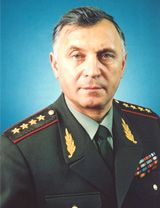
Chief of the General Staff Nikolay Makarov

General Staff Chief Nikolay Makarov spoke at length to the press yesterday. In no particular order, here are some of the impressions and reports that followed in his wake.

RBCdaily quoted Makarov on the possible Mistral purchase:  “Ships of the Mistral type have very great multifunctionality, and they surpass our ships in all parameters by three times.”  He went on to say that Russian shipbuilders would only be able to produce helicopter carriers of this quality in 5-10 years.  Aleksandr Khramchikhin commented that, in the first place, Russia doesn’t currently have comparable ships and, in the second, it will take 50 years.

Makarov said the final decision on buying the Mistral had not been made.

According to Rossiyskaya gazeta, Makarov said the Russian Army went to brigades vice divisions to avoid the previous need to flesh out units with reservists and take days to bring them to combat readiness.  ‘Modular’ battalions by contrast are permanently ready for battle in an hour.

Makarov didn’t rule out establishment of some type of ‘rapid reaction forces,’ though these are closest in nature to today’s VDV.  And this wouldn’t mean VDV would simply change its name. And other services need rapid reaction capabilities too for action in the air, on the sea, etc.  Aren’t permanently ready brigades rapid reaction forces already?

On the Navy headquarters move to St. Petersburg, Makarov claimed Moscow is overflowing with army and navy leadership [but haven’t they just cut 200,000 officers and lots of excess command structures to create a personnel pyramid?].  And with today’s networks the fleet can be commanded from thousands of kilometers away from the Genshtab and other main commands.

Makarov doesn’t foresee any change to the one-year conscription policy, but there may be changes in NCO acquisition.  Instead of six months training in MD training centers, they may only get 3, so they can serve 9 months in troop units.  Makarov thinks they’ll cut back on conscript sergeants once their professional ones start to appear.

Moskovskiy komsomolets quoted Makarov on the new strategic arms agreement with the U.S. to the effect that it’s 97 percent complete, and it only remains to agree on the relationship between offensive and defensive weapons, and there will not be anything in the treaty to Russia’s detriment in this regard.

On Mistral, Makarov said, after study, we’ve concluded we need this type of ship, which can be an amphibious assault ship, hospital, command ship, and helicopter carrier.

On the Navy and Piter, MK notes Makarov wanted to avoid Baluyevskiy’s fate and didn’t contradict his superiors.  He expounded on his vision (perhaps dream) of Russian netcentric warfare:

“Earlier it was like this:  the closer to subordinates, the more reliable the command and control.  Now all leading countries, including us also, are going to netcentric command and control systems.  This allows completely remote means of reconnaissance, command and control, electronic warfare, fire, command posts–all spread over an enormous distance, but located in a single information-communications space and capable of solving tasks in real time.”

On a related note, Makarov said the new Sozvezdiye tactical level command and control system will be part of the netcentric structure toward the end of the year.

Gazeta’s coverage focused on Makarov’s comments about establishing the personnel pyramid, i.e. going from armed forces with about 500,000 officers and warrants to one of 150,000 officers and 720,000 soldiers in the space of a year.  It also noted Makarov’s remark that brigade commanders in their training assembly at the General Staff Academy are learning new warfare and command and control principles.

Izvestiya quoted Makarov at length on the Navy Main Staff’s move to Piter.

“Presently all command and control organs are concentrated in Moscow, but we want these command and control organs to be as close as possible to the troops they control [didn’t he also call this the old way of doing business?].  The dispersal of command and control and fire means at great distances doesn’t have any great significance, what’s important is maintaining uninterrupted and clear command and control of troops and weapons.  Therefore, the transfer of the Navy Main Staff to St. Petersburg won’t place any kind of extra burden on the command and control system, with the exception perhaps, only in the initial period of its functioning in a new place.”

Viktor Baranets in Komsomolskaya pravda focused on Makarov’s words on the U.S. and Iran, noting his statements that the U.S. has a plan to strike Iran, and, if it occurs, it’ll be terrible for Iran, the region, and the U.S.

Krasnaya zvezda covered the Iran issue.  It noted that Russia’s need for ready units forced the shift to brigades.  It also covered Makarov’s comment that the Voronezh conference agreed on changes needed in the Sozvezdiye C2 system, and that it would be received this July and fielded in November.  KZ also quoted Makarov at length on the capabilities of the 5th generation fighter aircraft.

KZ also indicated that Makarov noted the U.S. as an example where units and commands are often separated by great distances when he talked about the Navy Main Staff and Piter.

Generally, it seems those invited to this press availability only asked Makarov ‘soft ball’ questions.

Babich on the Command Changes

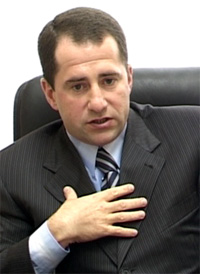
Duma Deputy Mikhail Babich

United Russia Duma deputy, and deputy chair of the Duma’s Defense Committee, Mikhail Babich believes that those who don’t agree with reforms in the armed forces are being pushed out.  NEWSru.com reports on what Babich told Interfaks

Babich says: 

“Changing military commanders–this is not a planned rotation.  This is an attempt to stop the possibility of a leak of any objective information from the troops.  Former Ground Troops CINC [Army] General Boldyrev, being a sufficiently professional military commander and understanding the hopelessness of what’s occurring, calculated it was better for him to go out on his pension than to continue putting today’s reforms into practice.  This also goes for the dismissal of very promising, well trained, and organized General [-Colonel] Sergey Makarov, but it’s only tied to the fact that the SKVO commander correctly, but very professionally established his position in relation to the negative consequences of transferring the district’s troops to the so-called new profile.  Rotating military commanders, undoubtedly, will continue to the point when those who don’t agree (with the conduct of reforms) or who have their own point of view no longer remain at all in the armed forces.” 

Babich sees General Staff Chief Nikolay Makarov appointing his SibVO loyalists to MD posts in these personnel changes. 

“The Genshtab chief is promoting people personally attached to him who owe him their military careers.  In this way, he’s trying to buy some time to cover up the negative consequences of the ongoing military reform, which are increasingly obvious today.” 

Babich said a just completed check of unit and formation combat readiness in the DVO “ended in complete failure.”   

“According to the results of the check, practically all units of the air-assault and motorized rifle brigades put on alert turned out to be not combat ready.  A complete zero–beginning from manning, ending with equipment readiness, its capability to exit the parking area, availability of mechanic-drivers and drivers, who are qualified to operate this equipment.  Despite the fact that they’ve already reported to the Supreme Commander-in-Chief [Medvedev] ten times about the fact that since 1 December 2009 all units and formations of the Russian Army have been transferred to the permanent combat readiness category and are fully combat ready, really not one of them is such.  The real situation is completely otherwise, but the Genshtab chief continues to mislead the Defense Minister and the country’s highest military-political leadership about the real state of affairs.” 

Makarov Declares Transition to ‘New Profile’ Basically Complete

According to Rossiyskaya gazeta, General Staff Chief Nikolay Makarov told a foreign military attache audience that Russia’s new military doctrine, with a reinforced emphasis on possible first nuclear use, has gone for President Medvedev’s signature.  Makarov has declared the military’s transition to a ‘new profile’ basically complete.  He says all remaining formations and units are now in a permanent readiness condition.  Although only 9 days remain in 2009, he insists the Defense Ministry will get 45,500 apartments for servicemen this year.  In line with planned cuts, Makarov said officers who have served their full careers and have housing were dismissed this year, but 37,000 were put outside the TO&E to await housing before being dismissed.  He says some 20,000 warrant officers were retained, but the rest were dismissed or transferred to sergeant positions.  General officers were cut from 1200 to 780, and Makarov claims the military is already down to only 150,000 officers.  Makarov called rearmament one of the most complex problems of reform, that will be costly and drawn out to 2020. He looks forward to a new strategic arms agreement with the U.S. that doesn’t harm Russia’s interests like START.