Tag Archives: Procurement

Emblem of Procurement Problems

On Friday, amidst Krasnaya zvezda’s usual fare, there was interesting coverage of a high-level meeting to review the military’s UAV (BPLA or БПЛА) procurement program.

Technically, it was a session of the collegium of the Federal Service for the Defense Order (Rosoboronzakaz or Рособоронзаказ) with the agenda item “Results of Inspecting the Placement and Fulfillment of the State Defense Order (GOZ) in the Area of Development and Supply of Unmanned Aerial Vehicles.”

Rosoboronzakaz Director Aleksandr Sukhorukov, a former Serdyukov tax service deputy, conducted the session.  Also participating were newly-minted Deputy Defense Minister Tatyana Shevtsova, also a former Serdyukov tax service deputy, and Director of the Federal Agency for Supplies of Armaments, Military and Special Equipment, and Material Resources (Rosoboronpostavka), Nadezhda Sinikova, another of the Defense Minister’s long-time proteges.

The military paper noted that representatives of the government, ministries, and other federal executive organs, state customers from the Defense Ministry, FSB, FSO, MVD, and MChS, representatives of the Main Military Prosecutor, and OPK officials also attended.

One Yu. Stolyarov gave the main report.  He’s Chief of the Directorate of Oversight of the State Defense Order in the Area of General Armaments and Military Equipment, Aviation Equipment, Aerospace Defense Means and Armaments, Ships, and Naval Armaments and Military Equipment.  Quite a broad portfolio.  Krasnaya zvezda didn’t elaborate on what Mr. Stolyarov said, however.

Ground Troops CINC, General-Colonel Aleksandr Postnikov, VDV Chief of Staff and First Deputy Commander, General-Lieutenant Nikolay Ignatov, an OAO Tupolev deputy chief designer, and OAO ‘Vega’ Radiobuilding Concern General Director, V. Verba also spoke at the session.  Their remarks weren’t reported either.

Krasnaya zvezda reported that all presentations were thorough and constructive, and the collegium adopted some draft directive, but we don’t know what it said.  The paper, however, says the main theme of all presentations was the same:

“. . . in their TTKh (ТТХ – tactical-technical characteristics) domestic UAVs must not lag behind foreign ones and it’s essential to do everything to achieve this.  State money has to be spent with maximum effectiveness.  Troops and power structures need to be supplied with those UAVs that will be most effective on the battlefield, and in conducting special operations.”

What should we conclude from this?  Firstly, the meeting highlighted Shevtsova’s new oversight and auditing role in procurement.

Secondly, the Defense Ministry’s leaving the door open for domestic UAV producers, and so this seems to amount to just another warning to them.  It doesn’t seem to be anything like a decision to include Russian firms or exclude foreign ones, or vice versa.

It’s not surprising the Defense Ministry highlighted this particular program review.  Few procurement issues have caused Russia as much angst recently as UAVs. 

Georgia’s Israeli-supplied UAV capabilities, and Russia’s relative lack of them, highlighted this issue in 2008.  Moscow had to risk manned aircraft instead of employing unmanned ones on reconnaissance missions.  What’s worse, two years after the five-day war, there’s still no fix to the UAV problem.  And it will become more acute should unmanned aircraft become the backbone of future air power for the world’s leading militaries.  Russia’s clearly behind on UAVs, and questions remain about whether it should catch up, and whether it can.

The Russian defense establishment has spent months debating buying from foreign manufacturers, purchasing sample quantities abroad, or producing jointly to jumpstart or pressure domestic producers.  In late 2009, Air Forces CINC, General-Colonel Zelin flatly stated it would be ‘criminal’ to accept inferior Russian UAVs into the arms inventory.  The FSB reportedly said it would buy Israeli UAVs.  In March, Defense Minister Serdyukov admitted domestic UAVs ‘seriously lag’ behind world standards, and, in April, then Armaments Chief, now First Deputy Defense Minister Popovkin reported that Russia had spent 5 billion rubles on UAVs without result.

So UAVs joined the list of other systems – helicopter carriers, soldier systems, light armored vehicles, etc. – that could be bought abroad, but it doesn’t look like Moscow is ready to rely, at least entirely, on foreign producers for any of them.
Is the Helicopter Carrier Tender for Real?

Speaking in Yerevan today, Defense Minister Serdyukov told journalists:

“We have announced an international tender for construction of a helicopter-carrying ship.”

He indicated Russia is talking about two ships.  He also welcomed the French builders of the Mistral to join in the tender.

The tender will take place next month, and the winning bid will be selected before year’s end.

After months of negotiations with France on building Mistral-class amphibious assault ships, the Russians couldn’t reach agreement on the terms of a deal.

The two sides may have agreed on building two ships in France’s STX shipyard.  French President Sarkozy told its workers last month they’d be building two ships with the Russians.

Maybe the Russians wanted to buy one and build three, but Serdyukov says the international tender is for two ships, so it seems likely Paris and Moscow had agreed on a ‘2+2’ formula.  So something else is probably the sticking point.

RIA Novosti suggests talks with Paris stalled over its unwillingness to sell Moscow the NATO standard tactical communications system aboard Mistral, according to an unnamed expert who spoke to Ouest-France.

The expert said the comms system is tied to the SENIT 9 tactical combat information system.  It’s described as an important node NATO isn’t prepared to share with Russia.  The French expert says the Russians “don’t have a very good command of military computers and are trying to fill the gap.” 

Officially, the Elysee says negotiations with Russia continue, it’s confident of a successful outcome, and it isn’t worried about the Russian tender.  It hasn’t commented on participating in it either.  Meanwhile, the French media claims Moscow has stopped its exclusive talks with Paris.

Tender for Helicopter Carriers May Just Be Formality

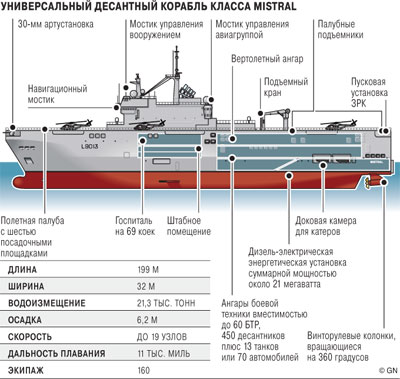
Mistral Schematic

Kommersant reports today that United Shipbuilding Corporation (OSK) has gotten the Defense Ministry’s permission to hold an open tender for procurement of helicopter carriers.  The paper concludes the Defense Ministry is refraining from a sole-source purchase of the French Mistral, and will consider similar proposals from OSK’s shipyards.  But the military [at least some military officials] haven’t hidden the fact that they prefer Mistral [but Defense Minister Serdyukov has always maintained they’ve been talking to other suppliers], so the tender could just be a formality. 

OSK President Roman Trotsenko says a special commission from the Ministry of Industry and Trade will conduct the tender, but details are sketchy.  A Defense Ministry source told Kommersant that, without a tender, a deal to buy a helicopter carrier [presumably Mistral] would be considered illegal.  So there won’t be a sole-source buy despite a year of government-to-government talks.

The paper reminds readers of OSK’s recent unsuccessful antimonopoly complaint in regard to the government’s consideration of Mistral.  Although the complaint was not reviewed, it must have had some impact on the decision to compete the helicopter carrier purchase.  Kommersant sources say OSK Board Chairman Igor Sechin also had something to do with it.

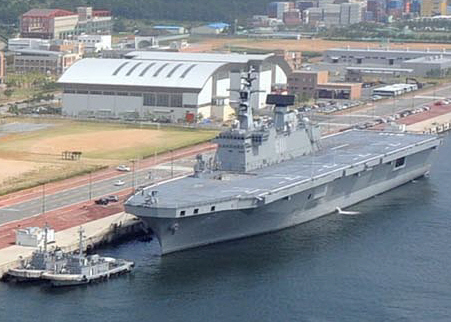
Trotsenko says far east shipbuilding plant ‘Zvezda,’ Petersburg’s ‘Admiralty Wharves,’ and Kaliningrad’s ‘Yantar’ will bid for the ships.  ‘Zvezda’ already has a joint venture in place with South Korea’s Daewoo – builder of the Dokdo helicopter carrier.  The OSK President says ‘Admiralty’ and ‘Yantar’ might work with ‘Northern’ shipyard or a foreign builder. 

Kommersant has a letter sent from Sechin to Prime Minister Putin this spring saying not only is Dokdo an alternative to Mistral, but Dutch and Spanish helicopter carriers are as well.

Trotsenko says OSK yards can build a helicopter carrier in 30 months for $500-700 million against a Mistral pricetag of €420-680 million.

Kommersant concludes the tender won’t end the conflict between OSK and the Defense Ministry.  Mistral will remain the latter’s priority.  The paper’s sources don’t know if the military wants to buy Mistral itself or place an order for a new unit in a French shipyard (STX).  OSK hasn’t been able to arrange a cooperative agreement with STX.

Mezhprombank-controlled ‘Northern’ and ‘Baltic’ shipyards will participate in the tender according to a representative of the bank. Kommersant’s sources think Mezhprombank, its owner Sergey Pugachev, and shipyards are the favorites among Russian contenders.  Pugachev was an early supporter of buying French, then building other units in his shipyards.  And, according to Kommersant, the Defense Ministry supports Pugachev.

Alongside Pugachev and Mezhprombank, OSK feels its chances to win the tender aren’t great.  Moscow Defense Brief analyst Mikhail Barabanov also says Mezhprombank yards are the favorites to build Mistral in Russia.  Such a deal’s been reached at a political level between Paris and Moscow, so the tender might just be a formality.  CAST’s Konstantin Makiyenko agrees.  But he thinks Mistral orders will go to ‘Baltic,’ since ‘Northern’ is loaded with frigate and corvette orders.  Meanwhile, OSK would like to buy both yards from Mezhprombank, but the sides haven’t reached agreement on a price.

Disappearing Deputy Defense Minister Portfolios

Or who will answer for what?

On Tuesday, Kommersant and Rossiyskaya gazeta described, even if they can’t explain, Deputy Defense Minister portfolio changes.  The shuffling began in early July, when Grigoriy Naginskiy was ‘freed’ from his responsibilities as Chief of Housing and Construction but remained a Deputy Defense Minister.

According to a decree known, but not published, Medvedev removed General-Colonel Dmitriy Bulgakov from his post as Chief of Rear Services, while retaining him as a Deputy Defense Minister without specific duties.  It’s widely believed, of course, Bulgakov has taken charge of a new Material-Technical Support (MTO) empire that will encompass not only logistics but also arms and equipment supplies.

For his part, Defense Ministry Apparatus Chief Mikhail Mokretsov formally became a Deputy Defense Minister (no longer holding just informal ‘Deputy Minister status’).

Kommersant points out there are still eight Deputy Ministers (six are civilians).  A Defense Ministry source told the paper, however, that Bulgakov might be civilianized.  And his MTO organization will be part of the Defense Ministry’s ‘civilian component’ as opposed to its ‘military component.’  Kommersant says the ‘military component’ (planning and operational troop command and control) will just be the General Staff when the current Defense Ministry reorganization is complete.

Bulgakov has apparently indicated that MTO will have a planning and coordination department, a resource and transportation support department, Main Automotive-Armor Directorate (GABTU), and also repair-refurbishment and metrological directorates.  As announced elsewhere, ten new MTO brigades are to be established in the four new OSKs.  Recall that, in the same presidential decree on Naginskiy, Bulgakov’s rear services chief of staff Sergey Zhirov became Chief of the Planning and Coordination Department (read staff).

One should really look at Mil.ru’s ‘Leadership Structure’ page here.  In it, you’ll see Vera Chistova retains her clear responsibility for finance-economic work.  Bulgakov’s biography notes he became simply Deputy Defense Minister in July.  Naginskiy’s contains no similar notation though it could.  Then comes the oft-forgotten Dmitriy Chushkin who followed Defense Minister Serdyukov from the Federal Tax Service in late 2008.  He has no portfolio spelled out in his title, but his bio reads:

“Responsible for forming and conducting the Defense Ministry’s united military-technical policy in the information and telecommunications technology area which aims to increase the effectiveness of the command and control system, as well as supporting and developing its foundations.”

Mokretsov’s bio has a note that he added Deputy Defense Minister to his title in July.

The ultimate plan behind these moves isn’t clear yet.  But it does seem to go back to late June’s replacement of Kolmakov with Popovkin in one of the Defense Ministry’s two First Deputy slots.  More support functions were and are being consolidated under civilians, while purely military training, planning, and operations may now be more solidly under General Staff Chief, First Deputy Defense Minister Nikolay Makarov.

No One, Except Us!

VDV Day Revelry

No service (or branch), except the VDV, generates this kind of media attention for its anniversary.

On 2 August, the VDV will celebrate its 80th birthday, and to mark this nice round number, the holiday will actually be a three-day fiesta running from 31 July.

Also marking the occasion, a new documentary film entitled ‘Landmarks of History, 80 Years of the VDV’ has been released, but, surprisingly, it wasn’t picked up by theaters or television. 

According to Rossiyskaya gazeta, the Moscow city government paid for its production.

VDV Commander, General-Lieutenant Vladimir Shamanov stars in the documentary, providing lots of the commentary, noting that the VDV are already ‘new profile’ since they are permanently ready, mobile, and physically fit.  Including its generals.  Shamanov told press conference he just recently made two jumps.

A VDV press-service representative told Nezavisimaya gazeta:

“Unfortunately, the VDV anniversary film will hardly be shown to a broad central TV audience at present.  For some reason, the central television channels have no particular desire to reflect this day comprehensively, but of course they will show people in striped tee shirts swimming in fountains.”

Ah, yes, the fountains . . . General-Lieutenant Shamanov told the press mobile groups of VDV and Moscow OMON troops would work together to keep airborne guys from bathing in the capital’s fountains on the branch’s birthday.  Interestingly, he had to admit to ITAR-TASS that he was perplexed by an announcement that the police have permitted dips in fountains for several years, having found that trying to prevent them only led to conflicts.  Police also said they would be on-hand to make sure nothing happens to bathers, according to Nakanune.ru.

While sounding reasonable and accommodating, the Moscow OMON Commander also noted that OMON, the GUVD’s 2nd Operational Regiment, and VV troops were ready to “respond to events.”  He expects 5,000 VDV revelers.  About 1,700 police, including 350 OMON (of whom 109 are former VDV themselves), will be on duty, according to Svpressa.ru.  It claimed former and current VDV officers would also help in keeping order.  The OMON Commander told Vesti.ru, “In recent years we’ve come to mutual understanding largely thanks to VDV veterans who now serve in the Moscow police.”

Of course, it doesn’t do for the regime to have two elite silovik forces square off in the capital.

Beyond announcing that the VDV is already fully subscribed when it comes to the ‘new profile,’ Shamanov also made his obligatory statement / promise that the VDV preserves its independence and  role as the reserve of the VGK to reinforce strategic directions.

He commented to ITAR-TASS on the VDV’s capacity for air drops:

“In realizing the measures in the State Program of Armaments – 2020, the VDV will be capable of landing by parachute an airborne or air assault division.  Now the question hinges on the degree of readiness of the existing fleet of Il-76 military-transport aircraft, but also on how these possibilities will be after the realization of the State Program of Armaments, calculated out to 2020.  A month ago we agreed on the draft GPV.  The modernization of the existing fleet of Il-76 aircraft and an increase in their number is in there.  It also provides for the purchase of Russian-Ukrainian An-70 aircraft, refurbishment of existing An-124 aircraft and the construction of 20 new aircraft of this type.”

He continued:

“. . . we also need to use the American experience in using civil aviation aircraft in the interests of the military.  All this would allow us by 2017 to establish the possibility of landing a full airborne or air assault division.”

“. . . it’s possible to solve it even more quickly by a combination, when the first echelon is approximately 30 percent airborne – landing by parachute, the rest by runway.  We could accomplish this task in three months after receiving the order.”

Answering a question about helicopters and air mobility for the VDV, Shamanov said:

“With the General Staff, we’ve defined a concept for establishing an army aviation brigade in the VDV in the future.”

And on army aviation’s transfer to the Air Forces in 2002:

“It would be the right decision to return army aviation to the Ground Troops, as it’s done throughout the world.”

Shamanov also told RIA Novosti 120 men from 104th Parachute Regiment of the 76th Airborne Division will stay in Kyrgyzstan until parliamentary elections are held.

Buy Two, Build Two

RIA Novosti reported yesterday that the purchase format for Mistral helicopter carriers hasn’t been determined, but a Russian Navy source says a ‘2+2’ variant is possible.

A highly-placed Navy Main Staff representative told the news agency that Russia could buy two and build two of the ships, and such a ‘2+2’ scheme is being discussed in negotiations in Paris.  

Initially, Moscow wanted to buy one and build three under license in Russian shipyards.  But French President Sarkozy mentioned a ‘2+2’ format earlier this year.

RIA Novosti’s source said the two Russian-made ships might be built at Sevmash, Baltic, Yantar, or Northern Wharf.

More Popovkin on GPV 2011-2020

Does the GPV really mean anything?

One has to recall Popovkin’s announced 20 trillion rubles is just a plan until the Duma allocates the money every year.  Then there’s a big question of whether allocated money is used effectively.

Mikhail Rastopshin and others have written about how every GPV in memory (GPV 1996-2005, GPV 2001-2010, GPV 2007-2015) was revised shortly after it began.  Now we have GPV 2011-2020 being formulated only four years into the previous one.  This overlapping and cascading makes it difficult to see (even for those involved) what’s actually been procured with the funding provided.

Five trillion for GPV 2007-2015 (about 550 million rubles per year) seemed like a pretty good amount in the mid-2000s, but, as Vladimir Yevseyev and others have been kind enough to point out, it didn’t buy that much.  Yevseyev said Russia’s rate of rearmament would only provide for modern weapons and equipment over the course of 30-50 years, if then.  A Defense Ministry official responsible for the GPV and GOZ, Vasiliy Burenok, recently said Russia’s rearmament rate is only 2 percent, and it should be 9-11 percent per annum.

Finally, Popovkin’s deputy, General-Lieutenant Frolov stated flatly, and rather shockingly, that the government’s first offer of 13 trillion for GPV 2011-2020 was barely one-third of what’s needed to rearm Russia’s Armed Forces.  Now, according to Popovkin, and probably after some intense lobbying, the government comes back with a counteroffer of about 20 trillion.  This insight into the current dynamic of civil-military relations is perhaps more significant than the GPV itself.  What will the ultimate figure be?  Does it matter?  No, because GPV 2011-2020 will be superseded and rewritten well before 2015.

It’s possible to assert plainly that no GPV will ever get done if GPV 2007-2015 — coming at the peak of  oil prices and Russia’s economic boom — didn’t lead to very much.

Back to other things Popovkin announced yesterday . . .

He reaffirmed Russia’s intention to build its own UAVs:

“We’ll build our own.  It’s possible that, based on the results of this air show [Farnborough], requirements for Russian UAVs will be refined.”

Popovkin said the world’s UAV makers are now modernizing existing systems rather than investing in developing new ones. 

He also announced that the Defense Ministry will soon select the Russian enterprise and location where Israeli UAVs will be manufactured.

On Russia’s new ICBM, Popovkin told the media:

“We’ve accepted the RS-24 ‘Yars’ and placed it on combat duty.  The first battalion is standing up.”

He said Russia plans to acquire 20 An-124 ‘Ruslan’ transports, while modernizing its existing fleet of them by 2015-2016, and buy 60 An-70 transports as well.  He also said Moscow will procure 1,000 helicopters by 2020, calling them “one of the priorities for us now.”  Special attention will be given to heavy transport helicopters.

Popovkin on GPV Financing, Inter Alia

Perhaps lobbying for more money for armaments pays off . . . at least a little.

At Farnborough today, First Deputy Defense Minister Popovkin told journalists financing for GPV 2011-2020 will be almost doubled.

Popovkin said:

 “We’re talking about increasing the amount.”

“With the Finance Ministry we’re now deciding the issue of the amount and the schedule of year-by-year financing taking into account of the state’s economic possibilities.”

“Now we’re talking about 20 trillion [rubles].”

Recall early June’s comments to the effect that the proposed 13 trillion would cover only one-third of the Defense Ministry’s needs.

Popovkin also said [again] that a state program for developing the OPK needs to be adopted at the same time as the new GPV.  He said:

“Both documents will be confirmed by the President this year.”

But he didn’t offer anything on the amount of financing for an OPK development program, but said ‘negotiations’ with the Finance Ministry are being conducted.

On the fifth generation fighter, Popovkin said the Defense Ministry plans to receive its first experimental model in 2013.  He also said:

“By 2015 the Defense Ministry plans to buy ten aircraft from the first assembly run which will go to operational forces.  And from 2016 we plan to implement a series purchase of fifth generation fighters.”

Air Forces CINC General-Colonel Zelin recently told the press more than 60 will be bought starting in 2015-2016.

More to follow . . .

Pressing the French on Mistral

Vladimir Socor has a good piece describing Russian shipbuilders’ complaints to the Federal Antimonopoly Service (FAS) about the Mistral purchase as another way to press Paris to finalize the deal on Moscow’s terms.  Socor says: 

“In line with the Russian government’s tactics, [Deputy PM and OSK Board Chairman] Sechin is signaling that Moscow could turn to other international shipbuilders, or ultimately to Russian shipbuilders, if France does not sweeten the terms of the Mistral deal for Russia.” 

“Thus, Sechin’s subsidiaries [Yantar and Admiralty] ostensibly seek anti-monopoly action in a case handled by Sechin himself for the Russian government.” 

This points up the bizarre circumstance in which Sechin is negotiating with the French, while his OSK subsidiaries complain about the potential deal. 

But, as Interfaks wrote on Wednesday, FAS says it lacks jurisdiction over the complaint from Yantar and Admiralty.  FAS also says there’s no basis for a complaint since no deal for Mistral has been reached. 

The shipyards argue they’ve been excluded from bidding to build amphibious assault ships for the Navy, and the terms of the competition weren’t publicly announced.  Their complaint seems to have merit since, from the outset, the Defense Ministry went directly after a specific ship and supplier, without issuing general requirements for a ship class. 

According to Interfaks, OSK supports Yantar and Admiralty, and calls the Defense Ministry’s actions ‘obscure.’ Its representatives periodically speak of Mistral like a done deal, but how the deal will proceed remains unclear.  An OSK source says, “And every time such statements deliver a blow to the self-esteem of domestic shipbuilders who know how to make these ships.”  

And, as Socor notes, talks continue also with the Dutch and Spanish [as Defense Minister Serdyukov has always pointed out] and now the possibility of a deal with the South Koreans has been thrown in, further roiling the waters. 

Izvestiya yesterday said OSK President Roman Trotsenko sent a letter to Defense Minister Serdyukov proposing a review of the military’s plans to acquire Mistral.  In its place, Trotsenko suggests building the South Korean Dokdo under license in a Russian shipyard.  He says he can build it in three years, and more cheaply than Mistral by one-third.  OSK has a joint production agreement with Dokdo builder Daewoo. 

Dokdo

The Defense Ministry insists Russian builders demurred when asked if they could build these ships.  Izvestiya doubts Trotsenko’s offer is realistic given the lack of available Russian buildingways.  But the paper concludes the appearance of the letter shows the struggle for the amphibious carrier contract isn’t over.

Pulling Back on Buying Abroad?

Is the Defense Ministry pulling back the reins on efforts to purchase foreign-made weapons and other military equipment?

Late last month, armaments chief Vladimir Popovkin said that Moscow would put German armor on its combat vehicles, perhaps laying to rest rumors that Russia might buy entire vehicles abroad.

Last Thursday, Popovkin and others seemed to put limits on buying more UAVs from Israel, calling the process more of a learning experience to improve Russia’s domestic models.

Then Friday, the press says OSK may have started a formal antimonopoly complaint against Defense Ministry efforts to buy the French Mistral helicopter carrier.  But OSK Board Chairman, Deputy Prime Minister, and Putin confidant Igor Sechin is in charge of negotiating Mistral’s purchase from Paris.

It certainly seems that the reins have been pulled back on foreign procurement somewhat.  But there’s a lot to these threads and not enough time to run them down.