Tag Archives: Vladimir Putin

Makarov’s Press-Conference (Part II)

Krasnaya zvezda provided a summary of General Staff Chief Nikolay Makarov’s press-conference yesterday.  The rest of us are still parsing and digesting.  Let’s look at more complete press reporting to do justice to Makarov’s remarks.

Gazeta.ru cited RIA Novosti in adding to Makarov’s comparison of French and Russian artillery systems:

“In France, we were shown the work of an artillery battalion which was ready to fire 30 seconds after a march.  Our analogous norm is 15 minutes.  The difference between one minute and 15 minutes is huge.  I think over this time an entire artillery battalion could be destroyed.”

But Gazeta noted Makarov said Moscow doesn’t intend to buy the French Caesar howitzer.

Gazeta, citing Interfaks this time, expanded on this comment on buying Western military technologies:

“We need to understand what to get, and what to acquire, but to acquire the technologies, and to produce on Russian territory.  Some technologies certainly have to be bought in the West.”

Igor Korotchenko explained to Vesti FM what Makarov and the Defense Ministry will or won’t buy:

“If suddenly for some reasons those models which industry proposes don’t correspond to declared requirements, the Defense Ministry will toughen its demands.  But on the whole the mainline remains – reliance on the domestic defense-industrial complex.  Makarov has spoken clearly about this.”

“Meanwhile, we’ll buy some leading technologies which will be required in Russia’s armed forces in the West.  In principle, these announcements are fully anticipated, they correspond to that policy that both Defense Minister Anatoliy Serdyukov and General Staff Chief Makarov have conducted since 2008.”

Gazeta and Novyye izvestiya contrasted Makarov’s criticism of Russian tanks with Putin’s praise for them.  Both news outlets see President Medvedev, Serdyukov, and Makarov lining up to make tougher demands on the OPK while Prime Minister Putin defends it. 

They cited RIA Novosti this way with Makarov’s comments:

“The T-90 turret calls for our serious respect, it doesn’t lag the leading foreign analogs, and in a number of characteristics exceeds them.”

“The T-90S still has a number of flaws which need to be fixed soon.”

“Experimental-design work to perfect this tank will continue.”

At Nizhniy Tagil, Putin sympathized with tank builders as they described their latest developments, saying:

“This is just what the Defense Ministry always complains about.”

Rounding out the tank news, Nezavisimaya gazeta’s Viktor Litovkin talked about the Defense Ministry’s continuing refusal to buy modernized versions of old tanks. 

He says it wants a new class of armored vehicles on a common tracked or wheeled chassis to simplify operation and maintenance, and different combat modules as needed – BMP, tank, reconnaissance, self-propelled artillery, or ATGM launcher – mounted on the same basic platform. 

Litovkin suspects, though, that this good idea could be ruined by “interdepartmental contradictions,” and a lack of leadership vision. 

He concludes that, while Makarov was critical of their product, Putin was promising Russia’s tank builders 64 billion rubles in government support.

Keep Close to Shore

“In essence, after many years of interruption, we are beginning a large shipbuilding program:  by 2020, 4.7 trillion rubles will be directed at reequipping Russia’s Navy.  The aim is clear — it is creating a modern fleet, capable of carrying out all missions — from nuclear deterrence to presence on the world’s oceans, to the security of our economic interests and Russia’s bioresources.”

That’s how Prime Minister Putin put it at Monday’s party conference in Cherepovets.  But Nezavisimaya gazeta and Vedomosti had sharp and pithy criticism for him and for the naval construction program.

NG concluded military voters might be cheered up, but the paper wants to know what the naval construction program is exactly.  Is it the one that’s buying Mistrals that may not be needed from France?  With what and how will the Navy be equipped?

Apparently not aircraft carriers.  And not other large warships either.  They’re built in Russia, but for sale to India and China.  NG continues:

“Our own fleet is being populated piecemeal.  And, as a rule, we’re talking about a mosquito fleet.  Which, of course, is not capable of completing missions ‘from nuclear deterrence to presence on the world’s oceans.'”

The editorial cites former Black Sea Fleet Commander Vladimir Komoyedov who complains about the retirement of the Kara-class CG Ochakov, and claims nothing new is being developed.  It quotes Aleksandr Pokrovskiy who says the Baltic Fleet’s new Steregushchiy and Soobrazitelnyy corvettes are not participating in exercises because they’re only 50 percent combat ready.

So, asks NG, what kind of modern fleet are we talking about?  About past shipbuilding programs, it says:

“They were concrete and understandable — how many and what types of ships must be built.  Today politicians prefer to talk not about this, but about large-scale financial investment in the future fleet.  And in the very distant future at that.  From the point of view of the 2011 and 2012 election campaigns, it could be, that this is correct.  But from the point of view of the country’s security — hardly.”

Vedomosti takes its turn:

“. . . the idea of turning Russia into a great naval power has agitated the minds of the leaders of the Russian state for more than 300 years already.  The question is how acute this mission is in the 21st century and how Putin’s new slogans correspond to programs already adopted.”
 
“But the thing is not just the quality of the state program [of armaments], but also its strategic aims, which the government’s leader lays out.  We’d like the prime minister to formulate precisely what level of Navy presence in the world’s oceans and what he has in mind for its participation in the defense of bioresources.  Security of mineral and biological resources is an affair for civilian services and maritime border guards . . . .”
The business daily goes on to say corvettes, frigates, and landing ships are capable of completing “understandable and necessary missions.”  Still, it
says:
 
“Many experts consider extravagant the purchase of the Mistrals (four ships cost 2.35 billion euros), intended to support amphibious operations at a great distance from native shores.  Some admirals and VPK directors called for development of aircraft carrier groups.  Similar projects, the cost of which stretches to tens of billions of euros, will cause curtailment of construction of ships needed for the fleet, overloading and technological breakdowns in Russian shipyards.  In any case, Russia’s main problems have to be resolved on land.”
Sound advice given that the procurement problems of the Ground Troops and Air Forces, not to mention the RVSN, are just as serious and urgent as the Navy’s (if not more so).
 

The GOZ This Week

Putin at the Conference (photo: RIA Novosti / Aleksey Nikolskiy)

At United Russia’s interregional conference in Cherepovets on Monday, Prime Minister Putin reported on the Defense Ministry’s failure to conclude all its GOZ contracts by his most recent September 1 deadline.  Putin said, despite Defense Minister Serdyukov’s assurances that only OSK contracts need to be finished, agreements with MIT and OAK are still not finalized.

According to RIA Novosti and the stenogram, Putin told the United Russia audience:

“Unfortunately, full agreement between the Defense Ministry and producers by 1 September didn’t happen, as we arranged.  Disagreements continue there in several areas.”

“I want to direct the attention of all sides to this process:  firstly, we have a colossal amount of money being allocated for strengthening the country’s defense capability.  We’ve generally never allocated such money, well, in Soviet times, when they threw everything at the defense sector, there were comparable figures, but in recent history never, — 20 trillion to 2020.  We are constrained in other places – very many – either to stop or cut our expenditures, but we need to do this to guarantee our defense capability.  But we don’t need to absorb these billions and trillions, we need to provide items quantitatively and qualitatively.”

“At the same time, of course, the profitability of enterprises should also be guaranteed.  The obvious fact is a minimum of 15 percent.  It’s necessary to get this profitability so there are resources for development, for worthy wages for the workers.  I hope that soon, in the course of a week, this process will be concluded in shipbuilding, in missiles, and in aviation.”

“In 2012, orders, advances and other payments should be sent in full measure to enterprises not later than March.  I’m counting on this very much.”

Vedomosti’s source close to the Defense Ministry admitted a week won’t be enough to close contracts worth 500 billion rubles with Sevmash and tens of billions with MIT.

Kommersant’s source familiar with the course of negotiations with MIT confirmed that the process isn’t complete.  Another source said a contract for Yak-130 trainers is almost complete, but one for MiG-29K fighters isn’t.  Konstantin Makiyenko told Vedomosti the MiG-29K doesn’t matter since the Kuznetsov aircraft carrier is headed for repairs.

Most striking is Putin’s call, a plea almost, not to “absorb” the GPV’s 20 trillion rubles without supplying the new weapons and equipment the army needs.  He’s well aware the situation could be like water in sand.

Latest on GOZ Woes (Part II)

To review this week . . . Prime Minister Putin’s current deadline for completing GOZ contracts is August 31, but it’s unlikely to be met, even by loyal Deputy PM and OSK Board Chairman Igor Sechin.  Deputy Finance Minister Siluanov said Defense Ministry contracts are being made on credits and government-backed financing rather than cash.  Putin said the price tag for GOZ-2011 is 750 billion rubles, but 30 percent of projected procurement still isn’t covered by contracts as the final third of the year begins.

How did the government, Defense Ministry, and OPK arrive at an August 31 deadline that’s unlikely to be met?

The latest round of this year’s GOZ woes started in early July when MIT General Designer Yuriy Solomonov told Kommersant that GOZ-2011 was already broken, and Russia’s strategic missile inventory is not being renewed as necessary.  He said there’s no contract for the RS-24 / Yars ICBM, and the late arrival of money makes it impossible to salvage 2011.

President Dmitriy Medvedev responded by calling Defense Minister Anatoliy Serdyukov on the carpet.  According to RIA Novosti, he told him:

“Sort out the situation.  If there’s information that the state defense order is broken, it’s true, organizational conclusions are needed in connection with those who are responsible for this, regardless of position or rank.”

“If the situation is otherwise, we need to look into those who are sowing panic.  You know how according to law in wartime they dealt with panickers — they shot them.  I’m allowing you to dismiss them, do you hear me?”

RIA Novosti reported Serdyukov’s opinion on the “wild growth” in the price of military products, especially from MIT and Sevmash.  He said MIT is asking 3.9 billion and 5.6 billion rubles respectively for Topol-M and Yars ICBMs.  Serdyukov put GOZ-2011 at 581 billion rubles [different from Putin’s figure!], and added that only 108 billion, or 18.5 percent, was not yet under contract.  He said everything would be done in 10 days.

At virtually the same time, Deputy PM and VPK Chairman, Sergey Ivanov told ITAR-TASS 230 billion rubles were not yet contracted out.  OSK piled on Serdyukov, claiming contracts for 40 percent of the Navy’s share of the GOZ weren’t finalized.

In late July, it looked like Northern Wharf (which reportedly produces 75 percent of Russia’s surface ships, and is not part of OSK) might be made into an example for other “GOZ breakers.”  While prosecutors talked vaguely about the misuse of GOZ money, the shipbuilder’s representatives apparently mounted a vigorous defense, asserting that the enterprise has been right on time, even though it’s underfinanced by the Defense Ministry.

Main Military Prosecutor Sergey Fridinskiy said prosecutors uncovered 1,500 GOZ-related legal violations during the preceding 18 months.  He indicated there were 30 criminal convictions, and state losses amounted to millions of rubles in these cases.  The most egregious example  was the theft of over 260 million rubles given to OSK’s Zvezdochka shipyard to repair Kirov-class CGN Petr Velikiy.  Fridinskiy indicated the enterprise director and his close associates apparently had 40 million of the money in their own names.  Recall Fridinskiy earlier said 20 percent of defense procurement funding is stolen.

According to Rossiyskaya gazeta, Defense Minister Serdyukov claimed he was on the verge of signing contracts with MIT for Topol-M and Yars production.  Once again, he said all contracting would be finished in two weeks.

In mid-August, OSK enterprises Sevmash, Admiralty Wharves, and Zvezdochka said they would soon be forced to cease work unless the Defense Ministry signed contracts with them.  Putin, Sechin, and Serdyukov met and launched a special interdepartmental commission to set prices for the Navy’s remaining 40 billion rubles in GOZ contracts.  And, according to Kommersant, everyone was once again reassured that all contracts would be completed in two weeks.

And it’s not just all ICBMs, ships, and submarines . . . Kommersant wrote that the Defense Ministry eschewed contracts for 24 or more MiG-29K and more than 60 Yak-130 trainers at MAKS-2011.

So what does the mid-year GOZ picture look like? 

The president and prime minister have fumed and set a series of deadlines, not met thus far.  And the defense minister and deputy prime ministers have assured them they would meet each deadline in turn. 

More interesting, and somewhat unnoticed, is the fact that the prime minister and defense minister (among others) seem to be consistently working from different sets of numbers on the size of the GOZ, and how much has been placed under contract.  The GOZ hasn’t captured this kind of leadership attention at any time in the past 20 years.

Producers are being honest when they say late state contracts mean they can’t do anything (or at least what the Defense Ministry wants them to) in what remains of the year.

Picking up the pieces of GOZ-2011, and trying to put GOZ-2012 on a better footing will occupy the rest of this year.

Lost in everything is what will the Russian military get eventually by way of new hardware, and when will they get it?  And how good will it be?

Latest on GOZ Woes (Part I)

So much has swirled around the state defense order (Gosoboronzakaz or GOZ) this year that it makes one avoid the topic.  But here’s a shot at making amends for neglecting it. 

Perhaps this information will just precede the next wave of GOZ news, likely to break before the end of August.  The current deadline for putting out GOZ contracts is August 31 (who knows when the weapons and other military equipment being bought will actually be delivered?).

You may recall Prime Minister Vladimir Putin set August 31 as the most recent “last deadline” for placing all GOZ-2011 contracts back in late July.  At that time, Putin pretty much put all blame on the Defense Ministry.  Defense Minister Serdyukov said he would complete the contracting, and report to the President and Prime Minister by the deadline.  The report is supposed to be a joint one reflecting the positions of all players involved in the GOZ.

This very day, BFM.ru reports that Deputy PM Igor Sechin says he’ll be two more weeks negotiating OSK shipbuilding contracts with the Defense Ministry.  He claims three of 13 remaining contracts are being signed today.  Prices for the remaining ten will apparently be specified and agreed over the next 14 days.

According to ITAR-TASS, a VPK source indicated the Defense Ministry still needs to contract with Sevmash for delivery of one Proyekt 885 (Yasen-class) and two Proyekt 955 (Borey-class) submarines this year.  The source said work continues despite the lack of a signed contract.

ARMS-TASS, however, provided the best insight into the current state of play on the GOZ.  The news agency cited Deputy Finance Minister Anton Siluanov on a Putin-led government conference on the GOZ early this week.  Siluanov concluded the Defense Ministry will soon sign its contracts and send out advance payments.  Additionally, he criticized the delays for “breaking budgetary discipline,” and added that defense contracts are being signed on credit schemes and state guarantee mechanisms [i.e. not cash].

ARMS-TASS also quoted Putin at length:

“Naturally, the priority in buying equipment, armaments is, of course, domestic equipment, but it should still be modern, wanted, promising and acceptable to the customer, to the Defense Ministry, but taking account of prices for the state.”

“An unprecedented amount of monetary resources — 750 billion rubles — has been allocated for the purchase and modernization of equipment and armaments, for RDT&E on defense subjects.”

“In modern Russia such money has never been allocated so that in a year there’s 750 billion rubles — this is not some kind of percentage, this is half again as much as in 2010.”

“The government is counting on all this enormous money being effectively used to improve the quality of the work of defense industry and state customers.”

“Meanwhile, according to data which I have, more than 30 percent of the total volume of the GOZ still doesn’t have contracts.”

There’s quite a lot in those statements.  Probably as much substantive as Putin’s said publicly about GOZ problems.

Tomorrow we’ll do Part II on the latest woes.  Then maybe we’ll look at 2011 — the year of the GOZ.  And possibly even a look at the GOZ since 2000 or so.

Popovkin to Roskosmos?

Vladimir Popovkin (photo: Sobakidendy-news.ru)

Friday Marker.ru reported rumors from its sources saying First Deputy Defense Minister, and GPV 2011-2020 architect, Vladimir Popovkin will relieve Anatoliy Perminov as Director of Roskosmos.  This is interesting because it supposedly features a little tandem tension between President Medvedev and Prime Minister Putin.

Marker.ru’s Ivan Cheberko writes that Perminov will resign at “his own request,” and become a presidential adviser for space issues.  For his part, Popovkin had hoped to replace Sergey Ivanov as Deputy Prime Minister with responsibility for the defense-industrial sector.  But Medvedev and Putin couldn’t agree on Ivanov’s fate, according to Cheberko’s report, and they proposed that Popovkin should head Roskosmos.

A source close to Perminov told Cheberko the Popovkin decision was made last week:

“The president and prime minister couldn’t determine Ivanov’s future, and they proposed Popovkin to head Roskosmos.  The Defense Minister has already signed the corresponding paperwork.”

Cheberko’s two independent missile-space sector sources say there have been three candidates for the Roskosmos job — Popovkin, Popovkin ally and deputy General-Lieutenant Oleg Frolov, and Roskosmos Deputy Director Vitaliy Davydov.  Frolov reportedly would have gotten the job if Popovkin took Ivanov’s spot.  Roskosmos rank-and-file lobbied for Davydov in hopes of avoiding changes Popovkin would make.  His views diverge from those of the agency’s current leadership, and he’s expected to make many personnel and organizational changes.  Among other things, Cheberko highlights Popovkin’s strong support for a new liquid-fueled heavy ICBM versus missile designer Yuriy Solomonov’s vocal public opposition to such a plan.

Unfortunately, Mr. Cheberko only dug so deep.  There’s a bit more to this story.

On the eve of the 18 March expanded collegium, Sergey Ivanov told the Federation Council the Defense Ministry was to blame for late placement of the State Defense Order (Гособоронзаказ, ГОЗ, or GOZ) this year.  Even prior, he had lots of sharp public criticism for Perminov, Roskosmos, and their failures.  Of course, Ivanov himself has long suffered at Putin’s hands over GLONASS, so he’s just letting stuff roll downhill, so to speak.

In his collegium speech, President Medvedev railed about problems with the GOZ last year, and demanded a “post-flight debriefing” to identify which industry and state officials are to blame.

Prime Minister Putin followed the collegium with a March 21 government session on the defense order at the Votkinsk missile plant.  Ivanov and Perminov were there, and probably Popovkin too.  The latter was very much on the defensive afterwards, asserting that GOZ-2010 was fulfilled “on the whole.”  And he blamed last summer’s heat wave and forest fires for disrupting defense production.

So where’s it leave us?

As Marker.ru implies, it appears Popovkin’s position isn’t too strong, and he could be headed out of the Defense Ministry after only 8 months on the job.  This would take away one of the louder proponents of buying arms and equipment abroad if necessary.  It begs the question who replaces Popovkin, and what does it mean.  Possibly someone closer to Serdyukov.  Never known for his skill as a political infighter, Sergey Ivanov actually comes out of this looking like a semi-adept bureaucratic warrior.  It’s interesting to imagine Medvedev and Putin discussing Ivanov’s fate when he was once thought the frontrunner in Operation Successor 2008.

Would the Army Oppose Siloviki Loyal to Putin?

Medvedev and Putin (photo: Reuters)

An unnamed FSB veteran thinks it would.

Monday New Times published a piece on the state of the tandem and political prospects over the next year leading up to the elections which will determine who will be Russia’s president until 2018.

The article’s authors ask whether Medvedev and Putin, frightened by North African events, might be determined to preserve the status quo by any means.  Or perhaps the president and prime minister face an inevitable clash.  The authors have consulted unnamed experts and present their findings.  Scenario No. 2 is Apocalypse Tomorrow.  The mood of the siloviki – in this case, rank-and-file men with uniforms, ranks, and guns – is key to Scenario No. 2 – the tandem blown up.  The authors ask “how would the siloviki conduct themselves if Medvedev decided to fire the premier and his entire government?  On whom would the experts bet?”

The authors asked former USSR intelligence and special service veterans of coup d’etats to sketch out what we’d see in the event of Apocalypse Tomorrow.  They sketch out some of the things Putin and the government would do in addition to calling for the support of the siloviki.

In the end, the article examines the possibility that Putin might agree to go, with the right personal and financial guarantees in place.  His situation is not, after all, exactly like Mubarak’s or Qaddafi’s.

The article ends like this:

“’Putin can hardly count on the silovik bloc if the matter gets to mass bloodshed,’ even a highly placed employee of the FSB’s Spetsnaz Center, which today joins in its structure Directorate A (formerly Group A) and Directorate V (formerly Group Vympel).  ‘His sole full-blooded reserve capable of entering the fray is the Internal Troops [VV], and mainly the VV Spetsnaz’ – the so-called maroon berets.  ‘They are the ones in 1993, after one of the Vympel groups refused to participate in suppressing the civilian population, who fulfilled the given mission’ (this means preventing the storming of the Ostankino television center – New Times).  ‘As far as the FSB Spetsnaz goes, after so many years of ‘reforming’ silovik sub-units, officers will scarcely be zealous in putting down civilians.  Quite the opposite.  It wasn’t for this that they risked their lives in the Caucasus.’  The weakest link, in the opinion of the same expert, is the army:  ‘Among the troops there’s a lot of negative information and dissatisfaction with the reforms that are being introduced.  Promises that a lieutenant will soon receive 50 thousand rubles just remain promises, the apartment issue isn’t resolved.  After the mass dismissal of officers – just in the past year 140 thousand completely young ‘reservists’ were put out in the streets – they will easily return to the ranks [i.e. Serdyukov’s reversal increasing the officer ranks by 70,000], but now they know who their enemy is.  Plus the disbanding of the GRU Spetsnaz.  As a result, the opposition will have something to oppose the Internal Troops.  So the generals will think a thousand times before giving the order to open fire, and if there is the slightest suspicion about the illegitimacy of the mission received, they’ll do everything to sabotage it.’”

“The experts polled by New Times come together on one thing:  a bloody scenario has a greater than 50% probability in one case:  if the premier and his closest silovik circle seriously fear for their lives and property and don’t get a security guarantee.  And now before their eyes there’s even a living example:  going peacefully into retirement Mubarak has a chance to preserve part of his billions frozen in Switzerland, Qaddafi shooting at his own people no longer has such a chance.”

Interesting scenarios, but there are a couple things your present author isn’t so sure about.  Firstly, two things not factored in that could be significant are:  the mood of the average militiaman [i.e. cop] who are very numerous and are also being ‘reformed,’ and the unhappiness among military retirees and older vets demonstrated recently in their Moscow assembly and last year on Poklonnaya gora.  One’s not sure, though, if they’re more supportive of Medvedev or Putin.  Given the choice, they’d probably shoot both.  Secondly, is Medvedev really the type to enter that kind of standoff (or any standoff actually) while holding very few, if any, good cards to play?  At the same time, one is cautious about assuming rational actors.  It’s perfectly conceivable the Russians could blunder and miscalculate their way into Apocalypse Tomorrow.

Meanwhile, Ancentr.ru was following a similar tack earlier this week . . . it looked at the recent personnel decisions regarding General-Lieutenant Valeriy Yevnevich which moved him from the GUBP to Deputy Chief of the General Staff and then to Assistant to the Defense Minister (ostensibly, to advise on peacekeeping activities).  The website thinks this interesting since Yevnevich is a ‘political’ general who as Taman division commander supported President Yeltsin in the 1993 battle with his opponents.  And, it says, such a decisive and staunch supporter of ‘democracy’ as Yevnevich could be useful to vlasti in a responsible post given the general growth in political tension in society, including also a “rise in disloyalty in the army.”  For example, he could command special VDV or other sub-units in an emergency to ensure their loyalty to the regime.  Ancentr.ru goes on to detail other reports from NVO’s Vladimir Mukhin about the level of discontent in the army’s ranks as well as ex-General Staff Chief and Security Council staff member Yuriy Baluyevskiy’s possible role as leader of a military backlash against Defense Minister Serdyukov’s reforms.

Serdyukov’s Anniversary

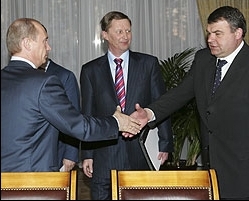
Putin Welcomes Serdyukov as Ivanov Looks On

The fourth anniversary of Anatoliy Serdyukov’s appointment came and went quietly enough on 15 February.  But WikiLeaks has come through as if to mark the occasion.  

On Friday, it posted an Amembassy Moscow assessment of Defense Minister Serdyukov a month and a half after he arrived in the “Arbat Military District.”  Mindful of hindsight bias, one can’t judge this cable too harshly.  But it’s an interesting retrospective on what was expected of the man going in, and what has happened since.

As stated all over the Russian media, Amembassy anticipated Serdyukov would impose discipline on the “Ministry’s notoriously loose financial control system,” and not otherwise initiate major changes.

Aleksandr Golts told Amembassy:

“Serdyukov’s inexperience on military issues would undermine his credibility with the General Staff and other senior officers, hindering his ability to push through needed reforms.”

A bit silly in retrospect.  Yes, he had no credibility with the Genshtab, nor it with him.  But he didn’t care and pushed right through the Genshtab, cutting the Genshtab (it suffered first in the reforms) and building his own bureaucratic machinery in the Defense Ministry.

Amembassy claimed that Serdyukov dismissed then-Chief of the Main Directorate of International Military Cooperation (GU MVS) General-Colonel Anatoliy Mazurkevich, and that Serdyukov’s auditors might be driving other corrupt officers into resignations or dismissals.

The cable describes the Defense Minister aptly as a “detail-oriented micromanager and ruthless policy administrator.” 

But what it doesn’t note (and what has become patently obvious over the last four years) is that the Defense Ministry, and the Russian military, is an unwieldy and untidy establishment not well-suited to micromanagement.  Talk about trying to turn an aircraft carrier on a dime . . . not gonna happen here. 

A couple stories come to mind . . . Serdyukov trying to put new uniforms on the troops, one of his first initiatives.  Now maybe only 20 percent of the troops have them, and the parents of those that do say the new uniforms aren’t as good against the cold as the old ones.

Also, Serdyukov talking about one new brigade commander who didn’t implement his directives.  It’s a big country and a big army.  What Moscow says isn’t always relevant in Chita, etc.

Next, Amembassy summarized the views of Ivan Safranchuk this way:

“He thought the Ministry establishment would try to ‘outlast’ any reforms that Serdyukov sought to impose, with the brass counting on Serdyukov to adjust to their way of thinking — or at least to stay out of their way.  Safranchuk told us that former DefMin Ivanov ultimately had not made a significant impact on how things functioned within the Ministry, despite his reform efforts, and predicted the same fate for Serdyukov.”

This one turned out to be pretty wrong, didn’t it?  There may still be some elements awaiting Serdyukov’s departure and a return to the way things used to be, but too much has changed.  The military establishment can’t ever be exactly what it used to be.  And the brass was definitely no match for Serdyukov, and he didn’t stay out of their way, but rather sent many of them down the highway.  And this Defense Minister has had a greater impact in four years than Sergey Ivanov in nearly six.  Ivanov’s fate was not to be Putin’s successor, and to muddle around in his next job, i.e. First Deputy PM.  As for Serdyukov’s fate, we’ll have to see.  As for his impact, at least some is likely to be lasting.  How long?  Only until the next determined reformer arrives.  None of this is to say Serdyukov’s impact is all positive, mind you.  Some changes may have messed things up worse than they were.  But he got reform off the dime in a way Ivanov never dreamed.

Here’s video of Putin’s meeting with Ivanov and Serdyukov on 15 February 2007.

The cable continues:

“Sergey Sumbayev, a former journalist with Krasnaya zvezda (Red Star), told us that management and accountability within the Ministry were dysfunctional and fostered inefficiency and corruption.  He referred both to financial accountability and responsibility for policy implementation.  Sumbayev thought the Ministry’s entrenched bureaucracy resisted, mostly successfully, institutional change, which generated considerable waste and delayed delivery of modern weapons systems to the armed forces.”

Sumbayev also told Amembassy:

“. . . management experience and tenacious work ethic make [Serdyukov] the ideal ‘technical’ manager that the Ministry needs.  While acknowledging Serdyukov’s political connections, Sumbayev did not think Serdyukov harbored any political ambitions.  He was chosen mainly for his managerial expertise, loyalty, and willingness to please his political bosses.  Serdyukov could probably make progress in streamlining the Ministry’s management structure, reducing waste, and exerting more control over its financial accounting systems.  One year, however, would not be sufficient to accomplish these tasks.”

“Sumbayev speculated that keeping the General Staff off-balance and focused on internal matters over the next year was one of Putin’s objectives in appointing Serdyukov. In this respect, he suggested that Serdyukov had a mandate to shake things up in the Ministry without sparking too much discontent.”

Amembassy concluded that:

“Serdyukov has his work cut out for him in bringing order to a Ministry badly in need of reform.”

Serdyukov’s made progress, but this final assessment probably remains true four years on.

Surprise, Mistral Wins

According to ITAR-TASS, General Staff Chief Nikolay Makarov told journalists today the decision to buy French Mistral helicopter carriers has been made.  He said:

“Today agreement on necessary price parameters is proceeding, and I think all documents will be ready this year.”

There are no technology transfer issues related to Mistral, according to the French Prime Minister.  He said a Russian high-level expert group has been in France talking about price and several technical issues.

The more cautious Prime Minister Putin, for his part, preferred to wait until the official end of the Defense Minister tender, but reiterated that specialists were working in France yesterday to clarify all issues of interest to Russia, and the report will appear later.

The military says the Mistral will appear in the Russian Navy in a year or two, according to the news service.

Serdyukov’s Two Presidents

One can’t avoid Wikileaks forever . . . you’ve already read about “alpha dog” Putin, and Medvedev who plays Robin to Putin’s Batman.  But not many media outlets picked up on Defense Minister Serdyukov’s story, but Argumenty nedeli did.

In early 2009, the Azeri Defense Minister reportedly shared details of his meeting with Serdyukov with the U.S. Ambassador in Baku.  Sufficiently lubricated after sharing two bottles of vodka, Serdyukov allegedly asked his Azeri counterpart:

“Do you follow the orders of your President?”

Then Serdyukov volunteered:

“Well, I follow the orders of two Presidents.”

This is really no more than anecdotal confirmation of what’s been known all along — Serdyukov was put in place by Putin, and he’s part of Team Putin.  While appropriately deferential and respectful of President Medvedev, Serdyukov is very unlikely to get in a situation where he might have to cross his mentors from Team Putin.  Medvedev himself is part of the Team writ large, but he’s from a different, and less influential branch.  So, the ruling tandem has a senior and junior member and everyone knows it.

Not exactly a revelation, but Serdyukov’s admission makes for a funny story, and no small embarrassment for him now in dealing with Dmitriy Anatolyevich.