Monthly Archives: January 2010

Why the Command Changes?

Writing in Grani.ru, Vladimir Temnyy reminds that Komsomolskaya pravda also indicated 58th CAA commander Anatoliy Khrulev would be retired.  This follows a theory that the Defense Ministry is cashiering all commanders from the five-day Georgian war.

But Temnyy says there are more serious reasons for the changes.  He says Serdyukov’s struggle to introduce the ‘new profile’ still has an ‘information-propaganda quality’ and real changes are coming with extreme difficulty, especially in the largest service, the Ground Troops.

According to Temnyy, here is where the greatest structural changes came–more than 20 combined arms divisions liquidated to make 80 brigades.  And although the Genshtab reported last month that all reform plans were fulfilled, today realistically not more than 10 percent of the troops entrusted to former CINC Boldyrev are ready to fulfill combat missions.  The rest are in a drawn out transitional state. 

Temnyy expects more retirements in other services.  He concludes that Serdyukov didn’t get to pick any [well, not many, certainly not most] of these military leaders.  Recent years of war, chaotic reforms, scandal, and intrigue have formed such a pack of military leaders that, if you grab any one of them, you get a real zero.

Some other thoughts…Utro.ru turned to one Yuriy Kotenok, who said the changes are a continuation of the army reforms.  He believes the departure of Boldyrev and Makarov is hard to explain since he calls them the ‘designers’ of victory in the five-day war.  They preserved the training and the units that fought, so in his opinion, their retirement won’t do anything to raise combat readiness or lead to anything good.  About the formula “retired on reaching the age limit” for service, one thing can be said, when the leadership needs it, it falls back on this method.  And considering that several [sic?] hundred thousand officers and warrants have fallen under it, the practice is sufficiently widespread.

Not terribly convincing…

One more try…Gzt.ru quotes a Defense Ministry spokesman, Aleksey Kuznetsov, who said that Postnikov is 53 and this is a good age for a Ground Troops CINC.  Kuznetsov said, in this reshuffling, the Defense Ministry’s desire for younger personnel and rotations is being pursued.  Commanders should get leadership experience in the central apparatus and then take it out ‘to the troops.’

Privately, a number of Defense Ministry sources told Gzt.ru that before the end of May chiefs of staff and deputy commanders would be changed in all MDs.  In the Genshtab, they’re expecting more high-level retirements.  By spring, Serdyukov may shed those generals who don’t agree with something in the reforms he’s introduced.  Vitaliy Shlykov hints that having new command teams in the MDs may not make the reform process easier in the short run, since they’ll need time to get oriented.

Postnikov New Ground Troops CINC

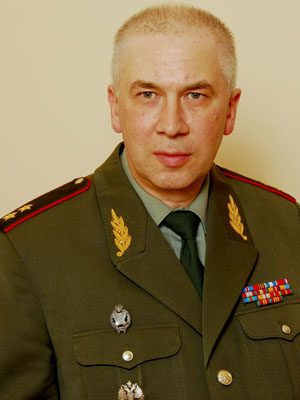
General-Colonel Aleksandr Postnikov

This morning ITAR-TASS reported a number of changes in the Ground Troops and military distict leadership.  SibVO commander Postnikov becomes Ground Troops CINC, replacing Vladimir Boldyrev, retired on age grounds–he just turned 61. 

Postnikov will be 53 in February.  Commissioned in 1978, he’s served in many combined arms command posts, including in the GSFG and several military districts.  He served in army-level staff and command posts in the MVO and SKVO.  He was chief of staff, first deputy commander of the SKVO from 2004 to late 2006, when he moved to SibVO, becoming its commander in mid-2007. 

Postnikov now goes by Postnikov, but his real surname is Streltsov.  After marrying the daughter of former Army General Stanislav Postnikov, he adopted the hyphenated Postnikov-Streltsov, later dropping Streltsov completely.  The recent problems at the frozen ‘Steppe’ garrison in Postnikov’s SibVO didn’t hurt his promotion chances.  He eagerly publicized every SibVO effort to implement Serdyukov’s ‘new profile,’ and it apparently paid off.  

Postnikov’s chief of staff, first deputy commander also benefited.  General-Lieutenant Aleksandr Galkin moves from SibVO to become SKVO commander, replacing 57-year-old General-Colonel Sergey Makarov, sent off to retirement. 

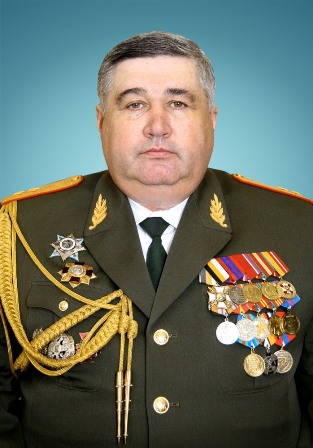
General-Lieutenant Aleksandr Galkin

Galkin commanded the 41st CAA before moving up in the SibVO.  He’ll be 52 in March.  He doesn’t strike as particularly fit. 

General-Lieutenant Vladimir Chirkin will replace Postnikov as SibVO commander.  Chirkin was chief of staff, first deputy commander of the PUrVO. 

General-Lieutenant Vladimir Chirkin

Chirkin once served as chief of staff of the SKVO’s 58th CAA, and later as a deputy commander of the MVO.  He served in the GSFG and several MDs.  He will be 55 this year.  Interestingly, he was born in Khasavyurt, Dagestan and has four children.  He needs more apartment space. 

In a move that may reflect continued downgrading of the central apparatus and staff in Moscow, the very junior General-Major Sergey Surovikin will leave the [once?] prestigious Genshtab Main Operations Directorate (GOU) to replace Chirkin as chief of staff, first deputy commander in PUrVO.  Officers used to leave GOU only to move up or to retire. 

General-Major Sergey Surovikin

Surovikin commanded the 20th CAA before replacing the very experienced General-Colonel Rukshin as GOU Chief before the war with Georgia in 2008.  Surovikin will turn 46 this year.  He reportedly fought in Afghanistan, Tajikistan, and Chechnya.  He commanded the 34th and 42nd MRDs.  He is said to come from the ‘iron fist’ school of military leadership.  While commanding the 34th, one of his colonels blew his brains out in front of the entire staff after Surovikin upbraided him.  Serdyukov’s weeding out of GOU apparently occurred on Surovikin’s watch; about 500 posts, including lots of colonels and generals were reportedly eliminated from GOU in late 2008 and early 2009. 

It’s strange Surovikin would return to the ‘sticks’ so soon, and simply to what would be the next rung of the career ladder for him.  Did he cope with the GOU assignment or not?  Maybe he accomplished what was intended and wanted to return ‘to the troops.’  But his GOU tour seems like an abbreviated one. 

General-Lieutenant Andrey Tretyak moves from chief of staff, first deputy commander of LenVO to take over GOU from Surovikin.  Before his LenVO tour, Tretyak commanded the 20th CAA, and served in various MDs plus the GSFG. 

General-Lieutenant Andrey Tretyak

Tretyak is probably about 50-51, and was born into a serviceman’s family in Soviet-occupied East Germany. 

Finally, General-Major Ivan Buvaltsev will take Tretyak’s place as LenVO chief of staff, first deputy commander. 

General-Major Ivan Buvaltsev

Buvaltsev has been serving as first deputy chief of the Defense Ministry’s Main Combat Training and Troop Service Directorate.  He previously headed the MVO’s combat training directorate and commanded a tank division.

Thrust Control Problem on Bulava

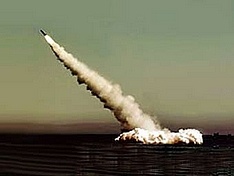
Bulava Test (photo: IA Rosbalt)

 Aleksey Nikolskiy in Vedomosti reports that Bulava testing will resume this summer.  He says the problem in December may have been a defect in the third stage engine, not a design flaw. 

Tests may resume this summer from the modified Dmitriy Donskoy SSBN.  Yesterday ITAR-TASS reported a minimum of two tests would be conducted from Donskoy.  If successful, testing would move to the missile’s intended platform, the new Proyekt 955 Yuriy Dolgorukiy, this fall.  

A Navy Main Staff representative told Vedomosti that Dolgorukiy would need to fire several missiles in a salvo launch.  An industry source said, if all these tests were successful, a “preliminary document on completion of the first phase of testing” could be signed and serial production of the missile could start. 

The Defense Ministry and OPK commission investigating the December failure has provided optimism for those involved, according to a source close to the commission.  In his words, a third-stage thrust control mechanism produced by the Perm-based NPO Iskra failed in the December test.  So some conclude the missile’s overall design is sound and it makes sense to continue work on it. 

Mikhail Barabanov says “shock work” on Bulava might be risky, since MIT already promised that it could produce the missile quickly and cheaply.  Konstantin Makiyenko reiterates the lack of an alternative missile to keep a naval component in Russia’s strategic nuclear forces. 

Denis Telmanov in Gzt.ru adds that a Defense Ministry source has not excluded the possibility that another design bureau, possibly Kolomna Machinebuilding, has gotten orders to work on a missile.  The Makeyev GRTs is another possibility, but its deputy general designer responded that quick development of a missile was physically impossible.  He said, even from an existing system, it would take 5-6 years.  And he said no one in the country’s leadership has taken a decision to start work on a new missile. 

All stories repeated the expressions of support for Bulava from the Defense Minister and Navy CINC.

Moscow Makes Note of U.S. Exercise with Estonia

In Gazeta, Denis Telmanov covers plans for a U.S. amphibious landing exercise in Estonia on 11 July.  According to Tallinn, 500 U.S. Marines will land from the USS Whidbey Island (LSD-41) and conduct a 10-day exercise with an Estonian recce battalion.  Estonia’s Defense Minister says this exercise will show that NATO’s serious about defending the Baltic states.  He said it won’t have any aggressive character, and therefore won’t harm relations with Moscow.  Telmanov raises the issue of whether this exercise prepares a defense against Russia in a Georgian-style scenario.

Then Telmanov turns to Leonid Ivashov to comment and he’s at his vitriolic best.  Ivashov calls the exercise hidden aggression against Russia, “When exercises are conducted, a situation is played out, no one just simply conducts exercises.  In every instance, the U.S. wants to work out scenarios of military action in these countries, since they see a threat from Russia.” 

Ivashov thinks the U.S. has the strategic aim of gaining “maneuver room” in the Baltic.  He concludes, “Controlling this territory, it’s possible to organize everything there as it suits–color revolutions, crises.  But the Baltic–this is a sore point for Russia, right next to the second capital–St. Petersburg.  These exercises need to demonstrate how far these three countries have moved away from Russia.”

New Officers’ Honor Code and Ethics Needed

Over the weekend, a Defense Ministry source told Interfaks-AVN that, until 1 February, officers in units, brigades, and ships are discussing a new honor code.  Deputy Defense Minister Nikolay Pankov is leading this broad discussion on the “moral profile of the contemporary Russian officer.”

A new set of corporate ethics for officers will be adopted during the Defense Ministry’s 3rd All-Army Assembly of Officers this November in Moscow.  The Assembly will address raising the educational level and professionalism of officers, the “social-legal” defense of servicemen, and raising the status of officers in society.

Today Aleksandr Konovalov told Gzt.ru that military men need to choose their work as service to the people not just a profession, and officers need to have higher standards than average citizens.  He describes his idealized vision of an officer who has a high sense of justice and duty, values the lives of his subordinates, and won’t use the army for anyone’s private interests, including those in power.

Vitaliy Shlykov also gave Gzt.ru his view on military professionalism.  He says there are now way too few instructors who can impart the qualities officers need–competence, traditions and ethics, and corporateness.  The basic provisions of the new code need to be laid out first though, according to Shlykov.

Konovalov wants to start from scratch.  “New profile officers” have to be formed outside the existing army traditions, which have appeared spontaneously and not always honorably.

How does this square with the reality that officers commit most crimes in the Russian Armed Forces?  Not well.

In the midst of an optimistic army crime report on 26 November, Krasnaya zvezda admitted:

“One of the main problems is the growth of legal violations among officers, including stealing budget money allocated for defense needs, and other corruption crimes by military officials.  The scale of ‘officer’ crime has reached the highest level in the last decade.  Today every fourth registered crime among the troops is committed by this category of servicemen, a third of them are of the corruption type.  The losses caused to military units and organizations by these crimes have increased by one-third and exceed the half-billion level.  The structure of this type of crime has substantially transformed.  Today the theft of military property and financial means is almost half of all the legal violations of officers.  The quantity of cases of bribetaking, of forgery of duty positions, of appropriations, and expenditures has grown substantially.”

According to KZ, senior officers are more often the perpetrators.  In the last year, they committed more than half of all illegal acts.  In 2008, 20 generals and admirals were held criminally responsible, 1,611 officers, including 160 unit commanders, were found guilty.  Out of the 874 people held criminally responsible in 2009, 162 were commanders of units, 127 were colonels and captains 1st rank and 14 were general officers.  More than 270 people were convicted, including 3 generals.  In 2009, over 5,500 law violations were uncovered in this sphere over the course of prosecutor inspections.  The losses amount to 2 billion rubles.

The smaller officer corps–now 150,000 according to the Defense Ministry–and the possibility of dramatically higher pay for all officers by 2012 might reduce officer crime and make those officers who are still part of the ‘new profile’ more honorable and ethical.

More on ‘Steppe’ Garrison, How Not to Handle PR

According to RIA Novosti, the SibVO has declared ‘Steppe’ fully restored in  heating.  Recall that 2,000 were without heat since 22 December and 100 residents were evacuated in temperatures as low as -47 C (-53 F).  All apartment blocks and the school have heat now.  The restoration ultimately required joint efforts by repair crews from various locations in the SibVO, the Air Forces, and Zabaykalskiy Kray.

The apartment management unit chief, Lieutenant Colonel Konstantin Kondrashov, charged with negligence in maintaining the garrison’s communal services faces a maximum punishment of three months arrest.  The authorities say the repair work costs millions of rubles.

They plan to restore heat to the kindergarten by week’s end.  There are minor problems still in two buildings and one boiler needs another piece of equipment.

Today’s Rossiyskaya gazeta criticizes the SibVO for concealing the problems in ‘Steppe.’  At first the command said there was only a problem with one boiler, but in fact all three in the boiler house broke down, leaving all 2,000 inhabitants without heat.

One resident said, by 28 December, it was +2 C in her apartment with two electric heaters going.  The electric grid couldn’t handle the load.  At this point, people started calling the news agencies and the governor for help.  And the military denied that ‘Steppe’ had been without heat for a week and said there was a problem in only one building.  On 26 December, the SibVO claimed electricity was restored to all three buildings that lost it due to the extraordinary load on the grid.  On 30 December, Lieutenant Colonel Kondrashov said all buildings were getting heat.

One officer said:

“Everything they say about restoring heat is complete bull.  All buildings have ruptured pipes, one after another batteries in apartments give out.  But the garrison’s leadership gives the impression that everything’s normal here!  The SibVO leadership sits in warm offices, not knowing the real situation, I wish one of them had come here.  My name is Nikolay, I’m an officer, serving right now in Steppe.  Believe me, we’re dying out here.  The command hasn’t done anything in the course of a week and concealed the crisis.”

On 30 December, Kray officials intervened with help for the garrison and the situation had improved by 6 January.  On 8 January, 20 repair crews were working in Steppe.

But maybe the incident had something to do with the poor condition and obsolescence of the garrison in the first place.

Unrest in the Black Sea Fleet?

In Part 2 of his article, Shurygin ended by describing the Black Sea Fleet as being on the verge of an explosion.  We’ll see if he elaborates on this in the final part when it’s published.

Meanwhile, on 12 November, Moskovskiy komsomolets wrote about thousands of officers and families in Sevastopol “thrown to their fate,” without the possibility of getting a job in Ukraine, and left practically without money and housing.  The author, Yekaterina Petukhova, like Shurygin, said the situation in Crimea is on the “verge of revolt.”

Young BSF Officer and Guided Missile Cruiser Moskva

According to Petukhova, 2,000 BSF personnel were cut in 2009, and another 9,000 have been warned that they will be dismissed.  She talked to an officer named Oleg, who said he was one of the “fortunate” ones who were put outside the fleet’s TO&E.

The situation’s not worse anywhere.  They’ve already cut thousands, now they’re mowing down the command and control organs.  When they put you outside the TO&E, for a half year they still pay your salary, but minus premiums and minus the supplement for handling secret information.  But this is nevertheless some money.  But then it’s all gone.  View it however you want.  But we’re all here with Russian citizenship.  Where are they going to let us work?  And we can’t go back anywhere in Russia.  They don’t want to give us the service apartments in Sevastopol which we lived in all this time.  They are proposing several cities in Russia, but there really aren’t apartments there—it’s excavation that could go on forever.  And so officers sit, they don’t get pay, nor can they finalize a pension without a permanent residence permit.

Oleg went on to say that single officers especially don’t know what to do.  They aren’t giving out single apartments and, if they get together with a friend and apply for an apartment for two, they are derided as homosexuals.

He gives his view of how it might end. 

Can you generally imagine such a crowd of healthy men, who know military matters firsthand, wandering around Crimea and the quays?  Some kind of Lenin will be found and he’ll raise a crowd, then people will wish he hadn’t turned up.  The fleet commander is silent, everyone spits on us, a kind of chaos is being created.

Petukhova ends by noting that when Kyiv makes a move against the BSF, Moscow politicians race to the defense of Russian sailors, but they’re all silent when the Russian authorities have driven thousands of BSF men and their families to the edge.  She concludes that the ‘new profile’ of the armed forces has an unpleasant odor.

Still Restoring Heat at ‘Steppe’ Garrison

The press reports heat has been restored in 8 of 10 buildings and the school.  Repair crews are working inside 2 buildings restoring the internal heating and water supply system.  They are replacing old electrical, heating, and water supply equipment.

The school will reopen 14 January, and some residents who have heat and water have started to return to their apartments.

Railroad Troops Officers Put in Sergeant Posts

Railroad Troops Working in Abkhazia

Today a Railroad Troops spokesman provided a year-ender for these bastard children of the Defense Ministry, and he described their efforts to adopt a ‘new profile’ in 2009.

Most interestingly, the spokesman said that the Railroad Troops have placed 300 excess officers, mostly lieutenants and senior lieutenants, in sergeant billets.  These men, who’ve suddenly discovered they’re no longer officers, will be the first to be promoted into officer positions when they become available, according to the spokesman.  He also said a similar scheme for preserving officer cadres, i.e. demoting them into the NCO ranks, exists in the other services and branches of the armed forces.

So rumors that officers were being ‘offered’ transfers into the NCO ranks turn out to be true.  This was reported as far back as the closure of the SibVO’s 67th Spetsnaz brigade late last winter, but had not been confirmed until now.

The Railroad Troops also put over 1,000 warrant officers into sergeant’s posts, but this downgrading was always an overt part of the Defense Ministry’s plans.

The Railroad Troops spokesman said 1,500 officers and 1,200 warrants were dismissed in 2009, and nearly 1,800 officers and warrants entered the limbo of being placed at the disposal of their commanders, i.e. they’ve lost their duty posts and are outside the TO&E.

Housing remains a problem.  About 3,000 personnel need apartments, or improved housing conditions.  The Railroad Troops need 1,700 apartments for dismissed servicemen.  They were allocated 472 apartments and 81 state housing certificates (GZhS).

Moscow Upgrading CSTO?

Nogovitsyn to be First Deputy Chief of CSTO's Joint Staff (photo: http://www.1tv.ru)

Several days ago, the Russian press reported General-Colonel Nogovitsyn, a deputy chief of the Genshtab and Russian military spokesman during the war with Georgia, would be moving to the Collective Security Treaty Organization (CSTO).  Nogovitsyn’s an air defense fighter pilot and former deputy CINC of the Air Forces who lost out to Zelin in the bidding to become CINC.  He will replace General-Lieutenant Oleg Latypov, who was not an operator, but a military diplomat who came from the Russian Defense Ministry’s Main Directorate of International Military Cooperation (GU MVS) and had experience in arranging arms sales, supplies, and military activities with former Soviet states.

Nogovitsyn’s move could be a pre-retirement posting or it could mean a little more emphasis on the Russian-led grouping.  Today, Interfaks-AVN reports that an operations center will be established for the Collective Rapid Reaction Force within the CSTO’s Joint Staff.  The chief of the center will be a general-lieutenant and deputy chief of the Joint Staff.  These changes follow decisions on a new structure and functions the CSTO made at its meeting last June.