Monthly Archives: July 2010

Pulling Back on Buying Abroad?

Is the Defense Ministry pulling back the reins on efforts to purchase foreign-made weapons and other military equipment?

Late last month, armaments chief Vladimir Popovkin said that Moscow would put German armor on its combat vehicles, perhaps laying to rest rumors that Russia might buy entire vehicles abroad.

Last Thursday, Popovkin and others seemed to put limits on buying more UAVs from Israel, calling the process more of a learning experience to improve Russia’s domestic models.

Then Friday, the press says OSK may have started a formal antimonopoly complaint against Defense Ministry efforts to buy the French Mistral helicopter carrier.  But OSK Board Chairman, Deputy Prime Minister, and Putin confidant Igor Sechin is in charge of negotiating Mistral’s purchase from Paris.

It certainly seems that the reins have been pulled back on foreign procurement somewhat.  But there’s a lot to these threads and not enough time to run them down.

New Commander, Old Fleet

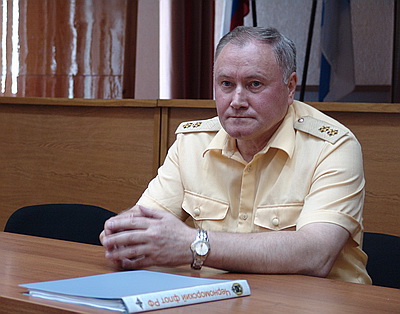
Vice-Admiral Korolev (photo: Novyy Region)

As expected, Northern Fleet Chief of Staff and First Deputy Commander, Vice-Admiral Vladimir Ivanovich Korolev (Королёв) officially replaced Vice-Admiral Aleksandr Kletskov as Commander of the Black Sea Fleet on 2 July.  

Turning 55 next month, Kletskov retired on age grounds, but, as only Kommersant bothered to note, Korolev turned 55 in February, so President Medvedev has either officially extended his service a couple years, or plans to give him another star, allowing him to serve to 60, under the law. 

Novyy Region quoted Navy CINC Admiral Vysotskiy introducing the new BSF Commander: 

“Vice-Admiral Korolev is a competent leader, possessing good personal knowledge and work habits, both in the staff and in command duties.” 

About Korolev’s background . . . after finishing officer commissioning school in 1976, he was assigned to a Northern Fleet nuclear submarine, serving as a division head in the navigation department.  

According to Kommersant, in the mid-1980s, he served in the Gadzhiyevo-based 24th Division of Submarines (24th DiPL).  He eventually served as executive officer and commander of Victor II-class (proyekt 671RT) SSNs  K-488 and K-387.  He completed mid-career Higher Specialized Officer’s Classes in 1987. 

In 1993, he became Deputy Commander of the 24th DiPL, and completed his advanced education at the Kuznetsov Naval Academy in 1995.  He then moved to the Northern Fleet’s Operations Directorate as chief of an unidentified department, then chief of fleet ASW.  

By August 2000, he was Commander of the 24th DiPL, and in 2002 became Commander of the Sayda Guba-based 12th Squadron (24th and 18th DiPLs). 

On 19 November 2007, Korolev became Deputy Commander of the Northern Fleet, and was appointed Chief of Staff and First Deputy Commander in August 2009. 

Media reports haven’t mentioned whether he’s married or has children. 

Korolev faces a large number of unresolved military and social issues in his fleet.  It has an extremely high percentage of old ships that aren’t combat capable.  Some problems with Ukraine persist despite the recent improvement in relations and the Kharkov agreement extending Russia’s Crimean presence to 2042, as well as the promise of 15 new ships and submarines which followed it. 

Independent analyst Aleksandr Khramchikhin told Novyy Region Korolev inherited a fleet in bad shape: 

“The fleet is in a state of disappearance, complete collapse.  It’s obvious the commander needs to stave off this collapse somehow.  But I don’t understand very well how this can be done.  Because these promises of numerous ships don’t correspond very much to the record of recent decades, and it’s extremely hard to believe in them.” 

“The basic mission of the fleet commander is to try to keep the fleet from dying, even though its service life is close to zero.  He can’t do anything because he doesn’t build ships.  The Black Sea Fleet has gone to the limit of obsolescence.  It’s the very oldest of our fleets.  It’s the only one of the fleets in which there are still ships built in the 1960s.  It’s the only one in which there’s been practically no kind of renewal in the post-Soviet period.” 

“It’s hard to understand what missions are being given to the BSF.  Let’s say it can’t even be closely compared with the Turkish Navy in forces, it is so much weaker.  I repeat, our entire Navy is in a state close to collapse, but the Black Sea Fleet is in first place in this regard.” 

An anonymous BSF staff source told Novyy Region Korolev’s first task is to replenish the fleet with new ships, not just secondhand Baltic Fleet units.  His second job is placing orders for repair and construction of ships not just at the BSF’s 13th Factory, but at Ukrainian shipyards as well.  

The fleet’s social problems are next.  It has hundreds of officers whose duties were eliminated, but they can’t be dismissed since they don’t have apartments.  The source says these guys are walking around in uniform, but have no jobs.  Korolev’s fourth task is a related one–returning Moscow Mayor Luzhkov to full engagement in Sevastopol.  Luzhkov is no longer building apartments there as he has in the past owing to a dust-up with the Defense Ministry over the handling of property in Sevastopol.  

Lastly, Korolev has some real naval missions to worry about like securing southern energy routes, the 2014 Winter Olympics, antipiracy operations, and keeping a Russian presence in the Mediterranean. 

Regarding Admiral Vystoskiy’s promise of new ships and submarines for the BSF, Moscow Defense Brief analyst Mikhail Barabanov told Kommersant the civilian and military leadership may see the fleet’s reinforcement a priority because it may more likely see real combat action than the Northern and Pacific Fleets.  

A Kommersant BSF staff source describes Korolev’s main mission not as planning for new ships by 2020, but simply supporting the combat capability of a fleet contracting before our eyes.

Naginskiy ‘Freed’ From Housing Duties

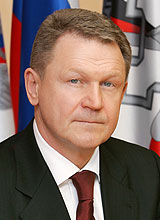
Grigoriy Naginskiy

This morning’s press reported (with varying degrees of accuracy) that the Chief of Housing and Construction, Deputy Defense Minister Grigoriy Naginskiy has been ‘freed’ from his principal duties, but remains a Deputy Defense Minister.  See Kremlin.ru for the text of President Medvedev’s decree.

The midst of a year of trying to deliver on huge permanent military housing promises seems an odd time to make yet another change of housing chief.

The decree also moved a two-star named Sergey Zhirov from his post as Chief of Staff, First Deputy Chief of Rear Services to a position called “Director of the Department of Planning and Coordination of Rear Support of the Defense Ministry.”

These could be the opening moves in Defense Minister Serdyukov’s reported effort to establish a unified material support establishment responsible for arms, equipment, and all logistics.

Extra Kant Security Sent Home

Russian press services announced this morning that extra VDV troops sent to Kyrgyzstan last month as security reinforcements returned home yesterday.

The VDV’s spokesman said:

“. . . in connection with the reduced tension in Kyrgyzia [sic] reinforced security sub-units at Kant air base from the 31st Independent Guards Airborne-Assault Brigade returned to their place of permanent deployment [Ulyanovsk] on Wednesday.”

“Three Military-Transport Aviation Il-76 aircraft transported 270 servicemen of the brigade commanded by Dmitriy Glushchenkov.”

This reduced strength battalion deployed to Kyrgyzstan on 13 June after increased fighting between Kyrgyz and ethnic Uzbeks in the country.

According to Newsru.com, the spokesman said two VDV companies deployed earlier will remain to secure Russian facilities and nationals in Kyrgyzstan:

“At present two companies of airborne troops sent to Kyrgyzia according to the decision of the General Staff Chief in April continue to provide security to the military facilities of Kant air base.”

Those companies comprise about 160 men according to reports at the time.

Old Weapons Good Enough, or Worn Out?

In Tuesday’s Gzt.ru, Denis Telmanov writes that Vostok-2010 features arms and military equipment that is 20, or sometimes 30 years old.  Neither the Defense Ministry nor independent experts see anything terrible about this, though they worry it could become physically worn out.

Telmanov says the exercise relies on old weapons systems like the Mi-24, Tu-22M3, and the Petr Velikiy.  The latter was laid down in 1986, and didn’t join the fleet until 12 years later.  The overwhelming majority of Pacific Fleet ships in the exercise were also laid down in the 1980s, and are at least 20-plus years old.  Even the vaunted Su-34 first flew in 1990, but didn’t go into operational use until 2007.  The remaining arms and equipment were developed in the 1960s and 1970s, and produced at the end of 1980s and early 1990s.

This state of affairs allows the Defense Ministry to show that the Russian military can fight successfully with the equipment it has.  The military’s press service chief wouldn’t comment for Gzt.ru on the age of systems taking part in Vostok-2010, except to say they’re the same as those on combat duty in formations and units in the rest of the Armed Forces.

The spokesman said:

“Today the army uses the equipment that it has.  And one of the missions of the exercise is to show how effectively established missions can be fulfilled in the new TO&E structure with this equipment.  The effectiveness of military equipment really doesn’t depend so much on its age, as on skill in using it and on how it corresponds to the established missions.  The course of the exercise still shows that the equipment is fully combat ready and allows troops to fulfill these missions put before them completely.  But it’s understood that this in no way diminishes the importance of the planned modernization and introduction of new equipment which will enable troops to act even more effectively.”

He cited EW equipment and the Su-34 as new systems being used in Vostok-2010.

Gzt.ru goes on to remind readers that, for over a year, President Medvedev and Defense Minister Serdyukov have taken pains to tell Russians the majority of the country’s armaments are obsolete or worn out.  Serdyukov said the share of modern military equipment in the inventory was only 10 percent.  That’s when he and Medvedev launched the campaign to increase this figure to 30 percent by 2015 and 70 percent by 2020.

CAST Director Ruslan Pukhov says the absence of serious military threats makes the next ten years a good time to do this:

“. . . Russia has a window of opportunity the next 10 years, and it isn’t threatened by war.  It’s necessary to use these 10 years to bring the armed forces into a condition in which they can repulse any threats which arise.”

Pukhov says the Black Sea and Baltic Fleets should be modernized first, Iskanders deployed to deter Georgia, and S-400s in the Far East to counter North Korean missiles [recall General Staff Chief Makarov’s claim last year that S-400s were there?].

Mikhail Barabanov of Moscow Defense Brief says the problem is not age, but physical wear:

“40-year-old ships and 30-year-old tanks are now almost gone.  In reality, the problem of old equipment in our Armed Forces is not so much its age as the amount of equipment wear and tear.  That leads to breakdowns.  For example, in the Vostok-2010 exercise the guided missile cruiser Moskva didn’t succeed in launching its Vulcan [SS-N-27??] anti-ship missiles.  As a result, missile boats with Moskit missiles destroyed the target.”

Nevertheless, Barabanov remains confident that, even with aging weapons, Russia’s military is superior to neighboring armies, including China’s:

“On the whole, the equipment level of Russian units in the Far East is generally adequate to perform defensive missions, although not at the highest level.  It’s another issue that the equipment is badly worn out.”

Barabanov is not against buying new equipment of older designs:

“Even if industry’s existing models can be criticized for deficiencies from the standpoint of modern requirements, the fact remains they will be physically new, with a full service life, and allow for significantly increasing the combat readiness of troops.”

Telmanov ends by reminding readers of President Medvedev’s late 2009 pledge to provide the military 30 land-based  and naval ballistic missiles, 5 Iskander missile systems, nearly 300 pieces of armored equipment, 30 helicopters, 28 aircraft, 3 nuclear submarines, a corvette, and 11 satellite systems in 2010.

Not Enough Officers in ‘New Type’ Brigades?

In today’s Vedomosti, Aleksey Nikolskiy writes that Vostok-2010 has revealed a problem with officer manning in Russia’s ‘new type’ brigades.

In the course of the exercise, practically all SibVO and DVO permanent readiness units have been ordered to training ranges to test out their new TO&E and train their higher-level command elements.

Nikolskiy says:

“In the words of an officer of one of the motorized rifle brigades participating in the exercise, the new structures sent to the troops at the end of 2008 after the beginning of Armed Forces reform showed that officer manning and supply services are extremely inadequate, for this reason part of the brigades’ forces — for example, air defense means — can’t physically reach the training range.  There were bigger problems also with material support of the troops.”

Vedomosti’s source also says the troops are expecting new brigade structures in August that, according to the rumor, will contain even fewer officers.  A brigade’s officers will reportedly be halved, from 200 to 100, and this will just make the situation worse.  However, an officer from the Defense Ministry’s central apparatus says the new structures are being prepared based on the shortcomings of the exercise, and, if it’s decided there aren’t enough officers, their number will increase.

Battalion Travels Lighter in Mobilnost Redux

Krasnaya zvezda covered the opening phases of Vostok-2010 for those willing to plod through or skim the article.  Motorized rifle brigades are taking turns practicing defeating bandit groups, the VVS are providing air support to MVD Internal Troops units, and PVO battalions are conducting night firing exercises with new C2 systems.

RIA Novosti and ITAR-TASS reported that nearly 600 Volga-Ural Military District (PUrVO) troops were flown to the Far East on Tuesday (29 June) to participate in summer’s marquee training event.  Four Military-Transport Aviation (VTA or ВТА) Il-76MD transports delivered a battalion tactical group (BTG) with only light weapons to join in the operational-strategic exercise (OSU or ОСУ). 

According to ITAR-TASS, General Staff Chief, Army General Nikolay Makarov said that in the course of Vostok-2010:

“. . . issues are being broadly worked out about the expedience of redeploying at a great distance trained personnel which have to take military equipment held at mobilization bases and immediately go into combat.”

This certainly sounds like a military establishment not fully embracing an idea, at least right away.

According to Krasnaya zvezda, a BTG from the 28th Independent Motorized Rifle Brigade flew 6,000 kilometers from Koltsovo, outside Yekaterinburg, to Vozdvizhenka, north of Ussuriysk, on a 10-hour flight with a refueling stop at Belaya near Irkutsk.  The 28th was built on the base of a regiment of the old 34th MRD.

Krasnaya zvezda said the battalion moved via truck to an armaments and equipment storage base [БХРВТ] at Sibirtsevo for outfitting with heavy equipment.  The 247th BKhRVT was established last year with the remnants of the former 121st MRD.  After removing equipment from storage and some training, they were slated to join tactical combat firing at Sergeyevka.

Acting PUrVO Commander General-Lieutenant Sergey Surovikin saw off the battalion; he commanded the brigade’s forerunner—the 34th MRD in 2004.  The brigade’s commander, Colonel Anatoliy Sinelnikov, was Surovikin’s deputy division commander in 2004 when it first sent a BTG to the Far East.

Krasnaya zvezda asked Surovikin to compare the current redeployment with the earlier one six years ago in Mobilnost-2004:

“Then a sub-unit with all of its TO&E equipment was sent into action.  And it fulfilled its assigned mission.  The current exercise is being conducted according to the General Staff’s decision which specifies checking the expedience of means of redeploying troops on various strategic axes.  In this instance, the exercise is being conducted only with personnel – without transporting combat equipment and heavy weapons to the Far East.  But it allows us to check the possibility of redeploying troops in other strategic directions.  And to conduct such a redeployment in a very short period.  And using for these purposes Military-Transport Aviation aircraft as well as civilian airlines.”

“In this exercise, means of regrouping troops in short time periods are being tried.  By comparison:  if in OSU Mobilnost-2004 we could send a battalion of the 276th Motorized Rifle Regiment of our division by air to the Far East together with its combat equipment and vehicles in 8 days, then this time such a battalion will get there in significantly less time.  And the quantity of aircraft take-offs to transport the very same sub-unit to another theater of military operations was reduced more than ten times.  High strategic mobility is achieved with much lower expenditure of forces and budget resources.”

While not exactly a Russian Reforger, this redeployment exercise looks like working smarter, not harder.  So it represents some payoff from the effort to turn understrength, excess units into mobilization bases.  Of course, one has to believe there’s still some element of the set piece in all this.  The battalion being moved was probably one of the best, and the BKhRVT was probably well-prepared to hand out the necessary weapons and combat vehicles.

Popovkin on Bulava Testing

Newly-minted First Deputy Defense Minister Vladimir Popovkin told RIA Novosti Wednesday that the State Inter-Departmental Commission on the Bulava SLBM completed its work in June, concluding that it’s essential to continue testing the missile.

Speaking at the international forum ‘Technologies in Machinebuilding – 2010’ in Zhukovskiy, Popovkin said:

“The state commission created to study the causes of recent failed Bulava launches completed its work in June and came to a conclusion about the necessity and possibility of conducting further testing.”

As noted in Grani.ru, Popovkin had no comments about other findings by the commission.

Krasnaya zvezda echoed an Interfaks report in which Popovkin was asked whether there will be a salvo firing of two or more Bulava missiles from the same SSBN.  He responded:

“Let us conduct one launch, and then we’ll announce plans for further testing.”

According to this report, Popovkin said the testing program calls for a minimum of three launches in 2010.

Only 5 of 12 Bulava tests have been successful, and its last test on 9 December failed as well.

Recall that in May Defense Minister Serdyukov said renewed Bulava testing would be put off until fall, allowing time to exert control over the missile assembly process to help identify possible technical defects.  He said three identical missiles would be produced in the effort to ferret out flaws in them. 

Meanwhile, on 30 June, a source in the missile and space industry told ITAR-TASS that the RVSN’s new RS-24 Yars ICBM has already been placed on combat duty.  Earlier an MIT source had said one RS-24 was on ‘experimental-combat duty’ with the RVSN.

Testing Army Reforms in Vostok-2010

Readers seem eager for anything they can get on Vostok-2010.  Here’s something. 

Russia’s largest maneuvers of the year, Vostok-2010, began June 29, and continue until July 8.  This broad-scale operational-strategic exercise (OSU or ОСУ) encompasses the Siberian and Far East MDs, as well as the Pacific Fleet—in other words, what will reportedly become the new Far East MD or operational-strategic command (OSK or ОСК) before the end of 2010.  

General Staff Chief, Army General Nikolay Makarov talked to RIA Novosti and ITAR-TASS at length about Vostok-2010 recently.  He said the Far East was chosen for its broad expanses, limited infrastructure, and difficult weather and climate.  Eleven combined arms, 3 air forces, and 4 naval training ranges will be used.  Makarov noted up to 20,000 soldiers, 2,500 weapons systems and pieces of equipment, 70 aircraft, and 30 ships will take part in the exercise. 

Makarov said Vostok-2010 will be a logical continuation of last year’s large training events.  Beyond Defense Ministry forces, operational groups and sub-units from the MVD, FSB, FSO, MChS, and FSIN will participate.

As is customary, Makarov said the maneuvers:

“. . . are not directed against any real country or military-political bloc.  They have an exclusively defensive orientation for ensuring the security and defense of the state’s interests on the Far East border against a notional enemy.”

And the exercise’s theme is:

“. . . preparation and employment of formations [military units] in a new TO&E structure to fulfill missions in isolated sectors to ensure the Russian Federation’s military security.”

Makarov said the maneuvers will:

  • Check the effectiveness of the newly-created three-level system of troop command and control;
  • Evaluate the readiness of new TO&E formations and military units to  conduct combat actions in isolated sectors in a constantly changing situation, as well as their mobility and combat possibilities;
  • Resolve training and command and control issues at the operational-strategic and operational level while conducting combat actions;       
  • Organize coordination of military command and control organs with the troops and military formations of other federal ministries and departments, and also local organs of executive authority in resolving joint missions; and
  • Investigate the capabilities of a unified system of material-technical support (MTO) which was created during the structural reformation of the army and fleet.

The exercise will include special operations, air defense and ship combat firings, and air and amphibious assaults.  Makarov said the RVSN will join the exercise play, but no ICBM training launches will occur.  Military transports will bring independent sub-units from the Moscow and Volga-Ural MDs to join the exercise, but they will draw their weapons and equipment from Siberian and Far East storage bases.

Makarov noted the participation of an unidentified number of Su-24M and Su-34 aircraft arriving from Central Russia during a direct flight with aerial refueling.   Black Sea Fleet flagship Slava-class CG Moskva and Northern Fleet Kirov-class CGN Petr Velikiy also completed long-range cruises to participate.

Makarov said new operational and operational-strategic level command and control posts will be used in the exercise, as will ‘fifth generation’ radio communications gear and future soldier systems under development at Sozvezdiye.  Iskander operational-tactical missiles and Russian-made UAVs will also be employed.

Siberian MD Commander, General-Lieutenant Vladimir Chirkin told Krasnaya zvezda the exercise will focus on defensive operations, but also special operations to localize and destroy irregular armed formations in several RF regions.  He said there will be more than a little new given that new combat regulations will be used.  He added:

“We’re moving away from linear tactics, from large-scale front operations.  As the experience of local wars and armed conflicts in recent years shows, there’s no need to utilize a massive quantity of forces and means to conduct front and army operations.”

In Nezavisimaya gazeta, Vladimir Mukhin focused on the logistics of Vostok-2010.  He noted Rear Services Chief, General-Colonel Dmitriy Bulgakov’s expectation that President Medvedev will soon issue a decree combining the jobs of Chief of Armaments and Chief of Rear Services.  And leaving First Deputy Defense Minister Popovkin’s old job vacant could be a hint of this.  After Vostok-2010, Mukhin expects a new deputy defense minister for material-technical support (MTO), presumably Bulgakov, to be appointed.

A lot of the activity before Vostok-2010 has apparently involved trying out new combat service and support arrangements.  A special logistics exercise tested the new MTO system.  And this year, according to Mukhin’s information, ten MTO brigades will be formed, one for each combined arms army.  The Railroad Troops will reportedly be downgraded to a directorate and each MD (OSK) will absorb the Railroad Troops units on their territory.

Krasnaya zvezda described these exercises.  Rear Services troops used 4,000 men, 30 units of different sizes, and 1,000 pieces of equipment in a pipeline-building exercise, training to repair damaged bridges over the Aga River, and refueling a brigade before its Onon River crossing.

General-Colonel Bulgakov talked about the new MTO regiments and the exercises.  He said they are permanent combat readiness units which have all necessary troops support structures and sub-units.  This was the first test of the new TO&E structure for logistics.  Based on the results, Bulgakov thinks this year the army can move from material support regiments (PMO) to material support brigades.  In every district (OSK), there will be a minimum of two, according to him.  Unlike regiments, material support brigades (BMOs?) will have repair and maintenance battalions.  Brigades were chosen to conform as much as possible to the prevailing three link ‘district-army-brigade’ command scheme.

Trud’s Mikhail Lukanin put Vostok-2010’s most difficult missions this way:

  • Moving troops great distances, including Siberian river crossings;
  • Supplying fuel, ammunition, and food to the area of combat actions;
  • Conducting an amphibious assault under enemy fire.

Prominent commentators view Vostok-2010 as a test of the success of Defense Minister Serdyukov’s army reforms.  Trud talked to independent defense analyst Aleksandr Khramchikhin who said:

“Military reform has gone on already for more than a year and a half, but there’s still no answer to the main question:  what have we gotten from it?  That is, after radical cuts in the officer ranks, the reorganization of military command and control organs, turning former divisions into combined arms brigades, are the Armed Forces capable of conducting modern combat actions.”

Anatoliy Tsyganok believes the army made a hash of Zapad-2009, with only 30 percent  of Russia’s maneuver brigades receiving good evaluations, most only satisfactory, and a handful unsatisfactory.  Presumably, he doesn’t expect to be more impressed by Vostok-2010.