Monthly Archives: March 2011

VVS Taking VMF’s Land-Based Fighters and Bombers

Vesti.ru has rebroadcast Interfaks information from a Main Navy Staff source who says, on 1 April, Naval Aviation (VMA) will begin transferring its land-based fighter and bomber aircraft to the Air Forces (VVS).

By year’s end, the VVS will get the Navy’s remaining Su-27 fighters, MiG-31 fighter-interceptors, long-range Tu-22 [sic] supersonic bombers, and also part of the VMA’s transport aircraft.

Russian Naval Aviation Tu-22M3

The Interfaks report will probably get garbled into all aircraft, or all land-based aircraft, going to VVS, which is not the case, as it makes its way into other Russian and English language news stories.

VMA will retain control of its Il-38, Tu-142, and Be-12 ASW aircraft, and its deck-based aircraft, the Su-33 fighter and Ka-27 helicopters, according to the Interfaks source. 

According to the Vesti.ru article, missile-carrying naval aviation has deteriorated since the Soviet collapse, and only the Northern and Pacific Fleets have long-range ASW aircraft which, it claims, amount to only 25 Il-38 and 15 Tu-142.  It says the Baltic Fleet has no ASW aircraft, and the Black Sea Fleet only four old Be-12 likely to be completely worn out by 2015.

The article notes that the Su-33, Su-25UTG trainer, multipurpose Ka-27 and Ka-29 combat-transport helicopters will remain in the air wing of heavy aircraft-carrying cruiser Fleet Admiral of the Soviet Union Kuznetsov.  There are reported plans to procure 26 MiG-29K fighters for Kuznetsov.

Here’s a nicely done, data-filled Russian language Wiki article on Russian Naval Aviation.

VMA lost something else recently.  A BMW-X5 used by VMA Chief, General-Colonel Igor Khozhin was stolen in Moscow on Friday, according to Interfaks.

ITAR-TASS also reported Friday that more than 80 RVSN aircraft — An-72, An-26, and Mi-8 helicopters — will also be going over to the VVS starting on 1 April.

Ivashov’s Inevitable Revolution

Leonid Ivashov

Ex-GU MVS Chief, retired General-Colonel Leonid Ivashov was apparently either asked or inspired to comment recently on the revolutions in North Africa.  And his comments got some press play beyond the blog where they originally appeared.  Ivashov is an inveterate conservative who always has sharp jabs for the U.S., NATO, and globalization.  But he’s an interesting guy whose anti-Western commentaries usually end up criticizing the Kremlin and Russian policies as well.

They apparently asked Ivashov whether Russia needs to fear a repetition of Tunisian, Egyptian, or Libyan events.  He goes on for a couple paragraphs with his view that the Arab world’s lagging behind in economic and social development explains what happened in North Africa.  Then he turns to its relevance for Russia:

“The situation is much more complex in Russia.  A revolution here is unavoidable.  It will become an attempt to find its own future and course of development that preserves Russia as a unitary state, both Russian and remaining native peoples – as a national-social formation.  Under the current course and regime, Russia has no future.  Catastrophe looms ahead – the country’s division and collapse, the departure of the Russian world from the historical arena.  These are objective data – when you look at government statistics even, your hairs stand on end.  There are approximately one hundred million Russians, 23 million alcoholics, 6 million drug addicts, 6 million sick with AIDS, 4 million prostitutes.  We have the very highest percentage of disadvantaged families, for every thousand marriages, 640 divorces.  Revolutionary transformations are simply necessary.  Let’s hope to God they come in a peaceful way.”

“What is happening now in the Middle East gives us reason to talk also about our degradation.  Yes, Mubarak, Qaddafi and the rest stole, hoarded riches for themselves, however there has never been in the history of a single state such complete plunder as is occurring now in Russia.  Two oligarchic clans, privatizers of resources and bureaucrats have sucked everything out of the people and the country.  Real incomes of the population in January compared with January of last year have decreased by 47%.  Oil gets more expensive — our gas gets more expensive.  Oil gets cheaper — our gas still gets more expensive.  Prices for food and other things constantly increase.”

“A handful of powerful bureaucrats and oligarchs close to them understand perfectly that there’s no avoiding a revolution.  Therefore they’re hurrying to suck everything up and tie their business to foreign structures.  So that when they start taking their assets away, they can call on NATO to defend them.”

“Russia doesn’t have its own Middle East geopolitical project.  We are extremely inconsistent — we sign military agreements with Israel, we institute sanctions against Iran, irritating the Islamic world.  Medvedev calls Qaddafi a criminal for firing on his own people.  At the same time, they put up monuments to Yeltsin who fired on his own people and his own parliament.  Such a contradiction shows the complete cynicism of our current vlasti.”

“The fighting in Russia will undoubtedly begin, and it will be, unfortunately, much more severe — since the country is multinational.  In the Middle East, they call their own Arab presidents occupiers, but we also have other peoples.  And if anti-Semitism in the Arab East is aimed beyond the borders of their own countries, at Israel or the U.S., then Russian anti-Semitism is directed inward.”

Would the Army Oppose Siloviki Loyal to Putin?

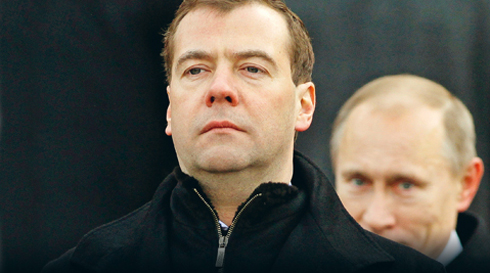
Medvedev and Putin (photo: Reuters)

An unnamed FSB veteran thinks it would.

Monday New Times published a piece on the state of the tandem and political prospects over the next year leading up to the elections which will determine who will be Russia’s president until 2018.

The article’s authors ask whether Medvedev and Putin, frightened by North African events, might be determined to preserve the status quo by any means.  Or perhaps the president and prime minister face an inevitable clash.  The authors have consulted unnamed experts and present their findings.  Scenario No. 2 is Apocalypse Tomorrow.  The mood of the siloviki – in this case, rank-and-file men with uniforms, ranks, and guns – is key to Scenario No. 2 – the tandem blown up.  The authors ask “how would the siloviki conduct themselves if Medvedev decided to fire the premier and his entire government?  On whom would the experts bet?”

The authors asked former USSR intelligence and special service veterans of coup d’etats to sketch out what we’d see in the event of Apocalypse Tomorrow.  They sketch out some of the things Putin and the government would do in addition to calling for the support of the siloviki.

In the end, the article examines the possibility that Putin might agree to go, with the right personal and financial guarantees in place.  His situation is not, after all, exactly like Mubarak’s or Qaddafi’s.

The article ends like this:

“’Putin can hardly count on the silovik bloc if the matter gets to mass bloodshed,’ even a highly placed employee of the FSB’s Spetsnaz Center, which today joins in its structure Directorate A (formerly Group A) and Directorate V (formerly Group Vympel).  ‘His sole full-blooded reserve capable of entering the fray is the Internal Troops [VV], and mainly the VV Spetsnaz’ – the so-called maroon berets.  ‘They are the ones in 1993, after one of the Vympel groups refused to participate in suppressing the civilian population, who fulfilled the given mission’ (this means preventing the storming of the Ostankino television center – New Times).  ‘As far as the FSB Spetsnaz goes, after so many years of ‘reforming’ silovik sub-units, officers will scarcely be zealous in putting down civilians.  Quite the opposite.  It wasn’t for this that they risked their lives in the Caucasus.’  The weakest link, in the opinion of the same expert, is the army:  ‘Among the troops there’s a lot of negative information and dissatisfaction with the reforms that are being introduced.  Promises that a lieutenant will soon receive 50 thousand rubles just remain promises, the apartment issue isn’t resolved.  After the mass dismissal of officers – just in the past year 140 thousand completely young ‘reservists’ were put out in the streets – they will easily return to the ranks [i.e. Serdyukov’s reversal increasing the officer ranks by 70,000], but now they know who their enemy is.  Plus the disbanding of the GRU Spetsnaz.  As a result, the opposition will have something to oppose the Internal Troops.  So the generals will think a thousand times before giving the order to open fire, and if there is the slightest suspicion about the illegitimacy of the mission received, they’ll do everything to sabotage it.’”

“The experts polled by New Times come together on one thing:  a bloody scenario has a greater than 50% probability in one case:  if the premier and his closest silovik circle seriously fear for their lives and property and don’t get a security guarantee.  And now before their eyes there’s even a living example:  going peacefully into retirement Mubarak has a chance to preserve part of his billions frozen in Switzerland, Qaddafi shooting at his own people no longer has such a chance.”

Interesting scenarios, but there are a couple things your present author isn’t so sure about.  Firstly, two things not factored in that could be significant are:  the mood of the average militiaman [i.e. cop] who are very numerous and are also being ‘reformed,’ and the unhappiness among military retirees and older vets demonstrated recently in their Moscow assembly and last year on Poklonnaya gora.  One’s not sure, though, if they’re more supportive of Medvedev or Putin.  Given the choice, they’d probably shoot both.  Secondly, is Medvedev really the type to enter that kind of standoff (or any standoff actually) while holding very few, if any, good cards to play?  At the same time, one is cautious about assuming rational actors.  It’s perfectly conceivable the Russians could blunder and miscalculate their way into Apocalypse Tomorrow.

Meanwhile, Ancentr.ru was following a similar tack earlier this week . . . it looked at the recent personnel decisions regarding General-Lieutenant Valeriy Yevnevich which moved him from the GUBP to Deputy Chief of the General Staff and then to Assistant to the Defense Minister (ostensibly, to advise on peacekeeping activities).  The website thinks this interesting since Yevnevich is a ‘political’ general who as Taman division commander supported President Yeltsin in the 1993 battle with his opponents.  And, it says, such a decisive and staunch supporter of ‘democracy’ as Yevnevich could be useful to vlasti in a responsible post given the general growth in political tension in society, including also a “rise in disloyalty in the army.”  For example, he could command special VDV or other sub-units in an emergency to ensure their loyalty to the regime.  Ancentr.ru goes on to detail other reports from NVO’s Vladimir Mukhin about the level of discontent in the army’s ranks as well as ex-General Staff Chief and Security Council staff member Yuriy Baluyevskiy’s possible role as leader of a military backlash against Defense Minister Serdyukov’s reforms.

Navy Still Not Moving to Piter (Yet)

A highly placed Defense Ministry source tells RIA Novosti there’s no final decision on moving the Navy Main Staff (NMS) from Moscow to St. Petersburg.  It’s been, of course, 3-1/2 years since the issue was first raised.

The press agency source says:

“There are two approaches.  The first is the Navy Main Staff remains in Moscow, and here the efficiency of resolving issues and tasks with the RF Defense Ministry wins and the second is the Navy Main Staff, with significantly reduced personnel, transfers to Saint Petersburg, where the scientific and shipbuilding base of the fleet is concentrated.”

According to this source, the pluses and minuses of both approaches are being calculated in the final phase of forming the command and control system of the Armed Forces.  The question of the NMS location is approached from the point of view that even temporary weakening in the command and control system for naval strategic nuclear forces (MSYaS or МСЯС) is unacceptable:

“The focus is placed on the effectiveness of the functioning of this system.  Whether the Navy Main Staff as just one attribute [of this system] transfers authoritative functions to St. Petersburg or remains in Moscow is not so important.  It’s important that the deployment location should be defended in a corresponding manner and not allow confusion in the general system of Armed Forces command and control.”

There is, according to the source, no doubt it’s essential to preserve the unitary structure of strategic nuclear forces command and control in the future:

“It follows that the Navy command in the form of the Navy Main Staff or, let’s say, a Navy department [департамент] is essential for coordinating the strategy of using the Navy in cooperation with the new regional commands [OSKs].”

He adds that, while OSKs West, South, Center, and East are complete, it still remains to distribute precisely the command and control functions for general purpose forces and strategic nuclear forces.

RIA Novosti’s interlocutor makes all this sound like the main issue may be less the move itself, and more one of figuring out the relationship and responsibilities of the now stronger and more significant MDs / OSKs and the somewhat diminished service main commands (Glavkomaty).  Perhaps the Navy Glavkomat is arguing with OSK West and OSK East over what is part of the strategic Navy, or supports strategic naval operations.

And Interfaks also has an item today saying that the Defense Ministry has ordered the NMS to prepare to move to St. Petersburg.  This came from an informed source in the Navy Glavkomat.  The written order contains no precise date for the move, but the source thinks the “active phase” of relocating will begin in July.

Malfeasance, Mayhem, and Murder

We haven’t looked at the military crime blotter for a while.  And the last two weeks have been particularly rich with various types of incidents.  The sentences handed down in recent days are, of course, for crimes committed earlier.  While some criminals in shoulderboards are getting caught, it leaves one wondering how many offenses go unknown and unpunished.

  • A conscript named Sergey Avdeychik was beaten severely on the parade ground of the Pechenga-based  200th Motorized Rifle Brigade (v / ch 08275).  The Murmansk School of Music graduate’s had surgery twice, his spleen removed, and he’s still too critical to relocate to a better hospital.
  • A negligence case is being brought against the ex-commander of the Space Troops’ Command Center, Colonel Aleksandr Karpenko.  He apparently forwarded the name of an officer with a “severe reprimand” along with a list of other officers slated to receive monthly bonuses [i.e. Order 400A premium pay] for excellent performance.  As a result, Karpenko’s subordinate received 470,000 rubles illegally last year.
  •  Conscript Nikolay Dorin apparently died of meningitis in Vladivostok.  He complained of a headache, and medics treated him with some pills, but they wouldn’t admit him to the military hospital in Vladivostok because it was already overflowing with patients.
  • The Eastern MD military prosecutor tells the media he’s worried about the rise in “nonregulation relations” [i.e. dedovshchina and other violence and crime], and the deaths of servicemen.  He says his experience shows it’s not the shortening of the service term that’s to blame, but rather the more than doubling of the number of conscripts [actually, two sides of the same coin], as well as serious shortcomings in the work of some commanders.
  • Then there’s the somewhat stunning case of the former chief of the Defense Ministry’s Main Directorate for Indoctrination Work (GUVR or ГУВР), General-Lieutenant Anatoliy Bashlakov.  Now Bashlakov wasn’t some old washed-up political officer.  He’s an ex-RVSN missile regiment commander turned Space Troops officer.  Apparently while commanding the Defense Ministry’s Plesetsk cosmodrome, Bashlakov accepted a 700,000-ruble bribe from a company interested in getting the base’s radioactive waste disposal contract.  Bashlakov received a pretty steep 7-year sentence.
  • An officer of the Chelyabinsk voyenkomat got caught taking a 200,000-ruble bribe for falsifying someone’s military service record.
  •  A conscript got crushed under BMP treads in Amur Oblast.  The armored vehicle’s commander has been charged with “violation of the rules of armored vehicle operation resulting in the death of a person through carelessness.”
  • A VDV Warrant Officer named Ayrat Akbashev received a 3-year sentence for killing of one of his subordinates, a contract soldier named Artem Ovechkin.  While they were repairing a BMD, the two argued, and Akbashev threw a log being used as a prop in Ovechkin’s direction.  It hit the latter in the head, and he never regained consciousness.
  • A cellphone video showing two Khabarovsk conscripts abusing a third made its way to the Internet.  You can view the somewhat sanitized version here.  Or the grittier original here.  The two guys are apparently from the Eastern MD headquarters’ security company and the guy whose head they put in the floor urinal is a conscript cook who hadn’t paid back money they lent him.  A little military loan sharking.
  • A conscript from Dagestan, one Esedulla Navruzbekov, got 3.5 years for killing another conscript in the unhappy 200th Motorized Rifle Brigade in Pechenga.  Both men were in the hospital at the time, and got in a fight when Navruzbekov butted in line in the dining hall.
  • A former VDV company commander in Ryazan (v / ch 41450, the 137th Parachute-Assault Regiment), Captain Mikhail Sevastyanov received a 60,000-ruble fine for extorting money and valuables from his subordinates in exchange for not reporting them to military investigators.
  • A soldier named Aleksey Samokhvalov got a 50,000-ruble settlement from a court for damages after being beaten by his sergeant in a unit in Novosibirsk last year.  He originally asked the court for 400,000.

PAK FA Engine Update

Saturday ITAR-TASS printed an interesting update on the PAK FA engine story.  It doesn’t really clarify anything (actually quite the opposite), but it’s part of the story. 

Recall last spring the engine designers were saying developing a “second phase” engine for PAK-FA could take another 5-6 years, while Sukhoy was saying it might be 10-12 years.  In what follows below, the engines aren’t specifically identified as “second phase,” but they are called “seriously distinct from the 117S.”

General Designer of the A. M. Lyulka Scientific-Technical Center (a Moscow subsidiary of NPO Saturn) Yevgeniy Marchukov claims the construction of an engine for the fifth generation fighter is going successfully, and it will go into serial production. 

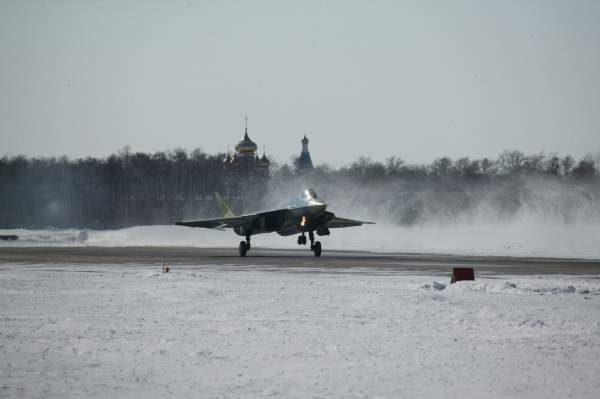
The second experimental T-50 reportedly took off with this engine on 3 March.

Marchukov said:

“The engines in the experimental prototypes of the future Russian fifth generation fighter are seriously distinct from the 117S engines intended for Su-35 aircraft, both in their parameters and in their fundamentally new automated control system.  The T-50 aircraft with NPO Saturn engines fully corresponds to the tactical-technical requirements for the aircraft.  And with these engines produced serially, the PAK FA will be supplied for the needs of the Russian Air Forces.”

For his part, Saturn managing director Ilya Fedorov noted that the enterprise “supported the takeoff of the aircraft in the necessary time,” just as it was ready for flight.

ITAR-TASS goes on to add that special stand tests and service life tests on the engine continue at the Lytkarinskiy Machinebuilding Plant (another Saturn subsidiary).  Ground development is being conducted on the T-50-KNS model with aircraft systems from OKB Sukhoy at the Gromov Flight Test Institute.  Flight tests are also ongoing.  T-50-1 has more than 40 flights, the T-50-2 two flights, and the Su-27 flying laboratory has 32 flights.

“New Profile” in Transbaykal

Nezavisimoye voyennoye obozreniye’s Viktor Litovkin wrote recently about his Defenders’ Day press pool visit to the 212th District Training Center (OUTs or ОУЦ) in Peschanka, and to the 29th Combined Arms Army in Chita.  Formerly part of the Siberian MD, they’re now in the Eastern MD or OSK East.  Litovkin set out to see how the military’s “new profile” has been implemented in the four years since he last traveled to Transbaykal.

Litovkin said the army’s future “junior specialists,” i.e. better trained conscript sergeants, aren’t just using simulators, and there’s lots of live action on OUTs ranges and training grounds.

Simulators at Peschanka (photo: V. Litovkin)

The majority of trainees were in training for a minimum of 8 hours a day, not including individual training and PT time.

OUTs Chief, General-Major Sergey Sudakov is new himself, but says much has changed at the center.  He says they’ve gotten new simulators, training buildings and barracks have been renovated, and the mess hall’s been outsourced so conscript-trainees no longer have to pull KP.

Four years ago, the Siberian MD listed 5,970 personnel without housing, but now only 120.  Those without apartments have been taken off the local books, and all their data’s been sent to the Defense Ministry’s Housing Support Department in Moscow. 

Now, however, there are rasporyazhentsy (распоряженцы), those officers, warrants, or sergeants at their commanders’ disposition, in all, more than 200 waiting for permanent apartments outside Transbaykal.  But only 2-3 per month are getting a “letter of happiness” from Moscow saying they’ve been allocated housing, and, in many cases, it’s not in the location they wanted.

The rasporyazhentsy were once commanders and chiefs but now they muster every morning to get orders from their former subordinates.  They don’t get anything serious to do.  They pull assistant duty officer for a unit once a week, or carry out a major’s orders for less than half their old pay.

Medic Senior Sergeant Zhanna Litvinenko is a rasporyazhenitsa who’s waited two years for an apartment in Rostov-na-Donu or Krasnodar Kray.  While waiting to return to “mainland” Russia, she lives on “bare pay,” without supplements, of 16,900 rubles, of which 3,200 pays for her dorm room.

Litovkin visited the officers’ dormitory to see what’s changed since 2007.  He describes familiar noisy corridors with common toilets, showers, and kitchens for officers and their families.  The building’s been renovated, old wooden window frames and the boiler have been replaced, kitchens updated, and showers divided so men and women don’t have to use them on alternating days.

One Captain Rinat Abubekirov and his wife say the load on officers has grown sharply now that there are fewer of them.  The tank training regiment had 140 officers previously, now 98, in a company, there were 7, now 5, and the number of additional duties is unchanged.  A company commander is now a captain, rather than a major as in the past.  Abubekirov has been an O-3 for five years, and no one can tell him when he might make O-4.

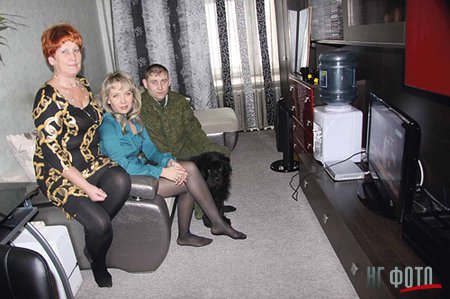
Litvinenko and the Abubekirovs in the Officers' Dorm (photo: V. Litovkin)

Training their conscript charges has changed.  Instead of six months, they now have three to do it.  The trainees’ education level varies greatly now — from higher education to some who didn’t finish high school.  Many conscripts arrived in poor health, and the severe Transbaykal winter doesn’t help either.  Minus forty isn’t rare, and -30° (-22° F) is the norm.  They are just not physically or psychologically prepared.  Nevertheless, OUTs Commander Sudakov says fewer are sick this winter than last.

Then, Litovkin turns to the Chita-based 29th Combined Arms Army commanded by General-Major Aleksandr Romanchuk, where the NVO editor says he sees “solid changes.”  All its units are fully manned and permanently combat ready.  In what’s become a fairly common refrain, Romanchuk believes his army’s combat potential exceeds that of its predecessor [the Siberian MD]. He said he and his deputy spent a month at the General Staff Academy learning the new automated command and control system.  He said his best subordinates can earn 100,000 rubles per month in bonuses.

Litovkin says there are questions about the introduction of new equipment in Romanchuk’s command.  It would be good if its tanks and combat vehicles could be replaced quicker.  There are no UAVs or PGMs.  The army relies on T-72B1, BMP-2, Strela-10 and towed air defense guns, and self-propelled Akatsiya and Msta-B artillery.

Litovkin concludes that, while no one believes Mongolia or China will threaten Russia’s borders today or tomorrow, this army needs to train in a real way, with equipment from the 21st century, not the last one.

But this, he continues, is not even the greatest problem.  He was told at every level that it’s simply not possible to make yesterday’s schoolboy into a good specialist in a year.  The commander of the 29th CAA’s 200th Artillery Brigade, Colonel Dmitriy Kozlovskiy, told Litovkin this spring he’ll lose 70 percent of his personnel.  New gun commanders, gunners, radiomen, and reconnaissance, topographic, and meteorological specialists will arrive and in less than a month they’ll need to work like crews, platoons, and batteries, like a unified combat mechanism.  They will learn and leave the army, and the process will begin again.

Sounds like a Russian O-6’s plea for professional enlisted and NCOs . . . .

Litovkin finishes with a story from Romanchuk.  He tells of a tank gunner conscript who hit his target [a 1 — an excellent in Russian training terms] on his 39th day of service.  He said he just did everything as he was taught, and as he did on the simulators.  In times past, according to Romanchuk, tank gunners got to fire live rounds only after serving six months, and this guy scored a 1 on his 39th day.  But Litovkin asked how his buddies did.  Romanchuk answered 2s and 3s.

Ground Troops and the GOZ

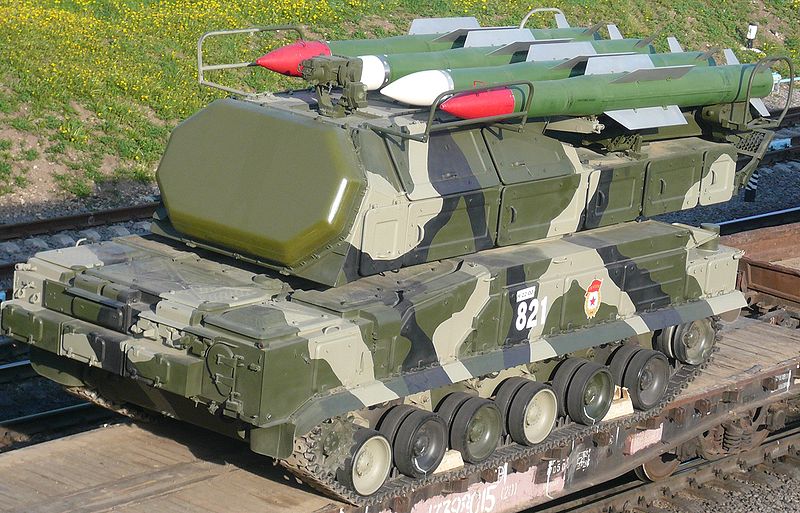
Buk-M2 (SA-17 / Grizzly)

Discussions of service wish-lists for State Armaments Program (GPV) 2011-2020 have tended to overlook the Ground Troops.  It seems they don’t enjoy the same priority as other services.

But in late February and early March, there was a flurry of press detailing what the land forces intend to procure, at least in the short term. 

Arms-expo.ru, Lenta.ru, and other media outlets put out brief items on Ground Troops’ acquisition.  They indicated the Ground Troops will emphasize air defense, command and control, fire support, and BTRs and support vehicles.

But the best run-down of all came from Ground Troops CINC General-Colonel Aleksandr Postnikov himself in Krasnaya zvezda.

Postnikov told the Defense Ministry daily that the main feature of GOZ-2011 is the transition from the repair and modernization of existing systems to the purchase of new, modern ones to reequip Ground Troops formations and units completely.

First and foremost, according to the CINC, the Ground Troops will buy modern digital communications equipment and tactical-level automated command and control systems (ASU), like Polyana-D4M1 for air defense brigades.  He said Ground Troops’ Air Defense will also receive modernized S-300V4 systems, Buk-M2 and Buk-M3, short-range Tor-M2U(M) SAMs, and manportable Igla-S and Verba SAMs.

Postnikov says they will continue equipping missile and artillery brigades with the Iskander-M, new MLRS, self-propelled Khosta and Nona-SVK guns, Khrisantema-S antitank missiles and Sprut-SD antitank guns.

The Ground Troops CINC says he foresees purchases of a new modification of the BTR-82A, BREM-K armored recovery vehicles built on a BTR-80 base and BREM-L on a BMP-3 base, Iveco, Tigr, and Volk armored vehicles, and new KamAZ trucks from the Mustang series.

NBC defense (RKhBZ) troops will get the heavy flamethrower system TOS-1A, RPO PDM-A thermobaric missiles with increased range and power, and VKR airborne radiological reconnaissance systems.  Engineering units will get the newest water purification system on a KamAZ chassis (SKO-10/5).

In the longer term, Postnikov sees rearmament as one of his main tasks, and he repeated President Medvedev’s statement that the Ground Troops should have 30 percent modern equipment by 2015, and 70 percent by 2020.  He laid special stress on getting YeSU TZ into the troops.  Postnikov’s Glavkomat has a Concept for the Development of the Ground Troops Armament System to 2025 emphasizing standardization, multi-functionality, modular construction, and electronic compatibility across several general areas:  armor and military vehicles, tube artillery and MLRS, SSMs, antitank systems, air defense, reconnaissance-information support, UAVs, communications, automated command and control, and soldier and close combat systems.

Ten Armies

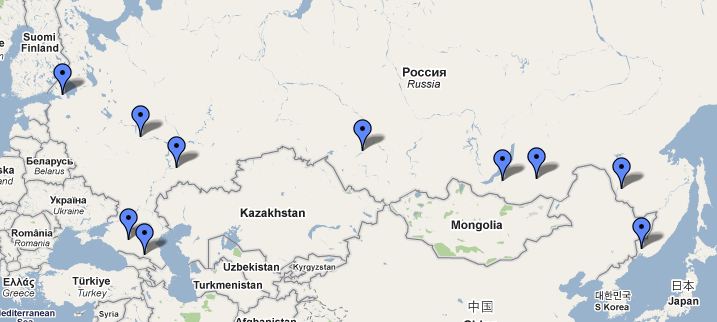
The Russians have been talking for some time about adding three armies to their existing seven, and here they are, along with their commanders, after a little research.

Ten Armies

Army Headquarters MD / OSK Commander
6th CAA Agalatovo Western General-Major Yevgeniy Ustinov
20th CAA Nizhnyy Novgorod Western General-Major Sergey Yudin
49th CAA Stavropol Southern General-Major Sergey Kurilenko
58th CAA Vladikavkaz Southern General-Major Andrey Kartapolov
2nd CAA Samara Central General-Major Aleksandr Zhuravlev
41st CAA Novosibirsk Central General-Major Vasiliy Tonkoshkurov
36th CAA Ulan-Ude Eastern General-Major Vladimir Tsilko
29th CAA Chita Eastern General-Major Aleksandr Romanchuk
35th CAA Belogorsk Eastern General-Major Igor Turchenyuk
5th CAA Ussuriysk Eastern General-Major Andrey Serdyukov

Second PAK FA Prototype Flies

Novyye izvestiya has 1TV’s video coverage and story on the flight.

Pilot.strizhi.info posted these photos, along with links to the high resolution originals from Sukhoy.org.

Second PAK FA Takes Off

Landing

PAK FA Chutes Deployed