Category Archives: Civil-Military Relations

The New Face of Russian Defense Policy

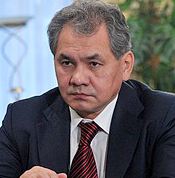
Sergey Kuzhugetovich Shoygu

Quite a surprise, a shock.  An interesting choice.  An ethnic Tuvan, an engineer who spent his post-Soviet life heading MChS — the Ministry of Emergency Situations, who was Governor of Moscow Oblast for just six months.

It’s a hard to imagine Shoygu advancing change and reform in the military to the degree Serdyukov did.

Despite his successes, Anatoliy Eduardovich was done in by offending his estranged mentor, father-in-law, and close Putin confidant, Viktor Zubkov.  The straw that broke the camel’s back was when police found the Defense Minister at Vasilyeva’s apartment, just below his own (how convenient), at 0600.

Ironically, Serdyukov wasn’t done in by the corruption of his young, largely female team of civilian administrators and former tax service officials.  And perhaps he wasn’t done in by his own corruption.  We’ll have to see what fate awaits him.

Serdyukov came close but didn’t match Sergey Ivanov.  Serdyukov spent 2,091 days as defense minister to the latter’s 2,150.

Can’t help but feel Shoygu won’t come close to either number.

Not a Fish, But a Crawdad (Part I)

It’s nice when you send yourself on a sabbatical.  But it’s terrible when your first post of the month doesn’t come until the 24th.  Seriously, this author should be flogged for neglecting the reader.  And he isn’t exactly prepared to dive back into frenetic posting either.  Only to hang more text out here now and again.

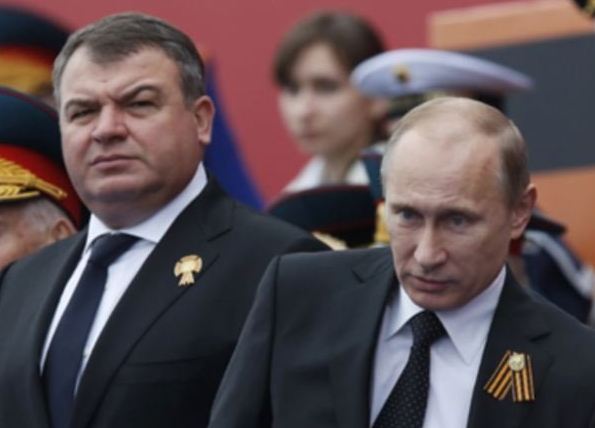
Serdyukov with Putin (photo: AFP)

This topic and title were stolen from Topwar.ru.  The site picked up on Kommersant’s examination of why Anatoliy Serdyukov was one of only five ministers to retain his post in the first Putin 2.0 government.

Kommersant claims Serdyukov came somewhat close to being retired in December when, at then-Prime Minister Putin’s behest, FSB Director Bortnikov searched out potential replacements.  Bortnikov looked at Rostekh’s Chemezov, Roskosmos’ Popovkin, and Deputy PM and OPK steward Rogozin.  The former pair convinced Putin of the “inexpedience” of making either of them Defense Minister in Serdyukov’s place.  Rogozin reportedly was willing, but, of course, already had a higher-ranking post.

Kommersant’s Ivan Safronov cited Aleksandr Kanshin and a Defense Ministry apparat source to the effect that Putin decided it’d be better to have Serdyukov see the military reform process through to its conclusion.

For its part, Topwar.ru also attributes Serdyukov’s “unsinkability” to a desire to avoid changing leadership in the midst of reform.  It also writes that Anatoliy Eduardovich turned out to be, at least in some ways, the best available and most willing candidate.  Topwar sums Serdyukov’s position up with this adage:

“When there aren’t any fish, even a crawdad is a fish.”

But Anatoliy Rak isn’t likely to replace Taburetkin as a nickname for the Defense Minister.

The most interesting part of Topwar’s account, however, may be the large number of commentaries, which we’ll look at in part II of this post.

Ivashov on the Army and Putin

Leonid Ivashov

Leonid Ivashov recently talked to Narodnyy politolog on a variety of army topics including reforms, the possibility of a big war, rearmament, president-elect Vladimir Putin, and his military program.  Segodnia.ru also printed the interview.

Once Russia’s top military diplomat, now avowed geopolitician, the former three-star thinks Putin fears externally-driven regime change and is improving the army to forestall such an eventuality.  Ivashov sees a U.S.-led West depriving Russia of allies before focusing on Russia itself.

Asked about army reforms, Ivashov says they have succeeded in cutting forces, but not in rearming them or improving their social conditions.  Reforms have degraded and weakened the army.  Military men mock the New Profile reforms saying, “There’s a profile, but not armed forces.”  Ivashov calls reforms craziness, and says it’s like servicemen have lived in a house under continuous repair for 25 years.

Following up his comment on mobilization reserves cut to the bare minimum, NP asked the retired general-colonel if a big war is possible today.

Ivashov says yes.  Citing how “they” are beating up Russia’s strategic allies (Syria and Iran), he says “What is this if not war?”

Ivashov foresees a large conflict between the U.S. and China and possible spinoff regional and local wars.  He cites a Chinese specialist who calls for a Russian-Chinese alliance to deter a big war and curb the appetite of the West and international oligarchs.

Is Russia ready for such an eventuality?  Ivashov answers:

“I think Putin understands perfectly how military weakness and the absence of strategic allies can be the end for Russia.  Clearly, the Libyan situation ‘helped’ him understand this, just like what is happening now in Syria, and what they are preparing for Iran.  If you can’t defend the country, you are subjecting yourself to a great risk personally.”

“Now Putin is making a sharp turn to the side of strengthening defense capability.  One can only welcome this.  Because today they don’t simply beat the weak, they destroy them.”

Ivashov calls Putin’s military program ambitious, if not systematic.  The regime’s been in a “light panic” since Libya.

He intimates that more than 20 percent of the state armaments program will be stolen since the amount of theft cited by the military prosecutor covers only cases under investigation, not all corruption.

Ivashov suggests lobbying has replaced forecasts of future military actions as the driver of arms procurement.

The case of Mistral, which one wonders where it will be built and how it will be used, Ivashov says well-connected lobbyist structures ensure what gets produced is exactly what their enterprises make.  He was somewhat encouraged that Putin, at Sarov, entertained turning to specialists and experts to examine the army’s requirements.

On GPV 2020, Ivashov concludes it’ll be a serious step forward if only half of what’s planned gets produced, but it can’t be equipment designed in the 1970s and 1980s.  He sees OPK production capacity problems too.  He questions whether Votkinsk can produce 400 solid-fueled ballistic missiles by 2020.

Returning to the big war, he questions a focus on defensive operations for Russian conventional forces, saying offensive capabilities are needed to deter potential enemies.  He claims reduced force structure and mobilization capability have become a joke in the General Staff:

“The main problem for the Chinese in a conflict with us is not defeating our brigade, but finding it.”

Ivashov’s just a little up in arms over the armor situation.  He all but accuses the General Staff Chief of being a paid (or bribed) lobbyist for foreign tank and armored vehicle makers.  He suggests that Army General Makarov should be placed in cuffs if he says the Leopard-2 is better than the T-90 [what about Postnikov then?], and the Main Military Prosecutor should investigate him.

So what is to be done first and foremost to strengthen the country’s defense capability today?

Ivashov replies get rid of Serdyukov and Makarov who have done great damage, and strengthen cadres in the OPK and military by replacing “managers” with those who can apply military science (as Ivashov was taught) to the problem of developing new weapons.

The always provocative Ivashov doesn’t venture whether he thinks  the current emphasis on defense capability will continue or have the intended results.  He seems sincerely to believe in a possible Western intervention in Russia’s internal affairs.  But it’d be more interesting to hear him talk about whether the army would fight for Putin’s regime in something less than that maximal contingency.  Ivashov, unlike some critics of Russia’s defense policy, shies away from blaming the once-and-future Supreme CINC for at least some of the current military state of affairs.

The Winner Is . . .

Putin, politics, and industrial policy.

One loser, for sure, defense policy.

Putin got his 63 percent.  He didn’t need fraud to get 50+ percent and avoid a second round, but he (or someone) wasn’t willing to take that chance.  The cheating should have drawn a flag for piling on or unnecessary roughness.  That it happened says something about Putin’s fear of being out of power.  But we digress.

Politics won over policymaking, not least of all in defense policy.

Yes, Russia is not the only place this happens.  It happens in most of the world’s democratic states.  This doesn’t prove Russia’s a democracy; it just proves Russia has politics.  But so did the USSR.  It had fights between industry and the military.

But back to our story.

Promises and populism secured votes for Putin in Russia’s industrial centers where they’ve waited years for serious defense orders.  He’d have won here without writing checks his treasury might not be able to cash.  But the once-and-future Supreme CINC made pledges he may hope factory workers forget before 2018.

If they don’t, working class disgruntlement may mingle with urban, middle class discontent in an increasingly flammable political mixture.

The case in point here is tanks and Uralvagonzavod in Nizhniy Tagil.  Did Putin court anyone, or any defense enterprise, more than the General Director of UVZ Oleg Siyenko?  Did anyone get comparable preelection attention?

The closest we get is Putin’s intervention between the Defense Ministry, OSK, and Sevmash to solve their submarine pricing dispute last fall.  But industry didn’t exactly get everything it wanted in that case.
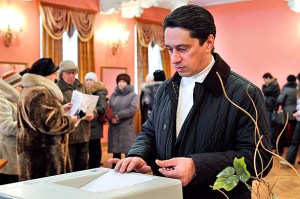
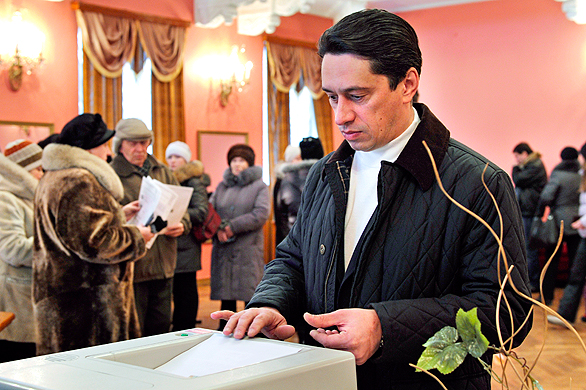
Siyenko Casts His Ballot

In an election day press-release, this industrial chieftain all but admitted his employees were ordered to vote for Putin.  Most probably never entertained the thought of doing otherwise.  UVZ likely didn’t have to organize “carousels,” but  “corporate voting” might have occurred.

On February 20, Putin declared 2,300 “new generation” tanks will be produced (by UVZ) under GPV 2020.

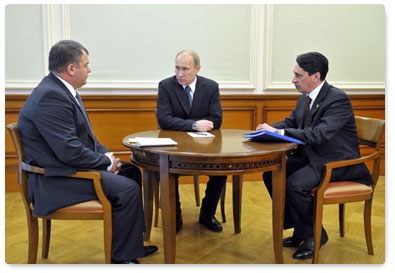
It was just February 15 that Putin had a meeting with Defense Minister Serdyukov and Siyenko.  It was actually more of a beating, for Serdyukov.
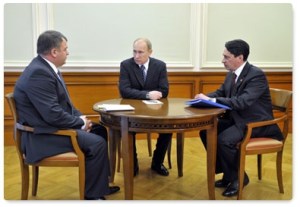
Putin With Serdyukov and Siyenko

The Defense Minister had to back down publicly from everything he’s said about tank acquisition over the last couple years.  He acknowledged, as Putin said, there will be a new tank from UVZ in 2013 that will enter series production in 2015.  And, for good measure, Serdyukov said the manufacturer will receive 100 percent advance payment on the GOZ.

As recently as January, the Defense Minister was lamenting huge stocks of old tanks and repeating his willingness to wait for fundamentally new armor rather than “new” T-72 or T-90 models.  In mid-2011, he criticized tank makers (UVZ) for dressing up old ideas, and said the army would just settle for updating its existing armor inventory.

Yes, everything changed sometime between then and now.

It was just prior to this Putin-Serdyukov-Siyenko session that General Staff Chief Nikolay Makarov again criticized the tanks offered to the army and argued for the military’s predominance in weapons procurement decisions.  Deputy PM Dmitriy Rogozin objected fiercely to Makarov’s public airing of dirty linen, and declared himself chief of acquisition.

All official doubts and complaints about Russian tanks heard in 2009, 2010, and 2011 were swept away in a stroke by Putin’s announcement.

It seems the Ground Troops — its supporting industry actually — were feeling left out of the GPV and GOZ.  Tanks were never one of Russia’s  priorities as enumerated by former armaments chief Vladimir Popovkin.

What do 2,300 tanks mean for the world’s largest country?  One that once measured sufficiency in tanks by the tens of thousands?  Is staving off a NATO ground attack really a top concern?  Would Moscow entertain putting most of its new tanks opposite China?  There’s been plenty written (including by Russians) about the end of the tank era.

What do these tanks mean for the GPV?  If they cost 200 million rubles per, the cost of the production run (if it actually happens) will cost close to 500 billion of the GPV’s 19 trillion rubles for procurement.  It’s a lot for one system.  The Putin-brokered sub deal in November was worth only 280 billion rubles.

So to return to the original point of this meandering post, these tanks are about industrial policy, updating the human and technical capital to make them, keeping a significant industrial center quiescent, and retaining the capability to sell tanks abroad.  There are, after all, other armies possibly facing big tank battles in the future.

When politics and defense intersect, the latter yields.  Nothing shocking in that, one admits.

One last thing.

Siyenko’s an interesting character.  The 46-year-old former bike racer and past President of the Russian Cycling Federation spent most of the 2000s as General Director of Gazprom subsidiary Gazeksport (Gazprom Eksport), selling natural gas to the Europeans.  From 2003, he was a deputy chairman of the shady gas intermediary Itera.  Itera Chairman Vladimir Makeyev too is a one-time world-class rider who succeeded Siyenko as the cycling federation’s head.

But suddenly in 2009, Siyenko changed tracks, and went to Sverdlovsk Oblast and UVZ in Nizhniy Tagil.  There must be a story explaining why he’d abandon gas for tanks and railcars.

FOM’s Poll

On this election day 2012, let’s look at FOM’s survey on attitudes about the army.  Its questions are different from 2011But this year’s results show less enchantment with positive changes in the army.

Just prior to the army’s February 23 holiday, FOM asked its sample whether the Russian Army’s combat capability is high or low.  Only 15 percent said high, 33 percent said low, 37 percent said average (not high or low), and 15 percent found it hard to say.

Two years ago 24 percent said high and only 27 percent said low.

Then FOM asked whether the army’s combat capability is increasing or decreasing.  Twenty-eight percent said increasing, 17 percent said decreasing, 38 percent said not changing, and 16 percent found it hard to answer.

In 2010, 36 percent said increasing.

It’d be interesting if FOM asked respondents to say what combat capability means to them.

Then FOM asked about the military’s prestige.  Given the choice of high or low, 21 percent said high, 27 percent low, 40 percent not high or low, and 12 percent found it hard to answer.

But 38 percent said the military’s prestige is growing, 11 percent declining, 38 percent not changing, and 13 percent hard to answer.

If Russia’s budget had extra resources that could go only to military needs, or only to civilian needs, just 18 percent said they would direct that money to the military, 61 percent said to civilian uses, and 21 percent said hard to answer.

Not Enough Resources

Konstantin Makiyenko (photo: Radio Mayak / Kirill Kurganov)

Still parsing reaction to Prime Minister Putin’s manifesto on the army . . . there are lots of positive reviews and recapitulations.  But commentators who don’t exactly agree with Putin are far more interesting and illuminating.

One particularly fitting this description is Konstantin Makiyenko, who makes succinct, obvious, and bravely ventured points.

Makiyenko, Deputy Director of CAST, is by no means anti-regime.  He is, however, honest.  His observations appeared in Interfaks-AVN, and you can read them courtesy of VPK.name.

He concludes simply that Russia may not have the resources for the plan of major army and defense industry modernization Putin laid out in his campaign article:

“The Russian economic system, which, with oil prices at 100 dollars a barrel, provides only four percent GDP growth, isn’t capable of being the base for realizing the plans outlined.”

AVN says Makiyenko doesn’t exclude that, owing to insufficient budgetary resources, the Finance Ministry will have to work out plans for future cuts in spending on national defense.  But, at the same time, he apparently said Putin’s manifesto on the army wasn’t populist, and he has “no objection” to majority of the Premier’s proposals.

But Makiyenko lays down a sharp, if understated, critique of Putin’s stewardship of Russia’s defenses since 1999.  Agreeing that nuclear deterrence has been the only guarantee of Russia’s security, Makiyenko continues:

“In this relation, the current situation is in no way different from the state of affairs in the 1990s, when, as it’s justly noted in [Putin’s] article, ‘other weighty material arguments didn’t exist.'”

“. . . adequately evaluating the situation now, one has to admit that even today other ‘material arguments’ haven’t appeared for Russia during the last 12 years.”

“In this connection, the thought about how one should particularly attentively follow the appearance of new technical means, for example MD systems and long-range, precision non-nuclear means, capable of devaluing Russia’s nuclear deterrence potential, are very important.”

So, conventional weakness drives Russian objections to MD, one supposes.

AVN also indicated Makiyenko is skeptical of Putin’s call for public-private partnerships and more private capital investment in the OPK given that the once-and-future Supreme CINC nationalized first-class companies like Irkut and Saturn.

Army Polls

Happy Defender’s Day!

Taking a break from Putin’s defense manifesto, let’s look at this year’s opinion polls on the army’s big holiday.

Levada’s poll is not so interesting this year.  Responses to its questions generally fell within the 3.4 percent margin of error of last year’s survey

But the number of respondents who thought drafted family members should find a way to avoid serving fell from 41 to 36 percent this year. 

People also indicated a slightly greater belief that dedovshchina is more prevalent in the army.  This year 19 percent think it happens everywhere  against 13 percent in 2011.  Those believing it occurs in a small number of military units dipped from 27 to 23 percent this year.

VTsIOM’s results were actually a little more interesting.

The agency reported again this year that 55 percent of respondents felt the Russian Army is capable of defending the country against a military threat.  But on the current training of troops, 30 percent saw positive tendencies, 30 percent negative tendencies, and 29 percent said they don’t see any changes.

A surprising 68 percent, according to VTsIOM, believe the level of outfitting of Russian forces with modern arms and equipment is average or higher.  Still, 72 percent feel equipping the army with more modern weapons is needed to increase combat readiness (?!).

Some 68 percent of respondents were aware, to one degree or another, of Russia’s military reforms.  Sixty-seven percent consider them essential.

VTsIOM, unfortunately, didn’t publish its exact questions and responses to each; it just aggregates its results in a verbal description.

But it did show us one full question.  Are the transformations introduced into the Armed Forces essential or not essential for increasing the army’s combat capability?  The answers:

  • Essential but insufficient — 55 percent.
  • Essential and sufficient — 12 percent.
  • Not essential, better to end them — 8 percent.
  • Hard to answer — 24 percent.

Putin and the Army (Part I)

Putin Flanked by Green Suits (photo: Konstantin Zavrazhin)

Candidate Vladimir Putin’s election manifesto on the military and national security appeared in today’s Rossiyskaya gazeta.  The rambling 6,500-word essay reads like most campaign literature — a series of feel-good sound bites with inconvenient facts, details, and background left out.

But let’s get at it.

Putin says the changing world presents risks of an unpredictable nature.  He insinuates that Russia should expect challenges to its sovereignty over its natural resources.  It can’t tempt others by weakness.  Strategic nuclear deterrence preserved Russia’s sovereignty in the difficult 1990s as it does today.

Putin continues his habit of excoriating the long-ago 1990s but largely ignoring what he did or didn’t do during the 2000s.

He points right off to the GPV’s 19 trillion rubles to modernize the Armed Forces, and the coming FTsP’s 3 trillion for the OPK.  And, he says, he’s convinced the country can afford these expenditures.

Putin then turns to the nature of future war.  He wants the military to “look over the horizon” at the nature of threats in 30-50 years to determine what the army will need.

Deterrence has worked, and Russia keeps its nuclear “powder” dry.  But Putin points to the mass introduction of long-range, precise conventional arms becoming decisive even in a global conflict.

Someone tell Putin this is not news.  But there’s more.

Putin reveals that space and information (or cyber) warfare may be decisive in the future.  Beyond this, he continues, new beam, geophysical, wave, genetic, and even psychophysical weapons may be developed.  Their effects may be comparable to nuclear weapons but more acceptable politically.  So, expect the role of nuclear weapons in deterring aggression to decline.

He then segues wildly to responding quickly and effectively to other new challenges, and how Russia’s ODKB partners will help stabilize the “Eurasian space.”

OK.

Putin proceeds to a long-winded explanation of how the army saved Russia in the terrible 1990s.  As mentioned earlier, he doesn’t have a lot to say about the eight years he was Supreme CINC.

Putin claims he rejected a proposal (he attributes to then General Staff Chief Kvashnin) to move SSBNs from the Pacific and consolidate them in the Northern Fleet.  He says permanent readiness units with contractees were formed on all strategic axes, and, he claims, they allowed Russia to “force Georgia to peace” in August 2008.

No mention that the large-scale introduction of contract service failed miserably during this time.  Also no mention of “winning” the Second Chechen War by ceding federal control of that republic to a brutal young warlord.

Putin rightly notes the Soviet Army’s mobilization model made no sense for Russia, and there was no alternative to building a New Army [starting in late 2008 when he was not president, and after things went so well for the army in Georgia].  He admits there were difficulties and mistakes in this process, but goes on to describe his view of what’s been done in the army.

Full-up permanent readiness brigades have replaced old cadre units.  “Non-core, auxiliary functions” have been moved out of the army to maximize time for training.  And effective Defense Ministry sub-units responsible for the military order have to guarantee the effective formation of technical requirements for the development and production of arms and equipment.

Yes, but that’s not happening yet.

Putin lists other changes in the Russian military.  C2 organs cut by 50 percent.  Four districts with air, air defense, and naval forces subordinate to them.  Seven large air bases established.  Twenty-eight airfields renovated, and 12 more set for this year.  The share of modern ICBMs increased from 13 to 25 percent.  Ten more regiments to be reequipped with Yars or Topol-M.  Putin says Russia has accepted its new strategic ALCM.  Dolgorukiy and Nevskiy will soon enter the fleet.  The Navy’s renewed its presence on the world’s oceans.

Then the Prime Minister turns to tasks for the next ten years — rearmament:  nuclear forces, VKO, comms, recce, C2, EW, UAVs and unmanned strike systems, transport aviation, individual soldier systems and protection, precision weapons and defense against them.  And he reemphasizes, new generation precision weapons need development and a larger place in Russia’s future doctrine.

Putin seems to say Russia’s happier with the capability of defeating any missile defense than trying to develop its own.  He again promises effective, asymmetrical steps to counter any U.S. MD.

Then, a ten-year acquisition laundry list from candidate Putin:

  • 400 ICBMs and SLBMs.
  • 8 Borey SSBNs.
  • About 20 multipurpose submarines.
  • More than 50 surface ships.
  • Nearly 100 military satellites.
  • More than 600 aircraft.
  • More than 1,000 helicopters.
  • 28 regimental sets of S-400.
  • 38 battalions of Vityaz SAMs.
  • 10 brigades of Iskander-M.
  • More than 2,300 tanks.
  • About 2,000 SP artillery systems.
  • 17,000 military vehicles.

The tanks are really surprising.  And the list doesn’t really even match the ten-year tasks Putin set out.

Look for the second half later.  It covers army social issues and the OPK.

Thickening Clouds

Deputy PM Rogozin and Serdyukov (photo: Yuriy Magas)

Anatoliy Serdyukov completed his fifth year as Russia’s Defense Minister on Wednesday (February 15).

But the inimitable Argumenty nedeli concludes “clouds are thickening” around him. 

AN says Serdyukov’s in the “eye of a storm” of PA cadre changes, and he’s begun sacrificing subordinates to save himself.

The paper’s Defense Ministry source claims there will be a large number of resignations from “support structures controlled by the military department,” i.e. the quasi-commercialized, civilianized logistic agencies established to outsource “non-core” military functions.

OAO Slavyanka — responsible for housing and communal services in military towns — will lose its general director, Aleksandr Yelkin, over poor winter preparations and boiler breakdowns in Murmansk, Kaliningrad, and the Far East. 

Not surprisingly, the source says this decision followed Prime Minister Putin’s harsh criticism of Serdyukov on February 9.  See Kommersant, Komsomolskaya pravda, Nezavisimaya gazeta, or Newsru.com for more on this.

The general director of Agroprom — an affiliate of OAO Oboronservis — Natalya Dynkova, lost her position for “redistributing” the military food procurement market.  Agroprom declined an AN request for comment on Dynkova’s situation.

AN’s source also says Serdyukov’s apparat chief [chief of staff] Yelena Vasilyeva is also “hanging by a thread.”  From detention, the indicted former chief of GVMU, General-Major Aleksandr Belevitin has given evidence against her. 

Several months ago, AN claimed dustups with Vasilyeva led to former Deputy Defense Minister Mokretsov’s departure as well as complaints from high-ranking civilians and officers.

Finally, AN’s officer source says the FSB is investigating and arresting some people connected to the Defense Ministry’s commercial structures.  He concludes Serdyukov is ridding himself of people who could compromise him or interfere with him finding a place in once-and-future president Putin’s new government this spring.

BFM.ru sounded a separate but similar note reporting that the chief of a firm entrusted with selling excess Defense Ministry property is suspected of fraud. 

General director of the “Expert” Legal Support Center, Ye. F. Smetanova  allegedly sold military property for reduced prices in exchange for kickbacks ranging from 5 to 25 percent of the transaction, according to the MVD.  She reportedly received 18 million rubles for endorsing the sale of four Samara Voyentorgy for 147 million. 

Investigators are trying to identify other Defense Ministry properties sold with kickbacks as well as possible co-conspirators in the schemes.

In 2011, the Defense Ministry conducted 43 auctions and sold real estate for 4.7 billion rubles.  Movable military property was sold to the tune of 560 million.

It’s worth recalling the Main Military Prosecutor’s words about the scale of Defense Ministry corruption in 2011.  He singled out commercial firms outsourcing for the military and violations of auction rules as particular problems, along with routine kickbacks and bribery.

Where does this leave us?

Things aren’t so rosy for Serdyukov right now. 

For one thing, Rogozin’s replacement of the virtually invisible Sergey Ivanov has probably been a near-daily irritation for the Defense Minister.

Even after five years, it’s still hard to get a handle on all the military’s “financial flows.” 

And resignations and reports of corruption don’t reflect well on Serdyukov.

Still, Serdyukov remains a member of Team Putin, and he’s probably secure.  The election season makes everyone nervous, and it’s hard to say who’s driving corruption charges.  Shaking out some incompetent or corrupt defense officials might serve to create the impression that Prime Minister Putin’s on top of things.

VDV Vets Rock Against Putin

The disparate parts of the anti-Putin movement probably couldn’t agree on much except their common desire to see the once-and-future president not win the election and a third term on March 4.

Yesterday VDV veterans from Moscow’s Akademicheskiy rayon appeared on the Internet rocking with hard-edged lyrics against Putin.  Livejournal comments indicate these guys are for real.  They were at Sakharov Square, and someone’s suggested they be on-stage at the February 4 demonstration.

Someone was kind enough to transcribe the lyrics here, and here are some English ones:

If you’re a citizen, if you’re president
There’s a law for you, there’s a prohibition for you
Don’t steal from the treasury and never lie
Be open for all, answer for your words
Eight years president and again a candidate
Look us in the eye and surrender your mandate
We believed you, but you lied many years
Employing in everything your KGB secret

You’re just like me, a man not God
I’m just like you, a man not a lout
Let’s not lie more, let’s not steal
We’re a freedom assault, the Motherland is with us
You’re a typical official, not tsar or God
For you a man is a stupid monkey
The ribbon’s color is freedom, for all positive
And only for you…a condom

I’m looking at you, at your portraits
You’re still lying to us just like your bears
We’re tired of looking at the shame of the entire country
With village poverty next to your castles
You destroyed the defense sector, and retired the army
You put it on soldiers, sent officers away
We won’t forgive all your services
We are demanding peacefully – go away tyrant

You’re just like me, a man not God
I’m just like you, a man not a lout
Let’s not lie more, let’s not steal
We’re a freedom assault, the Motherland is with us
You’re a typical official, not tsar or God
For you a man is a stupid monkey
The ribbon’s color is freedom, for all positive
And only for you…a condom

We remember our granddads who fought the SS
We remember our Guards who jumped from the sky
Berlin and Afghan remain in our heart
But the heart of One Russians is their own pocket
Nowadays honor’s not in respect, there’s no virtue
And only the systemic gleam of coins
Global materialism of machines and wimps
This is rotten systemic cynicism
They’ve forgotten culture in YeGE schools
Diplomas for money and bribes everywhere
An old man can’t be treated for free
This is the deadend of a rotten system

You’re just like me, a man not God
I’m just like you, a man not a lout
Let’s not lie more, let’s not steal
We’re a freedom assault, the Motherland is with us
You’re a typical official, not tsar or God
For you a man is a stupid monkey
The ribbon’s color is freedom, for all positive
And only for you…a condom

Of course, it loses a lot in translation.  But even if you can’t follow the original, its anger and power is palpable.

It seems to this author very unlikely Vladimir Putin will depart the scene any time soon.  But the demonstrations and the protest movement (even this song) signify that politics and activism are returning to Russia.