Category Archives: Defense Industry

Government Credit for Two New Almaz-Antey Factories

In a 29 December interview on Vesti’s Rossiya-24 program, Deputy Prime Minister Sergey Ivanov addressed modernization, development, arms sales, and defense industry.  He said international demand for Russian air defense systems has led the government to take a decision to extend credit for Almaz-Antey to build two new factories.

As written in an earlier post about shortfalls in productive capacity in the OPK, this possibility has been under discussion since at least last February.

Military Parity picked up additional RIA Novosti coverage of Ivanov’s remarks:

“This year we decided on additional support to ‘Almaz-Antey’ and the allocation of credit for the construction of two more factories.”

Ivanov explained that most of Almaz-Antey’s production is going to satisfy the Russian Army’s requirements, and:

“Now they don’t have production capacity for large volume exports.  But this good, if it’s possible to call it that, is in great demand on the international market.”

A bit from the video . . . Ivanov’s interviewer asks about the state of military-technical cooperation (i.e. arms sales), and aviation’s role in it.  Ivanov says it got along “not badly” in 2010.  Arms sales exceeded $10 billion for the first time.  This, he says, attests to the competitiveness of, and demand for, Russian equipment, and so, in many areas, the defense sector isn’t doing badly.  Aviation represents more than a third of arms sales, or more than $4 billion.  He thinks military transport aviation sales have a good future, and, of course, buyers stand in line for Almaz-Antey’s PVO systems.  Thus, with internal and external demand, the need for two completely new factories.

Of course, saying they’ve decided for two factories is not the same as actually building them and starting new production lines.

Serdyukov’s Year-Ender

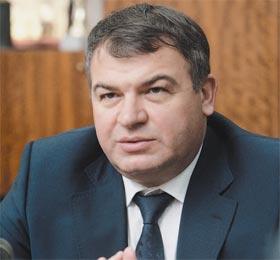
Anatoliy Serdyukov (photo: Izvestiya / Vladimir Suvorov)

ДОРОГИЕ ЧИТАТЕЛИ ! ! !

С НОВЫМ ГОДОМ ! ! !

Thanks for reading and commenting this year.

This one could have been entitled, The Army’s Great Scourge or Reform Isn’t Utopia or We Straightened Them Out.  Great quotes, but you’ll have to read to the bottom.

Defense Minister Anatoliy Serdyukov’s year-ending interview in Monday’s Izvestiya is a good read.  The paper asked some harder-hitting questions than Serdyukov normally gets.  And, though they aren’t necessarily new, his answers are pretty direct and revealing.  There are problems with a lot of them though.

Let’s look first at what Serdyukov said, then we’ll look at the deeper meaning of his answers.

Asked about this year’s command and control changes, the Defense Minister says:

“The most important thing is that we already changed the entire troop command and control system.  From one side, we tried to minimize the command and control levels; from the other side, to equip them technically.  Now the next task is before us – to tie it all into a single system so that every district commander answers not just for the ground, but also for the air, and air defense, and naval component.  The next step is we are trying to conduct exercises in such coordination between districts.  I think 2011 is key for us on this plane.”

On the decision to move to four unified strategic commands (OSKs) and cutting levels of command, Serdyukov said:

“This is the General Staff’s idea.  Before going to the president with such a proposal, we discussed this initiative since the end of 2007.  At the same time, we had conferences at various levels, consulted with experts, important military leaders, and studied international experience again – both American and NATO.  We tried to analyze the situation from every angle and arrived at the fact that this is really useful for various reasons.” 

“First and foremost, the transition to the OSK should be reflected in the controllability of the army.  A simple example:  at the beginning of the transformations, an order from me to a battalion commander had to go through 17 levels.  So you understand this influenced the speed of their transmission, and the content of the information itself.  Now we have three levels in all. If one wanted, it would be possible to calculate how much was saved both on communications nodes, and on communications systems themselves, and in speed.  And as a result – the army’s combat capability rose 50 percent.”

Asked about what will happen in combat situations now that more civilians occupy military support jobs, the Defense Minister says:

“Several factors converge into one point here, therefore, we came to the conclusion that we could and should divide directions of responsibilities – operational and support.  It’s not an accident that the Defense Minister has a first deputy – the Chief of the General Staff and a first deputy – a civilian who handles the direction connected with supporting the operational component.  Everything’s been thought out, and there won’t be any kind of failures.  Neither peacetime, nor wartime frightens us.”

On General Staff Chief Makarov’s assessment that the commander’s slovenliness caused 150 conscripts to get ill in Kemerovo, Serdyukov takes the opportunity to describe the pains he’s taken in establishing systems to monitor the implementation of military reform:

“Unfortunately, we are getting started.  Actually, when we launch any process, we try to organize the monitoring system and incentive system in the final result.  But this doesn’t always work.  We’ve established a series of structures for monitoring.  They are, for example, the financial inspectorate, which checks the use of budget resources.  Then the personnel inspectorate – occupied with the activity of every officer and civilian specialist.  There is the military inspectorate, which checks those measures which should go on in this or any military institution.  There is an organizational-inspector directorate occupied with checking fulfillment of all directives, orders, decrees, laws, etc.  This is that system of monitoring which gives the capability to influence internal army processes, and to move them.  Naturally, an entire system of regulations exists where the duties of every colleague, every sub-unit are strictly prescribed as is the corresponding period for fulfilling the orders.”

Asked about indicators of the fulfillment rate for Defense Ministry orders:

“All orders are being fulfilled.  The question is different:  are they on schedule?  And for the last half year, the picture generally doesn’t look bad.  The schedules we are establishing are holding on the whole.  Inside the ministry, we changed our entire workflow, accordingly this entailed a cut in signatories on this or that issue or project.  We are introducing electronic workflow which allows us at any stage to check how this or that directive or order is being fulfilled.”

“But there are also breakdowns.  Recently we had a collegium in Khabarovsk.  We listened to the report of an army commander who should have implemented 87 different measures, but implemented all of two.  What kind of combat readiness and discipline can you speak of if an officer doesn’t fulfill his own duties?”

“When we embarked on reform, both I personally, and many of my colleagues strove to understand:  what kind of problems really could be blocking the army’s development – housing, lack of money, lack of equipment, of soldiers?  Now there’s everything.  If you serve, then according to order 400 the money is very respectable.  We are providing housing.  There’s one hundred percent in equipment.  Almost one hundred percent – give or take one-two percent – in servicemen.  There you have it:  if you chose this profession, then serve.  But here we are stumbling over weak managerial discipline – the army’s great scourge.  And even here we’re trying, from one side, to stimulate work, and from the other – to severely demand fulfillment of service duties.”

Is Russia buying weapons abroad because the systems are really needed or is it being done out of political considerations:

“There is a certain requirement for foreign military equipment, because in a series of types of armaments, we, unfortunately, will fall behind.  Our models don’t meet the demands presented by the times.  It’s important also to understand how to formulate the tactical-technical tasks and characteristics of this or that essential production.  Therefore, we’re also trying to familiarize ourselves with those modern models of equipment and armaments which our partners have.  For this, in fact, we are buying equipment in small amounts – as in the case of UAVs.”

“However, besides equipment, it’s also necessary to have trained personnel, and a command and control system.  We don’t have many models of armaments, but to work on their development, spend time and money on their adoption is simply irrational, it’s simpler to buy, to study, and later begin to develop our own production.  Those Israeli drones gave a serious impetus to developing domestic industry.  Not long ago, the president was at the test range and there we showed him Russian models that are sufficiently reliable.  They are fully suited to us.”

“We don’t have ships like the Mistral.  We never built them.  But to try to catch up now is senseless.  We plan to buy the license and technical documentation for their production.  Moreover, there’s an agreement that, starting with the third ship, we’ll build the helicopter carriers in Russia.”

Doesn’t such an approach hurt Russia’s defense industry?  Wouldn’t it be better to finance and support our own enterprises:

“In the new state program of armaments, for four years, we laid out 600 billion rubles which will be allocated according to a new credit system for enterprises under a government guarantee.  Now  discussion is going quite actively on the subject of how this should happen, with what credit requirements and conditions.  This is one of the forms of financing which has a relationship not so much to support of enterprises as to the system of paying the state defense order itself.  It allows for transferring the load from the second half of the GPV to the first and vice versa.  Or to take off the peak load, meanwhile working out forms of active participation in financing by the Ministry of Finance and the banking system.  Incidentally, the reaction is fully positive, we already have trials with the largest banks – with Sberbank and VTB.”

On inter-ethnic conflicts in units and the possibility of creating nationality-based units:

“This isn’t today’s or yesterday’s problem.  If the commander fulfills his duties completely, then time and energy for conflicts simply won’t remain.  If they’re occupied with physical training for a minimum of four hours a day in every unit , and the remaining time is combat training, as it’s stipulated, then no kind of misunderstandings will arise.  It’s not important where you’re from, which nationality, and religion, if you just fall in your rack after exercises.  The problem again is in the commanders.  Some of them are simply estranged from working with personnel – they see that there are many physically strong, willful guys in the unit, and give over control of the barracks to them.  But those ones become abusers.”

What happens with commanders like these:

“We’ll dismiss them, get others.  An officer must be physically and morally very well prepared and engender only respect.”

Has the army rid itself of dedovshchina with the move to one-year service:

“We now are trying to get away from this term.  There is no longer such a phenomenon.  There is simply hooliganism, crude violation of the law.  If a man served three months, what kind of ‘ded’ is he?  The roots of dedovshchina are much deeper than commonly believed.  In Soviet times, when people served three-five years, then it was the rule:  a man just called up, and a man looking at demob in six months, have different training.  Here then is this phenomenon, really, and its origin.  Now this is pure hooliganism, legally punishable crime which we have fought and will fight without compromise.  Here it’s important that the commander in the sub-unit should fulfill his duties completely.  Then there can’t be any kind of conflicts by definition.”

Asked about accidents with munitions dismantlement over the last year, and how is the problem being resolved now, Serdyukov says:

“The problem is very serious.  For long years, munitions were stockpiled to excess, calculated for a multimillion-man army.  Besides, in the last twenty years, virtually no attention was given to combat training and firings, but the norms of munitions stockpiling remained as before.  As a result, so much ended up in excess that we have work for several years.  To dismantle them by industrial methods is quite complex – there aren’t enough enterprises.  Besides, this is very expensive and not safer than destruction.”

“Therefore, we’re now preparing special teams, certifying equipment, and selecting officers.  They mainly need to be combat engineers.  We’re picking ranges.  We’ve figured where, in what volume, and what we need to blow up, and worked out safe techniques.  We need at a minimum two, maybe three years of such work.  Yes, this will create some temporary discomfort and difficulties.  But it’s impossible to not do this.  If the entire arsenal at Ulyanovsk had blown up, the trouble would have been much more serious.”

Asked about demographic problems, a potential shortage of conscripts, and possibly cutting more deferments, the Defense Minister answered:

“We won’t revoke anything.  As far as demographic problems go, it goes without saying that they exist and we will take them into account.  How do we solve this problem?  I think if the country’s financial situation allows, then we will still try to return the issue of a contract army.  No one has revoked this program, we didn’t realize it because of a lack of resources.  We haven’t  rejected the idea itself.”

Serdyukov tells his interviewers flat out, there’s no longer opposition to his reforms in the army.  What happened to his opponents:

“We straightened them out.  Of course, this was difficult, especially at first.  Now a team of like-minded people has been laid down which itself is generating reform ideas.  Something’s already started to come from it.  People see this and understand:  reform is not utopia, but completely concrete matters.”

After four difficult years in the Defense Ministry, where does Serdyukov see himself:

“I still haven’t finished my service, so I can’t begin to talk about what’s been achieved and what hasn’t.  We’re now in a transitional phase.  There’s not a single direction of the ministry’s activity that modernization, the transition to a new profile wouldn’t affect.  We are working everywhere – in all spheres:  armaments, scientific-research activity, education, organization of daily service, military-technical cooperation.  I can’t say now what we’ll succeed in, and in which direction we’ll lag.  It seems to me that everything’s going pretty well.  We’re on schedule, there’s no deviating.”

Let’s deconstruct some of this shall we? 

Serdyukov and company seem to be obsessed with eliminating layers.  You know sometimes redundancy is good, and prevents making mistakes.  In a net-centric army, every layer sees the picture, but doesn’t necessarily have it for action.  It’s very hard to believe Serdyukov’s claim that just cutting command levels increased combat capability 50 percent when you look at everything that’s factored into the Russian definition of combat capability. 

Yes, we know operational and support stovepipes have been created.  But Serdyukov completely dodges the question of what happens when the combat tooth depends on a civilian tail.  There are obviously answers to this, but the Russians aren’t accustomed to this.  He brushes it off saying there just simply won’t be any failures.  That’s reassuring.

 On the soldiers in Kemerovo and slovenliness, Serdyukov goes a bit non-sequitur.  It’s great hearing about his monitoring system and the implementation of orders, etc.  One wonders, however, if electronic workflow in the Defense Ministry was as important as many things that needed to happen in the troops this year.  But then it gets really interesting.  We start to hear in Serdyukov’s words some of the animus he has for officers.  Why did he ever have such an army commander as the one he vilifies?  He really lays into officers, saying he’s given them everything they need now, they just need to do their jobs.

Serdyukov really avoids the question on buying arms abroad and hurting domestic producers.  He monologues about some convoluted credit provision scheme for paying out the GOZ.  This issue of real money for producers to make weapons and equipment is significant.  Even with the GOZ and a new GPV in place, all anyone can talk about is extending credit to the OPK in 2011.  Hmmm, interesting.

He blames commanders again for inter-ethnic conflicts in the army.  If they were doing their jobs, it couldn’t happen.  If they just wore the boys out properly, it wouldn’t occur.  There is some truth in this, yes, but it’s more complex than just that.  But saying any more might have taken the Defense Minister into a social and political minefield.

On dedovshchina, again Serdyukov blames officers for not taking care of the problem.  Serdyukov’s insistence on just talking about hooliganism makes some sense, yes, but there is still dedovshchina going on.  And, by the way, dedovshchina was never just purely hazing, making the juniors do the crappy jobs; it always had more violence, abuse, and crime in it than Serdyukov is willing to allow.

Serdyukov doesn’t say how he’s addressing the real civil-military relations problem he’s got in Chelyabinsk with regard to the explosions at Chebarkul.  But at least it’s a little like the problems his counterparts face in normal countries, and one has to credit him for taking on a lingering military problem all his predecessors simply ignored.

Wow, is Serdyukov cocky on vanquishing his opponents in the military!  He ought to watch it, it could come back on him.  But as we’ve seen, large-scale, public political demonstrations are going to come from other sources (i.e. the soccer fan bunt or pogrom).  The purely military ones (i.e. the Russian Airborne Union, etc.) tend to be more farcical.  But veterans and even serving officers could provide critical mass in a bigger social protest.  And there’s always the chance that some disaffected Kvachkov could fire a grenade at the Defense Minister’s limo.  Yes, yes, I can hear you — this is just by way of playing out one scenario on what could happen in the future.

One has to respect Serdyukov’s reticence to judge his legacy right now.  It may be possible he’ll leave the big marble building on the Arbat one day thinking how much he’s changed everything, thinking he’s a 21st century Dmitriy Milyutin.  And he may be, at least in comparison with any other choice.  He is making essential changes, and some progress.  More than this analyst thought he would back in early 2007.  But, on close inspection of the military, we may discover that less will actually have changed and improved than we think right now.

How much longer will Serdyukov continue in this burn-out job?  He’s pretty stoic, but he’s definitely more frayed than 4 years ago.  The issue probably comes down to the larger context of the Putin-Medvedev tandem and team — changes in high-level personnel could be more difficult now with every passing day.  Perhaps Serdyukov will remain through a fifth year, and the seating of the next Russian president.

It’s a great interview.  We got some real insight into the Defense Minister’s thinking.  Never could have gotten this 20 or 30 years ago.

Video of Su-34s at Lipetsk

St. Petersburg’s Channel 5 carried this video of the new Su-34s at Lipetsk.  The reporter talks to the center’s commander, General-Major Aleksandr Kharchevskiy, as well as pilots about the Su-34s.  Thanks to Military Parity for finding it.

More on Mistral

Vedomosti’s Aleksey Nikolskiy published an informative piece on Monday.

He says the announced deal for the first two Mistral helicopter carriers, built in France, includes spare parts and training for a grand total of €1.3 billion (52 billion rubles).  The deal reportedly includes the option to build two more units in a Russian shipyard.  While the deal’s sealed, the final contract is still being worked between France’s DCNS and Russia’s OSK.

Nikolskiy said the Elysee website said the Mistral package would provide 4 years of work for 1,000 French shipbuilders (5 million man-hours) at STX in Saint-Nazaire.

Paris is selling Moscow the SENIT 9 combat information system aboard Mistral, but apparently without license rights.

The contract for unit one is worth €700 million, and €600 million for unit two.

OSK maintains Russia will get a 20 percent share of the work on unit one, fabricating some sections for the ship in Russia.  Its share of the work on the second unit could be more, according to analyst Mikhail Barabanov.

An OSK representative told Nikolskiy the main goal of this deal is to get modern technology, and a possible Russian builder for the optional units hasn’t been determined.

Nikolskiy juxtaposes two views on Russia’s need for Mistral.  He quotes Barabanov:

“Why does the Russian Navy need this ship which was designed for the French Navy’s overseas expeditions?”

And he repeats General Staff Chief Makarov’s statement from June that the first Mistral will go to the Pacific Fleet to transport forces where they might be needed, particularly the Kuril Islands.

As post-script, Nikolskiy gives a snapshot of what 52 billion rubles for two Mistrals could buy:

  • 2 Borey-class (proyekt 955) SSBNs, or
  • 3 proyekt 11356 frigates (Talwar– / Krivak IV-class), or
  • 50 Su-30 fighters, or
  • 800 T-90 tanks, or
  • 50,000 apartments for servicemen.

Of course, you can generally double these alternative purchases if Russia builds a third and fourth Mistral.

Ivanov’s GLONASS Report

Today Deputy Prime Minister Sergey Ivanov reported to President Medvedev on the results of the investigation into the loss of 3 GLONASS satellites on 5 December.  As expected, the report points to mistakes in fuel calculations for the DM-3 booster stage. 

The Kremlin.ru account also says Vice-President, Chief Designer for Launch Vehicles, RKK ‘Energiya’ Vyacheslav Filin, and Deputy Director, Federal Space Agency (Roskosmos) Viktor Remishevskiy have been relieved of their duties.  Roskosmos Director Anatoliy Perminov received a reprimand.

Additional steps to strengthen administrative discipline at Roskosmos will be taken, at Medvedev’s direction.

GLONASS as Dolgostroy

Viktor Myasnikov authored an interesting piece in the 17 December Nezavisimoye voyennoye obozreniye regarding the loss of three GLONASS-M satellites in the Pacific on 5 December. 

Myasnikov said the ten-year Federal Targeted Program (FTsP or ФЦП) “Global Navigation System” has spent $4.7 billion since 2001, but GLONASS has confirmed its status as a ‘long unfinished work’ [dolgostroy or долгострой] in space.

Myasnikov pointed out Prime Minister Vladimir Putin’s long personal interest in the system’s restoration, and Putin’s description of it as a sine qua non for development and deployment of modern precision weapons systems.  Myasnikov noted the government’s intention to invest 48 billion rubles in space and ground infrastructure for GLONASS in 2010-2011.

He said the 3 ill-fated GLONASS-M and now-delayed GLONASS-K, originally intended for launch on 28 December, were supposed to bring GLONASS to a complete constellation of 24 satellites and full global coverage. 

President Dmitriy Medvedev had just promised that the GLONASS grouping would be fully formed before the end of 2010, and its large-scale use would begin in the next two years.

After the 5 December failure, Medvedev ordered an investigation of GLONASS, its financing, and who might be responsible for the 5 December mishap.

Myasnikov also explored the insurance scheme for the 5 December launch.  It turns out insurance was provided by the ‘Sputnik’ Insurance Center, which just happens to be run by the sons of current and former deputy chiefs of Roskosmos.  ‘Sputnik’ has assured everyone that the GLONASS loss was reliably reinsured, but it provided no specifics.  Roskosmos Chief Anatoliy Perminov, however, said the launch was partially insured, and a settlement will be collected but only after a long and drawn-out process.

Myasnikov spends some time discussing possible causes of the 5 December accident which largely boil down to an upper stage improperly fueled with too much liquid oxygen.  He concludes that, while a couple scapegoats might be found at RKK ‘Energiya,’ no one associated with GLONASS at Roskosmos is worried about his job.

And so he recaps where this leaves GLONASS.

By 2008, GLONASS reached 18 satellites and complete coverage of Russia.  A fully deployed GLONASS of 24 spacecraft should have covered the planet by the end of 2009.

Russia counted on a service life of 7 years, but the satellites are only lasting 3-1/2 to 5 years, so the system couldn’t be completed.  The system officially has 20 operational, and another 5 are held as “being studied by the General Designer.”  The oldest satellite is 71.7 months old, one is 60 months, and two are 47.4 months.

So, Myasnikov concludes, even if 6 satellites are orbited, a complete system will likely need 8 over the next two years, leaving GLONASS a ‘long unfinished work.’  GLONASS-K is coming, and it’s supposed to have a 10-year service life.

Then he turns to the global positioning system market.  GLONASS has only a 1 percent share of a $60-70 billion market.  In the future, if Russia captured 15 percent, this would be $9-10 billion annually, more than Russian arms sales.  But it isn’t likely.

In 2014, the European ‘Galileo’ system will begin operations.  This will be a serious competitor for GLONASS.  And the Chinese ‘Compas’ will be fully deployed by 2020.  And GPS is already moving to the next level – 48 satellites and 0.9 meter accuracy.

Myasnikov sums up:

“Russian cosmonautics is living through a serious crisis.  It has turned from high technology, science-intensive sector into simply capital-intensive.  Global scientific projects lead to project-mongering, while plans for real earth and space research are regularly delayed.  Almost nothing new is being created.  To replace some multibillion projects come others which cause even greater enthusiasm among the budget recipients.  The reusable ‘Angara’ has already been in development for ten years, cosmodrome ‘Svobodnyy’ is first closed, then opened.  So GLONASS is just the tip of the crisis iceberg.”

“In four months, the country will proudly note the 50th anniversary of Yuriy Gagarin’s flight.  But what’s being done now that we’ll proudly note after the next 50 years?  Certainly not GLONASS in a halo of lies.”

I’m Good Until 2026

Happy 51st RVSN Day . . . Commander General-Lieutenant Sergey Karakayev indicated that service life extension can keep Voyevoda, Stiletto, and Topol in the strategic missile inventory until 2026.  The RVSN is working on ICBM modernization, and has RDT&E in the GPV to deal with new challenges and threats to its missile force.

According to ITAR-TASS, Karakayev said:

“Nevertheless, the service life of the RS-18 ICBM (U.S. and NATO classification Stiletto) has already reached 33 years.  For the RS-20V missile (Voyevoda) and RS-12M (Topol), this term is 23 and 24 years respectively.  And the initial warranty period was defined as 10-15 years.  Practice has shown that the service life of the systems considerably exceeds the established warranty term of use.  It is quite difficult now to determine definitely what kind of safety margin there is.  A series of experimental-design work is being conducted with this goal.”

“The economic expedience of such work is obvious.  For example, extending the service life of the RS-20V (Voyevoda) missile system will allow us to keep the world’s most powerful missiles in the RVSN force until 2026.  Such possibilities also exist for RS-18 and RS-12M missiles.”

“Replacing them with new missiles would require financial outlays far exceeding expenditures on this work.  At present, there are no unresolved technical problems to the further extension of the service lives of the missile systems.”

“Together with the general designers from a whole row of domestic industrial enterprises and organizations, the missile troops are conducting work not only to support the condition and the improvement of existing missile armament, but also their significant modernization, with a constant goal:  under any conditions, to provide a guaranteed resolution of the missions of nuclear deterrence.  Everything is subordinate to this, including measures to modernize the combat equipment of missile systems, which are fully adequate for both the emerging and forecasted military-strategic environment.”

“The scientific-technical and design pool of domestic military missile building will allow us to react flexibly to rising challenges and threats to Russia’s security.  The RDT&E laid out in the State Program of Armaments for 2011-2020 is directed at this.”

Solomonov and Bulava

Bulava designer Yuriy Solomonov seems to have come out from underground now that the Bulava SLBM has some successes under its belt.

Yesterday the Russian media carried excerpts from a soon-to-be-published interview with Igor Korotchenko’s Natsionalnaya oborona

Solomonov already has a book about his adventures in missile design to his credit.  The only thing that’s changed is the Bulava program seems to be righting itself.

Solomonov said, not surprisingly, that the Bulava’s warheads are ready, and he expects the missile to stay in the inventory until 2050.

He expects Votkinsk to ramp up for Bulava production.  He noted that, for a facility that produced 100 missiles a year in Soviet times, “Now there isn’t any kind of problem from the point of view of organizing the technological process and organizing people for this task.”

Solomonov said Borey-class SSBN Yuriy Dolgorukiy will begin (like Dmitriy Donskoy did) with a surface test launch.  But he doesn’t rule out that this could be changed to a submerged launch.  The tentative date is 17 December. 

He forecasts 4 tests in 2011, the start of serial Bulava production, and possibly the missile’s acceptance into the Navy arsenal, if it achieves a “high reliability coefficient.”

In the interview, Solomonov apparently will talk about how Bulava could be adapted into a ground-launched missile.  This brings back the whole issue of “inter-service unification,” which led to some of the excitement with Bulava.

Svpressa.ru and Anatoliy Tsyganok have a good time lambasting Solomonov for this (again) if you want to take a look.

Cablegate on the Mistral Sale

In case you missed it in Wikileaks, the U.S. Defense Secretary discussed many important topics with his French counterpart in early 2010, and France’s plan to sell the Mistral to Russia among them, though it may have been one of the less urgent issues.

What you read is the dialogue of allies respectfully sharing differing views of the situation and its significance.  It’s interesting for Defense Secretary Robert Gates to say it’s not Russia’s capability the U.S. worries about, but about sending the wrong signal to new allies on Moscow’s doorstep.  His French counterpart argues for Mistral as a tangible sign of the benefits of Russian partnership with the Western allies.  He concedes the ship is intended for power projection, but argues this single ship [well, two plus the plans for two more] won’t change Russia’s capabilities much given the poor condition of its naval production infrastructure.

————–Russia/Mistral                                                                                                                           ————–

18. (S/NF) SecDef expressed U.S. concerns about the Mistral sale to Russia.  He told Morin that because of Sarkozy’s involvement in brokering a ceasefire in Georgia, which Russia was not fully honoring, the sale would send the wrong message to Russia and to our Allies in Central and East Europe.

 19. (S/NF) Morin told SecDef pointedly that he had pushed hard for the sale.  He conceded that it was indeed a warship for power projection.  But Morin asked rhetorically how we can tell Russia we desire partnership but then not trust them.  Morin told SecDef that he understood the U.S. position on considering Central and East European Allies’ concerns about the perceived threat from Russia.  Morin argued, however, that this single ship would not make any difference with respect to Russian capabilities, as Russia’s naval production ability was severely degraded.

 20. (S/NF) SecDef replied that U.S. concerns were not about military capacity but about messaging.  Some allies, because of their past experiences, are still very concerned with Russia and are not sure how much to trust the West.  SecDef observed that Russian democracy has disappeared and the government was an oligarchy run by the security services.  President Medvedev has a more pragmatic vision for Russia than PM Putin, but there has been little real change.

The Navy and State Armaments Program 2011-2020

One could make a study of nothing but forecasts about the Russian Navy’s future.  They vary pretty widely.  But Trud’s military correspondent, Mikhail Lukanin, published an interesting and realistic one on 24 November.

Lukanin claims the details of future Navy procurement plans have been revealed to Trud.  This assumes the Navy (or someone) actually knows what they are at this point . . . a debatable proposition.  At any rate, what he presents sounds pretty reasonable and achievable, whether or not it has any official sanction.

Lukanin breaks the news that the largest part of Russia’s military expenditures and arms procurement over the next 10 years will be for the Navy.  He cites Ruslan Pukhov:

“Of the 19 trillion rubles allocated in the budget for the purchase of new armaments until 2020, the fleet’s share comes to 5 trillion, that is significantly more than any other service of the Armed Forces.”

If this turns out to be true, it is a significant amount, 500 billion rubles (more than $16 billion) per annum over the coming decade, if the Defense Ministry gets its promised amount, and the Navy gets its.  Lukanin says the Navy, which got only four new ships in the last 20 years, will be the military’s priority for the very first time.  He says, according to ‘plans,’ the Navy will receive 36 submarines and 40 surface combatants.

Lukanin explains all this with a quote from former First Deputy CINC of the Navy, Fleet Admiral Ivan Kapitanets:

“Sharply reinforced attention to the fleet is explained by the fact that Russia’s military-political leadership, judging by everything, has come to the conclusion that the state’s naval power is more important than ground forces.”

He points to the rapid U.S. defeat of a strong Yugoslav Army in 1999 using only air power, much of which was carrier-launched.

But Lukanin also cites Anatoliy Tsyganok, who believes a continental power like Russia can never undervalue its land troops.

With all this said, Lukanin addresses what will come out of Russia’s new ‘naval concept’ in which the U.S. is no longer the enemy, and ships aren’t built for a single purpose like killing carriers.  He lists:

  • 8 SSBNs.
  • 22 SSNs and diesel-electric submarines (yes, this would be 30, not 36, as it said at the top, and at least two of the SSBNs are complete, well almost).
  • 12 frigates like the new Admiral Gorshkov frigate (proyekt 22350).
  • 20 Steregushchiy corvettes (proyekt 20380).
  • 10 amphibious landing ships, 4 Mistral type ships and 6 Ivan Gren-class LSTs (proyekt 11711).

Citing unnamed ‘analysts,’ Lukanin posits four missions that would be fulfilled exclusively by Russia’s naval forces:

  • Securing Russia’s oil and gas resources, facilities, and transport on the world’s oceans.
  • Protecting maritime trade links from piracy.
  • Providing a naval counterweight to China’s population and military manpower on Russia’s Far East borders.  Lukanin’s analysts contend the Chinese Navy is relatively weak, and the “Pacific Fleet even in its current, far from perfect condition is superior to the Chinese in combat potential by several times” (was the same thing said about the Japanese before Tsushima?).
  • Showing the flag in the Middle East, Southeast Asia, and Latin America to interest countries in closer ties and arms contracts with Russia.

Lastly, Lukanin looks at how the importance and roles of Russia’s individual fleets will change.  He calls this the turn to the Pacific.  He says the Pacific Fleet will get most of the Navy’s large surface ships, and half of its nuclear submarines.  It will get the first Mistral, and has the mission of deterring both China and Japan.  The Northern Fleet will retain its importance as home to many SSBNs, and because of Russia’s oil and gas claims in the Arctic.  But its surface force will decline.  The Black Sea Fleet will be a focus of renewal; it is looking at a Mistral, 12 new corvettes, and 6 new submarines.  Its focus is Georgia, and South Stream.  The Baltic Fleet will be reduced, losing ships to the Black Sea Fleet, though it will get 2-3 new corvettes.

So what it comes down to is, can the Navy get everything Lukanin listed?  ‘Back of the envelope’ math says yes.  What he listed might cost $30 billion, maybe $40 at the extreme.  There is also stuff the Navy’s discussed but he didn’t mention (carriers, refurbishing CGNs, restarting the WIG program, new naval aircraft).

What are the impediments to carrying off such a program?  Firstly, actually getting the promised amount of financing.  GPVs are easy to launch, but don’t get finished before they’re superceded by another one.  In short, over a ten-year period, it’s unlikely the Navy will get the planned amount.  Even if it does, how much will the corruption ‘tax’ eat away at the amount?  Short answer – a lot. 

Beyond financing, there’s another complex issue – can Russia’s naval industry produce this list in the coming decade?  How much productive capacity is available, what condition is the infrastructure in?  Is there sufficient skilled labor for what shipyards pay and where they’re located?  Recent experience says things aren’t good on this score.  Some yards are still pretty full with foreign orders, Sevmash seems full with Russian orders, and other yards are in poor shape.  In short, it seems it is taking longer than planned to get new ships and submarines in the water.

Perhaps the present author is just not an optimist.  Moscow can afford the ‘plan’ Lukanin describes, but actually completing it will be difficult for a lot of reasons.