Category Archives: Force Modernization

New Year’s Peep Show (Part I)

Yes, the season of little or no news continues . . . but there’s always something to write. 

On 29 December, Krasnaya zvezda provided a little holiday treat — a year-ending issue filled with official views on a variety of topics:

  • Priorities of Armed Forces Organizational Development.
  • Armed Forces Manning.
  • State Program of Armaments.
  • Global Political-Military Situation.
  • Improving the Military VUZ System.
  • State of Military Discipline.
  • Transition to a Unitary System of Armed Forces Material-Technical Support.
  • Provision of Housing to Servicemen.

A cornucopia of data for discerning and careful readers.

Caught up in the joy of the holidays, many probably overlooked these articles.

Let’s have a look at the first one — Priorities of Armed Forces Organizational Development.

What’s interesting is we’re given a little peep show into a much more interesting, detailed, and lengthy document — “The Concept of Organizational and Force Development of the Armed Forces of the Russian Federation in the Period to 2020” — approved by President Dmitriy Medvedev on 19 April 2010, with absolutely no fanfare.

What we don’t know is how this little peek inside the document was edited.  We don’t know what was emphasized, or left out, and why.

A couple preliminaries.  First, the title in the vernacular is “строительства и развития Вооружённых Сил.”  We really don’t want to say “Construction and Development” or “Building and Development” or something like that.  We’re not talking a suburban Moscow water park here.  By the same token, “Organizational Development and Development” sounds dumb. 

What we’re really talking here is force structure planning and force development.  The emergence of this planning document isn’t surprising given that they got a new national security concept in 2009, and a new military doctrine in early 2010.  This article also makes the point that, besides this ten-year military organizational development plan, there are also five- and one-year plans.

We’re going to move quickly today.  So pay attention.

The priorities are:  strategic deterrence (SYaS and VKO); building inter-service groupings on strategic axes (as in OSKs); building a new command and control system; reequipping in line with GPV-2020; a new education and training system for officers and sergeants; and resolving ever-present issues of social defense [i.e. pay and benefits] of servicemen.

What does it mean for each service?

  • For the Ground Troops, get organized on the axes and prepare to be mobile. 
  • For the Air Forces, emphasize supporting the Ground Troops and Navy.  Improve VTA and airfields for strategic mobility.
  • For Navy, support personnel and combat readiness of naval SYaS.  Series construction of multipurpose nuclear submarines and surface ships.
  • For RVSN, preserve the structure of ground SYaS.  Complete rearmament with fifth generation missiles.
  • For Space Troops, deploy formations with future missile attack warning and space monitoring systems.  Complete the full orbital grouping with future satellite systems.
  • For VDV, improve training, especially inter-service training.  Reequip with armaments, military equipment, and specialized equipment.

Sounds like Ground Troops have to make do with the weapons and equipment they have.

Stay tuned for Part II.

Latest on VVS Procurement

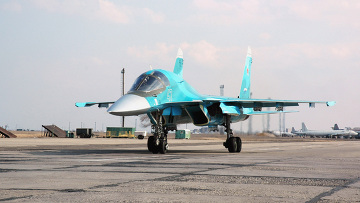
Su-35

Russian Air Forces (VVS) spokesman Colonel Vladimir Drik picked the day after New Year’s to make some specific announcements on his service’s plans for procuring airplanes and helicopters out to 2015.  Not sure what inspired or spurred the sound bites, but one’s glad for every morsel.

He said the VVS will acquire up to 100 Sukhoy aircraft by 2015.  Sukhoy has three state contracts to provide, as Drik put it:

“. . . nearly 50 multifunctional highly-maneuverable Su-35 fighters (they should be delivered by 2015), more than ten modernized Su-27SM and nearly five two-seat multipurpose Su-30M2 fighters (they will be delivered before the end of 2011).”

It doesn’t read as awkwardly in RIA Novosti’s original:

“. . . около 50 многофункциональных сверхманевренных истребителей Су-35 (их должны поставить до 2015 года), более десяти модернизированных Су-27СМ и около пяти двухместных  многоцелевых истребителей Су-30М2 (их поставят до конца 2011 года).”

It’s not clear whether “before the end of 2011” applies to just the Su-30M2, or Su-27SM deliveries as well.

What Drik describes is basically Sukhoy’s VVS contracts signed at MAKS-2009 (48 Su-35, 12 Su-27SM, and 4 Su-30M2).  In all, 64 aircraft for about 80 billion rubles.

Drik also said 25 Su-34 fighter-bombers will be procured.  The Su-34 purchase has always been reported as 32. 

It’s easy to lose track – were there 2, then the 4 at the end of 2010, plus 25 for a 31?  Or was it really 3, then 4, plus 25 for a total of 32?

He concludes that, in all, there are long-term contracts for “nearly 130 combat aircraft.”

Recall that Deputy Air Forces CINC Sadofyev said the VVS order for 2011 includes the Su-27SM, Su-30M2, Su-34, Su-35, Yak-130, and helicopters, but he gave no numbers.

Now this observer counts 90 Sukhoy airframes in Drik’s comments, so that’s pretty much “up to 100.”  Less clear is where the balance of 30-40 combat aircraft will come from by 2015.  Will they be new Yak-130 combat trainers, helicopters?

Drik did enlighten us a little on VVS plans for helicopters.  He said three (not four as reported elsewhere) Ka-52 / Alligator arrived at Torzhok at the end of last month, and he noted that serial deliveries of this helicopter will begin this year.

Ka-52 (photo: RIA Novosti / Anton Denisov)

He emphasized that the Mi-28N / Night Hunter, accepted into the inventory in 2009, is no less important to the VVS.  He said Army Aviation will need it for a long time.  For trainers, series deliveries of the Ansat-U began in 2009, and preliminary testing of the Ka-60U continues, but Drik didn’t say anything about numbers the VVS expects to receive.

If this is the complete plan until 2015, it’s fairly modest.  Modest can be good.  Modest is achievable.  It may or may not be the whole picture.  We have to continue parsing the statements, and triangulating the words, to try and see where the VVS will be in the next few years.

If this is the plan, it doesn’t sound like what’s been touted as 500 new airplanes and 1,000 new helicopters by 2020. 

Yes, this is a skeptic’s viewpoint.  Maybe VVS procurement is backloaded after 2015. 

But a few other thoughts linger . . .

  • The Su-35 still faces state testing.  It was supposed to start this past fall. 
  • Seems like a lot of aircraft are gap-fillers for PAK FA.  It’ll be interesting if it’s not an obvious success well before 2015.
  • One supposes MiG aircraft are completely out of the picture.
  • Nothing was said about transport aircraft.  They’ve been emphasized a little lately, and sooner or later someone’s got to talk exact numbers.
  • Interesting that there’s so little specific said on helicopters.

Government Credit for Two New Almaz-Antey Factories

In a 29 December interview on Vesti’s Rossiya-24 program, Deputy Prime Minister Sergey Ivanov addressed modernization, development, arms sales, and defense industry.  He said international demand for Russian air defense systems has led the government to take a decision to extend credit for Almaz-Antey to build two new factories.

As written in an earlier post about shortfalls in productive capacity in the OPK, this possibility has been under discussion since at least last February.

Military Parity picked up additional RIA Novosti coverage of Ivanov’s remarks:

“This year we decided on additional support to ‘Almaz-Antey’ and the allocation of credit for the construction of two more factories.”

Ivanov explained that most of Almaz-Antey’s production is going to satisfy the Russian Army’s requirements, and:

“Now they don’t have production capacity for large volume exports.  But this good, if it’s possible to call it that, is in great demand on the international market.”

A bit from the video . . . Ivanov’s interviewer asks about the state of military-technical cooperation (i.e. arms sales), and aviation’s role in it.  Ivanov says it got along “not badly” in 2010.  Arms sales exceeded $10 billion for the first time.  This, he says, attests to the competitiveness of, and demand for, Russian equipment, and so, in many areas, the defense sector isn’t doing badly.  Aviation represents more than a third of arms sales, or more than $4 billion.  He thinks military transport aviation sales have a good future, and, of course, buyers stand in line for Almaz-Antey’s PVO systems.  Thus, with internal and external demand, the need for two completely new factories.

Of course, saying they’ve decided for two factories is not the same as actually building them and starting new production lines.

Video of Su-34s at Lipetsk

St. Petersburg’s Channel 5 carried this video of the new Su-34s at Lipetsk.  The reporter talks to the center’s commander, General-Major Aleksandr Kharchevskiy, as well as pilots about the Su-34s.  Thanks to Military Parity for finding it.

Ivanov’s GLONASS Report

Today Deputy Prime Minister Sergey Ivanov reported to President Medvedev on the results of the investigation into the loss of 3 GLONASS satellites on 5 December.  As expected, the report points to mistakes in fuel calculations for the DM-3 booster stage. 

The Kremlin.ru account also says Vice-President, Chief Designer for Launch Vehicles, RKK ‘Energiya’ Vyacheslav Filin, and Deputy Director, Federal Space Agency (Roskosmos) Viktor Remishevskiy have been relieved of their duties.  Roskosmos Director Anatoliy Perminov received a reprimand.

Additional steps to strengthen administrative discipline at Roskosmos will be taken, at Medvedev’s direction.

GLONASS as Dolgostroy

Viktor Myasnikov authored an interesting piece in the 17 December Nezavisimoye voyennoye obozreniye regarding the loss of three GLONASS-M satellites in the Pacific on 5 December. 

Myasnikov said the ten-year Federal Targeted Program (FTsP or ФЦП) “Global Navigation System” has spent $4.7 billion since 2001, but GLONASS has confirmed its status as a ‘long unfinished work’ [dolgostroy or долгострой] in space.

Myasnikov pointed out Prime Minister Vladimir Putin’s long personal interest in the system’s restoration, and Putin’s description of it as a sine qua non for development and deployment of modern precision weapons systems.  Myasnikov noted the government’s intention to invest 48 billion rubles in space and ground infrastructure for GLONASS in 2010-2011.

He said the 3 ill-fated GLONASS-M and now-delayed GLONASS-K, originally intended for launch on 28 December, were supposed to bring GLONASS to a complete constellation of 24 satellites and full global coverage. 

President Dmitriy Medvedev had just promised that the GLONASS grouping would be fully formed before the end of 2010, and its large-scale use would begin in the next two years.

After the 5 December failure, Medvedev ordered an investigation of GLONASS, its financing, and who might be responsible for the 5 December mishap.

Myasnikov also explored the insurance scheme for the 5 December launch.  It turns out insurance was provided by the ‘Sputnik’ Insurance Center, which just happens to be run by the sons of current and former deputy chiefs of Roskosmos.  ‘Sputnik’ has assured everyone that the GLONASS loss was reliably reinsured, but it provided no specifics.  Roskosmos Chief Anatoliy Perminov, however, said the launch was partially insured, and a settlement will be collected but only after a long and drawn-out process.

Myasnikov spends some time discussing possible causes of the 5 December accident which largely boil down to an upper stage improperly fueled with too much liquid oxygen.  He concludes that, while a couple scapegoats might be found at RKK ‘Energiya,’ no one associated with GLONASS at Roskosmos is worried about his job.

And so he recaps where this leaves GLONASS.

By 2008, GLONASS reached 18 satellites and complete coverage of Russia.  A fully deployed GLONASS of 24 spacecraft should have covered the planet by the end of 2009.

Russia counted on a service life of 7 years, but the satellites are only lasting 3-1/2 to 5 years, so the system couldn’t be completed.  The system officially has 20 operational, and another 5 are held as “being studied by the General Designer.”  The oldest satellite is 71.7 months old, one is 60 months, and two are 47.4 months.

So, Myasnikov concludes, even if 6 satellites are orbited, a complete system will likely need 8 over the next two years, leaving GLONASS a ‘long unfinished work.’  GLONASS-K is coming, and it’s supposed to have a 10-year service life.

Then he turns to the global positioning system market.  GLONASS has only a 1 percent share of a $60-70 billion market.  In the future, if Russia captured 15 percent, this would be $9-10 billion annually, more than Russian arms sales.  But it isn’t likely.

In 2014, the European ‘Galileo’ system will begin operations.  This will be a serious competitor for GLONASS.  And the Chinese ‘Compas’ will be fully deployed by 2020.  And GPS is already moving to the next level – 48 satellites and 0.9 meter accuracy.

Myasnikov sums up:

“Russian cosmonautics is living through a serious crisis.  It has turned from high technology, science-intensive sector into simply capital-intensive.  Global scientific projects lead to project-mongering, while plans for real earth and space research are regularly delayed.  Almost nothing new is being created.  To replace some multibillion projects come others which cause even greater enthusiasm among the budget recipients.  The reusable ‘Angara’ has already been in development for ten years, cosmodrome ‘Svobodnyy’ is first closed, then opened.  So GLONASS is just the tip of the crisis iceberg.”

“In four months, the country will proudly note the 50th anniversary of Yuriy Gagarin’s flight.  But what’s being done now that we’ll proudly note after the next 50 years?  Certainly not GLONASS in a halo of lies.”

Serdyukov’s Duma Session

ITAR-TASS reported a few tidbits from Defense Minister Serdyukov’s closed session before the Duma yesterday.  Not surprisingly, Serdyukov told Duma deputies:

“We fulfilled those tasks which the President gave to conduct the Armed Forces to a new profile in 2010.  The Armed Forces’ combat readiness increased 1.5 times.  We believe that the combat readiness of the army and navy will grow 3-3.5 times toward 2020.”

RIA Novosti reported that Serdyukov said combat capability, not combat readiness.  Combat capability seems to make more sense.

ITAR-TASS says Serdyukov familiarized deputies with the basic tasks of transitioning to the new profile, and the completion of reforms planned for 2010.  Attention was given mainly to implementing the State Program of Armaments and social issues for servicemen.  He said:

“I familiarized deputies with the transformation of the military districts, changes in army corps and brigades, and military command and control at all levels.”

Corps?  Did he really say that?

Answering a question about housing for servicemen, Serdyukov said the Defense Ministry has fulfilled the government’s order about this:

“In 2009, we obtained 45,500, and in 2010 55,000 apartments from all sources.  This attests to the fact that the government’s order has been fulfilled and is being fulfilled.”

As usual, the official news sources turned to Duma Defense Committee Chairman Viktor Zavarzin for comment, and he said:

“I give high marks to today’s meeting of the chief of the defense department and deputies.  We have established tight coordination with the Defense Ministry on legislative support of military reform, and bringing the Armed Forces to a new profile. “

“We are certain we will decide all issues concerning the rearmament of the army and navy, and social support of servicemen with the Defense Ministry leadership.  I say that we need to preserve this pace which exists in the Defense Ministry and with us next year to take the work to the intended results.”

Regarding rearmament, Zavarzin said:

“Besides, in ten years, the share of modern weapons in the army should be not less than 70 percent, for which unprecedented sums have been allocated.  For this, not only a principled position of the Defense Ministry, but also readiness by OPK enterprises for serial deliveries of modern types of armaments is required.”   

Zavarzin said Serdyukov didn’t have much to say on the Mistral purchase, but Zavarzin said:

“In our view, we don’t need to acquire a hunk of metal, but we need the documentation and understanding of those ideas and developments abroad which will enable us to realize the possibilities of our industry.”

Is Russian shipbuilding really going to learn that much from Mistral?

Zavarzin expressed the opinion of the deputies who think:

“We need to give the Defense Minister great credit because he is deeply involved in these issues and, as the one ordering, aiming to supply the army and navy modern armaments and military equipment. Our convictions are that we should create a competitive environment and competitive structures which would push Russia’s defense-industrial complex to the development and creation of the newest weapons systems, including for the Navy.”

At the same time, Zavarzin credited the Defense Ministry for understanding that military social issues deserve special attention too:

“We are talking about creating attractive conditions for those who are serving, but also providing all stipulated benefits to those who are dismissed from military service.  And this is the guarantee of permanent and service housing for servicemen and their family members, but also increasing pay to servicemen and military pensioners.  By 2012, the new pay system for servicemen should be functioning.”

“It’s understood that the level of pay and military pensions today is far from what’s really needed.  Here it’s necessary to change the situation in a cardinal way.”

ITAR-TASS also talked to members of the three other factions in the Duma. 

The KPRF’s Gennadiy Zyuganov negatively evaluated the army’s combat capability saying:

“The state of preconscription training is zero, and mobilization reserves have disappeared.  The general condition is such that today the army is not in a state to defend the country reliably in the event of a small conflict.”

Zyuganov claimed that defense is spending every third RF ruble, and “spending it absolutely ineffectively.”

He complained that outsourcing support functions to civilian companies has doubled the cost of maintaining each soldier.  Zyuganov also said that, “Switching to expensive cars is a luxury in hard times.”

The Just Russia spokesman supported Serdyukov’s formation of a single queue for military apartments, saying:

“We all know that earlier this was a very corrupt sphere where there was a great deal of injustice and complaints.”

Just Russia supported publishing the apartment queue on the Internet, as well as Serdyukov’s ‘humanization’ of conscript service (an extra day off, ability to communicate with family, service near home, and weekend passes), though nothing was said about the extent to which any of these have been implemented in units.

But the Just Russia faction leader also said:

“Today we raised the issue of material support for civilian workers serving the RF Armed Forces.  Today their wages are so low that a whole row of military commanders complains that they can’t fill vacant positions:  simply no one comes for such pay.”

According to RIA Novosti, Just Russia also supports giving military retirees the option of civilianizing their pensions, a move also advocated by the Defense Ministry, but opposed by the Finance Ministry.  The move would spare the Defense Ministry from choosing between paying more in pensions as active pay rises, or breaking the sacred link between active pay and pensions.  For its part, the Finance Ministry doesn’t want pay out for more expensive civilian pensions.

The LDPR was skeptical of Serdyukov.  Its spokesman said:

“We didn’t hear any news that would surprise us.  And the points of this endless reforming, they are all mainly well-known.  It feels like the man [Serdyukov] is in the flow of what’s happening, but our faction doesn’t always share those methods with which this is happening, particularly cuts, civilianization.”

Sounds like he’s tired of sound bytes too.

Igor Barinov, Deputy Chairman of the Defense Committee from United Russia, expressed concern that Serdyukov’s VVUZ reductions have cut military education to the bone:

“Of course, optimization on this level was essential.  But I think it was clearly a mistaken decision to stop induction [of new cadets] into military VUZy altogether this year and next.”

Mikhail Grishankov, also from United Russia, said there have been failures in the program of providing housing to servicemen.

The Air Forces and the GPV

General-Lieutenant Sadofyev

Last week, General-Lieutenant Igor Sadofyev – Chief of Aviation, Deputy CINC of the Air Forces (VVS) for Aviation – spoke to the press about his service’s ambitious plans for procurement under State Armaments Program (GPV), 2011-2020.

General-Lieutenant Sadofyev told RIA Novosti the VVS will receive 1,500 new, and 400 modernized aircraft by 2020.  The Chief of Aviation said the State Defense Order (GOZ or ГОЗ) for 2011 includes acquisition of Su-27SM, Su-30M2, Su-34, Su-35S, and Yak-130 aircraft for the VVS, as well as Ka-52, Mi-28N, Mi-8AMTSh (MTV-5-1), Ka-226, Ansat-U helicopters for Army Aviation.  But he provided no specific procurement numbers for next year.

Su-34 (photo: RIA Novosti / Igor Rumyantsev)

For Long-Range Aviation (LRA or ДА), he said the VVS will modernize existing Tu-160, Tu-95MS, Tu-22M3, and Il-78M aircraft.  The goal is to update 80 percent of this inventory in what he calls the medium-term future – defined by him as 2020.  What he has in mind here is service life extension and the replacement of some electronics and other systems.

For Military-Transport Aviation (VTA or ВТА), Sadofyev says the VVS will modernize its existing aircraft, and purchase more than 50 percent new ones.  He doesn’t break it down by particular types of transports.

For Frontal Aviation, some existing aircraft will be modernized, and over that medium-term future (2020) more than half the order-of-battle will be replaced with new aircraft, and 14 percent of the inventory will be ‘perspektivnyy’ (перспективный) aircraft.  One supposes that means PAK FA.  If that 14 percent is 70 PAK FAs, that would put Frontal Aviation at about 500 aircraft total.

Army Aviation, according to Sadofyev, will get 70 percent new aircraft by 2020, and 100 percent sometime afterward.  He said the VVS will begin getting the Ка-52 / Alligator next year.  And he made a point of noting that Army Aviation will remain within the VVS, despite rumors it might return to the Ground Troops.

He said serial deliveries of the Yak-130 trainer will begin next year to replace 1970s-vintage L-39 jets.  Flight instructors and technical personnel will learn the Yak-130 at Lipetsk before using it to train young pilots at Krasnodar.

Sadofyev also told RIA Novosti the number of VVS day-night, all-weather aircraft will increase 4.5 times, and this will lower aircraft losses by a factor of 10-12.  According to him, the share of precision weapons in the VVS will increase 18 times, taking it to 70 percent of the inventory by 2020.  So less than 4 percent of current air-delivered munitions qualify as precision weapons.  UAVs will be increased 6 times, taking them to 30 percent of the aircraft inventory.  So they are about 5 percent at present.  Sadofyev adds that money will go to providing a common reconnaissance-information environment for the VVS.

Defense Ministry spokesman Colonel Vladimir Drik also talked about VVS procurement last week.  He said the VVS got new and modernized aircraft this year, including Su-27SM and Su-25SM, and Mi-24PM and Ansat-U helicopters.  But he had to admit only the Ansat-U is new, and he didn’t provide numbers.

There was a major garble over the Su-27SM.  RIA Novosti quoted Drik as saying the VVS “received four squadrons of modernized Su-27SM” this year.  In fact, the transfer of the final 4 of 48 Su-27SM happened in late November 2009.

Drik said Russia’s air defenses will be 100 percent new by 2020, with the VVS operating the S-400, S-500, and Pantsir-S.  Once again, no one seems to want to talk about what’s going on with SAM production.

Igor Korotchenko’s take on VVS procurement from October looks pretty on-target in light of this latest press.  He said the priorities were precision weapons, automated C2, aircraft, and air defense systems.  And, at that time, he put the acquisition numbers at 500 new aircraft, 1,000 helicopters, and 200 air defense systems.

All in all, an extremely ambitious plan.  Fulfilling it will demand complete and timely funding, and even then it will be a challenge for Russia’s aviation industry.  Also, Sergey Ivanov says the GPV has gone to the government today, so maybe we’ll learn how VVS requirements fare.  VVS will be a priority, but we’ll have to see how high.

Medvedev Calls for Unified Aerospace Defense

Yesterday President Dmitriy Medvedev delivered the annual Federal Assembly address.  It was rather brief, uninspiring, and contained relatively little on the military, except his call for work on a unified aerospace (air-space) defense (VKO or ВКО).  This could be a death knell for independent Space Troops.  He also repeated his warning that an agreement on missile defense is needed, or another round of the arms race will ensue.

But let’s look from the beginning . . . Medvedev suggested the army’s modernization might help jumpstart the scientific and technical modernization of the economy.  He said the 20 trillion rubles for the State Program of Armaments will be doubly effective if they give Russia dual-use technologies that can help modernize production processes and develop both fundamental and applied research.  And Medvedev again mentioned creation of a Russian DARPA:

“Therefore we are creating a special structure which will research and develop breakthrough technologies for the defense sector.  There are such structures, you know, in other countries.  We are expecting many of them will find application in everyday life.”

There seems to be a huge disconnect between Medvedev’s almost offhand comments here and what military men expect out of that 20 trillion.  One doubts many in the armed forces see any of this funding going to R&D.  They see it going almost entirely toward procurement of existing weapons and equipment woefully lacking in today’s military inventory.  Perhaps it’s Medvedev’s way of selling (as if he needs to) these expenditures to the average citizen.  

At any rate, Medvedev then gets down to brief comments on the armed forces:

“The development of our state and society is impossible without effective support of national security and defense.  We have taken a course for a deep modernization of the Armed Forces, for conducting systemic, meaningful transformations in them.  The combat component of the Armed Forces, the combat readiness system, command and control, and material-technical support of troops have already been updated.  Our combat exercises have again become regular and, what’s of no small importance, large-scale.  Four military districts have been formed instead of six.  In the framework of the State Program of Armaments to 2020, troops are being outfitted with modern equipment.”

“What tasks still have to be resolved?  First.  In the next year, particular attention needs to be given to strengthening the country’s aerospace defense, to unify existing air and missile defense systems, missile attack warning, and space monitoring.  They should act under the unitary command and control of a strategic command.”

“Second.  Today’s Russia, it goes without saying, also needs a modern army and fleet, compact and mobile troops manned with high-class specialists and the newest weapons.  This requires both serious resources (I just stated the volumes of these resources), and new, sometimes complex, decisions.  At the same time, it is necessary to fulfill all obligations to people who chose army service for themselves, first and foremost to resolve the housing question within the planned time.”

“Third.  The army should free itself from ancillary tasks and noncore functions.  These functions need to be transferred to civilian organizations, to concentrate attention, most of all, on real combat training.  A young man only goes to the army for one year, and the program of training in military affairs is not becoming easier.  It is essential that every young man assimilate the program in full measure.”

Medvedev goes on to describe his discussions about European missile defense with NATO in Lisbon.  He repeats his warning that, if an agreement on missile defense isn’t reached and a full-fledged joint cooperation mechanism isn’t created over the next decade, another round of the arms race will begin:

“And we will be forced to make a decision on the deployment of new strike means.  It is perfectly obvious that this would be a very grave scenario.”

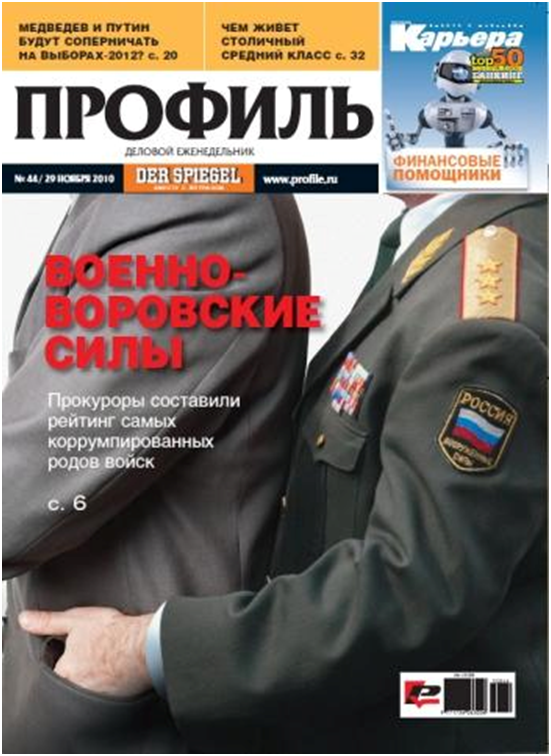
Military-Theft Forces

Prosecutors Rate the Most Corrupt Service Branches

40-50 Percent of State Defense Order Simply Stolen in Recent Years . . . no wonder large-scale procurement hasn’t happened.  Serdyukov supporter Korotchenko tries to paint opponents of military reforms as people trying to protect their corrupt schemes.  This surely goes on, but there also have to be people opposing them for reasons other than greed.  Finally, it’s at least conceivable that, if Serdyukov doesn’t make progress against corruption, it could cost him his job (if he stays that long, he is approaching the four-year mark).  Thus endeth the precis for this post . . .

This week Profil investigates military corruption.  The magazine notes the number and scale of Defense Ministry corruption cases is growing by leaps and bounds, reaching losses of 2.2 billion rubles for the first ten months of 2010.  It concludes, despite a significant cut in the officer corps and Defense Minister Anatoliy Serdyukov’s battle against “thieves in broad stripes [generals],” the number of corruption crimes is not only not declining, but has substantially increased.  Profil obtained an analytical report compiled by the Main Military Prosecutor (GVP) showing who has stolen how much this year.

The GVP presented its report to a closed session of the Duma Defense Committee.  It says its analysis shows “efforts to counteract corruption in the troops are insufficiently effective.”

Profil’s first graphic . . .

Growth of Corruption Crimes in the Army (First 10 Months of 2010)

Troops/Military District/Fleet                     2009       2010       Growth (%)

North Caucasus MD                                             184          311                 69

Moscow MD                                                              94           152                61.7

Air-Assault Troops (VDV)                                 34            119                250

Siberian MD                                                             76            117                 54

Strategic Missile Troops (RVSN)                  59              93                 57.6       

Northern Fleet                                                      50              59                 18

Space Troops                                                        27              44                 63

Caspian Flotilla                                                      5                  7                 40

Black Sea Fleet                                                      2                  6                 200

Profil suggests the recent wave of military retirements signed off by President Dmitriy Medvedev could have been sparked by corruption charges.  While possible, there’s no evidence to support this thesis. 

A Profil source in the Defense Ministry says, not surprisingly, officials responsible for the State Defense Order (GOZ or ГОЗ), capital construction, and the disposition of military property (first and foremost real estate) inflict the greatest losses on the budget.  The article quotes Igor Korotchenko:

“In the course of recent years, 40-50% of resources allocated for the State Defense Order were simply stolen.  This happened, for example, when money was directed at the fulfillment of some concrete work, but there were no real results.  Write-offs appeared in the end or a weapons system was developed that simply didn’t meet its technical requirements.”

Profil suggests that many officers are rushing to get one last bite of military money before Serdyukov’s reforms completely derail their schemes.  It cites Ruslan Pukhov offering two different explanations for rising military corruption:

“Feeling an impending dismissal, officials are probably trying to take the maximum from their positions.  However, it can’t be ruled out that the prosecutor has really reinforced his work in different areas.  Corruption is an acute issue for the prosecutor.”

Pukhov thinks that, although the percentage increase in corruption looks really bad for the VDV, “corruption in the armed forces is spread equally and the growth in corruption crimes in separate branches or districts is connected only with where they are being investigated.”

A very good point, Mr. Pukhov.  Yes, the results of this little anticorruption experiment are very much influenced by where and how it is being conducted.  One should also pay much more attention to the absolute numbers of corruption cases than the percentage changes, and nothing has been said about the relative size of the various parts of the armed forces . . . no per capita figures are provided.  Are 44 crimes in the relatively small Space Troops more significant than 152 in the larger Moscow MD?

Korotchenko, a fairly strong Serdyukov proponent, says the Defense Minister and his tax service colleagues are beginning to break existing corrupt ties, institute financial transparency, and deprive the generals of the right to conclude any contracts.  Dividing the Ministry into military and civilian halves will keep military men out of financial expenditures, and this “process of shifting generals out of the feeding trough” will continue until 2012.  The generals will provide requirements, and civilians will allocate the financing.

A second graphic with some absolute figures on losses due to corruption . . .

Growth of Corruption Crimes in the Army (First 10 Months of 2010)

Troops                                                                  Loss Amount                      Annual Growth

                                                                           (millions of rubles)                        (times)

Strategic Missile Troops (RVSN)                      59.8                                            15          

Air-Assault Troops (VDV)                                   57.5                                            12.2

Space Troops                                                            47.6                                              2.2

Korotchenko claims:

“The campaign against Serdyukov is mainly heated up by those people who’ve been deprived of the feeding trough.  So, the director of a large defense enterprise has for many years sawed off rubles by the billion every year in the transfer of money that comes to fulfill the Gosoboronzakaz.  When Serdyukov deprived this director of such a trough, he began to finance any actions directed at discrediting and, possibly, even removing the Defense Minister.”

So, Korotchenko asserts most conflicts over army reform are banal conflicts of interest for those who can’t steal like they used to.  But didn’t the GVP just say they’re doing a better job of stealing than ever before?

Korotchenko continues:

“Of course, Serdyukov is not an angel, and many of his actions on the military reform plane call forth questions, but it’s another thing that before he arrived, corruption in the Defense Ministry had achieved such a level that he was forced to cut to the bone.  Many scandals proceed only because their financial-economic interests were affected:  the meetings of the airborne guys is just one in this series.”

Then Profil turns to Vitaliy Shlykov, who says:

“Broad publicity for corruption scandals in the Defense Ministry cannot but affect the minister.”

But he believes the Kremlin knows no one can fight corruption like Serdyukov, therefore the GVP report isn’t a real blow to him.

Profil concludes, so far, Serdyukov hasn’t squandered the trust placed in him, but the struggle against corruption only strengthens him as long as it’s a success.  If corruption keeps growing, it’s possible the Defense Minister himself could wind up on the “shot list.”