Category Archives: Ground Troops

There Will Be Professionals, But Later

In Thursday’s Vedomosti, Aleksey Nikolskiy wrote about Defense Minister Serdyukov’s remarks on contract service to the Federation Council.  Serdyukov and General Staff Chief Makarov have cited different figures on the current number of contractees (150,000 vs. 190,000), but agree they’ll be cut.  Professionals will come not only later, but in a smaller numbers.  And contractees will occupy only certain duties.

Nikolskiy cites a figure of only 50,000 contractees signed on during Russia’s failed 2003-2007 attempt to set up a professional enlisted force.

A future smaller number of contract NCOs could receive pay equivalent to that of junior officers.  Except that junior officer pay is supposed to increase dramatically toward 2012 under the new pay system.

According to Nikolskiy’s interlocutors, a new table of organization will soon spell out exactly where contractees will serve, i.e. there will reportedly be few driver-mechanic contractees, while the number of senior NCO billets will increase.

While contract soldiers decrease, how will Moscow manage its commitment to keep conscripts out of ‘hot spots’ (i.e. potential combat zones)?  As recently as April, the Defense Ministry had to reassure the public it had no intention of stationing draftees in Chechnya.

Here’s Nikolskiy verbatim:

“In the long run, contractees in the army will increase from 150,000 to 250,000, but first they will cut them to pick the best and pay them more.”

“Defense Minister Anatoliy Serdyukov told reporters in the Federation Council yesterday there are no plans to abandon contractee servicemen and their number in the future will increase to 200,000-250,000. The day before in the defense committee of the upper chamber, the Genshtab chief Nikolay Makarov said the number of contractees will be significantly reduced compared with the current 190,000.  According to him, contractees will occupy only duties in the Navy, Air Forces and Air Defense requiring good professional training, and also in permanent readiness units.  Only conscript soldiers will serve in the remaining posts.”

“An officer from the Defense Ministry central apparatus explains that Serdyukov’s and Makarov’s statements don’t contradict one another.  In the long run, depending on developing financial conditions, the number of contractees will grow, but first they will reduce them to get rid of ballast which got into these posts during the first attempt at professionalization of the army.”

“In 2003 the FTsP “Transition to Manning with Soldiers Conducting Military Service on Contract in Some Formations and Military Units” was adopted at a cost of more than 20 billion rubles.  According to it, by 2007, the number of contractees in soldier and sergeant duties in permanent readiness units should have gotten to 150,000.  However, they began to fulfill this program from the wrong end, said an officer, having simply mechanically increased the number of contractees in posts not worrying about their training or paying a normal wage.  As a result, they took less than 50,000 and the program collapsed, as the Defense Ministry’s leaders confirmed this year.  Now, after their reduction, the number of contractees will be increased carefully, take well trained people into posts and pay them wages equivalent to salaries of junior officers, said Vedomosti’s source.  At President Dmitriy Medvedev’s meeting on Monday [7 June], increasing wages was discussed and a figure was named—from 25,000 rubles [monthly].”
 
“In the words of an officer from one of the Ground Troops’ motorized rifle brigades, the latest order about contractees came to the unit at the beginning of the year and it indicated there should be no more than 5 percent of them among the number of soldiers and sergeants in driver duties, though more posts for contract sergeants as company and battery sergeant-majors were introduced.”
 
“According to him, you can’t judge where exactly contractees will serve until the introduction of new tables of organization which they’ve promised to do in coming months.”

More on the Military Manpower Dilemma

Social Portrait of SibVO Conscripts (Photo: Trud)

Mikhail Lukanin wrote in Trud this week about the Defense Ministry’s unending manpower woes. 

He concluded that the first two months of this spring’s draft campaign showed there’ll be almost no way to avoid conscription.  Experts he talked to believe the Defense Ministry’s conscription plan is unrealistically high, and the armed forces will turn to inducting every student. 

The callup is supposed to run 1 April to 15 July, and take in 270,000 new soldiers.  Voyenkomaty have already sent 100,000 men—mostly from the Volga-Ural region and Siberia—to their units.  One-third of callup-aged men were screened out due to health problems, most of which were diagnosed initially when the men appeared before the military-medical commission. 

Experts consider the early part of the draft campaign the easy part.  Voyenkomaty have been dealing with young men not in school who go pretty willingly to the army, according to human rights advocate Sergey Krivenko.  

But he says in the last weeks of the draft the voyenkomaty have to meet their quotas mainly with VUZ graduates who don’t have any desire to serve.  Valentina Melnikova of the Soldiers’ Mothers’ Committee says: 

“Mass roundups in student dormitories have already begun.  They traditionally conduct them mostly in Moscow and St. Petersburg.” 

In the fall, 43,000 university and institute graduates found themselves in the army—that’s 15 percent of all conscripts. 

Demographers indicate that the number of 18-year-old men will fall, and not exceed 600,000 for the next two years.  That number equals the number of places available in higher education institutions.  Independent military-economic analyst Vitaliy Tsymbal concludes: 

“The Defense Ministry can fully meet its draft plan only by means of total conscription of students.” 

And it has done little to hide its appetite for students, according to Lukanin. 

GOMU Chief Vasiliy Smirnov already talked to the Federation Council about drafting students after one or two years in a VUZ, and the Education Ministry reportedly didn’t object.  The extension of the current draft until 31 August means that those finishing school at 18 can now fall directly into the army, rather than taking their VUZ entrance exams.  Similarly, the ‘nonstop draft’ means VUZ graduates hoping to start their graduate studies will now fall subject to the draft. 

Of course, Smirnov has also raised cutting sharply the number of VUZy that can provide students a draft deferment.  He talks about a 50 percent cut, expanded later to a 70 percent cut in qualified VUZy.  Trud has been told all nongovernmental institutions will lose the right to provide deferments. 

Sergey Krivenko believes in every draft about 130,000-150,000 conscripts are ready to serve [his number may be high since it wasn’t so long ago that 133,000 were drafted every six months, and surely not every one of them was happy to go].  If, according to Krivenko, the Defense Ministry stuck with this number, it wouldn’t have any problem with conscription [it would certainly have fewer problems].  He continues: 

“However, the whole point is that beginning with spring 2009 the plan jumped to almost 300,000 in one callup.  Troop commanders themselves say that half of this number is simply ballast for the army.  Mainly these are guys in poor health, with a low level of education, and also inveterate hooligans.” 

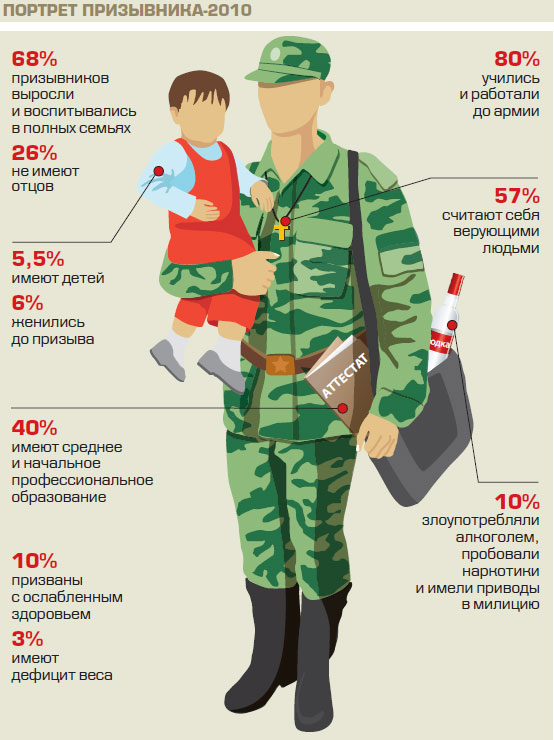
Lukanin had a second article reviewing data from a survey of 7,800 conscripts in the SibVO.  Every third conscript considers serving a burden.  Only 40 percent had a secondary school (high school) or initial professional (post-secondary technical training) education; 4.5 percent had a complete higher education.  A third of the men grew up without fathers.  One in ten admitted either misusing alcohol, trying narcotics, or having a run-in with the police before coming to the army. 

More than 30 percent said they came to the army just to avoid trouble with the authorities.  Two percent said they have a negative attitude toward the army [this represents the small number of young men willing to tell the army’s pollsters what they really think to their faces]. 

Experts tell Lukanin the poll results will change as conscripts from Moscow, St. Petersburg, and other large cities begin to arrive.  A figure of 15 percent with negative attitudes toward the army is about the norm. 

Ten percent of the conscripts have health problems.  Three percent are underweight. 

The medical condition of conscripts may be worsening.  Official data say half of conscripts have health-related restrictions on their service.  And army commanders confirm that it’s hard to find draftees without some kind of defect.  ‘Ideal’ soldiers (from a physical and social standpoint) are found only in honor guards.  The deputy commander of the Moscow honor guard battalion said last fall he traveled all over Kostroma Oblast and, of 1,000 candidates presented by local voyenkomaty, he accepted only 30. 

Finally, one last story of draft-related problems . . . Nezavisimaya gazeta ran an editorial this week describing how some conscripts finishing their year of service in the DVO, Pacific Fleet, and SibVO are not being demobbed on time.  According to this report, they are being held because the DVO doesn’t have trained soldiers to take their places and participate in the operational-strategic Vostok-2010 exercise starting at the end of June.  The editorial concludes that the spring conscripts don’t even know how to handle their weapons yet, much less find a target on radar.  NG calls it a symptom of the fact that the Russian Army never has, and never has had, enough specialists.  The editors could hark back to the need for a professional army, but instead they recommend a better system of reserve mobilization.

Sharp Cut in Contract Soldiers Coming

In the wake of General Staff Chief Makarov’s February admission that professional contract service had failed, a Defense Ministry source told Interfaks last week that contractees in noncombat positions will be sharply cut.  According to Newsru.com:

“It’s planned that by 1 July of this year only those specialists affecting combat readiness of military sub-units will remain in contract positions.”

He said this means combat vehicle commanders, driver-mechanics, gunner-operators, and other specialists, and civilians or conscripts will fill other contractee posts.  Lenta.ua noted the source didn’t specify how many contractees would be released or how many would remain.

Some of data cited referred back to a Vedomosti editorial about two weeks ago.  It said, under the 2003 Federal Targeted Program “Transition to Manning by Servicemen Conducting Military Service on Contract in Some Formations and Military Units” for 2004-2007, professional contract soldiers in permanent readiness units were to increase from 22,000 to 147,000 by 2008, and from 80,000 to 400,000 in the armed forces overall.  But in reality, there were only 100,000 in permanent readiness units by 2008, and only 200,000 in the Defense Ministry overall.  Meanwhile, the effort cost 84 billion rubles.  Vedomosti concluded:

“It seems the generals could not fulfill (or sabotaged) the directives of the country’s highest political leadership in peacetime.  Who will guarantee that the generals’ disobedience won’t be repeated in an emergency situation?”

“The Defense Ministry could not organize or make professional service in the army attractive and it sees as a way out stuffing the developing hole with a growing number of conscripts.  It’s understandable that the quality of these one-year draftee soldiers will be lower than that of contractees.”

“The abandonment of the move to a professional army promises many dismal consequences for Russia’s future.  Drafting 27-29-year-old higher educational institution graduates, who are in professional demand, could deliver significant damage to the economy and scratch the country’s modernization.”

So what is to be done?

This spring the Defense Ministry floated several trial balloons to answer its manpower problems.  As Parlamentskaya gazeta reported, the chief of the Genshtab’s GOMU, Vasiliy Smirnov told the Federation Council last month that he wants to increase his conscription base by reducing student deferments, raising the upper limit of the call-up age from 27 to 30, lengthening the semiannual callup until it becomes almost perpetual, and requiring young men to report to voyenkomaty without a summons.  Reportedly, the Kremlin has approved some or all of these proposals.

The Genshtab has proposed cutting the number of VUZy with the right to provide students deferments.  Even though deferments were trimmed in the recent past, Russians still have 21 legal ways to postpone their military service.  Smirnov claimed over 2 million draftees, more than 60 percent of the overall number, legally ‘dodge’ the army with deferments, the vast majority of which are educational deferments.  He continued:

“The number of higher educational institutions in which study is a basis for the right to a draft deferment from military service has to be reduced in stages.  Already this year it would be advisable to cut the number of VUZy having the right to a deferment in half or even by 70 percent, keeping that right only for educational institutions having a state order.  An alternative option could be having students perform conscripted service after the first or second year of studies.  The Education Ministry made this study and sees no negative consequences.”

Noting that voyenkomaty have been unable to notify 200,000 men to report, Smirnov concluded:

“Thus, the existing system of holding citizens liable who for some reason are not fulfilling military service obligation is ineffective today.  We have to change the system of notifying citizens.  In case a person does not receive the notice from the military commissariat, it is proposed that he go to the induction center on his own on the date indicated in the certificate of a citizen subject to call-up for military service.  This procedure functions in many states.”

Summing up, Smirnov said:

“A General Staff analysis of capabilities for manning the state’s military organization with conscripted servicemen showed that the needs of the state’s military organization for a draft contingent will not be supported as early as the end of 2010.”

In other words, the ‘demographic hole’ created by the sharp reduction in male births during the early 1990s is beginning to have its inevitable effect.

Deputy Defense Minister, State Secretary Nikolay Pankov and Main Directorate for Socialization Work Chief Yuriy Dashkin appeared at a Duma roundtable on 31 May to discuss conscription and conscript life.  According to RIA Novosti, Dashkin told Duma members, “Today the armed forces, dealing with a large number of tasks, are forced by the state’s economic condition, by resource provision, to rely still on a conscript army.”  Pankov said he could not give percentage figures on the future mix of conscripts and contractees in the Russian Army.  Soldiers’ Mothers Committee chair Svetlana Kuznetsova expressed doubt that the army will be able to induct 270,000 men as planned this spring.

Trud recently published a number of open letters to President Dmitriy Medvedev, one of which came from Soldiers’ Mothers’ founder Valentina Melnikova.  She asked Medvedev to end conscription, writing:

“Dear Dmitriy Anatolyevich, explain, please, why the Defense Ministry buried the idea of creating a professional army in Russia.   Back in 2003 the government adopted a special Federal Targeted Program on the full manning of all permanent readiness units with contractees.  All together, it was proposed by 2008 to bring into the forces 147,000 professional sergeants, for this 79 billion rubles was allocated.  The Defense Ministry reported that it was managing the task, and promised to increase the number of contractees in the army, and reduce the share of conscripts.  But in the end everything turned out exactly opposite.  At the beginning of this year the military officially stated that the task of building a professional army is being put off for indefinite long term.  As regards conscription into army units, the Defense Ministry intends to take it to 700,000 per year.  It’s simply impossible in Russia to find so many boys fit for military service according to the state of their health.  Almost a third of all conscripts that end up in the army have serious illnesses.  They’ll make just as many young citizens serve who have parents who can’t work.  End conscription and force the generals to create an army not of boys, but of professionals.  And don’t believe the generals when they say Russia doesn’t have the money for a professional army.  Independent experts believe that the state, if all expenditures are considered (pay for voyenkomat doctors, medical evaluation in hospitals, transporting conscripts to their service locations, assistance to soldiers’ wives, etc.), spends 150 billion rubles every year on conscription.  It seems to me that for this money it would be fully possible to maintain a fully contract army in a worthy condition.”

Serdyukov Looks at IVECO Light Armored Vehicles

Defense Minister Serdyukov indicated today that, although Russia is interested in foreign light armored vehicles, it won’t buy any, and wants to produce its own.

During last week’s visit to Italy, IVECO put on a demonstration for Serdyukov at Moscow’s request.

According to RIA Novosti, Serdyukov said:

“The Defense Ministry is actively studying modern tendencies in arms employment.  Particularly in transporting personnel, medical personnel, and also reconnaissance in light armored vehicles.  The experience of Afghanistan and Iraq and our experience (in the regions), where explosions often occur, shows it’s essential to transport Defense Ministry sub-units in armored vehicles.”

Maybe Serdyukov should have said we already transport troops in armored vehicles, but we need to transport them in good, modern ones.

Serdyukov also noted that Germany is actively studying armor protection for troops, and Russia’s Defense Ministry is interested in similar production of its own.  He called Germany the leader in armor, and noted that German armor is mounted on Italian vehicles.  Serdyukov continued:

“We’re not talking about purchases of these vehicles in Italy or another country.  The main thing is to organize production of such equipment in Russia.”

Fifth Generation Helicopter

Andrey Shibitov

In a 13 May news conference, OAO Helicopters of Russia Executive Director Andrey Shibitov described the company’s work on a concept for a fifth generation helicopter.  His comments to the press came in advance of HeliRussia-2010 beginning today in Moscow. 

Shibitov said:

“We are actively working on the concept of a fifth generation combat helicopter.  Wind tunnel testing of two aerodynamic designs coaxial [Kamov] and traditional [Mil] has begun.  Initial results have been received.  Which of the two designs we’ll pick will become clear in the first quarter of 2011.”

According to Gzt.ru, Shibitov claimed OAO Helicopters is willing to invest $1 billion in its development, and is looking for state investment beyond that amount.

Neither OAO Helicopters nor the Defense Ministry is talking specifics about the new helicopter, but former VVS CINC Aleksandr Kornukov stated the obvious when he told Gzt.ru a fifth generation helicopter needs to be quiet and stealthy.  According to Newsru.com, Kornukov also stated a preference for two pilots in a side-by-side configuration.

In Gzt.ru, former army aviation commander, retired General-Colonel Vitaliy Pavlov said noise isn’t so significant since Mil’s X-shaped tail rotor already reduced noise on the Mi-28 by 15 percent (in comparison with its Mi-24 predecessor), but he added that reworking the engine could further reduce noise.  Pavlov doesn’t see great importance in increasing flight speed.  He sees the coaxial Kamov design as more reliable, but Mil’s traditional rotor system as more stable.  He also likes the maneuverability of Kamov’s helicopters, but he still thinks it’ll be a difficult choice between the two producers.

Also in Gzt.ru, Defense Ministry critic, retired General-Colonel Leonid Ivashov said the fifth generation helicopter could be stillborn:

“If there isn’t a state order for this aircraft, it will wither.  We’re grasping at all fifth generation aircraft, fifth generation helicopters, but for some reason none of this is coming to the troops, today we have helicopters from the 1970s in the army.  So the country’s leadership shouldn’t just rejoice at new equipment in various air shows, but also buy it for the troops.”

Then Ivashov’s deputy at the Academy of Geopolitical Problems, Konstantin Sivkov, takes over, citing his definition of a fifth generation helicopter—increased range, ‘fire and forget’ weapons, capability to engage fixed-wing aircraft, low radar detectability, and speed up to 500-600 km/h.  Sivkov sees noise reduction as secondary since radar can detect helicopters at a 150-200 km range.

Sivkov thinks, under favorable conditions—steady financing, cooperative work by the design bureaus and factories—a new helicopter could be developed in 5 years, but, absent those conditions, development could take 20 or 30 years.

Dmitriy Litovkin in Izvestiya covers a lot of the same information on the pre-design research and wind tunnel blowdown of the prototypes.  He says the so-called Ka-90’s ‘dual-contour’ jet engine could develop speeds over 800 km/h, and he cites a system development timeframe of 5-8 years.  According to him, work is focusing on canted blades with thrust vectoring as well as a new blade design.

He believes one of the designs will win out, but there could be a third hybrid design.  But he thinks there’s little time to waste since the U.S. is already testing new designs, albeit unsuccessfully thus far. 

Writing in Nezavisimoye voyennoye obozreniye, Viktor Litovkin notes three named prototypes–Mi-X1, Ka-90, and Ka-92. 

Shibitov also talked to the press about OAO Helicopters’ record state defense order from army aviation in 2010.  He said:

“A year ago I said it was a shame the Defense Minister wasn’t buying new helicopters.  Beginning this year, I can’t say this.  Finally conscious, sensible purchases of military equipment have begun.”

“We got a record order from the Defense Ministry for purchases of combat, strike, and reconnaissance helicopters in the basic and supplementary order.  Unfortunately, we can’t fulfill the supplementary order because other commercial projects are being completed.”

“From this year, we’re delivering volume for the Defense Ministry comparable with all export deliveries of combat and strike helicopters.  In the course of the coming five years this tempo will continue, and in the period to 2017-2020 the Russian Air Forces will renew its complement of combat, strike, and reconnaissance helicopters by 85-90 percent.”

Aviaport.ru indicated the armed forces will also receive their first Mi-35D, Mi-24D, and Ka-226T helicopters, previously produced only for foreign customers.  OAO Helicopters is reportedly looking at modernizing Ka-29 or Ka-32 helicopters for Mistral, but Ka-52 is another candidate for shipboard helicopter.

CAST’s Konstantin Makiyenko puts the armed forces helicopter inventory at 850, of which 90 percent is obsolete.  He estimates it’ll cost $8 billion to renew this force.

There is evidence of life in Russian military helicopter procurement.  Talking about the GOZ, President Medvedev said 30 would be bought this year, and Defense Minister Serdyukov claimed the army got 41 during 2009.  In late 2008, VVS CINC Zelin said the plan was to obtain 100 new helicopters over 4 years, so these numbers would be in that range.

Supreme CINC Meets Troops at Alabino

President Medvedev at Alabino

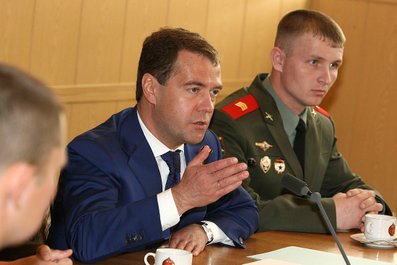
On 5 May, President Medvedev visited Alabino’s 5th Guards Taman Independent Motorized Rifle Brigade (formerly division), a traditional showcase and test bed formation for new equipment and concepts.  

Medvedev and Defense Minister Serdyukov followed up the latter’s late April meeting with the Committee of Soldiers’ Mothers and other public representatives about ‘humanizing’ the armed forces.  At that time, Serdyukov presented ideas for driving the ‘spirit of the prison camp from the army.’  They included freeing soldiers from additional duties to focus completely on training, allowing them more free time, pushing reveille and lights-out back an hour, mandating a rest hour after lunch, instituting a 5-day conscript working week, allowing the possibility of draftees serving close to home, and obtaining weekend passes to leave the garrison. 

Alabino is a place where things like these are typically tried out. 

As Rossiyskaya gazeta put it, Medvedev went to Alabino to see how conscripts live in ‘new profile’ conditions.  He inspected the training grounds, classrooms, and barracks, and answered questions from the new soldiers themselves.  

Medvedev and Serdyukov addressed physical training, one-year conscription, contract service, weekend passes, mobile phones, and hiring civilians to perform nonmilitary support services. 

Taman Brigade Commander Andrey Ivanayev told the Supreme CINC about the experiment with intensive physical training (PT) in his formation.  Ivanayev indicated the troops formerly had 53 hours of PT  per year, but now get 4-5 hours per day, or about 25 per week.  He and Medvedev discussed how soldiers are separated into groups by the physical load they can handle. 

In the Kremlin.ru transcript, Ivanayev said in April testing there were only 88 negative PT evaluations.  According to RIA Novosti’s reporting, Ivanayev thinks the formation’s fitness level has already increased 50 percent.   

Medvedev remarked on the Taman brigade’s outfitting with special PT gear.  He asked Defense Minister Serdyukov about introducing new athletic uniforms in other units.  Serdyukov said:  

“Yes, we are literally this spring buying 50,000 sets and toward fall, apparently, on the order of 100,000 more, the fact is in the course of two years we’re trying to outfit the entire army fully with sports gear for training in summer as well as winter.” 

Most important to the vast majority of Russians, Medvedev told Taman brigade soldiers he doesn’t intend to raise the current 1-year conscription term:  

“That decision on the transition to one-year service which was made, it was painful for us, it isn’t easy, but we won’t change it.  Service in other countries comparable to our country in combat potential is organized in exactly such as way.  And this year still allows us to train a quality specialist, soldier, sergeant.  And despite the fact that there are now certain problems with manning—it’s true, we don’t intend to change the service term.” 

When one soldier asked about enlisted contract service, Medvedev turned to Serdyukov to explain what’s new on this front.  Serdyukov answered: 

“We are now preparing a concept precisely on contract service for soldier and sergeant personnel.  There will be an entire complex of proposals, including on pay, service conduct.  We will equate the entire social package (sergeant like officer) on support, pay and all parameters . . . .” 

“I think in the course of this summer we will prepare and then send you concrete proposals about how this will look, what quantity of contractees we intend to accept, in which specialties particularly and with what kind of pay.” 

Medvedev responded that current pay is not very high, but those who are serving well on it should be retained: 

“However, at the same time, it’s completely obvious according to the well-known principle, better less, but better.  Let there be higher pay and those remaining will really want to serve, instead of us spreading this [pay] among a large quantity of contractees, who won’t have the stimulus, particular desire, or any kind of motive to continue serving and to serve well.” 

When Medvedev pressed him for what he thinks about contractee pay, Moscow MD Commander Valeriy Gerasimov finally said he thinks contractees should get 50-60 percent of lieutenant pay.  Serdyukov said it would be more on the order of 80-85 percent, depending on the duty position.  The more technically complex, the closer to officer pay.  He continues: 

“We are proceeding from the fact that, on the whole, in all the armed forces—a lieutenant from 55, and a sergeant from 35 [thousand rubles per month] . . . .” 

But a little math says that is closer to Gerasimov’s figure, or 64 percent of officer pay . . . 

Medvedev asked his Defense Minister about devising a policy to give conscripts weekend passes to visit home if they live nearby.  Serdyukov said: 

“We are planning over two-three months to proceed on this regime.  Well, naturally, after taking the oath, after he becomes a soldier, after this we’ll introduce it.  We have this really experimental brigade, we are just beginning to work all these approaches out.” 

Medvedev added: 

“Here again we have to proceed from modern approaches.  If a guy serves close by and manning goes according to the territorial principle, then why not let him go home?  Another thing, of course, everyone has to understand what responsibility the soldier carries for any type of infraction in this case, but this is just a question of self-discipline.  You want to go home for the weekend, this means, simply do everything as it’s supposed to be done.” 

Serdyukov chimed in: 

“In the course of five days [of the working week] you need to show the highest indicators, then this will be a particular stimulus for one who wants to pay a visit home on Saturday and Sunday.” 

This policy is especially interesting . . . the possibility of the weekend pass is predicated on several things not really discussed during the Alabino visit.  Working backward, the pass depends on successfully implementing a five-day working week for conscripts.  Then on having conscripts serving relatively close to home in the first place.  At least one voyenkom has already said conscripts from his republic don’t have this chance because they all serve outside their home borders.  A prized weekend pass could also become one more thing to be bought and sold to the highest bidder, or briber.  If implemented, this policy will be difficult to maintain in the face of soldiers who don’t return to the garrison or get into serious trouble while away from it. 

A new conscript asked Medvedev if mobile phones are permitted in the army.  The President asked him if he had one in his pocket, and the soldier replied yes.  Medvedev responded, “Then why did you ask?”  He continued: 

“In fact these rules, as I understand, essentially are established at the unit level, at the level of the corresponding troop formation, but there are no bans on this issue.” 

Gerasimov added that in the Moscow MD anyone may have a cell phone, but they may not be used during training or duty time. 

Discussing training and physical conditioning, Serdyukov turned to one of his earliest initiatives at the Defense Ministry—relieving soldiers from essential nonmilitary duties like kitchen patrol, cleaning, groundskeeping, and utilities maintenance. 

He mentioned the goal of moving to civilian service and support within 12-18 months in all Defense Ministry units, but “everything will depend on our financial condition.  According to preliminary calculations, we have to make do in the bounds of our existing budget.” 

Medvedev said: 

“I think here it’s obvious to everyone that soldiers and officers need to serve the Motherland, be occupied with troop training, improve their physical conditioning, but questions of maintaining the sub-unit, generally, this is an issue which civilian organizations could do successfully for money, as this is done, incidentally, around the world.  Then there won’t be problems with tiresome details and it’ll be possible to concentrate on fundamental service.” 

Civilians already take care of the Taman brigade’s food service, and soon they will maintain its engineering networks, and provide cleaning services.  Serdyukov indicated the FSB is working on licensing firms to work in closed facilities, and Oboronservis will work in remote garrisons where contractors can’t be found.

More on OSKs, and ASU TZ

On Monday, Olga Bozhyeva reminded readers the proposed OSKs were former Genshtab Chief Baluyevskiy’s idea, and she called them part of a command reorganization along an American model.  She contends Baluyevskiy lost his job for pushing the change from military districts (MDs) to operational-strategic commands (OSKs).  And now the OSK will apparently win out, even though Baluyevskiy’s long gone. 

Bozhyeva says Baluyevskiy and the shift to OSKs were defeated in the past by MD commanders [and their powerful patrons] who stood to lose out in the process.  She claims Baluyevskiy’s opposition to the  Navy Main Staff transfer from Moscow to St. Petersburg was a pretext for his dismissal when the OSK was the real issue.  And his OSK experiment in the Far East was quietly dismantled after his departure. 

Actually, it’s more likely Baluyevskiy went down for opposing–rightly or wrongly–the whole range of ideas pushed by Defense Minister Anatoliy Serdyukov.  By contrast, Baluyevskiy’s replacement has been a veritable extension of Serdyukov on policy issues.

With Baluyevskiy gone, according to Bozhyeva, the MD commanders bent the OSK idea to their way of thinking, proposing to make every MD an OSK, without cutting or consolidating MDs, and duplicating efforts in the process.  She says this reflected the MDs as ‘sacred cows’ upon which no one would encroach, and this tracked with new Genshtab Chief Makarov’s background as an MD commander.  Recall that Baluyevskiy was a career Genshtabist.

Bozhyeva continues, saying this year Makarov has begun to think about how to command the ‘new profile’ army.  And wars of the future will hardly accommodate a command structure like the MD.  But Bozhyeva reports a rumor that the name Military District could be retained to appease opponents of merging MDs in favor of modern OSKs.  She concludes, if the OSKs are realized, it’ll be possible to talk of a really ‘new profile’ army.

Dmitriy Litovkin also had his say on the OSK story last Friday.  He describes the possible move to OSKs in terms of more responsive command and control, reducing the transmission of orders from 16 to 3 steps.  But, he cautions, the OSKs are still just a proposal at this point.

Litovkin says the military hasn’t tried to hide the fact that the OSK is borrowed from the U.S. concept.  The main thing achieved in such an approach, he continues, is responsiveness in issuing and receiving combat orders.  The Defense Ministry says this new OSK structure will be tightly tied to the new automated battlefield command and control system ASU TZ (АСУ ТЗ).

Litovkin mentions how Prime Minister Putin saw ASU TZ at Voronezh, and how the system is supposed to centralize command and control down to the ‘electronic soldier’ on the battlefield.  This fall brigade exercises are supposed to employ ASU TZ with the aim of controlling several hundred ‘objects’ in battle simultaneously.  This summer the OSK model will be tried as part of the Vostok-2010 exercise in the Far East.

Litovkin’s source says:

“Developing ASU TZ without trying it in the new armed forces structure is impossible.  We need to understand in practice not just how this works, but also, possibly, that we are developing something unnecessary or, conversely, we aren’t making anything.”

Not a big vote of confidence for the new system.

Litovkin concludes by saying the possibility of unit and even garrison relocations might be a limitation on the OSK scheme.  Forces would need to be better balanced among the four strategic directions.  For example, the Western OSK would have too many motorized rifle units and the Eastern too few.

German Armor

Serdyukov Wants Troops to Ride Inside

Reports about Russia looking abroad for light armored vehicles and not buying BTR-80s and BMP-3s in GVP 2011-2020 came into better focus this week . . .

On Tuesday Defense Minister Serdyukov announced Russia will buy armor for vehicles and light armored equipment from Germany.  In his meeting with representatives of public organizations, he said:

“The RF Defense Ministry will proceed from the need to guarantee the protection of personnel.”

“We have forced KamAZ and other Russian companies to enter into contacts with foreign firms.  They’ve already begun to make contact in order to buy light armor and use it in reconnaissance vehicles, BTRs, BMPs and other transport means.”

Kommersant talked to KamAZ officials who didn’t know anything about buying armor for vehicles abroad.

Serdyukov said, in particular, they were talking about purchasing light armor from one German company (reportedly Rheinmetall).

ITAR-TASS said Serdyukov was referring to poor protection of personnel inside Russian armored vehicles when he warned:

“We, of course, won’t buy Russian vehicles and armored equipment in the condition they are in.”

“We want Russian industry to produce what we need and what the times demand, so that they (OPK enterprises) will modernize their production and create quality equipment.”

In Stoletiye.ru, Sergey Ptichkin writes that Rostekhnologiya’s Sergey Chemezov and FSVTS’ Mikhail Dmitriyev have concluded that the purchase of foreign arms for the Russian Army is a ‘done deal’ at this point.  Dmitriyev said in particular that the political decision to buy Mistral has been made, and the contract will be signed this fall.

Ptichkin concludes:

“In connection with this, by all appearances, a large number of domestic military programs are being rolled up.  Billions are needed to support the import of ships and weapons.”

Chemezov also said, reluctantly, that Russian armor really doesn’t meet the Defense Ministry’s sharply increased requirements, therefore purchases from Germany are justified.  Ptichkin wonders what Rostekhnologiya’s [Chemezov’s] specialty steel holding will do if Germany supplies Russia’s defense industries.

Media sources alluded to past statements by Deputy Defense Minister, Chief of Armaments, Vladimir Popovkin to the effect that foreign purchases would only be to ‘patch holes’ in the Russian Army and OPK.  They imply that either arms imports have expanded beyond ‘hole patching,’ or the ‘holes’ are bigger than originally thought.

Nezavisimaya gazeta writes that buying armor abroad will be catastrophic for Russian metallurgy.  Without part of the GOZ, they reportedly won’t be able to modernize.  Uralsib metals analyst Nikolay Sosnovskiy said, without state orders, enterprises which still produce something won’t be able to survive.  He said buying foreign armor for BTRs and BMPs will lead to buying it for tanks, which is much more costly.  Sosnovskiy says armor orders were ‘second tier’ for the past 20 years, so no one was working on new types.  On the other hand, Aleksandr Khramchikhin thinks the competition posed by foreign armor will force the Russian industry to improve.

Despite this little uproar, it seems unlikely that the Defense Ministry or Russian government are suddenly ardent fans of free trade in all things.  Moscow’s economic management remains more paternalistic and state-directed than that.  Rather purchases abroad are probably viewed as the only way to:  (a) rearm Russian forces quickly with badly needed high-quality arms and equipment; and (b) shake the OPK enough to get it started on the road to competitiveness.

Shamanov Wants Aviation Back

VDV Commander General-Lieutenant Vladimir Shamanov told ITAR-TASS today that the airborne troops need their organic light transport aviation back because its absence is complicating their training.  He says:

“The results of the air-assault training of the VDV in the first quarter of this year show that the transfer of light aviation to the Air Forces is stalling the system.”

As an example of this, Shamanov said light aviation fulfilled only 60 percent of planned jump training at the VDV’s Omsk Training Center.  He said its commander has asked to continue jumps until 7 May.

Shamanov said the VVS ban on Saturday, Sunday, and Monday flights was making the VDV a hostage.  He continues:

“We’ve already had cases.  The VVS command allocated one helicopter each for jumps by our Spetsnaz and communications regiments near Moscow.  However in practice it turned out that the regiment having clear priority, the Spetsnaz regiment, could use the helicopter coming from Levashovo in Leningrad Oblast for jumps in all for only a half day out of five for purely aviation reasons, at the same time as the second, communications regiment, with the other helicopter coming from Ryazan, jumped for a full week.”

“We’ve sent the Genshtab our proposals to create organic sub-units of light aviation in the VDV.  Unfortunately, there’s no hope for them since no answer has been received from the  Genshtab, but we will continue to assert our position.” 

A VDV spokesman said last year, when they still belonged to the VDV, An-2s supported 140,000 jumps in combat training, and the VVS’ Il-76 medium military transport aircraft only 35,000.

The VDV’s light transport force had 7 squadrons of Mi-8 helicopters and An-2 and An-3 aircraft and three airfields until the General Staff Chief’s 1 January directive transferred them to the VVS.

Shamanov also repeated his past calls for each of his three air-assault formations to have its own regiment of 20 combat and 40 transport helicopters.  He said a proposal to this effect is being prepared.  An interlocutor told ITAR-TASS:

“Having organic helicopter regiments in the VDV’s air-assault formations undoubtedly would raise their air-mobility, fire power, responsiveness of command and control in combat conditions, and in the course of combat training.  So the formation commander, who gets a helicopter regiment, could independently, when he considers it necessary, without turning to the VVS command, decide to have air-assault training for personnel including helicopter jumps.”  

Recall the early January Genshtab directive that transferred all aviation units in other services and arms, with the exception of RVSN, to the VVS. 

Shamanov’s complaint and appeal for a change is interesting.  He isn’t one to be afraid to demand special treatment.  He warded off the change from divisions to brigades in 2009.  

Shamanov last publicly lobbied for an upgraded VDV rotary wing component, both attack and transport helicopters, in late 2009.  The Ground Troops would also like army aviation, which they lost to the VVS in 2002, returned to them.  ITAR-TASS noted that former Ground Troops CINC Army General Boldyrev said as much last September.  He wanted helicopter regiments for air-assault brigades that belong to the military districts.

The organic aviation issue will be another place to watch for a possible policy about-face.

Major Beating at Shilovskiy

According to Kommersant, prosecutors have charged an artillery battalion commander from a motorized rifle brigade based below Novosibirsk with exceeding his authority by beating four conscripts from Dagestan.  A senior investigator from the Military-Investigative Department of the Prosecutor’s Investigative Committee for the Novosibirsk Garrison reports that the incident occurred last November at the Shilovskiy range when Major Nikolay Levyy beat two draftees from Dagestan in his office, then smashed their cell phones.  Levyy had been critical of the pair on more than one occasion. 

Two more natives of Dagestan got it from the major in front of the formation.  The investigator determined that Renat Magomedov got the worst of it when the major asked whether Magomedov would fight for the battalion or his own people if he had to choose, and Magomedov responded for his compatriots.

After this, the investigator reported, Slavic servicemen proceeded to beat all four soldiers from Dagestan.  Major Levyy looked on without intervening.  That evening, the events spiraled into a larger fight.  Russian servicemen herded dozens of Caucasian servicemen into one barracks and locked them  down.  Overnight, the unit’s officers managed to quiet the disturbance, and all soldiers from Dagestan were later sent to other units.

Major Levyy was relieved of duty pending the outcome of his case.  He did not admit his guilt, but also refused to incriminate himself by giving evidence.  The events involving the other fighting are still under investigation.

The media accounts note that this is not the first mass fight between Caucasians and Slavs at Shilovskiy.  The last one occurred on 8 January 2007 when officers had to fire warning shots to break it up, according to Kommersant.  Law enforcement only found out when one soldier turned up in the hospital with a ruptured spleen several days later.

Some press reminded readers of the early July 2009 incident in which 200 Russian and other soldiers reportedly fought with 44 conscripts from Dagestan at Aleysk, also in the SibVO.

Some thoughts on this news item . . .

The major smashing the soldiers’ cell phones is interesting.  Commanders say they don’t like soldiers having them because new conscripts have them taken away by older soldiers, contractees, and officers.  Commanders say cell phones jeopardize their units’ secrecy and security.  But they probably don’t like them because cell phones are a lifeline to call for help in cases where conscripts are being abused or mistreated.  This tends to get the commander in trouble, one way or the other.

Would the major ask a soldier from Dagestan if he would fight for his battalion or for his compatriots if there weren’t already some pretty serious interethnic violence, conflicts, and tensions in his unit?

Shilovskiy is basically a SibVO arms and equipment storage base left  unchanged despite the army’s ‘new profile.’  Levyy, like other Russian officers, probably faced the reality that there are now fewer officers, warrants, and contract sergeants to supervise increased numbers of conscripts.  The commander also faces more demands from his superiors, the SibVO, Genshtab, and Defense Ministry today with the push for the ‘new profile.’  It likely breeds frustration that drives higher levels of officer crime from year to year.  It’s interesting that it’s the battalion commander himself using his fists against soldiers, and not their own battery commanders, captains, or lieutenants.

A major in Levyy’s position is damned if he doesn’t and damned if he doesn’t.  If he acts, he has few levers at his disposal—where are the new military police, the guardhouses, the old military commandant?  So he resorts to his fists and something akin to prison camp order.  And if he doesn’t act, he can’t keep order at all and the situation just gets worse.

There are lots of other incidents involving conscripts from Dagestan either giving, or taking, beatings in the armed forces.  And we’ll look at some in days to come.  But interethnic tensions in the Russian Army don’t always involve just soldiers from Dagestan.