Defense News

Some Russian defense news from August 6, 7, and 8, 2012 . . .

Sukhorukov’s Press Conference (photo: Mil.ru)

Mil.ru provided a wrap on the First Deputy Defense Minister’s press-conference on GPV-2020.

Sukhorukov “particularly turned attention” to media reports that the program’s funding will be cut.  He told journalists such a step isn’t foreseen, and the government is talking only about “optimizing” the budget load between years by using good old state-guaranteed credits for the OPK.

Sukhorukov claims 95 percent of GOZ-2012 has been contracted, and 82 percent of funds disbursed.

Arms-expo.ru also covered this story.  It emphasized Sukhorukov’s statement that the rate of defective arms delivered by producers isn’t declining.

According to RIAN, Sukhorukov said Russia won’t buy more Israeli UAVs beyond its current contract.  He reiterated the Defense Ministry believes the BMD-4M doesn’t meet its requirements, and won’t buy it.

Sukhoy reports it’s now testing the new Tikhomirov phased array radar on PAK FA, T-50-3 to be exact.  See RIAN’s story.

Sukhoy also announced that its Su-35S is in “combat employment” testing within the process of state acceptance testing at GLITs.  The company says it meets all established requirements, and has flown more than 650 times.

New Navy CINC, Vice-Admiral Chirkov made an interesting visit to the State Missile Center named for Academic V. P. Makeyev on Monday.  The Makeyev design bureau is home, of course, to liquid-fueled SLBM development.  Could not find the last time this happened.  Might be prior to 2007.

Main Military Prosecutor Sergey Fridinskiy told the GenProk collegium yesterday that abuse or dedovshchina in the ranks is down a third this year.  But, according to ITAR-TASS, Fridinskiy noted that general crimes exceed purely military offenses by a factor of two.  Specifically, he said murders are up by half, bribery has almost doubled, and drug offenses have increased 27 percent.

Fridinskiy also said nearly 3,000 GOZ corruption cases and losses worth 400 million rubles were investigated in the first half of this year.  He said, for example, Dagdizel received 3 billion rubles in defense orders, but hasn’t sent a single product to the military, and bought farm equipment and building materials with the money.  He cited losses in purchasing apartments for military men at inflated prices as well as the problem of unfinished housing projects.

Izvestiya claims a large number of young pilots are leaving the Air Forces because the lion’s share of increased flight hours and promised higher pay are going to their commanders and older officers.  Could this be a continuation of Igor Sulim’s travails at Lipetsk?  The paper also reports a number of cleaning companies say the Defense Ministry owes them 5 billion rubles for housekeeping work outsourced over the last year.

Defense News

Some Russian defense news from August 6, 2012 (and a bit earlier too) . . .

Militaryparitet.com picked up the VVS CINC in Interfax.ru talking about the   Su-35 flight test program, and serial production beginning in 2014, or even next year.  PAK FA, he said, will be produced from, or after the start of, 2015.

Preliminaries for Rubezh-2012 (photo: Mil.ru)

Mil.ru and KZ published on the beginning of Rubezh-2012 — the ODKB’s Collective Rapid Deployment Force exercise at Chebarkul.  Vladimir Mukhin, however, writes in today’s NG about “fault lines” in collective defense.  He contrasts the alliance’s exercise activity with its inaction against real Central Asian instability.

Coastal rocket and artillery units have been busy.  Mil.ru showed the DP-62 Damba MLRS firing from the beach on Kamchatka, and TsAMTO covered a Western MD press-release about Northern Fleet launches of  Rubezh and Redut coastal antiship missiles.

KZ today issued its take on the Navy CINC’s comments during Ekho Moskvy’s Voyennyy sovet program last week.  It’s always interesting to compare the KZ summary with Ekho’s transcript.

Mil.ru reports the well-nigh forgotten future professional sergeants in training at Ryazan will graduate in November.  It says 130 will head off for new assignments.

Recall this grew out of the failed 2003-2007 contract service program, and utilized space available due to the drastic reduction in officer training.  Izvestiya provided a late 2010 look into how few men showed up and lasted at Ryazan.  In early 2011, the Defense Ministry slashed the funding and largely euthanized the stillborn effort.  One waits to see how it’ll find 425,000 contractees in the future.

Putin on Nuclear Forces and Aerospace Defense

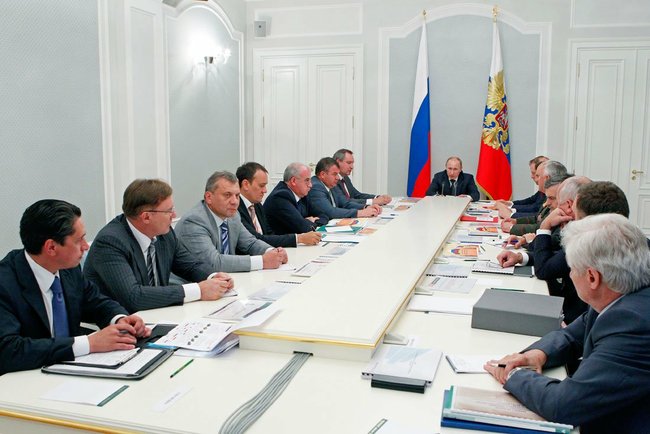
Today’s meeting on implementing GPV-2020 (the third thus far) was devoted to nuclear forces and aerospace defense.  However, President Vladimir Putin had little specific to say, at least in his published remarks.

He obligatorily noted how VVKO and especially SYaS bear “special responsibility” for Russia’s security, territorial integrity, and global and regional parity and stability.

VKO, the president said, must not only be in permanent combat readiness to defend military and state command and control facilities against a potential enemy’s attack, but also “provide clear and effective coordination with other services and troop branches.”

In other words, lots of air and aerospace defense assets don’t belong to VVKO, and their job is to integrate them into a network.

On the nuclear side, Putin said Russia isn’t looking for an arms race but rather to ensure “the reliability and effectiveness of our nuclear potential.”

To reequip SYaS and VKO, the Supreme Glavk indicated Russia intends to allocate a “significant part” of the total resources for GPV-2020, but, again, nothing more specific.  By 2020, SYaS is supposed to have 75-80 percent modern weapons systems, and VVKO not less than 70 percent.

And that’s all we learn about the meeting.  Or almost all.

Kremlin.ru provided a participant list that’s a bit interesting.  Many officials and industry leaders you’d expect attended.  But some were noticeably absent — missile designers from MIT, missile builders from Votkinsk, and the RVSN Commander.  Surprisingly, the general director of the Makeyev design bureau was present.

Power Couple

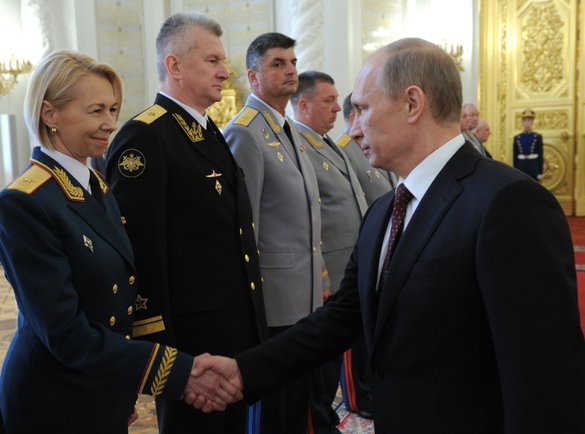
Putin Congratulates Knyazeva

No, not newly-minted General-Major Yelena Knyazeva and President Putin.  The couple is Knyazeva and her husband, Deputy Chairman of the Moscow City Duma, Andrey Metelskiy.

It’s not surprising Kremlin.ru published this picture of the Supreme Glavk shaking Knyazeva’s hand instead of some run-of-the-mill male general’s.

When Putin elevated the fiftyish Knyazeva to one-star rank last month, the Russian press noted his decree gave the Armed Forces a female general for the first time in a number of years.

The last one was the world’s first woman in space, Valentina Tereshkova, who reached general-major in the 1990s.  Media reports added that several women currently hold general officer ranks in the MVD and other uniformed federal services.

This year the Russian Armed Forces indicated having 3,000 female officers in the ranks, a 50 percent increase over 2011.  There were 28 (now 27, of course) women colonels.  There were only 12 female O-6s in 2011, according to RIA Novosti.

Yelena Georgiyevna is Deputy Chief of the Defense Ministry’s Main Directorate for International Military Cooperation.  Before that, she headed the English Department at Moscow’s Military University.  That university now encompasses the Military Institute of Foreign Languages (VIIYa) where she graduated and taught for many years.

She became chief of VIIYa’s English faculty in 1995.  Her participation in international projects during the heyday of Russia-NATO cooperation provided a logical segue to her current duties.  But her timing was fortuitous too.

Under Serdyukov, women emerged in various top Defense Ministry posts, although Knyazeva’s case was somewhat different because she rose inside the military department.

At VIIYa, Knyazeva met her future husband, Andrey Metelskiy, according to Krasnaya zvezda.  Some eight or nine years her junior, Metelskiy studied Farsi and French at the military institute.

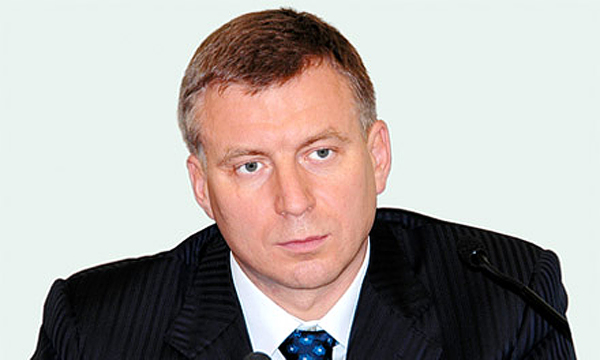
Andrey Metelskiy (photo: Volgorad.er.ru)

Metelskiy’s an interesting figure.  In a Bratishka.ru interview, he indicates he was an 18-year-old lieutenant (!?) serving in Afghanistan when he was wounded in 1986.

After finishing VIIYa and leaving the army, Metelskiy was a businessman with a somewhat confusing political biography.  One observer claims he was a Derzhava supporter who only emerged in the youth section of Unity in early 2000.

But Metelskiy’s mainline biography says he was a deputy chairman of the Moscow city branch of Unity before the December 1999 State Duma elections.  He went on to be first deputy of the Moscow regional branch of Unity’s successor, United Russia.

Metelskiy was elected to the Moscow City Duma in 2001, and is currently in his third term.  He has been a Duma Deputy Chairman since 2004, and heads the United Russia faction which holds an overwhelming 32 of 35 seats in the municipal legislature.  Metelskiy represents the Izmaylovo area in northeastern Moscow.

The observer above recounts a legal dustup in late 2005 between Metelskiy and Rodina’s Dmitriy Rogozin who accused him of sporting military awards he didn’t earn.  But Metelskiy won a defamation case against today’s deputy prime minister for the OPK.

On Medvedevu.ru, a man tells his version of a 2009 car accident with Knyazeva, Metelskiy, and their Lexus.  According to him, Metelskiy denied causing the crash, threatened him, and advised him to forget the whole incident.  Nor did the victim get satisfaction after wending his way through the court system for a couple years.

Knyazeva and Metelskiy are an interesting and well-connected Moscow power couple.  Putin was probably just renewing his acquaintance with Knyazeva since it’s more than likely they’d already met given her husband’s position.

Reacting to Felgengauer

A good friend asked for a reaction to Pavel Felgengauer’s latest piece.

This author agrees with many of Felgengauer’s views, though not all of them.  In particular, this observer is unable to declare, like Felgengauer, that Russia’s military reform is failing abjectly, despite its uneven results.

Let’s look at his article.

Mr. Felgengauer presented the essence of Defense Minister Serdyukov’s dustup with Prime Minister Medvedev last week.  Serdyukov said outright, if the PM wanted to fire someone for failing to prepare semi-abandoned military towns for handover to regional authorities, he should fire him.

You may have read on these pages, the problem of no-longer-needed military towns is an enormous one.  There’s a veritable archipelago of hundreds of voyengorodki throughout Russia.  They’ve long since lost their purpose and support from the Defense Ministry.  Fixing them to transfer to civilian control is an enormous task, probably beyond the Defense Ministry’s current financing and capabilities.

One Putin campaign pledge for 2012 was not to foist broken down military infrastructure on Russia’s regions and localities.  And, though left unsaid, the problems of voyengorodki are connected to the military housing woes.  If more apartments were ready for occupancy, there might be fewer ex-servicemen living in the archipelago of former military towns.

Felgengauer could have written about how the Serdyukov-Medvedev flap reflects wider tensions in Russia’s ruling elite.  Between Putin’s people and Medvedev’s.  He did say the scandal showed the latter’s relative powerlessness.

Felgengauer might have clarified for some folks that, under the constitution, the Defense Minister answers to the President first, and the PM second.  Not so for most ministers.

He mentioned the situation harked back to Serdyukov’s reported ambivalence about continuing in his job.  There was also pre-election talk that Serdyukov might be replaced at the start of Putin’s third term.  But Felgengauer concludes Putin wanted to keep him in the post regardless.

Felgengauer suggests Serdyukov might suffer a “mental meltdown.”  He could have reacquainted readers with the temper and frustration Serdyukov showed the VDV in Ryazan in late 2010.

Turning to strictly military issues, Felgengauer concludes, “. . . the actual capabilities of the military after almost four years of Serdyukov’s reforms are questionable.”

Despite efforts to move away from reliance on hollow units, and increase permanently ready units, woeful undermanning (Vedomosti, June 9) leaves newly formed army brigades crippled, “with most of them not ready to be used in combat as full units in any circumstances.”

He continues:

“Most of the soldiers are one-year serving conscripts, called up two times a year, so half of them at any moment have been serving less than 6 months — not yet trained to be battle-ready at all.”

Let’s examine all this a bit.

Undermanning certainly exists.  The lack of detail on the strength of Russia’s new brigades make things somewhat sketchy.  If (a very big if) the brigades aren’t large, 300,000 conscripts might stretch to cover them, barely.

If the 45 maneuver units have only 3,000 draftees each, that’s 135,000.  Add maybe 60,000 (40 x 1,500) in other brigades, and Russia uses 200,000, or two-thirds, of its conscripts for the Ground Troops.

If these brigades are fully equipped and can depart garrison in an hour or two, they’re technically permanently ready.  But, as Felgengauer points out, six months is not adequate time for combat training, so it’s not clear what missions they can accomplish.  The issue is more combat capability than readiness.  Permanent readiness is a starting point, not an end in itself.

Felgengauer rightly notes that Serdyukov’s reform has lacked a strategic objective and defined doctrine.  One might say it’s failed to prioritize goals, problems, and threats.  Felgengauer says “attempts to meet all other possible threats [besides the U.S. / NATO] resulted in thinly spreading out limited resources.”

This author agrees completely.

Felgengauer ends, weakly, saying military food service was outsourced to make conscript service more attractive, and Putin might abandon it.  He views it as a failed military reform.  It may be, but outsourcing was really introduced to keep draftees in training 100 percent of the time rather than in non-military duties like KP.

We’ll return to the issue of whether military reform is succeeding or failing another time.

Putin on Ground Troops and VDV

Meeting on GPV for Ground Troops and VDV

Kremlin.ru has the transcript of President Putin’s introductory remarks yesterday at a meeting on the land armaments portion of the State Armaments Program, the GPV.  This is his second review of where things stand.  Recall in mid-June he held a session on the Air Forces and the GPV.

Noting that “leading countries” are increasing the potential of their ground forces with new reconnaissance, C2, and “highly accurate” systems, as well as modern armor, Putin continued:

“I remind you in the framework of the state armaments program to 2020 it’s planned to allocate more than 2.6 trillion rubles to outfitting the Ground and Airborne forces.  We have to reequip units and sub-units, to fill the troops with new equipment with these resources.  By 2020 its share must be not less than 70 percent.”

“So 10 ‘Iskander-M’ brigade missile systems, 9 S-300V4 army brigade SAM systems, more than 2,300 tanks, nearly 2,000 self-propelled artillery and gun systems, and also more than 30,000 units of automotive equipment alone must enter the Ground Troops.  Besides this, it’s planned to introduce new communications, C2, advanced reconnaissance systems, individual soldier systems.”

As previously, the president stressed that complete fulfillment on schedule and at agreed prices is “very important.”

Then Putin turned to three problem areas.

First, fielding new weapons systems is complicated by the involvement of many sub-contractors.  A breakdown in one contract can cause an entire effort to fail.  Putin cited the VDV’s new BMD and YeSU TZ as examples:

“[BMDs] still haven’t gone through state testing and, as a result, haven’t been accepted into the inventory.  In turn, this is impeding development of practically all the VDV’s weapons sub-systems.  Today I’d like to hear, respected colleagues, why the task of the state program in the area of armor development and supply to the VDV hasn’t been fulfilled.”

“Creating a unified command and control system for troops and weapons at the tactical level [YeSU TZ] is another example.  The test model still doesn’t fully answer the requirements the Defense Ministry set out.  And I’d like also today to hear how this question is being resolved.”

Refer here and here for recent words on the BMD-4M and YeSU TZ.

Second, the Ground Troops and VDV spend too little on R&D (10 and 5 percent of what they spend on serial purchases and repairs respectively).  And the R&D money is put toward a small number of projects.  The president wants more work on advanced soldier systems, infantry weapons, individual protection, and comms.

Third, and finally, there’s a mess in Russia’s munitions industry.  There’s no long-term plan for ammunition makers, and this presents a problem for new arms systems.  The time has come, Putin said, to determine how the Defense Ministry and enterprises in this sector will interact.

President Putin has really seized on the GPV.  It seems near and dear to him.  Or perhaps it seems more tractable than Russia’s political and economic problems.  More amenable to his directive leadership and manual control.

The cases Putin mentioned are longstanding, well-known “poster children” for the problems of the OPK, i.e. easy and logical targets.  One wonders what more pressing and acute, if less publicly advertised, military-industrial difficulties were discussed.  Putin’s focus on R&D is also a bit odd when you consider it’s been blamed for waste and slashed.

Putin didn’t address strong rumors and denials of slipping the schedule for GPV 2011-2020 to 2016-2023.

Does the GPV Look Like This?

If Putin keeps on the GPV, perhaps we’ll gain a somewhat sharper picture of how it’s shared out.  It’d be interesting to learn where the RVSN and VVKO fit.

Defense News

Some Russian defense news from June 27, 28, and 29 . . .

A few stories from Technologies in Machinebuilding — 2012 now playing at Zhukovskiy.

A senior VVKO general said a long-range missile for the S-400 is being tested and will reach units soon, RIA Novosti reports.

An Almaz-Antey rep said the fifth S-400 “regimental set” will ready for delivery in September.  He also said the company will show the system to the Chinese this fall.

VVS CINC General-Major Viktor Bondarev told the press the first S-500 could reach the forces in 2013.

RIA Novosti quoted First Deputy Defense Minister Sukhorukov on Russia fielding its first strike UAV in 2014.  St. Petersburg firm Tranzas will test and deliver it in the same year.

Militaryparitet picked up Arms-Tass about Salyut’s presentation of a modernized AL-31F engine, the AL-31F M2.  The new engine is intended for       Su-27 variants.

Also at Zhukovskiy, RIA Novosti quoted Deputy PM Rogozin about declaring war on OPK monopolists.  Good luck with that.

RIA Novosti reports outgoing OSK head Roman Trotsenko cited conflict with the Defense Minister as his reason for leaving, and he blasted Serdyukov for unwise, unreasonable use of procurement money.  Sevmash chief Andrey Dyachkov is taking over OSK.

President Putin greeted and feted top graduates of Russia’s military academies.  He told assembled officers the Armed Forces’ combat capability and application of new equipment depends on them.  He emphasized resolution of military housing problems and improved living conditions for military families.

According to RG, Putin basically called for reestablishment of voyenpredy in defense plants while answering questions from Federation Council members.  Defense Minister Serdyukov has essentially dismantled the old military acceptance system.

General Trash

Late last week news services reported the Investigative Committee (SK) lodged serious allegations against former commander of the Special Designation Command (KSpN), retired General-Colonel Yuriy Solovyev.  The KSpN was a forerunner of today’s VVKO.

Retired General-Colonel Yuriy Solovyev

The gist of the story goes like this.  In 2006, Solovyev supposedly allowed a commercial firm, Proyekt Stroy to establish and operate an unregistered landfill on military property under his command.

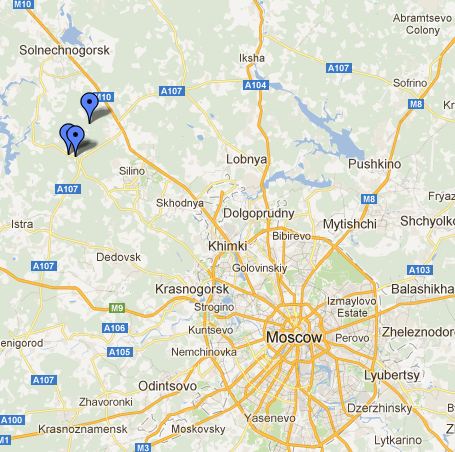
Specifically, military unit 62845, which, according to Warfare.ru, is the 584th Guards SAM Regiment (5th PVO Brigade), near the settlements of Lytkino, Marino, and Povarovo in Moscow Oblast’s Solnechnogorsk Rayon.

Vicinity of Lytkino, Marino, and Povarovo

The regiment operates S-300PM (SA-20 / Gargoyle) SAMs.

The SK apparently plans to charge him for “exceeding his authority with infliction of serious consequences.”  Gazeta.ru reports the 64-year-old ex-general checked into a hospital (where he can’t be charged or interrogated).  His alleged crime could bring a possible 3- to 10-year prison sentence.

According to Gazeta, Solovyev contracted with Proyekt Stroy to reclaim some land, but actually allowed it to use it for an illegal landfill.  The dump grew five times, from four to 20 hectares (about 50 acres or 1/5 of a square kilometer), during Solovyev’s tenure, according to the SK announcement.

Gazeta says specialists estimate the landfill has caused 8 billion rubles in environmental damages.  The investigation is continuing, and more names connected to the case are expected to emerge.

The news site noted that the case stemmed from an MVD investigation back in March.  The MVD announced then that “an organized group consisting of former and current highly-placed RF Defense Ministry officials” was responsible for the dump.  At the time, it estimated 13 billion rubles in damages to the state.

The MVD said the pits Proyekt Stroy dug threatened Moscow’s reservoirs and groundwater sources.  Federal Water Resources Agency experts found concentrations of toxins elevated by more than 200 times at the site.  Vzglyad’s report on this story indicated mercury alone was found at 30 times the allowable level.  Proyekt Stroy reportedly cut 18 hectares of forest before digging the landfill.

Gazeta adds that locals described the dump as the size of five soccer fields and having a powerful stench of methane.  One talked of changes in the color of a nearby stream’s water.  He also estimated possible profit from the trash heap at  $100,000 per day, and confirmed that the military controlled access to the site.

Experts claim this isn’t a unique story, with more than 700 unsanctioned dumps located around Moscow.  They’ve been ignored, but the problem is catastrophic.  New Moscow Oblast Governor Sergey Shoygu has vowed to close illegal landfills, according to Vzglyad.

Kommersant’s March reportage indicated the dump was first reported by locals last September.  The paper claimed 50 “guest workers” work there and live in nearby barracks.  It added that the SAM regiment’s missile launchers were not more than 200 meters from the site.

Kommersant concluded ominously:

“Now the investigation will clarify exactly who in the Defense Ministry permitted the organization of a trash heap right next to militarymen and why they closed their auditing eyes to its operation.”

They’ve apparently found at least one person to blame.

Update on World-Class Competitors

By way of follow-up on a previous post, Defense News’ list of the top 100 defense industrial producers for 2011 is out.  No change in Russian companies except for some changes of position on the list.

Sukhoy, Helicopters of Russia, and RTI moved up the list with increased revenue over 2010.  Almaz-Antey, Irkut, and United Engine-building slipped down.  RSK MiG hasn’t reported 2011 data.

Here’s last year’s post.

No One and Nothing is Forgotten

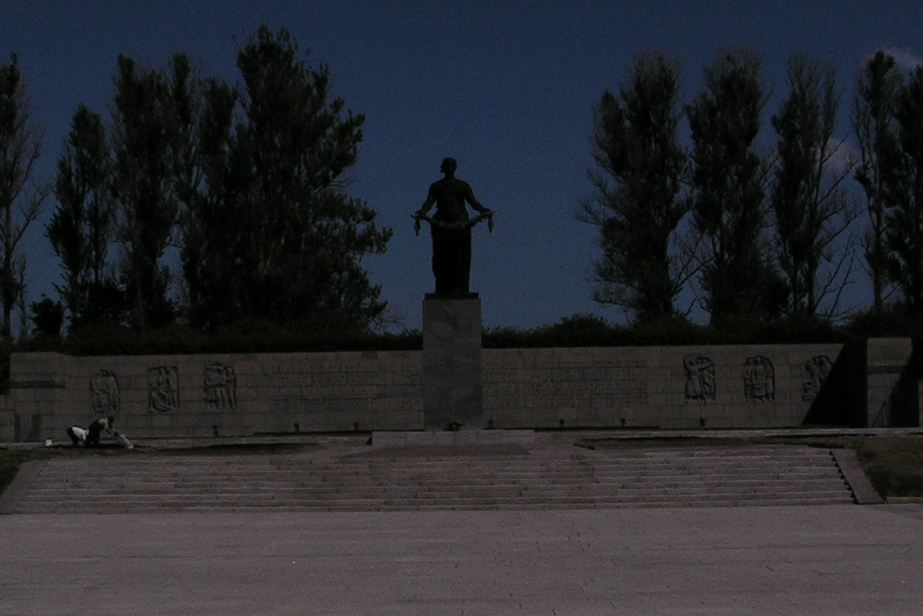
Piskarevskoye Memorial Cemetery

One happened to stumble on something yesterday, 71st anniversary of Germany’s invasion of the Soviet Union . . . famous words that “No one and nothing is forgotten” on Russia’s Day of Remembrance and Grief.

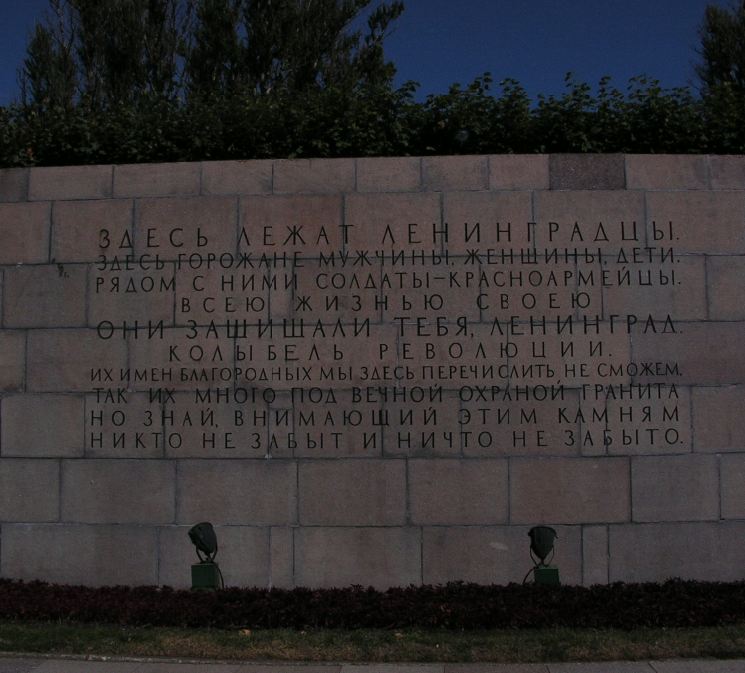
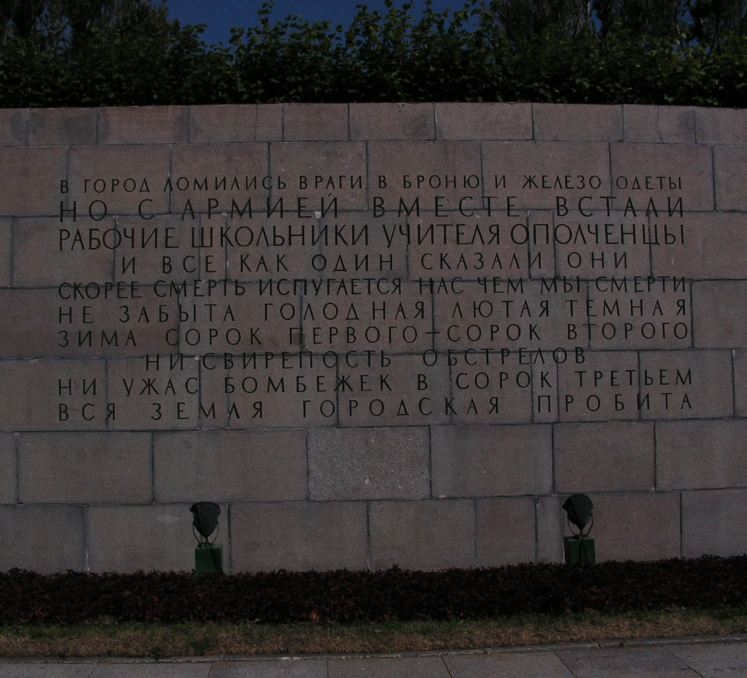
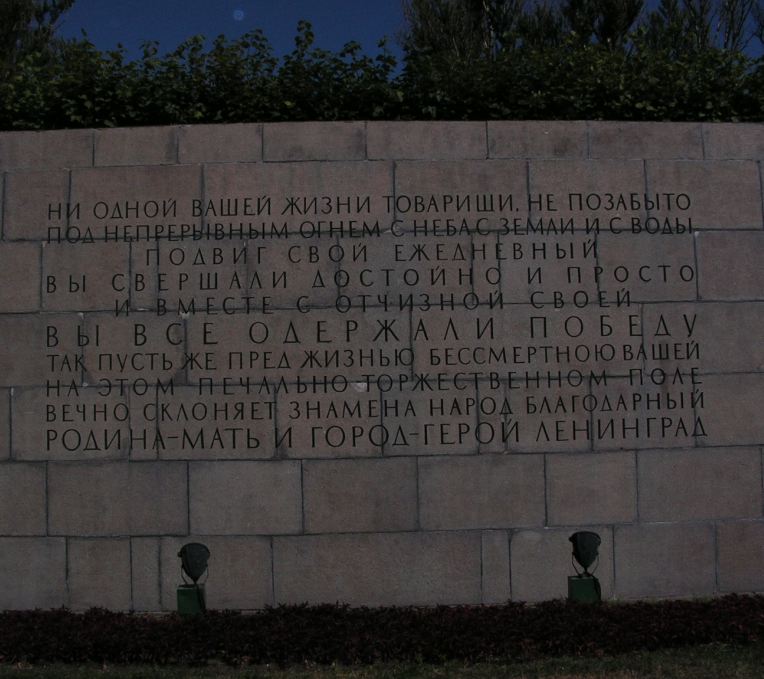
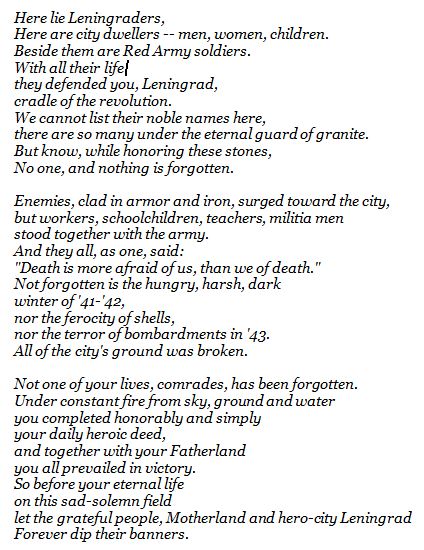
Probably few non-Russians are familiar with their origin.  They come from a poem by Leningrad blockade survivor Olga Berggolts.  Poignant verse carved in the stone at the center of Piskarevskoye Memorial Cemetery on the outskirts of St. Petersburg.

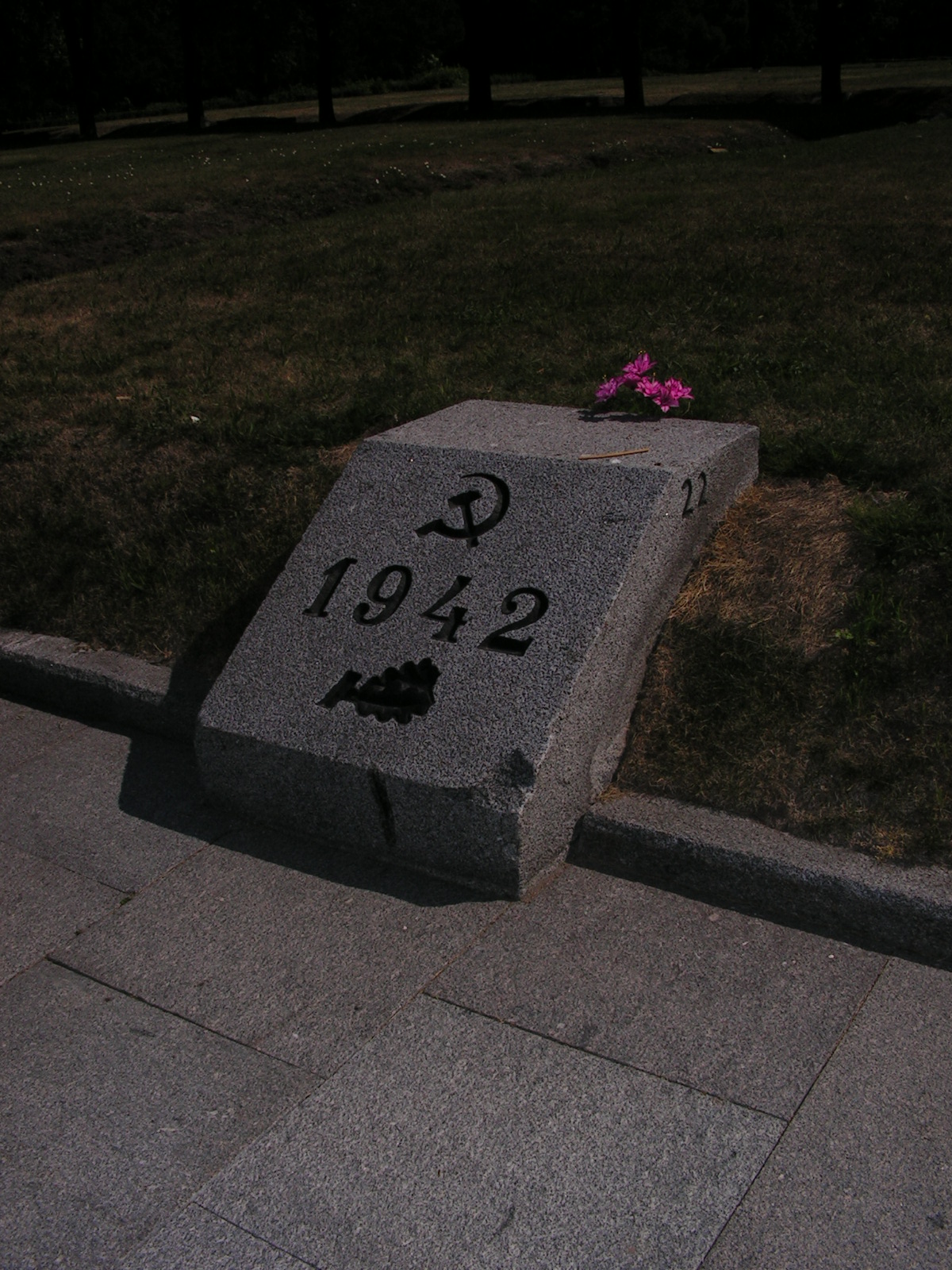
Nearly half a million Soviet citizens killed by bombs or bullets, or starved in the siege are buried in 186 rows of mass graves at Piskarevskoye.  Markers like the one below indicate the year and row number (22).

Here’s a translation of Berggolts’ poem:

Berggolts and her family were victims not only of the Nazis, but also Stalin’s terror.  Still she was a patriotic and loyal citizen.

Her life history makes one wonder if she felt “No one and nothing is forgotten”  covered more than the war’s tragedies.  This line written long ago still seems relevant in the struggle for Russia’s historical memory.