Demobbing the Central Apparatus

Over the weekend, Moskovskiy komsomolets reported the next wave of reform will civilianize the entire central apparatus of the Defense Ministry.  Civilian administrators will replace uniformed officers everywhere except the Genshtab and “combat support structures.”  Special commissions will select civilians on a competitive basis. 

MK’s Defense Ministry sources claim this phase of reform will be completed by December.  The Main Legal Directorate will civilianize in August-September.  The Press-Service and Information Directorate will be reformed from 1 August.  The Personnel Inspectorate will civilianize also, according to MK’s report.

Needless to say, generals think it strange to let civilians decide the fate of their careers.  But an MK source argued:

“And who prevents them from working just the same, but in civilian attire?  For them, in principle, just like for prosecutors, it’s no different – in shoulderboards or without them, only the knowledge of directive documents and legislative acts is important.”

For counterpoint, MK turned to Leonid Ivashov:

“It’s obvious today that a transition to civilian duties is taking place in the military department.  The second tendency is the domination of women in the new structures.  They head finance, the legal directorate, the apartment-management service, a nice girl headed the directorate for international military cooperation for a time.  Ms. Shevtsova became deputy minister, in charge of construction, a woman – a specialist in taxes and alcohol production heads the military education department . . . .  Don’t think that I’m badly disposed toward women, I like them very much.  I wouldn’t, for example, be irritated if Natalya Narochnitskaya [a well-known scholar, social-political figure, doctor of historical sciences — Ed.) became Defense Minister.  She’s an intelligent analyst, who has tact, and, I think, could bring a lot of useful and healthy things into army structures.  But if managers from business go there and gather such people around them, then the army will turn into some kind of commercial organization.  When they say we are copying the American or other democratic model of an army where the Defense Minister and his department are civilians, this is not true.  Yes, we have a civilian minister.  But I don’t see in a single serious government that people from commercial life come to this post.  They are always politicians, representing some party which controls or consults with them.  But to simply to throw any guy into the military department so – and do what you want, there isn’t anything similar in a single government.”

Ivashov makes the observation that civilianization, and feminization, of the Defense Ministry’s been going on for a while now.  But he spins off into a diatribe against ex-businessman Serdyukov.  It’s not really Serdyukov’s fault there’s no democratic party system to produce politicians who could lead the Defense Ministry.  And one could argue the Defense Ministry was a corrupt commercial organization well back when Ivashov was there, but men in uniforms were the ones making the illicit deals then.  But we digress . . .

Recall at the outset of Serdyukov’s reforms in fall 2008, he indicated he intended to cut the Defense Ministry’s 10,523-strong central apparatus and roughly 11,000 military personnel in command and control organs down to no more than 8,500 in all.  So perhaps now we’re looking at about 4,000 personnel, civilians that is, in the Defense Ministry’s central apparatus.

Dropping officers in favor of civilians in the Defense Ministry might buttress Dmitriy Litovkin’s report last week about a deeper cut in military manpower.

Arsenal Explosion Blows Up a Couple Careers

Friday Kremlin.ru published Defense Minister Serdyukov’s list of those responsible for the June 2 fire and explosion at the 102nd Artillery Munitions Arsenal.

Not surprisingly, small fish got dismissed while large ones got off with reprimands.

The text of Serdyukov’s report to President Medvedev concludes:

“The basic causes of what happened were nonobservance of the requirements of explosives and fire safety while working with munitions, a negligent attitude by the Central Military District directorate and the command of the 102nd arsenal toward fulfilling their immediate duties in organizing and supporting daily functions, but also not fulfilling the requirements of Russian Federation Government order No. 135 from 17 February 2000 regarding the establishment and designation of prohibited zones and areas.”

Those dismissed for failures before or during the disaster:

  • General-Major S. V. Khokh, Chief, Technical Support Directorate, Central MD.
  • Colonel L. V. Chumakov, Chief, Material-Technical Support Planning and Coordination Directorate, Central MD.

Those getting reprimands:

  • Deputy Defense Minister, Army General D. V. Bulgakov.
  • Commander, Central MD, General-Colonel V. V. Chirkin.

Those receiving severe reprimands:

  • Acting Chief of Staff, Central Military District, General-Major S. A. Chuvakin.
  • Chief, Main Missile-Artillery Directorate, RF Ministry of Defense, General-Major A. L. Romanovskiy.
  • Chief, Material-Technical Support Planning and Coordination Department, RF Ministry of Defense, General-Lieutenant S. A. Zhirov.  

Warned about incomplete duty fulfillment:

  • Deputy Commander of the Central Military District for Material-Technical Support, General-Major Yu. A. Svintsov.

Dismissed early for nonfulfillment of contract terms:

  • Acting Chief, Missile-Artillery Armaments Service, Central Military District, Colonel A. N. Kozlov.
  • Section Chief (base, arsenal, and depot administration and security), Material-Technical Support Planning and Coordination Directorate, Central Military District, Colonel Kh. Kh. Beglov.
  • Chief, 102nd Arsenal (artillery munitions, 1st rank), Central Military District, Colonel Yu. I. Banin.

More Cadre Changes

President Medvedev issued another decree yesterday (can’t manage to get caught up).  This one had two major changes — General-Major Popov promoted to head all air defense for VVS, and Vice-Admiral Korolev goes to head the Northern Fleet.

Appoint:

  • Colonel Andrey Yevgenyevich Kondrashov, Deputy Commander, 2nd Air Forces and Air Defense Command, relieved as Commander, 12th Aerospace Defense (VKO) Brigade.
  • General-Major Dmitriy Viktorovich Gomenkov, Commander, 12th Aerospace Defense (VKO) Brigade.
  • General-Major Sergey Vladimirovich Popov, Chief, Air Defense, Deputy CINC for Air Defense, Air Forces, relieved as Chief, Surface-to-Air Missile Troops, Air Forces.
  • General-Major Viktor Vasilyevich Gumennyy, Chief, Surface-to-Air Missile Troops, Air Forces, relieved as Chief, Radiotechnical (Radar) Troops, Air Forces.
  • Vice-Admiral Vladimir Ivanovich Korolev, Commander, Northern Fleet, relieved as Commander, Black Sea Fleet.
  • General-Major Igor Yuryevich Makushev, Commander, 1st Air Forces and Air Defense Command, relieved of duty as Chief of Staff, First Deputy Commander, 4th Air Forces and Air Defense Command.
  • Colonel Mikhail Aleksandrovich Smolkin, Chief, Radiotechnical (Radar) Troops, Air Forces.
  • Rear-Admiral Aleksandr Nikolayevich Fedotenkov, Commander, Black Sea Fleet, relieved as Commander, Leningrad Naval Base, Baltic Fleet.

Relieve:

  • Colonel Sergey Vasilyevich Grinchenko, Deputy Chief, Federal Directorate for the Safe Storage and Destruction of Chemical Weapons, RF Ministry of Industry and Trade.
  • Captain 1st Rank Yevgeniy Ivanovich Irza, Commander, 2nd ASW Ships Division, Northern Fleet.

Bulava Launch Window

An OPK source told RIA Novosti yesterday a state commission on experimental flight testing has identified June 28-30 as the window for this year’s first Bulava SLBM test.  The commission will select a precise date within the next two days.  The source says Borey-class SSBN Yuriy Dolgorukiy will be the platform for the launch.

Cadre Changes in the Armed Forces

Three more decrees from President Medvedev, published yesterday (there’s still one more ukaz from early this year your author hasn’t covered).

Appoint:

  • Colonel Valeriy Grigoryevich Asapov, Commander, 37th Independent Motorized Rifle Brigade.
  • Colonel Andrey Anatolyevich Burbin, Commander, 7th Missile Division.
  • General-Major Aleksey Vladimirovich Zavizon, Commander, 136th Independent Motorized Rifle Brigade.
  • Colonel Dmitriy Leonidovich Kostyunin, Commander, 6950th Aviation Base (1st Rank).
  • Captain 1st Rank Aleksandr Alekeyevich Moiseyev, Deputy Commander, Submarine Forces.
  • Rear-Admiral Sergey Grigoryevich Rekish, Chief, Organization-Mobilization Directorate, Deputy Chief of Staff for Organization-Mobilization Work, Pacific Fleet.
  • Captain 1st Rank, Arkadiy Yuryevich Romanov, Chief, Organization-Mobilization Directorate, Deputy Chief of Staff for Organization-Mobilization Work, Northern Fleet.
  • Colonel Oleg Mussovich Tsekov, Commander, 200th Independent Motorized Rifle Brigade.

Relieve:

  • General-Major Vladimir Vladimirovich Samoylov, Deputy Commander, 49th Army.

* * *

Relieve:

  • Colonel Valeriy Mikhaylovich Zhila, Commander, 37th Independent Motorized Rifle Brigade.
  • Colonel Pavel Valentinovich Kirsi, Commander, 18th Machine Gun-Artillery Division.

Relieve and dismiss from military service:

  • Rear-Admiral Yuriy Vladimirovich Baylo, Chief of Rear Services, Deputy Commander for Rear Services, Pacific Fleet.

Appoint:

  • Colonel Stepan Aleksandrovich Vorontsov, Chief, Rear Support Directorate, Western MD.
  • General-Major Aleksandr Valentinovich Golovko, Chief, 1st State Testing Cosmodrome, relieved as Chief, 153rd Main Test Center and Space Systems Directorate.
  • Colonel Dmitriy Vladimirovich Krayev, Commander, 18th Machine Gun-Artillery Division.
  • General-Major Oleg Vladimirovich Maydanovich, Chief, 153rd Main Test Center and Space Systems Directorate, relieved as Chief, 1st State Test Cosmodrome.

 Dismiss from military service:

  • General-Major Sergey Petrovich Degtyarev.
  • General-Major Vladimir Ivanovich Perekrestov.

* * *

Appoint:

  • General-Major Sergey Vasilyevich Varfolomeyev, Chief of Staff, First Deputy Commander, 4th Air Forces and Air Defense Command, relieved as Deputy Commander, 1st Air Forces and Air Defense Command.
  • General-Major Igor Mikhaylovich Nerestyuk, Deputy Commander, 1st Air Forces and Air Defense Command, relieved as Commander, 6983rd Guards Aviation Base (1st Rank).
  • Colonel Aleksandr Vasilyevich Duplinskiy, Commander, 6983rd Guards Aviation Base (1st Rank).
  • Colonel Vladimir Viktorovich Kvashin, Commander, 62nd Missile Division.

Relieve and dismiss from military service:

  • Rear-Admiral Aleksey Borisovich Tuzov, Deputy Chief, Navy Training-Scientific Center “Fleet Admiral of the Soviet Union N. G. Kuznetsov Naval Academy.”

Dismiss from military service:

  • General-Major Igor Mikhaylovich Kharchenko.

Below One Million?

Dropping Russia’s military manpower level below one million?  Talk about a watershed.  This might be spurious information, but coming from Dmitriy Litovkin, the report has to be taken seriously.  In fine Russian tradition, it could be a trial balloon to elicit public and elite reactions.

In yesterday’s Izvestiya, Litovkin reported that, over the course of two years, the Russian Army will become smaller by 150,000 men, according to a Defense Ministry source.

The impetus for this is the Finance Ministry’s.  Aleksey Kudrin’s been ordered to fight the budget deficit, and he’s got defense and security spending in his sights. 

The source says concrete proposals to cut military expenditures were prepared for a special government conference in early June.  As a result, the government adopted an “additional reduction” of 150,000 servicemen.  This would reportedly save 10 billion rubles in 2010 [sic], and almost 50 billion rubles in 2014.  The article says military staffs have already been cut 40 percent as a result of army reform. 

Litovkin notes Defense Minister Serdyukov has previously called one million the “optimal” manning figure — ostensibly 150,000 officers, 100,000-120,000 contract sergeants, and conscripts for the balance.

But it wasn’t so long ago that the Defense Ministry declared the need for an increase of 70,000 officers, and raising the number of contract NCOs and soldiers to 480,000.  It’s not clear how these new cuts are supposed to jibe with increases proposed earlier this year.  The Supreme CINC [together with his tandem partner] will have to decide.

Litovkin enumerates Defense Minister Serdyukov’s competing costly initiatives — higher officer pay, outsourcing nonmilitary tasks, etc.  According to this, outsourcing alone has already brought 380,000 [!?] civilians into military support positions and this number is supposed to increase.  Litovkin doesn’t close the loop on this, but he seems to imply the high cost of these efforts requires cuts in manpower.

This is all exciting and interesting and occasions a couple thoughts.

One.  The new “optimal” number for the Armed Forces must be 850,000.  Liberal Russian politicians, military analysts, and observers have long argued for this, or an even more radical cut.  But one million has had mystical power.  Russian conservatives will vociferously object that the country’s borders are too extensive to be defended by a single man short of one million, as if even one [or for that matter two] million could do it, or as if sheer manpower’s the best way to parry modern military threats.

Two.  Though not mentioned by Litovkin, isn’t it possible Moscow’s decided to make a virtue of necessity and recognize that demographic and draft problems have left them well short of a fully-manned force of one million anyway?  This could be a small step in the direction of becoming (or at least looking) more like just another European army.

Three.  The inevitable downsides.  Keeping more officers had been intended to deal with the outplacement cost (apartments) and other negative fallout of cutting the officer corps in half, not to mention simply having more officers around to deal with unruly nonprofessional soldiers in the ranks.  And another round of personnel reductions is likely to delay any resumed movement toward a long-term professional enlisted force.

Just the latest fro in the game of Russian defense policy to-and-fro.

No Funding for Domestic UAVs

Israeli Searcher Mk.2

RIA Novosti reports a highly-placed OPK representative says development of Russian UAVs hasn’t been financed for two years.  According to him, this is connected with the drawn-out work of Defense Ministry experts considering Israeli drones purchased two years ago.  The source continues:

“It’s obvious Russia’s Defense Ministry can’t figure out its future actions:  either continue to buy UAVs abroad, or finance our own development.”

It seems pretty clear to this author it’s the former, especially considering the following figures.

TsAMTO gave the news agency a rundown on Russia’s 2009 contract for Israeli UAVS:  two Bird Eye-400 ($4 million), eight I-View Mk150 ($37 million), and two Searcher Mk.2 ($12 million).  TsAMTO also says a $100 million contract for 36 unspecified UAVs was signed later.

RIA Novosti also notes, this March, the Defense-Industrial Corporation (Oboronprom) agreed on a $400 million contract with IAI to assemble Israeli UAVs in Russia.  Oboronprom’s Helicopters of Russia sub-unit is responsible for the Russian side of this joint venture.  At the time, Russian experts argued that comparable domestic UAVs were several times cheaper.  But Russian designers also acknowledged lagging in some technologies, particularly optical-infrared sensors and data transmission.

More than a year ago, then-Armaments Chief Vladimir Popovkin said 5 billion rubles had been spent on domestic UAV development without result.  Then months of comparing foreign and domestic models followed.  And now the money trail makes it pretty obvious the Defense Ministry (and big OPK players themselves) are intent on buying abroad.  Small Russian UAV makers are the short-run losers. 

This seems a smart choice for now.  It will be some time before  Russia successfully integrates foreign-designed UAVs into its military operations.  There doesn’t seem a compelling reason to aim for self-sufficiency in something that’s still a niche mission. 

What will happen depends on how Moscow handles its domestic developers.  Will they be able to apply foreign UAVs to their own work and make competitive models of their own?  Falling behind on pilotless technology is not exactly a negligible risk in the coming unmanned age.

PAK FA in 2019?

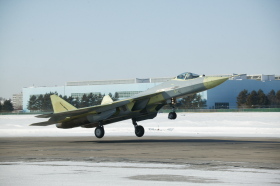
PAK FA

According to ARMS-TASS, Deputy Chief of Rostekhnologii Dmitriy Shugayev told the assembled press corps at the Paris Air Show that Russia’s PAK FA will need about eight years to reach serial production.

This sounds like a very different story from what we’ve heard thus far.  Most official pronouncements have talked about starting serial production in 2015 or 2016, and pretty much completing the run by 2020.

No reason or context was given for what seems a pessimistic appraisal of PAK FA’s timeline.  However, it might be connected to the challenge of getting “second phase” engines on the aircraft.

Done Deal

Mistral Contract Signing

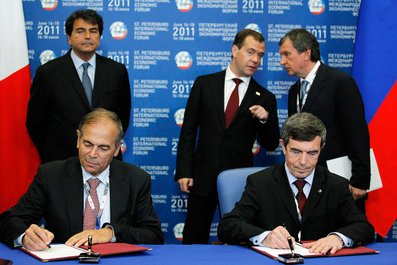
The deal for the first two Mistrals, that is.  With President Medvedev looking on, Rosoboroneksport’s Anatoliy Isaykin and DCNS’ Patrick Bouasie signed the contract at the Petersburg International Economic Forum.  RIA Novosti quoted Isaykin on the €1.2 billion price.  Work can begin after the Russians pay an advance (Versii.com repeated a rumor that the French wanted 80 percent prepayment). 

RIA Novosti also noted Isaykin saying the Russian Mistrals will be identical to French units except they’ll have reinforced hulls and flight decks to handle Russia’s northern waters, and its heavier helicopters.  Isaykin said Russia has an option for two more Mistrals to be built in Russia.  But it’s up to the Defense Ministry to get money for them in the Gosoboronzakaz.

ITAR-TASS made the point that the Senit 9 tactical command and control system, and its documentation, are part of the just-inked deal.  OSK General Director Roman Trotsenko told Rossiya-24, “The French side has gone to an unprecedented level of technology transfer and is transferring technologies, including the programming source codes for battle information-management systems, communications systems.”

Kommersant reported the first Russian unit is expected in 36 months, the second in 48, or 2014 and 2015 respectively.   It cited Trotsenko on Russia contributing up to 40 percent of the work on the two ships to be built at STX in Saint-Nazaire.

While the Mistrals will come with French electronics, the Russians will have the task of outfitting the ships with their own weapons, helicopters, amphibious assault craft, and other systems.

Radio Svoboda asked for some thoughts about the occasion.  NVO’s Viktor Litovkin opined that these expeditionary warfare ships don’t make much sense under Russia’s current military doctrine or in the context of defending the Kurils.  Pavel Felgengauer said the Mistrals may be appropriate for fighting enemies with weak air and naval forces, but Russia’s leadership hasn’t specified who they might be.  Viktor Alksnis complained that they are another stake in the heart of Russia’s dying OPK.  He calls for Russia to modernize its own arms production base instead of buying abroad.  He also fears the French could put an “off switch” in the ships’ C2 systems, effectively turning them into “target barges.”

Aleksandr Golts supports the deal because Russian shipbuilders will participate and get new technologies, but he also because he favors the emphasis on force projection rather than the Navy’s pro-SSBN mission.

Navy CINC, Admiral Vladimir Vysotskiy made some appropriately effusive comments about the capabilities and prospects for employing the Mistrals.

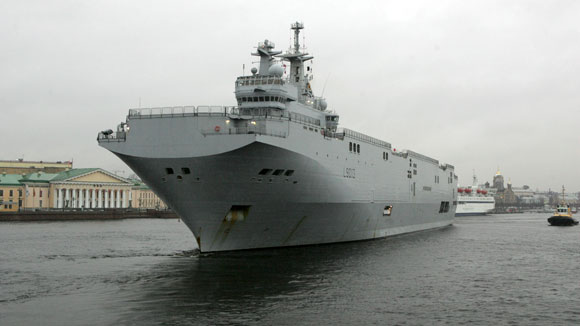
Mistral in Piter (photo: Izvestiya)

Defense Minister Serdyukov was less willing to elaborate saying:

“Let’s build them first, and then we’ll think about where to deploy them.  We have plans to employ them, when they’re closer to ready we’ll disclose them.”

In Moskovskiy komsomolets, Olga Bozhyeva writes that the Mistral deal does several things for Moscow.  An arms sale like this implies a level of acceptance by Europe, it divides old and new Europeans, and it serves as a wedge between the U.S. and its European allies.  She notes that Russian military leaders have kept pretty quiet about Mistral.  And Bozhyeva concludes, overall, it’s a bad deal for Russia.  It’s a high price tag for something that’s not a priority for the fleet.  Its missions are not well thought out.  A relatively old system like Senit 9 won’t help Russia catch up very much.  And Russia didn’t seriously consider Dutch, Spanish, or South Korean shipyards to drive the French price down, but:

“. . . we would have to exclude a certain corruption component, which, in the opinion of many experts, is included in the Russo-French contract (but it’s better to leave this subject to the procuracy).”

As is often the case, Nezavisimaya gazeta sums it all up best:

“The Glavkom [CINC] ought to specify the countries on which our Navy intend to ‘project the power’ of the LHD.  Judging by the fact that it’s intended to deploy the first two ships in the Pacific Fleet, for the defense of the Kuril Islands (can it really be that someone intends to attack them?), then Japan—ally of the U.S., China—our strategic partner or North and South Korea could be the object of this projection.  Again with Seoul it’s somehow uncomfortable.  It’s also an ally of Washington.  And don’t mention projecting power on Pyongyang, apparently, even the Americans aren’t risking doing this.”

“And not everything’s clear with our deck-based aviation for ‘Mistral.’  Our attack helicopters, Mi-24, Mi-28N, Ka-52, and naval Ka-27, Ka-28, Ka-31 are bigger (higher) in their dimensions than French ones, so it’s necessary to redesign the LHD’s hangar deck for them.  This means extra expenditures of financial resources, as well as a change of extremely weak armament for this ship.  Including even air defense.  There are also other problems.  Like the construction of a shore base for the deployment of ‘Mistrals’ on the country’s eastern shore, on the Pacific Ocean.  It still isn’t there.  But to keep such a huge hull tied up at anchor in Petr Velikiy Gulf or in other Far Eastern bays, like it was with domestic Proyekt 1123 class helicopter carriers ‘Moskva’ and ‘Leningrad,’ means to expend their service life in vain and kill it without reason.”

“In a word, the French LHDs, which should enter our Navy’s inventory in 2014 and 2015, could be not a reinforcement of our groupings of ships, which, by the way, also still need to be built up, but a headache for Russian admirals.”

Government Hour (Part II)

There was plenty of interesting media coverage of the Defense Minister’s meeting with the Duma on Wednesday, and plenty of criticism of what he said or didn’t say.  Plenty worth covering in a Part II, especially regarding Serdyukov’s effort to shift the blame for another failing GOZ.

Radio Svoboda quoted KPRF deputy Vladimir Ulas putting all the blame for the army’s current state right at Anatoliy Serdyukov’s feet:

“The public clearly understands that the situation in the Armed Forces is far from favorable.  Constant scandals which rock this department, the morale-psychological situation in which personnel, first and foremost, the officer corps, find themselves, both the material condition, and the lack of modern armaments – all these problems are completely real.  I also hoped to hear answers to questions, how the Defense Ministry intends to solve them, from the minister.  But, to my greatest regret, the biggest, in my view, problem of today’s Armed Forces is the absolutely dense incompetence of the military leadership.  With people like Serdyukov still heading our Armed Forces, and he, unfortunately, is far from the only one, hoping for some kind of positive shifts is absolutely senseless.”

There was plenty more to be said about problems with the GOZ, the OPK, and the VPK and Defense Ministry blaming each other for what looks like a failing GOZ-2011.

KPRF deputy Anatoliy Lokot told Nakanune.ru:

“I have the impression that these sessions are ‘closed’ to hide the bitterness of the questions and negative results of the work of Military-Industrial Commission (VPK) and Defense Ministry leaders.”

United Russia’s Igor Barinov reiterated what he said he told President Medvedev a year ago:

“I noted then that the lack of competition and incomprehensible system of price formation in the VPK is a deadend path.  We’re reaping the fruits of this now.  Judge yourself:  one, well, a maximum of two enterprises produce this or that type of our armament or military equipment.  Meanwhile, enterprises getting money from the federal budget dispose of it as they wish.  Prices simply come from the ceiling.  No one bears any responsibility for quality.  No one invests money in improving types of military equipment, in the end it goes that even in infantry weapons we’ve fallen behind.  Our legendary automatic weapon Kalashnikov, the value of which everyone recognized before, now lags the best Western types in tactical-technical characteristics.  And so it is in almost every area, with rare exceptions in the areas of missiles and some aircraft.”

“The Defense Ministry announced it won’t buy airborne combat vehicles [BMDs] and infantry combat vehicles [BMPs] from ‘Kurganmashzavod.’  This enterprise was one of the guilty in breaking the Gosoboronzakaz.  And here’s the thing in this.  ‘Kurganmashzavod’ is part of the United ‘Tractor Plants’ Corporation.  Budget money is shared out with ‘Kurganmashzavod’ in a targeted way for the purchase of equipment, but the corporation’s directors dispose of it according to their discretion, and, naturally, BMP and BMD production is the last thing of concern for the owners of this holding company.”

“If they understand that they can be deprived of budget resources, then this enterprise will be forced to invest in quality, and in cutting defects, and in the improvement of product types.  In addition, strict supervision is needed.  Money was allocated but no one asked anyone about this money, and the result was zero.”

The KPRF’s Lokot also dwelled on the GOZ:

“It’s obvious that if the Gosoboronzakaz isn’t formed in the first half of the year, then nothing will be accomplished in the remaining part of the time since money will only begin coming in at the end of the year.  Serdyukov acknowledged that today 13.4% of all contracts in the plan have been formed.  Some time ago, Sergey Ivanov gave us other numbers.  But I think that this number juggling was caused by competition between the Defense Minister and the Military-Industrial Commission.  Ivanov lumps all the blame on the Defense Ministry, Serdyukov – on the defense-industrial complex.  He even began his [Duma] speech with this, saying that the military-industrial complex is guilty of everything.  They have poor qualifications, technology losses, poor production and so forth.  But really at a minimum the Defense Ministry itself bears 50% percent of the responsibility for such a situation.”

“I have given the example of Novosibirsk proving the obvious guilt of the Defense Ministry in breaking the order.  One of the enterprises – the Lenin Factory, which puts out very important products for infantry weapons, became a victim of Defense Ministry officials.  In January this year, Serdyukov opened a state order tender with his signature, but closed it in March.  Now half the year is gone, and there are no results.  The enterprise isn’t working, products aren’t coming out, 211 million rubles spent on reequipping won’t bring any returns, and now they’re generally talking about cutting part of the work force.

“Right in Novosibirsk at the Comintern Factory the S-400 surface-to-air missile system is being produced on the enterprise’s own money, and not with government resources.  Serdyukov says:  ‘I don’t see anything terrible in this, let the enterprise do it on its own money.’  But where does it get its capital resources?  What world is Serdyukov living in?”

Vedomosti talked to a former Defense Ministry official who basically said the threat of arms purchases abroad really didn’t scare anyone.  And, according to him, although Serdyukov considers defense industry leaders lazy and prone to stealing, everyone understands imports can never replace domestic production.  Finally, a source close to the PA told the business daily that Serdyukov himself opposes the Mistral acquisition because of the large expenditures required to build its base infrastructure.