Recommended Reading

Take a few minutes and read two posts from Paul Goble’s Window on Eurasia —Russian Commander Appeals to Mufti to Help Restore Order in His Unit and Russian General Staff to Experiment with ‘Mono-Ethnic’ and ‘Mono-Religious’ Units.

Goble reviews recent problems with insubordination and violence by conscripts from Dagestan at an air base in Perm.  The situation is similar to others written about on these pages.  The second article reports on rumors the army is ready to entertain the idea of single-nationality units to forestall some of these problems.

Not long ago Tatar parents actually argued for monoethnic units to protect their conscript sons from ‘dedovshchina on nationality grounds.’  Once again, conscripts from Dagestan were the perpetrators of the violence in many cases.

The possibility of ethnic units to control zemlyachestvo in the army runs counter to the Defense Ministry’s current policy of letting more conscripts serve closer to home if possible.  Presumably a unit of men from Dagestan wouldn’t serve anywhere near their homes.  At the same time, such a unit could be the source of many problems with the locals in a predominantly Russian area.

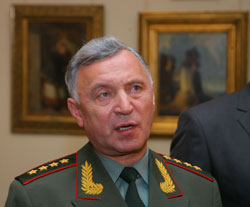
Makarov Talks to Duma Defense Committee

Nikolay Makarov (photo: Rossiyskaya gazeta)

Last Thursday, General Staff Chief, Army General Nikolay Makarov spoke to a closed session of the Duma’s Defense Committee about the situation in the armed forces.  A few committee members were kind enough to inform the press about some of the discussion.

Rossiyskaya gazeta said it’s no secret the Defense Ministry wants more money in its 2011 budget.  And the generals’ arguments are well-known — the army needs to reequip, relocate, and raise officer pay.  Additional financial means are needed for this.  Makarov didn’t avoid this issue, and he had a lot of supporters.  Deputy committee chairman Yuriy Savenko had this to say on the issue of budget and rearmament:

“Today there isn’t just not enough money for this.  We have to recognize that our military industry has sagged a lot over the last two decades.”

Makarov apparently commented on Bulava, seeing the recent successful launch as opening the way for its quickest acceptance into the Navy arsenal.  But he said first it has to complete three [not two] more tests.  The next won’t come earlier than November, and the first from Yuriy Dolgorukiy possibly before year’s end.

The General Staff Chief talked about the country’s new military-administrative divisions, claiming the reduction to 4 MDs isn’t causing major troop relocations, but rather allowing the army to stand-up additional combined arms, reconnaissance, and airborne brigades on its strategic axes.

He apparently mentioned the introduction of information management systems into the troops is a priority.

Nezavisimaya gazeta’s Viktor Litovkin reports Makarov said Russia will hold just one operational-strategic exercise, Tsentr-2011, next year, and, after it, the focus will be on tactical platoon and company exercises.  Litovkin says the issue isn’t money, but the time it takes to train units from platoon to brigade in what they need to demonstrate in a big exercise.  And training time is too short with one-year soldiers.  He reports the army’s decided to put all officers from new lieutenants to generals through tactical retraining and improvement courses.

KPRF Deputy, Vladimir Komoyedov — former Black Sea Fleet commander — commented a little on what he heard.  He said Makarov mainly touted what’s been achieved the last two years.  Komoyedov said he heard about conventional forces, but not much about strategic ones, and when he asked specifically about naval strategic forces, Makarov’s answer didn’t satisfy him.  Komoyedov spoke to Tverskaya, 13, but he quickly spun off into his own commentary, rather than Makarov’s.

Perhaps the most press went to Makarov’s announcement that the Defense Ministry will go forward with military police units in the armed forces after all.  They’ll reportedly number about 20,000 personnel.  MP sub-units will be present from brigade to military district, and they could be manned by servicemen dismissed in the course of Serdyukov’s reforms.

Finally, Komsomolskaya pravda says Makarov has told it about various changes in the army coming in the next five years.  Some are not all together surprising, but there are new twists on others:

  1. A two-pipe Defense Ministry — military and civilian, with the latter handling money, personnel, and support.
  2. Hired cleaners, maintenance people, and security guards for the barracks.
  3. Military pay via bank cards to make it more difficult for older soldiers to extort money from new conscripts.
  4. Contractees will get 30-35 thousand rubles per month.
  5. Conscription will stay at one year (there are 156,000 men with deferments and 130,000 evaders).
  6. Specialty training time for soldiers needs to be cut from 6 to 2-3 months.
  7. Tsentr-2011 will occur, but other exercises will focus on the company-level and lower.
  8. There will be 8 aviation centers [bases?], but 4 would be ideal.  Air defense aviation will have 2 months on duty, and 2 months at home.
  9. Glavkomaty of services and branches will be cut from 1,000 personnel to about 150 or 200.  Generals’ duties will go out to the new MDs.  All the ‘glavki’ will relocate into the Ground Troop headquarters on the Frunzenskaya embankment.
  10. The Genshtab will keep its hands on strategic submarines, bombers, and the RVSN.
  11. The VDV will not be cut, and will continue to report through the Genshtab.  They are likely to be reinforced with new brigades.
  12. The Navy will get 1-2 nuclear-powered submarines each year.  New aircraft carriers are in development.  The fleet gets 23% of the defense budget, the RVSN 25%.

More Testing for YeSU TZ

RIA Novosti reports that, starting tomorrow, the Defense Ministry will test its developmental Unified Tactical Level Command and Control System (YeSU TZ or ЕСУ ТЗ) on its range at Alabino in Moscow Oblast until 23 October. 

This is not the first time the system’s been tested, but a Ground Troops spokesman says:

“In the course of the exercises for the first time the capability of the given system to support the work of sub-unit [battalion and below] command and control organs equipped with its command and control stations [YeSU TZ] will be tested in the course of combined arms combat.”

As is often the case, the 5th Independent Taman Motorized Rifle Brigade will be used in the testing.  Command and control for the brigade will also employ “new technical means.”

Proposals and recommendations on the use of the automated system will be made for combat regulations based on the results of the exercise.  Mi-24 helicopters, Su-25 aircraft, and Russian-produced UAVs will also participate.

Dizzy with Bulava’s Success?

Iosif Vissarionovich might have accused Bulava’s proponents of dizziness after the SLBM’s test firing on October 7.  There’s no mistaking it was a clear boost to a troubled program.  Success always trumps failure.  It may even turn out that all of Bulava’s design, production, and assembly problems are resolved.  But one would think the history and current state of the Bulava would call for more cautious, guarded optimism.  This successful test was necessary, but far from even close to sufficient to complete the program.

The biggest news story after this successful test was the report that, as a result, the Bulava SLBM and Borey-class SSBN weapons system might be accepted into the arms inventory as early as mid-2011.

A highly-placed Navy Main Staff source told Interfaks:

“Before the end of the year, another two test launches of the missile are planned, if they are as successful as today’s launch, then it’s legitimate to consider the issue of the quickest completion of tests of this strategic system.  I’m proposing that the acceptance of Bulava into the arms inventory could happen in the middle of next year.”

He follows adding that serial production of the SLBM and its deployment in proyekt 955 Borey-class SSBNs will ensue.

The Navy Main Staff source doesn’t go into exactly what ‘quickest completion’ entails, but others do.  Presumably, this means another test from Dmitriy Donskoy before the end of October and, if that’s a success, the first launch from Borey-class Yuriy Dolgorukiy before year’s end.

Vesti.ru conjectures that ‘quickest completion’ might mean a second, ‘insurance’ shot from Yuriy Dolgorukiy in early 2011, then a volley firing of two missiles in spring or early summer.  After this, if every test is a success, the weapons system would be accepted, serial production would begin, and Bulava would be deployed on Yuriy Dolgorukiy.  That’s if everything goes right.

An irrationally exuberant Defense Ministry source even told RIA Novosti:

“The successful launch of the missile gives a basis to suppose that the entire system ‘submarine plus missile’ will be accepted into the Russian Navy’s arms inventory by the end of the year or at the beginning of next.”

Former Armaments Chief Anatoliy Sitnov was pretty confident, telling Interfaks and ARMS-TASS that no specialists are expressing doubts about Bulava, and ‘broken links’ in its production process have been overcome.

Old RVSN general Viktor Yesin told Interfaks he agrees it’s possible to plan for completing Bulava testing by mid-2011.  But he retains some caution:

“The tests conducted instill hope that the two flight tests of the Bulava ballistic missile coming before the end of this year will be successful.  If this happens, it’ll be possible to confirm that the designers and producers overcame a period of failures in the creation of the new submarine-launched missile system.”

Yesin also notes that only the telemetry can say if all the Bulava’s systems were working normally.

Forum.msk’s Anatoliy Baranov is skeptical about making Bulava part of Russia’s strategic nuclear forces even if the next two tests are successful, and make the tally 8 successes in 15 attempts.  He says having a missile you want to produce doesn’t mean you can produce it quickly in the necessary quantity:

“Incidentally, no one has answered for the strategic decision which left the country practically without a naval component of strategic nuclear forces [SYaS].  Don’t believe that the resignation of MIT director Solomonov is a sufficient measure of responsibility considering the possible consequences of such a mistake, and the fact that today our naval strategic nuclear forces [MSYaS] already lag the strategic enemy by a factor of 5.  But even given the most successful confluence of circumstances, we will have a gap between old missiles and submarines going out of service and new ones coming into service because the possibilities of domestic industry in serial production of solid-fuel missiles are very limited.  The Votkinsk factory produces 5-6 solid-fuel ‘Topol-M1’ missiles, there aren’t other producers.  This means the production of new missiles of the ‘Bulava’ type puts an extra load on production which already can’t cope with the creation of new land-based missiles — see, straining the RVSN rearmament program even worse.  In the best case, the necessary complement of armaments for the 3 new ‘Borey’ class SSBNs will be produced in nearly 15 years.  This is a catastrophe.”

Andrey Ionin doesn’t agree with Sitnov above.  He told Gazeta.ru that the Defense Ministry shouldn’t be impatient:

“A state commission report on successful testing and a formal decision on accepting the system for regular use doesn’t change the fact that the problem of low quality in joint production has not been eliminated.”

Carnegie Center Moscow associate Petr Topychkanov says:

“Three successful tests in a row is not a reason to put a type into serial production.”

But, unlike Baranov, he points out that the production run for Bulava doesn’t have to be too big since there are, and will be, relatively few tubes to fill.

Pavel Felgengauer in Novaya gazeta is skeptical about how close the Bulava RVs came to their intended targets, but, more important for this discussion, he calls saying that Bulava is almost ready for deployment after this successful test a “dangerous adventure.”  He adds:

“And here is a ‘raw’ missile, not completely ready and the not tested ‘Yuriy Dolgorukiy,’ a crew which clearly hasn’t mastered its submarine — and missile launches right away.  Very bold to put it mildly.”

Viktor Baranets sums it up:

“A successful launch instills some optimism.  But it’s still a long time before accepting the missile into the arms inventory.  And of 13 launches only 6 (including yesterday’s) [October 7]  were recognized as successful.  Or ‘partially successful.’  But this is not cause to launch the missile into a serial run.  Higher ‘positive indicators’ are needed.  Our specialists and foreign ones believe the quantity of successful launches should be steadily above 90%.”

Return to Cam Ranh?

Russia Departs Cam Ranh in 2002 (photo: ITAR-TASS)

The Russian Navy’s possible return to Vietnam became the latest military rumor floated in the media last week.  If it happens, it won’t have exactly the same purposes as in 1979, and it probably won’t be on the same scale.  But it will be part and parcel of the issue of being, or wanting to remain, a naval power.  Moscow might have to ask itself if it still is one, or will be one in the future.

On Wednesday, former Navy Main Staff Chief, Admiral Viktor Kravchenko told Interfaks the Navy is proposing to reestablish a material-technical support base (PMTO or ПМТО) at Cam Ranh.

The news service quotes Kravchenko:

“Without a system of bases for deployment, full support of Navy ships in distant waters is problematic.  Navy surface ships and submarines need repair, resupply, and crew rest to fulfill a wide range of missions on the world’s oceans.  If as before Russia considers itself a naval power, the reestablishment and creation of basing points like Cam Ranh is unavoidable.”

A Defense Ministry source told Nezavisimaya gazeta that:

“The [Navy] Glavkomat has finished work on the documents considering and substantiating the need to reestablish a basing point to support Russian ships in the Asia-Pacific region.  If there is a political decision, then the Navy is prepared to reestablish a working base in three years.”

The base would support ships on antipiracy missions in the Pacific and Indian Oceans, according to the source.

The Chairman of the Duma Defense Committee’s Subcommittee on Military-Technical Cooperation, former Captain First Rank Mikhail Nenashev told Interfaks:

“The rent for a naval base at Cam Ranh, in the end, would cost Russia less than regular support of combatants on the world’s oceans using auxiliary ships, tankers, and repair ships.”

And:

“Reestablishing a base at Cam Ranh would help strengthen and develop cooperation with Vietnam and the Asia-Pacific region countries not only in military, but in many others spheres of activity.”

Izvestiya says, Moscow doesn’t intend to return to a Cold War-style global military confrontation with Washington – it has not the forces, means, or desire for it – but the ‘Cam Ranh initiative’ shows that a gradual reanimation of specific military bases abroad could happen.

According to Newsru.com and Vremya novostey, in 1979, Moscow and Hanoi signed a 25-year agreement by which the Soviet Pacific Fleet’s 17th Squadron gained access to Cam Ranh.  Vietnam allowed the Soviet Navy to base 10 surface ships, 8 submarines with a submarine support ship, and 6 auxiliaries at the port.  Later, the 922nd PMTO was established at the Vietnamese port.  The Soviets had POL storage, an ASW and missile armaments base and technical service unit, a Naval Infantry sub-unit, and an air regiment at Cam Ranh.

The base was initially free, but Hanoi asked for $300 million in rent in 1998.  In 2001, Moscow decided not to extend its agreement with Vietnam, and the last Russian elements departed Cam Ranh in mid-2002.  The decisionmaking around the Cam Ranh withdrawal (likewise for Lourdes, Cuba) is anything but clear-cut.  But then President Putin probably made the decision, reportedly against the advice of many senior uniformed officers, in an effort to save money for the military at home, and to make nice with Washington.  Former high-ranking General Staff officer Leonid Ivashov claims the $300 million rent, at least, shouldn’t have been an issue since it could have been written off against Vietnam’s $10 billion debt to Moscow.

Prime Minister Putin’s December 2009 Hanoi visit and major arms deal, including six proyekt 636 diesel submarines, with Vietnam may have started movement on a return to Cam Ranh.  Defense Minister Serdyukov went to Hanoi in February and told Rossiyskaya gazeta the Vietnamese were very interested in constructing a Navy repair plant and Russian help with naval logistics.  However, Serdyukov claimed the Vietnamese didn’t propose anything about Cam Ranh.  But NG’s Vladimir Mukhin speculates a deal for a renewed Russian presence at the base might be inked during President Medvedev’s late October trip to Vietnam.

Izvestiya quotes independent military analyst Aleksandr Khramchikhin:

“Theoretically, I welcome the reestablishment of a Navy base at Cam Ranh.  For Russia, it is a very composite and most useful facility abroad. Without it, the operations of the Pacific Fleet are impeded.  Also very little remains of the Pacific Fleet.  This fact, however, doesn’t change the usefulness of the base at Cam Ranh.  Such a step could, of course, create certain foreign policy difficulties for Russia.  I suppose the U.S. and China will express dissatisfaction, but this will hardly have any real effect.  As concerns Vietnam, it would pay to view it as our most important ally.  Russia largely cast it aside after the collapse of the USSR.  This was a gross mistake worth correcting.”

It’s worth recalling Khramchikhin may view Vietnam through a slightly Sinophobic prism.

Talking to NG, Duma Deputy, and former Black Sea Fleet commander, Vladimir Komoyedov worries there won’t be anything to deploy at Cam Ranh:

“The Pacific Fleet, whose ships need to control the waters of South-East Asia, has hardly received any new units for the last two decades.  And what will we deploy to Cam Ranh?”

Fridinskiy vs. Serdyukov on Dedovshchina

Barracks violence in Russia has risen by at least 50 percent thus far in 2010; this isn’t exactly news since the Main Military Prosecutor announced the same thing back in July.  But his comments on the situation provide an interesting contrast with what Defense Minister Serdyukov said in his interview this week.

ITAR-TASS reported on Main Military Prosecutor (GVP or ГВП) Sergey Fridinskiy’s statement that increasing the number of conscripts in Russia’s armed forces has led, as he predicted, to a rise in ‘nonregulation relations.’  And some 3,000 servicemen have suffered from hazing and other violence in the barracks.

Fridinskiy said:

“If we’re talking about nonregulation manifestations, then, of course, they worry everyone – both society and military prosecutors – since they infringe on the life and health of servicemen, and therefore we view them in the most severe way.  Amid a reduction in general criminality, the quantity of cases of barracks violence rose by almost a third over nine months of this year.”

Among the 3,000 victims, Fridinskiy reported:

“Nine men died, and another 96 suffered serious harm to their health.”

“Our joint efforts – both with commands and with civil society institutions – really allowed us not only to stop negative processes in the army environment, but even to prevent many serious consequences.  The curve of nonregulation manifestations certainly went lower.  However, since last year, the situation began to change again.  Since the fall [of 2009], we felt that the sharp increase in conscript soldiers could lead to a deterioration in legal order among the troops.  And we talked about this.  And so it happened.”

“There’s no need to fear.  And I will say that, on the whole, the crime level among the troops is declining.  Based on the results of the first eight months, the number of registered crimes fell almost 10 percent.  There are a lot of military units where there are practically no legal violations.”

Fridinskiy called the doubling of the draftee contingent one of the reasons for the growth in ‘nonregulation manifestations.’  He said more than 1,400 soldiers and sergeants were convicted of assault and battery through August.  Then Fridinskiy added a second reason – great negligence in the work of officers.

GVP data shows approximately one-third of the victims of violence are draftees in their first 2-3 months of service, and the offenders, on the other hand, have served 8-9 months.  So, Fridinskiy concludes, the informal division of conscripts into ‘seniors’ and ‘juniors’ in the barracks hasn’t gone away.

Fridinskiy noted that instead of ‘youthful boldness,’ barracks violence is now more often motivated by baser motives.  The number of ‘nonregulation manifestations’ connected with theft and extortion has grown more than 50 percent.  And he said:

“They steal mobile phones and money most often – just exactly like it happens on city streets.”

So, let’s go back to Defense Minister Serdyukov’s analysis of barracks violence.  Asked whether one-year conscription is having any effect on dedovshchina, he said: 

“There are more nonregulation instances in absolute terms.  But this doesn’t scare me, because there are more conscripts.  The situation has to level out with time.  And the statistics will begin to fall perfectly precisely.  Particularly when you account for our methods:  we are very demanding with commanders on this, even up to dismissal in cases with deadly consequences.  Human rights advocates have already begun to criticize me for dismissing many of them for nothing.” 

So Serdyukov and Fridinskiy agree there are more, and they surely know if there are more in relative terms as well.  Say incidents per 1,000 soldiers.  But they aren’t saying. 

And the argument that there’s more violence because there are more conscripts doesn’t necessarily hold water either.  Before the shift to 1-year conscription, about 130,000 guys were inducted every six months in 4 cycles over 2 years, for a total of roughly 520,000 conscripts at any given time.  The only thing that’s changed is that they’re taken in two large tranches now . . . if it’s 260,000 guys, that’s still 520,000 soldiers at any moment.

In late 2009, Serdyukov called hazing and other violence a major unresolved problem, and clearly the situation will be even worse by late 2010.  Don’t forget that dedovshchina and other violence remains the number one reason why Russian men don’t want to serve, and it’s significant it’s rising at the very moment the army’s trying to put ever-expanding numbers of guys [280,000 this fall] in uniform.  It certainly doesn’t make the job easier. 

Serdyukov’s answer above really sounds like soft-peddling an intractable problem.  He thinks this will magically “level out” by itself.  And he’s counting on commanders to rectify it, the very people Fridinskiy says are to blame.

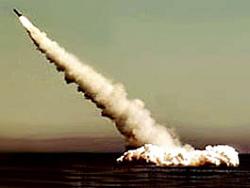
Successful Bulava Test Reported

Bulava Launch (photo: ITAR-TASS)

ITAR-TASS reports today’s Bulava SLBM launch from Dmitriy Donskoy was successful.  It was the 13th test overall.  The missile’s warheads impacted on the Kura range on Kamchatka, according to the Defense Ministry press service. 

Dmitriy Donskoy fired the Bulava while submerged in the White Sea.  The missile’s flight trajectory was normal.  ITAR-TASS notes Russia’s military command and defense industry prepared for this launch more thoroughly than ever.

Litovkin on What the GPV Will Buy

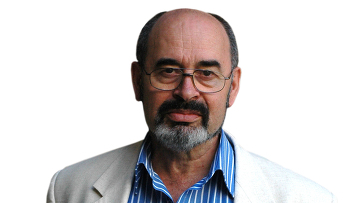
Viktor Litovkin (photo: RIA Novosti)

Returning to procurement and the GPV . . . in this week’s Delovoy vtornik, NVO’s Viktor Litovkin also asks what will 19 trillion rubles be spent on. 

He says the answer isn’t simple.  During the last 20 years of ‘starvation rations,’ the armed forces got handfuls of essential combat equipment, and, meanwhile, a dangerous imbalance between strike and combat support systems was created.  And this was obvious against Georgia in 2008. 

Litovkin says this imbalance has to be corrected, meanwhile priorities like strategic nuclear forces can’t be forgotten – not just the offensive triad, but also the missile attack early warning system (SPRN), missile defense (PRO), and aerospace defense (VKO). 

Like Viktor Yesin of late, Litovkin asks how Russia will replace its aging strategic offensive arms to stay up to the limits of the Prague / New START agreement.  Half the Russian force is SS-18, SS-19, and SS-25 ICBMs which will be retired in 7-10 years.  Moscow needs to build 400 strategic systems to replace them.  He doesn’t even mention Delta III and IV SSBNs and their aging SLBMS.  And Russia has only the SS-27, RS-24 Yars, Sineva, and Bulava to replace them. 

Litovkin expects a very large amount of money to be spent not just on replacing strategic systems, but also reequipping the enterprises that produce them. 

He turns to his second priority – also demonstrated by the Georgian war – precision-guided weapons, which in turn depend on reconnaissance-information support and equipment in space, on long-range surveillance aircraft [AWACS], and UAVs. 

Priority three – automated command and control systems (ASU).  He cites Popovkin on linking all service C2 systems into one system over 2-3 years. 

Litovkin says you can’t forget about the Navy, but he mentions just the Borey-class SSBNs, and the need for a wide range of surface ships.  And he makes the point [made by many] that Mistral is all well and good, but it’ll have to have multipurpose combatants operating in its battle group.  They need to be built, and they won’t cost a small amount of money. 

One can’t forget aviation either.  Litovkin cites a $100 million per copy cost for 60 fifth generation fighters [that’s a significant 180-billion-ruble bite out of the GPV].  He notes Vega is working on an updated Russian AWACS (A-100).  And, like Korotchenko, he mentions transport aircraft, but also combat and support helicopters. 

And so, says Litovkin, the question arises – isn’t the country putting out a lot of money to rearm its army? 

Viktor Litovkin (photo: Ekho Moskvy)

Being bold, he says, not really.  He actually uses that accursed 22 trillion figure, which is procurement for all power ministries.  If he used 19 trillion, it would be 1.9 trillion or $63 billion per year for Russia against $636 billion for the U.S., $78 billion for China, $58 billion for the U.K., and $51 billion for Japan.  But he doesn’t say this is annual procurement, the GPV, against the total annual defense budget for these other countries.  A bit of comparing one piece of pie to a whole pie.  Nevertheless, he concludes this makes Russia far from champion when it comes to military expenditures. 

Litovkin’s last word is Russia will remain one of the G8 with a powerful, combat capable, and effective army, but without it, only a raw materials appendage of either the West or East. 

But one wonders, hasn’t Russia long been in the G8 without that kind of armed forces?  Doesn’t breaking away from the raw materials supplier role have more to do with developing an open, attractive, innovative, value-added, and competitive economy (and a political system and society to match) than with military power? 

More on Serdyukov as Possible Moscow Mayor

Defense Minister Serdyukov (photo: Vadim Savitskiy)

Russkiy Newsweek has taken a look at Anatoliy Serdyukov as a candidate for mayor.  And gotten an interview from him.  He doesn’t give many. 

The magazine does it two ways . . . they give their spin on the interview, then the actual text of the interview.  Fair enough. 

Their spin is labeled КОНТЕКСТ (Context).  Their bold sub-heading says Serdyukov might be the only guy who meets the criteria for Moscow mayor.  They repeat today’s Nezavisimaya gazeta on Serdyukov meeting with Putin last week, then with General Staff Chief Makarov.  The latter reportedly gathered highly placed military men and told them ‘cadre changes are possible,’ which people take as confirmation ‘they’ will move Serdyukov to the mayor’s office. 

In Serdyukov’s favor, he’s from Piter, he’s twice shown his effectiveness in tough places (Tax Service, Defense Ministry).   And shocked at how they stole stuff in the Defense Ministry on his arrival, he’s been successful in the struggle against corruption [well, maybe more successful than predecessors who were completely unsuccessful!].  And Russkiy Newsweek concludes he’s shown he’s capable of moving a large structure like the army from a dead stop, and this makes him a fully possible candidate for mayor [since the same thing is required in the Russian capital].  And finally, Putin and Medvedev trust him. 

Now, the interview . . . 

Asked about the GPV budget, Serdyukov says Russia didn’t allocate money for rearmament for a long time, and now expenditures are being increased to what is really necessary for effective development of the armed forces.  He lists the following priorities — nuclear deterrence, Space Troops, PVO, aviation, and communications.  He says proposals for the GOZ 2011-2013 are now being prepared based on the ten-year GPV. 

On cooperation with the U.S. in missile defense, Serdyukov says the possible joint use of a radar in Kaliningrad remains just a proposal. 

Did the Georgian war spur military reform?  He says: 

“The conflict really accelerated this process.  It confirmed the need for reorganizations.  We are trying not to use the word ‘reform.’  We’re establishing a new profile for the army.  We’ve done a great deal.  We researched the experience of foreign armies — Israel, America, Germany, France, Italy — for the creation of our own model, taking account of geopolitics and economic possibilities.  But it all began with basic things.  We evaluated the correlation of officers and soldiers.  It turned out to be 50:50.  That is a soldier for every officer.  When we began to analyze it, this was for officers, it became clear — senior personnel, not lower than lieutenant colonel.  And among them the overwhelming majority not only didn’t have combat experience, but even experience commanding sub-units and units.  Were this many necessary?  We concluded this was an inflated correlation.  In European armies, the share of officers is from nine to 16%.  It’s true their armies are built differently.  We have space, rocket troops, and strategic nuclear forces.  Here the share of officer personnel is much higher.  And this is essential.  The calculations we made showed that the number of officers should be within the limits of 15% of all armed forces personnel.  Approximately the same correlation as in the world’s leading armies.” 

Serdyukov says he made: 

“The conclusion that it’s essential to make the transformations quickly and decisively.  The conflict showed that the army acutely needed a modern command and control system for its troops and equipment.  That it needed to change its entire system of training officers, soldiers, and sergeants.” 

The interviewer asked Serdyukov about the new military districts / OSKs. 

“The character of wars has changed in recent decades.  The zone of military actions is now not some piece of territory, but the entire country.  This has changed the demands on troop groupings.  They have to be flexible, maneuverable, and highly mobile.  And the former six military districts didn’t fully guarantee the reliable defense of our borders.  The military-administrative divisions of the country no longer answered existing military threats.  Troops essential for repulsing aggression had to be scattered in several military districts.  Besides we didn’t have command and control organs on strategic axes that were capable of uniting the effort of ground, aviation, and naval forces.  And finally, the territorial borders of the military districts didn’t correspond to the borders of zones of responsibility for air defense.  These problems are being eliminated with the establishment of the updated military districts.  Now all troops on their territory will be subordinate to one commander.  And he will bear personal responsibility for security in the region.” 

Asked if he’s an opponent of the domestic arms industry, Serdyukov said: 

“In this case, we’re in the role of consumers.  Consumers of those arms that the OPK supplies.  There are requirements which form the basis of parameters — technical characteristics for their production which are presented to us.  The thing is our opponents also have requirements for defense production.  And we need to correlate these figures.  Our defense sector often can’t support the required characteristics.  We are talking about this with domestic corporations.  You can’t do it yourself — go to them.  The issue of the ‘Mistral’ arose for this reason.  The Russian OPK couldn’t support the essential parameters for us.  Therefore we’re talking about readiness to buy foreign ships.  Our enterprises want to put out old models.  We don’t want to buy them.  But this isn’t really a conflict — it’s a working situation.” 

Asked about his largely civilian team of financial specialists, their focus on results, and what kind of results they seek, he said: 

“A combat capable, modern, like one of my colleagues put it, a ‘smart’ army.  An army is a sufficiently serious consuming part for the country.  The money could go to more humane purposes, if it’s possible to say so.  Therefore, it needs to justify expenditures on itself by their effectiveness.  We have tried to make the management structure two-tier.  To divide its activity into military and that connected with support of the military.  There is still the task of building a financial oversight system.” 

This one was the most shocking to many folks.  Asked simply if they steal in the Defense Ministry, Serdyukov said: 

“When I came to the Defense Ministry, to put it bluntly, I was discouraged by the extent of theft.  This sensation still hasn’t passed.  Financial licentiousness, the impunity of people whom no one had ever checked out.” 

“This system was so ingrained that it was already a way of thinking.  We are developing an effective oversight system.  I’m not saying that today the problem has been fully uprooted.  But there are very palpable results.” 

Asked why Russia is moving away from contract service when the budget for arms has tripled, the Defense Minister said: 

“Don’t believe that armaments are cheaper than a good contractee.  If you calculate it, these are colossal expenditures.  The past program didn’t work precisely because it was done in a formalistic way.  The military was told you have to do it.  They saluted.  But it was perfectly clear that a contractee wouldn’t go into the army for seven thousand, if he could earn not less than 15 as a civilian.” 

“We actually could forego rearmament and let the money go to the improvement of contract service.  But then we’d have old equipment and weapons that don’t meet modern requirements.” 

He continues: 

“We aren’t giving up on contract service, but only shrinking the number of such servicemen.  To 90-100 thousand.  We’ll see further.  If we save money in other areas — of course we’ll return to this idea.  But an already well-prepared one.” 

Asked whether one-year conscription’s having any effect on dedovshchina, Serdyukov said: 

“There are more nonregulation instances in absolute terms.  But this doesn’t scare me, because there are more conscripts.  The situation has to level out with time.  And the statistics will begin to fall perfectly precisely.  Particularly when you account for our methods:  we are very demanding with commanders on this, even up to dismissal in cases with deadly consequences.  Human rights advocates have already begun to criticize me for dismissing many of them for nothing.” 

Asked if he has carte blanche from the country’s leadership, he says: 

“There is trust.  I’m trying to talk over, get support for any serious things.  Before beginning the transformations there were three meetings with Putin, then with Medvedev.  There were many meetings and sessions.  All of 2008 we gathered [Duma?] deputies in various formats and tried to explain the logic from military, economic, and financial viewpoints.  This is serious work.  Large-scale.  But there was no longer another way.  Otherwise was a road to nowhere.  More and more money would be spent, but the results would be worse and worse.” 

So the interviewer concludes they needed someone from the financial sector: 

“Honestly, I never expected such a decision.  When they dismissed me from the army after my service, I thought I wouldn’t end up there any longer.  Obviously, they decided that they really needed a financial specialist for these tasks.”

Collegium in Southern Military District

Anatoliy Serdyukov conducted another extramural Defense Ministry collegium today, this time in Rostov-na-Donu, and the new Southern Military District (MD).

RIA Novosti quoted a spokeswoman who said:

“Participants in the session are reviewing issues concerning formation of the YuVO.  In particular, they will review questions about optimizing the deployment of formations and military units on the district’s territory, work with personnel, medical and housing support for servicemen, and also preparations for the heating season.”

So, they’re talking about possibly moving some brigades or regiments to better locations, and probably about who will command some of them.

The YuVO began operations in its new composition on 1 October.

According to ITAR-TASS, Serdyukov spoke of the ‘doubling’ of the ‘potential’ of the armed forces in the south with the establishment of the new district, but added this isn’t connected with the army’s counterterrorism missions in the region.

One would like to know how that ‘doubling’ was calculated since the MD’s ground units haven’t changed.

The Southern MD, or Unified Strategic Command (OSK) ‘South’ encompasses not only the former SKVO, but also the Black Sea Fleet and Caspian Flotilla.