Category Archives: Defense Industry

Serdyukov Year-Ender (Part I)

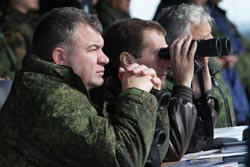
Serdyukov Watches Troops with President Medvedev

Defense Minister Anatoliy Serdyukov gave a two-part interview to Rossiyskaya gazeta this week.  It covers some contentious issues, but the questions aren’t exactly hard-hitters, and there’s no follow-up on his answers.  Nevertheless, Serdyukov as always puts out a steady and consistent message on what he, the government, and military are trying to accomplish.  Much of the first part of his interview concerned this year’s GOZ problems and the Defense Ministry’s difficulties coming to terms with defense sector enterprises.

Serdyukov says he’s been occupied for two years with reaching agreement on prices, deadlines, and quality for arms and other military equipment.  But, he says, now producers have no reason to complain because they’re receiving 80-100 percent advance payments for their work.  Some contracts for ships, aircraft, and strategic missiles are long-term ones extending to 2017-2020.  He adds:

“The fact is we are completely forecasting the entire future activity of a company for many years to come.  This allows for planning for expenses and receipts, training personnel, introducing new technologies, reequipping the production base.”

Regarding the tussle over OPK prices, Serdyukov says he’s told enterprises to give the Defense Ministry their production cost [себестоимость], and the military department will make production profitable for them.  Producers can have a profit margin of 20-25 or even 30-35 percent, but, he says, component suppliers will be limited to a one-percent mark-up.

Many producers (Sevmash for one) blame their suppliers for their own high costs, but it seems likely that limiting sub-contractors to a 1 percent profit is a formula for failure.

But Serdyukov has one condition for profits of 30-35 percent over the cost of production:

“The difference [10 percent?] has to go toward the technical reequipping of the enterprise, the purchase of new technologies and licenses.  And this will lead to lower costs or improved technical characteristics and combat potential of this or that weapon in the future.”

Later Serdyukov noted the Defense Ministry will compensate producers for annual inflation but production cost and timeframe will remain fixed. 

Then questions turned to the issue of foreign weapons.  Serdyukov said the Defense Ministry can’t buy Russian arms that aren’t up to world standards in price and quality.  Russia, he said, is interested in foreign systems so it can understand where it lags or has already fallen behind.  He described cooperative ties with foreign producers, buying licenses, and organizing joint production of entire systems or components in Russia as a way to get domestic industry up to date.  Serdyukov said foreign characteristics and prices are always part of the discussion of price formation with OPK enterprises.

Serdyukov told RG he doesn’t believe the Russian defense sector’s potential has dissipated despite the economic and financial difficulties of the last 15 years.  But now, with a 10-year GPV in hand, Russia has to restore the volume of defense production to the level of the 1980s.

He said foreign purchases were mainly small numbers of samples for the Defense Ministry to investigate.  It bought Iveco armored vehicles for explosive testing, after which Russia proposed to produce them jointly with Italy in Voronezh.
Year Two

This blog completed its second year yesterday.  There were 288 posts in year two (a few less than last year).  Just a couple to go to reach 600 posts since December 10, 2009. 

One hopes the reading was half as worthwhile as the writing.  But frustration lingers.  It’s impossible to follow everything.  Adding Twitter provided a “release valve” for overflowing news.  Still there’s tension between posting short items and writing more detailed pieces drawing together many different sources. 

In 2011, Defense Minister Anatoliy Serdyukov and General Staff Chief Nikolay Makarov had plenty of interviews, official appearances, and other public utterances to cover.  There were a large number of high-level personnel changes, retirements, and dismissals to report.

Serdyukov eased a little on cutting the officer corps.  The Defense Ministry readied its new higher pay system while scandal plagued the stopgap premium pay scheme.  Military housing remained a major headache as always.

Moscow hit a wall on manpower and had to accept undermanning.  After acknowledging there aren’t enough potential draftees, the military is starting over (yet again) with an effort to create professional enlisted and NCOs through contract service.

This year began with questions about the GPV’s feasibility, but devolved into immediate problems with GOZ-2011.  The Russians threw money at the OPK without looking at the defense sector’s (and the procurement bureaucracy’s) capability to turn financing into the kind of weapons and equipment the military requires.  Difficulties ramping up production of naval and missile systems occupied media attention.  The public debate over the relative merits of buying Russian or foreign weapons made several headlines.     

So where is Russia’s military?

To this observer, the Russian Armed Forces are improving and beginning serious rearmament.  But the hour is late.  Significant future problems could derail recent positive changes.  These include new and old, unsolved economic, budgetary, social, demographic, and possibly even political challenges.  Not to mention purely military obstacles to modernizing the army and navy.

Your visits and page views grew significantly in year two.  Page views are about 400 a day, 2,000+ a week, and 9,000-10,000 a month.  We’ll see if this is the ceiling for this rather specialized topic.

Your views, opinions, and arguments are always appreciated.  Those sharing or highlighting data and evidence on issues are particularly valuable.

Dyachkov’s Interview

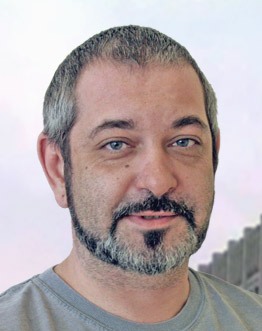
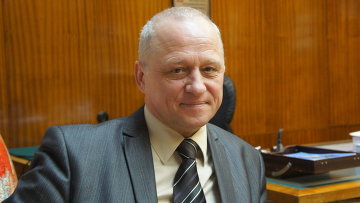
Andrey Dyachkov (photo: RIA Novosti / Sergey Safronov)

As General Director of both Sevmash and TsKB MT Rubin, Andrey Dyachkov’s a pretty significant individual when it comes to submarines.  What follows are highlights from his RIA Novosti interview last Friday.

Some blurbs have been published, but one frankly hasn’t had time to see if they captured the importance of what Dyachkov said.  Hence this summary.  It has less elegance (or perhaps fluff) than you may be accustomed to reading on these pages.

Dyachkov said the following:

  • Sevmash and the Defense Ministry signed a contract for the modernized Yasen, or Yasen-M this year.  It will be five units; Severodvinsk plus five.  Severodvinsk will be delivered next year; there were problems with some components obtained from suppliers and the Kalibr missile system needs to complete state testing.  About six months are needed for all this.
  • This year’s huge contract problems were a result of a changed Defense Ministry approach toward price formation Sevmash wasn’t ready for.  But times have changed, and Sevmash recognizes money has to be used more effectively, and ways have to be found to cut production expenditures.
  • Rubin has a contract to design the modernized proyekt 955, Borey, the Borey-A.  The contract should be signed by early 2012.  The lay-down of the first improved Borey will happen next year, and Saint Nikolay is still the working name for the first unit.  No word from the Sevmash chief on the final number of boats until after the contract is signed.  They’ve started laying down Saint Nikolay, but the official ceremony’s still to come.
  • Seventy percent of sub costs are reportedly to pay suppliers.  The main thing is getting them to reduce the cost of their products.  The Defense Ministry might even consider foreign component suppliers for some SSBN components.
  • Sevmash will take on construction of two diesel-electric proyekt 636 from Admiralty Wharves.  This will lighten the workload of the latter, and use excess capacity at the former.
  • Severnoye PKB has a contract to figure out how to modernize Kirov-class CGN Admiral Nakhimov (proyekt 1164, Orlan).  First and foremost, it needs new missiles (Kalibr and Oniks) to replace its Granit.  They are talking only about Nakhimov at this point.
  • Sevmash won’t be repairing CV Admiral Kuznetsov in 2012.  The shipyard is prepared to build a future carrier.
  • Modified Typhoon-class SSBN Dmitriy Donskoy will be kept active at the White Sea Naval Base for sub-on-sub trials of new boats.  Northern Fleet subs won’t be diverted for this task.
  • KB Malakhit has developed repair and modernization plans for the Akula-class (Proyekt 971, Bars).  Money’s been allocated and Zvezdochka will do the work. 
  • Russia may offer up the Amur-1650 diesel sub in next year’s Indian tender.  It could have air-independent propulsion, but Russia doesn’t seem really high on the idea.
  • They want to test Proyekt 677 Lada and its sonar in deeper waters next year.

Perhaps the Borey and Yasen mods reflect the problems of restarting construction that had been dormant (or at least very slow) for a long time and of using newly-made components rather than older ones.

First Get Some Rockets

Iskander

How do you rattle your rockets?  First get some rockets. 

President Dmitriy Medvedev’s address last week underscored the extent to which Russian foreign and defense policies are hampered by the condition of the OPK and its shortage of production capacity.

Medvedev’s description of Russian steps in response to U.S. and NATO missile defense in Europe certainly didn’t surprise anyone, though it may have forced them to conclude the U.S.-Russian “reset” is wearing thin.

To refresh the memory, the first four were (1) put the Kaliningrad BMEW radar into service; (2) reinforce the defense of SYaS with VVKO; (3) equip strategic ballistic missile warheads with capabilities to overcome MD; and (4) develop measures to disrupt MD command and control.

Then fifth, repeating several previous assertions to this effect, Medvedev said:

“If the enumerated measures are insufficient, the Russian Federation will deploy in the country’s west and south modern strike weapons systems which guarantee the destruction of MD’s European component.  One such step will be deployment of the ‘Iskander’ missile system in the Kaliningrad special region.”

And, ultimately, of course, Medvedev also noted the dispute over MD could lead Russia to withdraw from new START.

Russianforces.org was first to write that Medvedev’s enumerated steps represented nothing more militarily than what Moscow already intends to do, with or without U.S. missile defense in Europe.

Kommersant recalled the difficulty of making threats with the Iskanders:

“The problem is by virtue of its limited range (several hundred kilometers) ‘Iskander’ missiles can only threaten [Russia’s] neighboring states, but in no way the U.S. MD system as a whole, and on this plane, they have little influence on the strategic balance as such.  Moreover, the Russian military has promised to begin deploying ‘Iskanders’ massively since 2007, but since then the deadlines for their delivery to the army has been postponed more than once.  The army now has a single brigade of ‘Iskanders’ – the 26th Neman [Brigade], which is deployed near Luga.  This is 12 launchers.  There is also a 630th Independent Battalion in the Southern Military District.  In GPV-2020, ten brigades more are promised.”

So, Iskander deployments, including probably in Kaliningrad, will happen anyway, regardless of MD, when Moscow is able to produce the missiles.

Interfaks-AVN quoted Ruslan Pukhov on the missile production capacity issue.  If Russia wants to deploy Iskander in Kaliningrad or Belarus or Krasnodar Kray as a response to European MD, then:

“. . . it’s essential to build a new factory to produce these missiles since the factory in Votkinsk can’t handle an extra mission.”

“Productivity suffers because of the great ‘heterogeneity’ of missiles [Iskander, Bulava, Topol-M, Yars].  Therefore, if we want our response to MD on our borders to be done expeditiously, and not delayed, we need a new factory.”

Vesti FM also covered his remarks:

“’Iskander’ is produced at the Votkinsk plant.  The ‘Bulava,’ and ‘Topol-M,’ and multi-headed ‘Yars,’ are also produced there.  Therefore, such heterogeneity in missiles leads to the fact that they are produced at an extremely low tempo.”

The 500-km Iskander (SS-26 / STONE), always advertised with significant capabilities to defeat MD, was accepted in 2006.  But the Russian Army didn’t  complete formation of the Western MD Iskander brigade or Southern MD battalion until the middle of last month, according to ITAR-TASS.  The army expects to get a full brigade of 12 launchers each year until 2020. 

But Iskanders still aren’t rolling off the line like sausages.  This spring Prime Minister Putin promised to double missile output, including from Votkinsk, starting in 2013, and pledged billions of rubles to support producers.  In early 2010, Kommersant wrote about Votkinsk overloaded with orders, trying to modernize shops to produce Iskander.

Votkinsk and Iskander are, by the way, not the only defense-industrial problem relative to countering MD.  Nezavisimaya gazeta pointed out VVKO will need lots of new S-400 and S-500 systems (and factories to produce them) to protect Russia’s SYaS.  But we digress . . . .

What do defense commentators think about Medvedev’s statement and Iskanders? 

Vladimir Dvorkin calls them a far-fetched threat:

“There are no scenarios in which they could be used.  If Russia used them in an initial preventative strike, then this would signify the beginning of a war with NATO on which Russia would never embark.”

Aleksey Arbatov says relatively short-range missiles don’t scare the Americans, but could spoil relations with Poland and Romania.

Aleksandr Golts says the slow pace of Iskander production makes it not a very serious threat.  He notes Putin’s restraint on threats over MD:

“Being a rational man, he perfectly understands that an attempt to create such a threat will get an immediate response, which, considering the West’s potential, will create a much bigger problem for Russia.  That is, there’ll be a repetition on another scale of the history with the deployment of Soviet medium-range missiles in Europe.”

One supposes rather than driving a wedge between the U.S. and MD-host countries, Russian threats might reaffirm the wisdom of having a tangible U.S. presence on their territory.

Lastly, Leonid Ivashov reacts to Medvedev’s reminder that Russia could withdraw from new START:

“When President Medvedev says that we will withdraw from SNV [START], the Americans just smile.  They know perfectly well the state of our defense-industrial complex.”

Bulava Postponed?

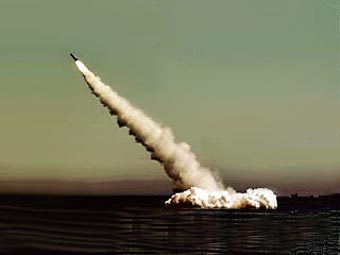
A Bulava Test

Interfaks reports an expected salvo launch of two Bulava SLBMs has been put off until next year, as Defense Minister Serdyukov said it might.  The press agency cites a well-placed Navy Main Staff source.  RIA Novosti, however, citing its own Navy Main Staff source, says the test was delayed by weather, but will occur today or tomorrow.  For its part, ITAR-TASS cites an OPK source who says the Bulava test firings are off until June because of White Sea ice.

The last Bulava test, a success, took place on October 28.  The Bulava / Yuriy Dolgorukiy weapons system might have been accepted into the inventory before year’s end following a successful salvo launch of two missiles.

BFM.ru talked recently to Aleksandr Golts and Vladimir Yevseyev about Bulava.  It notes the last planned launch of 2010 was also put off for ice.

Golts believes there’s a political motive for postponement.  He thinks the Defense Ministry can’t allow another failure and blow to its reputation and the image of Russian weapons.  And, by the time of the next test, the elections will be over, and Serdyukov may no longer be at the Defense Ministry.

Golts attributes Bulava’s problems to problems in the component base and the collapse of the Soviet sub-contractor chain.  The lack of serial production has made it impossible to guarantee quality component manufacturing.  Hence, something different seemed to go wrong in every test failure.

Golts doesn’t rule out the possibility that there simply aren’t enough missiles for testing (or for picking ones to test) because of the GOZ-2011 contracting dispute between the Defense Ministry and Bulava’s producer.

Yevseyev is a suspicious about postponing a shot for weather.  He calls the situation around Bulava ambiguous and unclear.  He says defects in the missiles might have been identified, and poor weather could be an excuse.

Like Golts, Yevseyev sees Bulava’s problems as symptomatic of larger defense industrial ones, and he doesn’t exclude a political motive:

“There’s a sharp decline in the quality of production, a partial loss of specific producers, technologies.  There’s aging of the machinery itself, the lack of qualified specialists who can work on it.  When the OPK’s been collapsing for so much time, it’s strange to hope it can produce such a complex technological product like a missile system.”

“It’s possible there’s a danger that, if there are unsuccessful tests in the period when we’re beginning Duma and presidential election campaigns, they’ll spoil the scene.  This is one of the possible reasons for the postponement.”

It seems understandable risk tolerance would be pretty low at this point given the history of the Bulava program, the bad publicity and angst generated by recent high-profile space failures, and the political season.  Perhaps it’s a case of better late, but better.

Innovation Locomotive or Brake?

Maksim Blant

Newsru.com economics commentator Maksim Blant wrote on an interesting subject this week:  is spending on the OPK an engine or drag for Russia’s innovation economy?

Blant has two primary arguments against military Keynesianism in Russia’s context.  First, more money for the OPK will further tighten an already taut market for certain labor.  Second, OPK spending’s multiplier effect will benefit raw materials producers more than consumers.

His article appears against a backdrop of questions about Russia’s ability to meet increasing pension obligations over the next 2-3 years without raising taxes, and former Finance Minister Kudrin’s contention that it could, but for the 20 trillion rubles going to the military’s rearmament program.

The problem, Blant concludes, is not that President Medvedev intends to rearm by depriving pensioners of their last bread crusts.  No, Medvedev defends rearmament as a means of stimulating growth in manufacturing, and turning the defense sector into an innovation development “locomotive.”

Blant allows that a majority of experts are inclined to agree that increased military spending can stimulate economic growth, and large defense industry orders can have a multiplier effect causing expansion in other sectors.  The argument is familiar.  State orders lead to job creation and greater consumer demand.  Defense enterprise orders to suppliers spur the process in other sectors.  The jolt causes the economy to turn around.

Blant says there are cases where military spending has brought an economy out of crisis, but asks will it work in Russia? 

He doubts creating jobs in the defense sector will increase consumer demand.  Even discounting how much procurement money will be stolen in the military or OPK, he says relatively little of the trillions will go for wages.  It would be easier to increase consumer demand by raising pensions.

Blant says this job creation effort will occur in the midst of a demographic crisis — not an excess, but rather a relative shortage of labor.  With state orders in hand, defense enterprises will compete against private businesses for engineers and skilled workers.  Faced with this, civilian producers can either raise wages and lose competitiveness, or “escape” to countries where the labor market isn’t so tight.  This, concludes Blant, makes the OPK not a “locomotive” of innovation development but rather its gravedigger.

Blant turns to the multiplier effect in adjacent sectors.  Yes, OPK money supports them, but raw materials suppliers and processors most of all.  Together the two sectors form a “closed loop,” only weakly connected to other industries.  In the end, he foresees a repeat of the 1980s, where the USSR’s defense sector, heavy machinebuilding, and raw materials producers sucked up the lion’s share of labor and other resources, leaving nothing for the consumer sector.

PAK FA Update

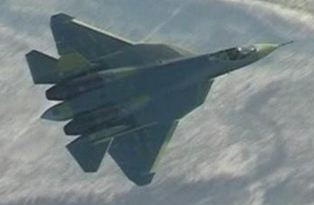
PAK FA

Sukhoy announced that its third PAK FA prototype conducted its first test flight today.  Operating from KnAAPO’s factory runway, the aircraft flew for more than an hour.

To run back a few milestones, the first PAK FA flew on January 29, 2010.  A second prototype joined it in March of this year.  PAK FA’s first public flight was August 17 at MAKS-2011.  And Sukhoy says the PAK FA has completed more than 100 test flights to date.  The hundredth flight apparently occurred early this month or in late October.

On November 11, ARMS-TASS reported that the third prototype will test the onboard phased array radar (AFAR)  system designed by the Tikhomirov NII of Instrument-building (NIIP).  Nezavisimoye voyennoye obozreniye published the same news, citing a Sukhoy spokesman.

Guns and Money (Part I)

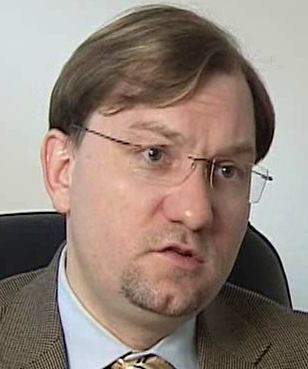
Ruslan Pukhov

What does Russia need to spend on defense?  Komsomolskaya pravda’s Viktor Baranets engaged Center for the Analysis of Strategies and Technologies Director Ruslan Pukhov on the issue recently.

It takes a bit, but the interview gets interesting, and it’s worth hearing, one thinks.

Baranets asks, do military expenditures depend first and foremost on the economy?  On government policy?  On the treasury?  On the military power of one’s enemies?  Pukhov replies:

“In the first place, on the requirements for guaranteeing national security, and secondly on economic possibilities.  But if the country faces serious threats, then maintaining adequate military power becomes an absolute priority.  And then the resources for these purposes are allocated without looking at the economy.”

OK, that’s standard, but the big question is if . . . if it faces threats and if those threats are really serious.  And one might quibble, you can’t allocate what you don’t have (at least most countries can’t).

Baranets probes further.  People want to understand the 30% jump in military spending.  Have external threats grown?  Pukhov answers: 

“We have to maintain large Armed Forces because of the country’s huge size and its borders with military giants, like NATO and China.  Here the correlation of our military potentials has significance first and foremost.  That’s one.”

“And two.  The most important mission for Russia will remain the preservation of powerful, but expensive strategic nuclear forces and advisably — nuclear parity with the U.S.  It’s clear nuclear arms are the main guarantee of our security.  They make a big war between contemporary world powers impossible.  I’m convinced that, if not for the nuclear shield, the fate of Yugoslavia would have awaited Russia in the 1990s.  That is forcible dismemberment with the support of a NATO intervention.”

“Yet another factor:  Russia is faced with real threats to its security in the form of terrorism in the North Caucasus where an ethnic separatist rebellion has transformed into a general Caucasus Salafist underground, but also in the post-Soviet space — in the first place, in view of Georgia’s aggressive actions.”

“Going further:  our Armed Forces are extremely obsolete technically, they lag the current level of military technology development and need renewal.  For almost two decades after 1991 our Armed Forces were totally and chronically underfinanced, didn’t receive new armaments.  After this almost 20-year ‘buying holiday’ it’s necessary now to pay up, trying in the most compressed time to overcome the accumulated lag.”

“And, finally, everything enumerated above has to be overcome in conditions of the fact, unpleasant for the national self-consciousness, but, alas, indisputable, that Russia is a poor country.”

Baranets asks, how can Russia be poor?  Pukhov’s answer:

“We actually have many natural resources.  And this, incidentally, is yet another argument for having effective Armed Forces.  Natural riches have to be protected.  But by the size of the economy we aren’t even in the top five countries in the world, and the main thing is we seriously lag behind developed states.”

“So we have to conduct military organizational development under conditions of a shortage of resources and significantly bowing before many other countries of the world according to our level of economic development and national wealth.”

“All types of resources enumerated by you [Baranets] are in short supply for us.  Industry requires serious modernization, the scientific-technical base, established in the USSR, is practically used up, the quality of human resources is also not at a high point — the technical training school system has collapsed, so finding qualified workers is an integral problem.  Now we can already talk even about the collapse of secondary education — more often illiterate conscripts are coming into the army, and how can you trust them with complex equipment?”

Baranets says some experts think 1.5 or 2 trillion rubles as foreseen for defense in 2012 is too much when compared with what will be spent on science, education, and health.  One can even hear pronouncements like “the army is stripping the people.”  Pukhov reacts:

“I repeat:  Russia’s in a situation where it’s forced to hurry to catch up and reestablish that which dissipated, was squandered and left adrift in the area of national defense in the 1990s.  Essentially, we didn’t develop, but, to the contrary, we collapsed the army.  Now we need to reestablish the army, buy new equipment and armaments.  This isn’t the army ‘stripping the people.’  This is them ‘stripping’ the army for long years.  But there is generally an old true formula — people who don’t want to feed their own army will feed a foreign one.  Education, medicine and other sectors can be self-financed to a significant degree.  The Armed Forces can’t be self-financed in principle.”

Pukhov covers a lot of ground.  And he makes sense of some stuff.  But some points are debatable.  He’s one who wants to blame the 1990s for everything when then-President Putin was also guilty of neglecting the army in the 2000s.  Yugoslavia did a good job of “dismembering” itself before NATO and Russia intervened.  Instruments other than force exist for managing Russia’s problems in the North Caucasus and Georgia.  Is there a realistic threat of having to feed someone else’s army?  Wouldn’t a slower paced military build-up be more sustainable?   

Part II tomorrow.

Nyet Means “Not Yet”

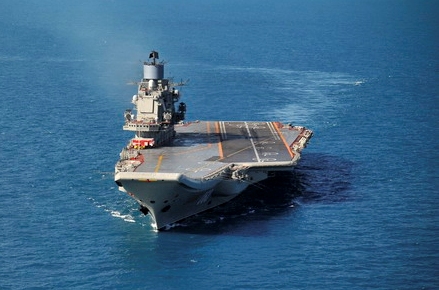
Fleet Admiral of the Soviet Union Kuznetsov (photo: Denis Abramov)

Russian aircraft carrier lobbyists — admirals and shipbuilders — define persistence.  To them, nyet means “not yet” or “keep trying.”

Izvestiya’s Denis Telmanov reported this week on future plans to build two new nuclear-powered aircraft carriers by 2027 — one for the Pacific Fleet and one for the Northern Fleet — along with 15-ship battle groups to surround them.

After years of arguing, the admirals reportedly decided they need carriers (not just nuclear subs and cruisers) to “broaden the Russian Navy’s zone of influence in the Pacific Ocean and North Atlantic.”

The Navy is reportedly completing the “technical tasks” for a new carrier, with a first design due next year, and the final one by 2017.  The first hull is supposed to be launched in 2023.  According to Izvestiya, sections and components will be built in several shipyards, but final assembly will be at Sevmash to save resources instead of building a new yard large enough to put a carrier together.

The article might be as much about where carriers would be built as if they will be.  There has been talk that the nascent New-Admiralty Wharves could get this work.

Izvestiya says land-based carrier trainers at Yeysk and Saki (NITKA) in Crimea will be used.  The paper also notes the new carriers will need new support bases because the lack of them “killed” or complicated the service lives of Soviet “heavy aircraft-carrying cruisers,” including the Kuznetsov.

One surmises that Russia’s coming experience with building, basing, and operating Mistrals will affect all this too.

But let’s rewind a bit . . . Navy CINC, Admiral Vysotskiy said in early 2010 that Russia plans to launch a carrier by 2020.  Defense Minister Serdyukov, however, has said twice in the last year that Russia has no plans to build carriers in the near future [by 2020].  On July 1, he emphasized that the Genshtab and Navy will decide on the need for an aircraft carrier after a “preliminary design” is complete.

No matter how much some say “Russia must have aircraft carriers,” it ain’t necessarily so. 

It ain’t so because (1) Russia may have more important requirements to fill with its limited resources, and (2) the people talking about carriers ain’t the same people who ultimately decide which requirements get met. 

Telmanov’s article is full of this:

“Strategists insist . . . .  The Navy has decided . . . .  The admirals have selected . . . .  In the military’s opinion . . . .  A Navy Main Staff representative explained . . . .  The military is deciding . . . .”

Not this:

“The president has decided . . . .  The government has selected . . . .  The VPK insists . . . .  The defense minister explained . . . .  In the General Staff’s opinion . . . .”

When we read that these types of people have decided to build carriers, it might really happen.

Farewell Russian Arms and Russian Army

Does it matter what old soldiers think?  It doesn’t seem to right now.  Maybe they’re just bitter old dudes whose time has passed. 

But they certainly provide interesting and frank commentary on the state of the OPK, the Armed Forces, and Serdyukov’s reforms at odds with official pronouncements from the Kremlin, White House, and Defense Ministry.

Former 58th Army Commander, retired General-Lieutenant Viktor Sobolev wrote recently for Pravda.  He reacted to a program on the army on NTV from October 9.  It apparently wasn’t posted on NTV’s site. 

Sobolev says this right up front:

“On the eve of elections, our president and Supreme Commander-in-Chief Dmitriy Medvedev and ‘national leader’ Vladimir Putin have been worried in turn by the condition of the country’s army and military-industrial complex and are assuring gullible Russian citizens that they will do everything so that our Armed Forces meet modern requirements and receive new types of armaments and military equipment in a timely manner.”

“The Russian mass media [SMI] under the government’s and president’s control have been actively used in making these assurances.”

The ex-general-lieutenant is critical of just about everyone:  Serdyukov and his “effective” managers, people who haven’t served in the army, former First Deputy Defense Minister Popovkin who wanted to buy more arms abroad, his successor Sukhorukov who dares insist that defense enterprises substantiate their prices, independent defense commentators like Litovkin and Pukhov, interest-hungry banks, corrupt middlemen.

He points only to Tactical Missile Armaments Corporation General Director Boris Obnosov in a positive light for recognizing that other countries won’t sell Russia their best weaponry. 

Still, Sobolev’s under a bit of a misimpression thinking that Moscow is really buying lots abroad.  In fact, a cynical observer might conclude the whole situation over the last year was designed to let Putin be the champion of the domestic defense sector vs. Medvedev the Westernizer.  But we digress . . . 

For Sobolev, this all sums to an OPK with a broken GOZ, that’s chronically underfinanced and losing its capability to produce modern arms and equipment. 

Again, the cynic might say this was already lost a number of years ago.

But, says Sobolev, when compared with the OPK:

“Even worse is the situation in the Armed Forces.  It’s believed we have a million-man army which Mr. Sukhorukov recalled on this program.  Let’s calculate it together.  According to TO&E, there are 150 thousand officers in the army, no warrants at all, they were liquidated.  According to civilian [but he still wears his uniform] GOMU Chief V. Smirnov, 184 thousand contractees are serving in the army and navy.  In all 334 thousand, the remaining 666 thousand are conscript servicemen.  But they simply couldn’t have called up so many.  Moreover, conscripts serve not only in the army and navy, of the number called up, up to 30% serve in the Internal Troops, Border Guards, MChS units, presidential regiment, and so forth.  This means in the army and navy huge undermanning exists, and it will only get bigger.  It’s planned to reduce the fall callup by 2 times.  More than 200 thousand citizens, according to Smirnov, are evading military service.  The spring callup stretches out to September, and the fall until March.  In the troops, they’re occupied with it constantly, in the course of the entire year, they take young soldiers into their ranks in small groups, organize individual training for them and try to man sub-units.  At the same time, the process of dismissal also goes on without interruption.  In these conditions, you can’t talk about any kind of quality manning of sub-units.  What kind of units of permanent combat readiness are these?”

“Therefore NATO’s military analysts note with satisfaction that, as a result of the reforms conducted, Russia’s Armed Forces aren’t capable of completing missions even in local conflicts, ‘The Russian Army does not have a sufficient quantity of transport resources for redeploying troops over great distances, does not have a sufficient quantity of aircraft and pilots who know how to fly in any weather, no unified information system.  There are not enough soldiers in the army . . .’”

“In NATO, they understand the Russian Army’s fallen apart, but how about our country’s leadership?”

Whoa. 

Sobolev’s no crank, and he’s not to be taken lightly.  Born and schooled in southern Russia, he probably has combat experience whereas the current General Staff Chief and Ground Troops CINC probably don’t.  Sobolev served as Deputy Commander of the OGV(s) in Chechnya in 2002, before taking over the NCMD’s 58th Army in 2003.  He ended his career as the chief military advisor in Russia’s Indian embassy in late 2010.

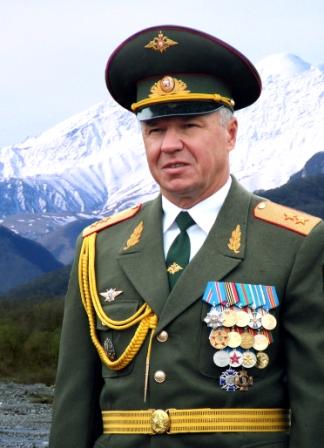
General-Lieutenant Sobolev

A more recent photo shows him looking just about as fit in retirement at age 61.

One wonders if a conservative like Sobolev realizes how much his thinking coincides with that of more liberal critics he seems to detest.