Category Archives: Defense Industry

Vysotskiy’s Navy Day Interview

Press coverage of Navy Day (25 July) was replete with interesting stories of plans to revivify Russia’s Kirov-class CGNs and even the Orlan-class wing-in-ground effect vehicle.  There was more talk about moving the Neustrashimyy and Yaroslav Mudryy to the BSF.  Navy CINC Admiral Vladimir Vysotskiy’s interview with Ekho Moskvy, however, didn’t get a lot of attention beyond a couple RIA Novosti and ITAR-TASS sound bytes.

Discussing development of Russia’s fleet of the future, Vysotskiy emphasized the long lead time required to get it:

“Today it takes 10-12 years to get some kind of definite design.  We understand that we have to go according to some operational-tactical requirements, perhaps even operational-strategic ones in this design, of course.  So, it means the development or construction of a series is approximately another 5-7 years, up to 10 years.  Perhaps more, the service life of the design is 20 to 25 years.  In other words, if today we make a decision on constructing some full-scale fleet, then we have to understand we’ll receive this fleet in about 50 years.  Well, at a minimum, beginning from the main component in 35 years.”

Vysotskiy’s comments on Bulava were also captured by the wire services:

“Well, the question which we, military men bearing certain responsibility for this, of course, well, honestly speaking, we are already tired of answering because there is one cause — a deep, I underscore, failure of primary production technology for such expensive missile systems.”  

“We all very simply understand well:  when we began to arrange the process of our work incorrectly from the beginning, and here everything was not done as it needed to be.  Here, of course, we’ll get big problems in the process of the work itself.  This means, in my view, in the last 2 years, a serious move in the direction of us receiving this system has been made nonetheless.  But we need to understand that getting this system in its current form is not the final step of the work.  But we have a fair chance all the same to complete this work successfully, well, so we’ll say, in the course of the coming year.”

“When a systemic mistake is found, it’s simpler,  In this instance, an entire systemic mistake was found precisely in the lack of a system.  That is, to put it properly, forgive such a tautology or, on the other hand, a paradox.  But, what we’ve got is what we’ve got.”

And Vysotskiy said lots of other interesting things that went unnoticed.

He naturally supported Vice-Admiral Sidenko as Far East OSK Commander, saying it made sense and reflected the country’s maritime interests in the Pacific and Indian Oceans. 

He connected the acquisition of the Mistral to drawing down mobilization resources in favor of permanent readiness.  He said PR units could be put on Mistral and the ship could be a mobile command point for an OSK’s inter-service grouping.  He defended turning abroad by saying it would take Russian yards 1.5 to 3 years to even prepare to make such a ship if they started today.

Vysotskiy wants the BSF to pick up the antipiracy load so the distant fleets don’t have to send their ships.

He discussed Russia’s long-term search and rescue support program, and he emphasized rapid information transfer and international cooperation and combined training, like NATO’s Bold Monarch exercise, as essential ingredients for success.

On the loss of the Kursk ten years ago, Vysotskiy said the accident started with a technical cause — errors in handling a peroxide-fueled torpedo — but there was an accumulation of mistakes, including organizational and command ones, that led to the tragedy.

Russia is working on its organizational and technical problems in SAR, both buying equipment and learning to use it abroad.  Vysotskiy cited an ‘absolute understanding’ on cooperation with foreign partners.

He was evasive on moving the Navy’s headquarters to St. Petersburg, saying a remote command and control point is there, and other steps in this direction are being taken.  But the overall military C2 reform has to be completed this year before he can really answer questions.

Lastly, on foreign bases for the Navy.  He’d like to have them, and there’s movement in this direction, at least compared with the recent past.  The Navy is working with a number of states to arrange for simplified port access for its ships in some strategic places, and it’s almost like having a base.
Defective Bulava Nozzle

That same highly-placed RIA Novosti source in the Navy Main Staff also said the next Bulava SLBM test will occur in August or September from Dmitriy Donskoy.  A favorable outcome would led to another test launch from Dmitriy Donskoy, then a third launch from the missile’s intended platform Yuriy Dolgorukiy.

RIA Novosti also reported a source — close to the state commission investigating the cause of the last failed Bulava launch — said yesterday that the cause of the unsuccessful December 2009 test was a malfunctioning rocket nozzle.  He said:

“The state commission established that the nondeployment of Bulava’s extendible nozzle between the missile’s first and second stages was the cause of the last unsuccessful launch.”

He added that the nozzle problem was not caused by a design flaw, but by a production defect, and the missile was simply made incorrectly.

RIA Novosti recalled that First Deputy Defense Minister Popovkin, on 30 June, said only that the commission had recommended continuing Bulava testing.  He didn’t comment on any conclusions on the cause of the last Bulava failure.

Buy Two, Build Two

RIA Novosti reported yesterday that the purchase format for Mistral helicopter carriers hasn’t been determined, but a Russian Navy source says a ‘2+2’ variant is possible.

A highly-placed Navy Main Staff representative told the news agency that Russia could buy two and build two of the ships, and such a ‘2+2’ scheme is being discussed in negotiations in Paris.  

Initially, Moscow wanted to buy one and build three under license in Russian shipyards.  But French President Sarkozy mentioned a ‘2+2’ format earlier this year.

RIA Novosti’s source said the two Russian-made ships might be built at Sevmash, Baltic, Yantar, or Northern Wharf.

Factory Testing Update for Yuriy Dolgorukiy

Translation, no commentary . . .

“MOSCOW, 21 July.  ITAR-TASS.  The crew’s readiness to fulfill combat missions is being checked onboard the new generation project 955 ‘Borey’ ballistic missile submarine ‘Yuriy Dolgorukiy.'”

“As the press-service director Yekaterina Pilikina of Severodvinsk enterprise ‘Sevmash’ announced today, ‘the missile-carrier has returned from the latest phase of factory underway testing.  This was the nuclear submarine’s first at-sea period this year,’  she reminded.”

“‘The nuclear submarine was in testing more than two weeks.  Navigation equipment, the submarine’s buoyancy control system were checked, essential yearly checks of several of the submarine’s parameters were done,’ Pilikina announced. ”

“In the estimation of the chief builder for military equipment production at ‘Sevmash’ Vladimir Prokofyev, ‘the outlined plan was completely fulfilled.  There are issues which have to be worked out to prepare the boat for the next at-sea period which will happen in the near future,’ he noted.”

“‘While at sea, the boat’s crew’s readiness to fulfill combat missions was checked,’ Pilikina announced.  ‘The crew commanded by Captain First Rank Vladimir Shirin successfully completed all training tasks.'”  

“Earlier it was announced that before the end of this year the Russian Navy plans to conduct not less than three test launches of the ‘Bulava’ submarine-launched intercontinental ballistic missile, and from the ballistic missile submarine ‘Dmitriy Donskoy’ and from the permanent platform for this missile system — nuclear submarine ‘Yuriy Dolgorukiy.’  It is the first ‘Borey’ type submarine.

“At present in ‘Sevmash’ there are three more submarines of this type in various stages of construction.”

“The ‘Borey’ type submarines were designed in St. Petersburg TsKB [Central Design Bureau] of Naval Equipment ‘Rubin.’  According to open source data, several achievements in the creation of shipboard radioelectronic means and noise reduction are employed in the construction of the ‘Boreys.’  They will be armed with the new ‘Bulava’ missile system.  The nuclear submarine can carry 12 solid-fueled intercontinental ballistic missiles with a MIRVed warhead.  The submarines are outfitted with a surfacing rescue chamber for the entire crew.  The hull of the ‘Borey’ type nuclear submarine is 170 m, the beam is 13.5 m, the submergence depth is 450 m, and the crew is 107 men.  According to the Defense Ministry’s plans, not less than eight nuclear submarines of this project  are to be built.  ‘Borey’ is supposed to be the main naval component of Russia’s strategic nuclear forces in the 21st century.”

72ZQ3NRFDWPT

More Popovkin on GPV 2011-2020

Does the GPV really mean anything?

One has to recall Popovkin’s announced 20 trillion rubles is just a plan until the Duma allocates the money every year.  Then there’s a big question of whether allocated money is used effectively.

Mikhail Rastopshin and others have written about how every GPV in memory (GPV 1996-2005, GPV 2001-2010, GPV 2007-2015) was revised shortly after it began.  Now we have GPV 2011-2020 being formulated only four years into the previous one.  This overlapping and cascading makes it difficult to see (even for those involved) what’s actually been procured with the funding provided.

Five trillion for GPV 2007-2015 (about 550 million rubles per year) seemed like a pretty good amount in the mid-2000s, but, as Vladimir Yevseyev and others have been kind enough to point out, it didn’t buy that much.  Yevseyev said Russia’s rate of rearmament would only provide for modern weapons and equipment over the course of 30-50 years, if then.  A Defense Ministry official responsible for the GPV and GOZ, Vasiliy Burenok, recently said Russia’s rearmament rate is only 2 percent, and it should be 9-11 percent per annum.

Finally, Popovkin’s deputy, General-Lieutenant Frolov stated flatly, and rather shockingly, that the government’s first offer of 13 trillion for GPV 2011-2020 was barely one-third of what’s needed to rearm Russia’s Armed Forces.  Now, according to Popovkin, and probably after some intense lobbying, the government comes back with a counteroffer of about 20 trillion.  This insight into the current dynamic of civil-military relations is perhaps more significant than the GPV itself.  What will the ultimate figure be?  Does it matter?  No, because GPV 2011-2020 will be superseded and rewritten well before 2015.

It’s possible to assert plainly that no GPV will ever get done if GPV 2007-2015 — coming at the peak of  oil prices and Russia’s economic boom — didn’t lead to very much.

Back to other things Popovkin announced yesterday . . .

He reaffirmed Russia’s intention to build its own UAVs:

“We’ll build our own.  It’s possible that, based on the results of this air show [Farnborough], requirements for Russian UAVs will be refined.”

Popovkin said the world’s UAV makers are now modernizing existing systems rather than investing in developing new ones. 

He also announced that the Defense Ministry will soon select the Russian enterprise and location where Israeli UAVs will be manufactured.

On Russia’s new ICBM, Popovkin told the media:

“We’ve accepted the RS-24 ‘Yars’ and placed it on combat duty.  The first battalion is standing up.”

He said Russia plans to acquire 20 An-124 ‘Ruslan’ transports, while modernizing its existing fleet of them by 2015-2016, and buy 60 An-70 transports as well.  He also said Moscow will procure 1,000 helicopters by 2020, calling them “one of the priorities for us now.”  Special attention will be given to heavy transport helicopters.

Popovkin on GPV Financing, Inter Alia

Perhaps lobbying for more money for armaments pays off . . . at least a little.

At Farnborough today, First Deputy Defense Minister Popovkin told journalists financing for GPV 2011-2020 will be almost doubled.

Popovkin said:

 “We’re talking about increasing the amount.”

“With the Finance Ministry we’re now deciding the issue of the amount and the schedule of year-by-year financing taking into account of the state’s economic possibilities.”

“Now we’re talking about 20 trillion [rubles].”

Recall early June’s comments to the effect that the proposed 13 trillion would cover only one-third of the Defense Ministry’s needs.

Popovkin also said [again] that a state program for developing the OPK needs to be adopted at the same time as the new GPV.  He said:

“Both documents will be confirmed by the President this year.”

But he didn’t offer anything on the amount of financing for an OPK development program, but said ‘negotiations’ with the Finance Ministry are being conducted.

On the fifth generation fighter, Popovkin said the Defense Ministry plans to receive its first experimental model in 2013.  He also said:

“By 2015 the Defense Ministry plans to buy ten aircraft from the first assembly run which will go to operational forces.  And from 2016 we plan to implement a series purchase of fifth generation fighters.”

Air Forces CINC General-Colonel Zelin recently told the press more than 60 will be bought starting in 2015-2016.

More to follow . . .

Chernavin on Bulava Design and Testing Problems

Svpressa.ru provided its version of this week’s comments from a Navy Main Staff source: 

“. . . there’s no alternative to equipping new proyekt 955 ‘Borey’ missile cruisers [SSBNs] with the Bulava missile.  Its acceptance into the arms inventory is delayed some, but the testing will be successfully concluded in any event and the missile will be accepted into the arms inventory.  There are no insurmountable obstacles to this.” 

Then former Soviet Navy CINC Vladimir Chernavin answered Svpressa’s questions about naval strategic systems.  He is still focused on what he sees as bad decisions in the process of designing and testing Bulava, rather than defective components and assembly problems.  But like most, he sees no alternative to Bulava at this point. 

Asked why the Navy doesn’t opt for Sineva, Chernavin said: 

“’Sineva’ is a magnificent missile, but it’s liquid-fuelled.  And this is a very dangerous ‘cargo’ for nuclear submarine crews.  The liquid fuel used in it is so corrosive, it burns through metal.  In addition, it’s extremely poisonous.” 

“In Soviet times solid-fueled missiles were put on proyekt 941 nuclear submarines.  But back then for technical reasons we could only make them in very large dimensions.  Proyekt 941 nuclear submarines had 20 90-ton missiles.  And each carried 10 MIRVed, highly accurate nuclear warheads.  The fact is one nuclear submarine [SSBN] could destroy up to 200 important targets, you can say, cities.  The biggest designer of missile-space equipment Vladimir Chelomey and his firm in Miass made all these missiles.  When I was still Soviet Navy CINC, we began to develop a missile [SS-NX-28 or Bark], like the ‘Bulava,’ to replace our heavy missiles on proyekt 941 boats.” 

Fleet Admiral Chernavin

Asked why it didn’t succeed, Chernavin replied: 

“Unfortunately, after Chelomey’s death, the continuity was broken.  One of Chelomey’s assistants headed the firm.  We gave it great resources to perfect this heavy missile – reduced dimensions, increased accuracy.  This work stopped with the USSR’s collapse.  And when the country’s leadership decided to restart it, they took as a basis not a naval missile, but the ground-based ‘Topol M.’  They changed design bureau accordingly.  The idea was tempting – to make one all-purpose missile for ground pounders and for sailors.  This would significantly reduce production costs.” 

But what was the stumbling block? 

“They didn’t figure that the firm that made the ‘Topol’ had no concept about naval missiles.  I remember a sad instance.  When ‘Topol’ specialists learned that a submarine-launched missile had to launch while the nuclear submarine is moving, they grabbed their heads.  Everyone knows ‘Topol’ fires from a stationary platform.  Everything in the calculations had to be completely changed.  The ground-based design bureau encountered problems that Chelomey had already solved, and it had to reinvent the wheel.  Another, to put it mildly, mistake was committed by cutting costs in the very course of missile development.  With Chelomey it was laid out as follows.   After the creation of a prototype so-called pop-up testing began.  We had an old specially reequipped diesel submarine in the Black Sea for this.  A missile tube was placed in it.  A telemetered missile is ejected from it.  Not less than two of such tests were needed.  Only after this did they proceed to other tests, of which there were a great number.  ‘Market consciousness’ in new Russian conditions gave the project’s directors the idea of economizing on tests.  There were no preliminary tests, but immediately they put ‘Bulava’ on a submarine and all steps were conducted with the wave of a hand, having skipped several phases of testing.  Now we all see what a ‘pretty penny’ this ‘economizing’ has cost the state.  The end of testing is not in sight, but ‘Bulava’ won’t fly.” 

 Does Bulava have any future?  

“I think there’s no longer time to give up.  Whether we want this or not, we have to get ‘Bulava’ in shape.” 

But what if its designers aren’t up to it?  

“I think they’re up to it.  They’ve hit so many bumps that they, on the whole, have gained experience and will guide it to the end, but again this will cost not a little money.  But less now than if we set out today to develop a missile from scratch.  Of course, in principle, it wasn’t necessary to let these people build a naval missile.  Now we have to get unscrewed.  And throw resources around.  But, I’m sure, they’ll still get ‘Bulava’ to fly.”

Pressing the French on Mistral

Vladimir Socor has a good piece describing Russian shipbuilders’ complaints to the Federal Antimonopoly Service (FAS) about the Mistral purchase as another way to press Paris to finalize the deal on Moscow’s terms.  Socor says: 

“In line with the Russian government’s tactics, [Deputy PM and OSK Board Chairman] Sechin is signaling that Moscow could turn to other international shipbuilders, or ultimately to Russian shipbuilders, if France does not sweeten the terms of the Mistral deal for Russia.” 

“Thus, Sechin’s subsidiaries [Yantar and Admiralty] ostensibly seek anti-monopoly action in a case handled by Sechin himself for the Russian government.” 

This points up the bizarre circumstance in which Sechin is negotiating with the French, while his OSK subsidiaries complain about the potential deal. 

But, as Interfaks wrote on Wednesday, FAS says it lacks jurisdiction over the complaint from Yantar and Admiralty.  FAS also says there’s no basis for a complaint since no deal for Mistral has been reached. 

The shipyards argue they’ve been excluded from bidding to build amphibious assault ships for the Navy, and the terms of the competition weren’t publicly announced.  Their complaint seems to have merit since, from the outset, the Defense Ministry went directly after a specific ship and supplier, without issuing general requirements for a ship class. 

According to Interfaks, OSK supports Yantar and Admiralty, and calls the Defense Ministry’s actions ‘obscure.’ Its representatives periodically speak of Mistral like a done deal, but how the deal will proceed remains unclear.  An OSK source says, “And every time such statements deliver a blow to the self-esteem of domestic shipbuilders who know how to make these ships.”  

And, as Socor notes, talks continue also with the Dutch and Spanish [as Defense Minister Serdyukov has always pointed out] and now the possibility of a deal with the South Koreans has been thrown in, further roiling the waters. 

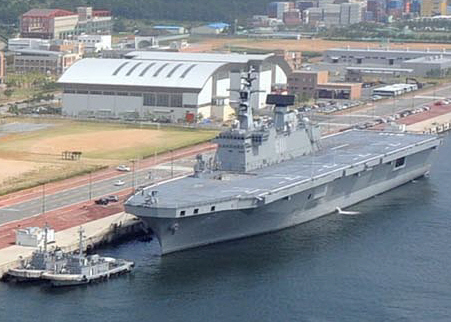
Izvestiya yesterday said OSK President Roman Trotsenko sent a letter to Defense Minister Serdyukov proposing a review of the military’s plans to acquire Mistral.  In its place, Trotsenko suggests building the South Korean Dokdo under license in a Russian shipyard.  He says he can build it in three years, and more cheaply than Mistral by one-third.  OSK has a joint production agreement with Dokdo builder Daewoo. 

Dokdo

The Defense Ministry insists Russian builders demurred when asked if they could build these ships.  Izvestiya doubts Trotsenko’s offer is realistic given the lack of available Russian buildingways.  But the paper concludes the appearance of the letter shows the struggle for the amphibious carrier contract isn’t over.

General Staff Chief Makarov’s Press Conference

Sound bites from General Staff Chief Nikolay Makarov’s press conference today dribbled out one at a time, as usual.

Makarov told reporters President Medvedev signed a decree establishing four operational-strategic commands (OSK) to replace the existing military districts on 6 July, but the text hasn’t been published.  Makarov also said arrangements putting the OSKs in place would be complete on 1 December.

Makarov talked more about the new “unified system of material-technical support (MTO)” also apparently covered in Medvedev’s decree.

Rear Services Chief, Deputy Defense Minister, General-Colonel Dmitriy Bulgakov, as expected, will head the unified MTO system, and new First Deputy Defense Minister Vladimir Popovkin will supervise the new state armaments program, 2011-2020, as well as coordination with military industries. 

Makarov stressed uniting transportation and supply functions under Bulgakov:

“We had a disconnect when all transport for supplies of material means to the troops was at the disposal of the Deputy Defense Minister for Rear Services, but he didn’t have anything he needed to move with this transport.  The other Deputy Defense Minister, on the other hand, had armaments, but no means for transporting them to the troops.”

“This is very important because now the management of transportation and armaments is concentrated in the hands of one man.  The correctness of the decision was confirmed by the recently completed ‘Vostok-2010’ operational-strategic exercise in the Far East.”

 “Now one official serving as a Deputy Defense Minister heads a unified system of material-technical support which has united rear services and armaments.  He alone personally answer for both the transport of supplies of material-technical means, and for these means themselves.  Now one man answers for the state of affairs with armaments and for their supply to the troops, who will also now be responsible for that.”

The way Makarov puts it, Popovkin be on the hook for product quality:

“He will work with defense-industrial complex enterprises to control their production of armaments and military equipment for the Armed Forces.”

Popovkin’s old job of Chief of Armaments, Deputy Defense Minister will disappear most likely.

Makarov told reporters Russia plans to move to netcentric command and control by 2015, once it equips its troops with new C3 systems united in one information space.  Such systems are now scarce, but he says, they are working hard so to install digital equipment everywhere.  Makarov calls this the main renovation that he’s giving all structures and troops starting in the fall of this year.  He says Russia’s new command posts unite reconnaissance, target designation, and troops and weapons to execute combat missions in real time.

It’s interesting that RIA Novosti took time to explain that the netcentric concept is an American creation more than 10 years old, and one not loved by those used to strictly centralized command and control.

Makarov told the press the army will begin forming light brigades, which it currently doesn’t have, this year.  They’ll have light combat vehicles of some type.  While not providing details, Makarov emphasized that light brigades will be built around a standard vehicle, so that, as in Vostok-2010, a brigade can fly in and its personnel can marry up with their normal vehicles in their place of deployment. 

Answering a question, Makarov said Russia will buy more Il-78 tankers in GPV 2011-2020, but he didn’t specify a number.

Makarov announced an intention to equip all Russian combat aircraft with new targeting-navigation systems over the next three years.  He said the new equipment will increase the accuracy of air strikes and allow the Air Forces to “abandon the previous practice of area bombing.”  He said the new system was tried on a Su-24M2 during Vostok-2010.  Installation of the targeting equipment on the Su-24M2 began in 2007.  Makarov said the VVS has nearly 300 Su-24 of all variants, and naval aviation about 60.

Stoletiye.ru had an interesting observation on Makarov and efforts to streamline command and control in the Russian Army.  It said the move to 4 OSKs and other steps are intended to reduce duplication of officer responsibilities and make 2-3 officers responsible for the fulfillment of combat missions.  It quoted Makarov, “We’ve eliminated the system of spreading responsibility throughout the Defense Ministry.”

Pulling Back on Buying Abroad?

Is the Defense Ministry pulling back the reins on efforts to purchase foreign-made weapons and other military equipment?

Late last month, armaments chief Vladimir Popovkin said that Moscow would put German armor on its combat vehicles, perhaps laying to rest rumors that Russia might buy entire vehicles abroad.

Last Thursday, Popovkin and others seemed to put limits on buying more UAVs from Israel, calling the process more of a learning experience to improve Russia’s domestic models.

Then Friday, the press says OSK may have started a formal antimonopoly complaint against Defense Ministry efforts to buy the French Mistral helicopter carrier.  But OSK Board Chairman, Deputy Prime Minister, and Putin confidant Igor Sechin is in charge of negotiating Mistral’s purchase from Paris.

It certainly seems that the reins have been pulled back on foreign procurement somewhat.  But there’s a lot to these threads and not enough time to run them down.