Category Archives: Force Modernization

Zelin’s Update (Part II)

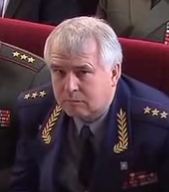
General-Colonel Zelin

In his recent NVO interview, VVS CINC, General-Colonel Aleksandr Zelin wasn’t as specific about transport aircraft and helicopter acquisition as about fighters.

He mentioned “reestablishing” An-124-100 and An-124-300 production, and said the Il-76MD-90A will fly in July.  The An-70 is moving forward with Ukraine, he says.

The VVS has settled on the An-140-100 as a light transport.  Russia will work jointly with India on a light MTA (multirole transport aircraft?), and Moscow may buy up to 100, according to Zelin.

Zelin concludes VTA must have not less than 300 aircraft.  That might actually be about what it already has.

The CINC says the General Staff wants VTA to be capable of lifting a “light” brigade anywhere in the country or abroad if necessary.

On helicopters, General-Colonel Zelin reemphasized the goal of 1,000 new ones by 2020.

He mentions getting about 100 Mi-26, or Mi-26T, heavy lift helos, as well as the Mi-8AMTSh, Mi-8MTV5, and Mi-38 (another Mi-8 variant). 

Zelin says little about the Mi-28N and Ka-52 except they’re complementary.  He sees no need to choose between them, but the former will be the military’s line combat helicopter.

Zelin’s Update (Part I)

Air Forces CINC, General-Colonel Aleksandr Zelin gave NVO editor-in-chief Viktor Litovkin an extremely long interview last Friday.  Zelin expanded on things he’s said in previous press encounters.  Some interesting stuff.

Here’s the first part of a quick synopsis.

Su-34.  Zelin mentions the contract for 92 by 2020, but says the VVS will buy 124 or even 140.  He again talks about making it a strategic platform by adding a long-range cruise missile.

Su-35.  The contract for 48 could become 100.

Su-30SM.  This fighter will be used in the progression of pilot training for Su-35 and PAK FA / T-50.

Yak-130.  Zelin mentions using this trainer as the base to develop a light strike fighter for training Su-34 and Su-35 pilots.

MiG-31.  The Air Forces CINC expounds on this old interceptor and plans for it.  About 100 will be kept, and Zelin talks about using a meter wavelength navigation system on it (and other aircraft) so it can operate from civilian airfields.

Su-24.  Two squadrons of “high series” Su-24 will be kept under Gusar and Metronom R&D efforts.  This is necessary because the VVS can’t go entirely to the Su-34, which, incidentally, will be based at Khurba, Chelyabinsk, Krymsk, Voronezh, and Lipetsk.

PAK FA / T-50.  Still planning on 60.

More later.

Not Enough Resources (Addendum)

Ruslan Pukhov

In Friday’s NVO, CAST Director Ruslan Pukhov expounded on Konstantin Makiyenko’s thoughts about whether Russia’s current military modernization plan is doable.  And he offered ideas on how to make it more doable.

Pukhov points out that, in addition to 19 trillion rubles for military modernization, the Kremlin is footing bills for higher military pay, better living conditions, and housing as well as intensified combat training.  Liberal critics question whether the government can afford a greater defense burden at a time when it also needs to modernize infrastructure, health care, and education.

The planned military expenditures seem, Pukhov continues, balanced and acceptable, following 15 years of army underfinancing.  They shouldn’t threaten the country’s development.

Still, he says, skeptics have a point.  Vladimir Putin’s plan presupposes a decade of growth in the economy, perhaps not dynamic, but growth.  However, it’s also highly possible we’ll see stagnation or even recession in an economy which, with oil prices over $100, shows meager (for a developing market) growth of four percent.

Then Pukhov really gets to it.

With the slightest decline in hydrocarbon prices, “Putin’s preelection promises, including also in the military sphere, will become unfulfillable.”  And the Finance Ministry is developing plans to trim defense spending by 0.5 percent of GDP.

Pukhov asserts the Defense Ministry can continue transforming the armed forces if it sacrifices quantity for quality and foregoes more “metal” for human capital investments.

First, he says abandon the official but never explained million-man army manning level in favor of 700,000 or 600,000 personnel.

Second, the state should meet all its social obligations to servicemen and continue training by skipping some procurement.  The only “holy cow” would be strategic nuclear deterrence forces.

Third, Pukhov suggests sacrificing some planned naval development.  He offers that, as the world’s fifth or sixth largest economy, Russia simply can’t afford to recreate a global navy.  First on the chopping block, Mistral and renovated Kirov-class CGNs.

But Pukhov doesn’t sound fully convinced himself.  Some points not made need to be noted.

Pukhov should know Moscow has already gone well below one million men, if only semi-officially.  There isn’t much savings in reduced conscript numbers.  Pukhov doesn’t mention the huge “human capital” expense of trying (once again) to recruit professional contract soldiers.  The word corruption — the proverbial elephant in this room — isn’t uttered either.  The state already accepts 20, perhaps 40, percent less military than it pays for.  That’s where real savings are.  Foregoing some “metal” is a good idea, but Pukhov has scarcely begun to sort out what Russia’s acquisition priorities should be.

Mr. Pukhov should be commended for addressing this topic, but his critique is pretty mild.  He may still be attacked for it by some.  A much more radical restructuring of Russia’s military development program than Pukhov’s may eventually be needed to save it.

Ivashov on the Army and Putin

Leonid Ivashov

Leonid Ivashov recently talked to Narodnyy politolog on a variety of army topics including reforms, the possibility of a big war, rearmament, president-elect Vladimir Putin, and his military program.  Segodnia.ru also printed the interview.

Once Russia’s top military diplomat, now avowed geopolitician, the former three-star thinks Putin fears externally-driven regime change and is improving the army to forestall such an eventuality.  Ivashov sees a U.S.-led West depriving Russia of allies before focusing on Russia itself.

Asked about army reforms, Ivashov says they have succeeded in cutting forces, but not in rearming them or improving their social conditions.  Reforms have degraded and weakened the army.  Military men mock the New Profile reforms saying, “There’s a profile, but not armed forces.”  Ivashov calls reforms craziness, and says it’s like servicemen have lived in a house under continuous repair for 25 years.

Following up his comment on mobilization reserves cut to the bare minimum, NP asked the retired general-colonel if a big war is possible today.

Ivashov says yes.  Citing how “they” are beating up Russia’s strategic allies (Syria and Iran), he says “What is this if not war?”

Ivashov foresees a large conflict between the U.S. and China and possible spinoff regional and local wars.  He cites a Chinese specialist who calls for a Russian-Chinese alliance to deter a big war and curb the appetite of the West and international oligarchs.

Is Russia ready for such an eventuality?  Ivashov answers:

“I think Putin understands perfectly how military weakness and the absence of strategic allies can be the end for Russia.  Clearly, the Libyan situation ‘helped’ him understand this, just like what is happening now in Syria, and what they are preparing for Iran.  If you can’t defend the country, you are subjecting yourself to a great risk personally.”

“Now Putin is making a sharp turn to the side of strengthening defense capability.  One can only welcome this.  Because today they don’t simply beat the weak, they destroy them.”

Ivashov calls Putin’s military program ambitious, if not systematic.  The regime’s been in a “light panic” since Libya.

He intimates that more than 20 percent of the state armaments program will be stolen since the amount of theft cited by the military prosecutor covers only cases under investigation, not all corruption.

Ivashov suggests lobbying has replaced forecasts of future military actions as the driver of arms procurement.

The case of Mistral, which one wonders where it will be built and how it will be used, Ivashov says well-connected lobbyist structures ensure what gets produced is exactly what their enterprises make.  He was somewhat encouraged that Putin, at Sarov, entertained turning to specialists and experts to examine the army’s requirements.

On GPV 2020, Ivashov concludes it’ll be a serious step forward if only half of what’s planned gets produced, but it can’t be equipment designed in the 1970s and 1980s.  He sees OPK production capacity problems too.  He questions whether Votkinsk can produce 400 solid-fueled ballistic missiles by 2020.

Returning to the big war, he questions a focus on defensive operations for Russian conventional forces, saying offensive capabilities are needed to deter potential enemies.  He claims reduced force structure and mobilization capability have become a joke in the General Staff:

“The main problem for the Chinese in a conflict with us is not defeating our brigade, but finding it.”

Ivashov’s just a little up in arms over the armor situation.  He all but accuses the General Staff Chief of being a paid (or bribed) lobbyist for foreign tank and armored vehicle makers.  He suggests that Army General Makarov should be placed in cuffs if he says the Leopard-2 is better than the T-90 [what about Postnikov then?], and the Main Military Prosecutor should investigate him.

So what is to be done first and foremost to strengthen the country’s defense capability today?

Ivashov replies get rid of Serdyukov and Makarov who have done great damage, and strengthen cadres in the OPK and military by replacing “managers” with those who can apply military science (as Ivashov was taught) to the problem of developing new weapons.

The always provocative Ivashov doesn’t venture whether he thinks  the current emphasis on defense capability will continue or have the intended results.  He seems sincerely to believe in a possible Western intervention in Russia’s internal affairs.  But it’d be more interesting to hear him talk about whether the army would fight for Putin’s regime in something less than that maximal contingency.  Ivashov, unlike some critics of Russia’s defense policy, shies away from blaming the once-and-future Supreme CINC for at least some of the current military state of affairs.

SIPRI’s List

SIPRI’s completed work on its list of the world’s biggest arms producers for 2010.

The list includes 11 Russian companies — Almaz-Antey, OAK,  OSK, Vertolety Rossii, Sukhoy, Irkut, ODK, Sevmash,TRV (Tactical Missile Armaments), Uralvagonzavod, and Salyut.

SIPRI listed parents and subsidiaries this year because the data was available.  It also notes that many Russian companies might be in the top 100, but there’s insufficient financial reporting.  There isn’t enough data on Oboronprom, but its subsidiary Vertolety Rossii is here.  Similarly, it says there would be many Chinese and some Ukrainian and Kazakh firms on the list if their annual reports were public.  SIPRI relies on CAST for its numbers on Russian arms makers.

Interesting to note a big 2010 loss for OAK and a small one for Sevmash.  If you look back to the 2009 report, you’ll see most of OAK’s problem is MiG.

We might compare SIPRI’s work to Defense News’ list described here.  Unfortunately, DN’s page is no longer available.

The discrepancy between the two lists is a little surprising.

Not Enough Resources

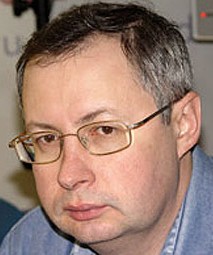
Konstantin Makiyenko (photo: Radio Mayak / Kirill Kurganov)

Still parsing reaction to Prime Minister Putin’s manifesto on the army . . . there are lots of positive reviews and recapitulations.  But commentators who don’t exactly agree with Putin are far more interesting and illuminating.

One particularly fitting this description is Konstantin Makiyenko, who makes succinct, obvious, and bravely ventured points.

Makiyenko, Deputy Director of CAST, is by no means anti-regime.  He is, however, honest.  His observations appeared in Interfaks-AVN, and you can read them courtesy of VPK.name.

He concludes simply that Russia may not have the resources for the plan of major army and defense industry modernization Putin laid out in his campaign article:

“The Russian economic system, which, with oil prices at 100 dollars a barrel, provides only four percent GDP growth, isn’t capable of being the base for realizing the plans outlined.”

AVN says Makiyenko doesn’t exclude that, owing to insufficient budgetary resources, the Finance Ministry will have to work out plans for future cuts in spending on national defense.  But, at the same time, he apparently said Putin’s manifesto on the army wasn’t populist, and he has “no objection” to majority of the Premier’s proposals.

But Makiyenko lays down a sharp, if understated, critique of Putin’s stewardship of Russia’s defenses since 1999.  Agreeing that nuclear deterrence has been the only guarantee of Russia’s security, Makiyenko continues:

“In this relation, the current situation is in no way different from the state of affairs in the 1990s, when, as it’s justly noted in [Putin’s] article, ‘other weighty material arguments didn’t exist.'”

“. . . adequately evaluating the situation now, one has to admit that even today other ‘material arguments’ haven’t appeared for Russia during the last 12 years.”

“In this connection, the thought about how one should particularly attentively follow the appearance of new technical means, for example MD systems and long-range, precision non-nuclear means, capable of devaluing Russia’s nuclear deterrence potential, are very important.”

So, conventional weakness drives Russian objections to MD, one supposes.

AVN also indicated Makiyenko is skeptical of Putin’s call for public-private partnerships and more private capital investment in the OPK given that the once-and-future Supreme CINC nationalized first-class companies like Irkut and Saturn.

Putin and the Army (Part III)

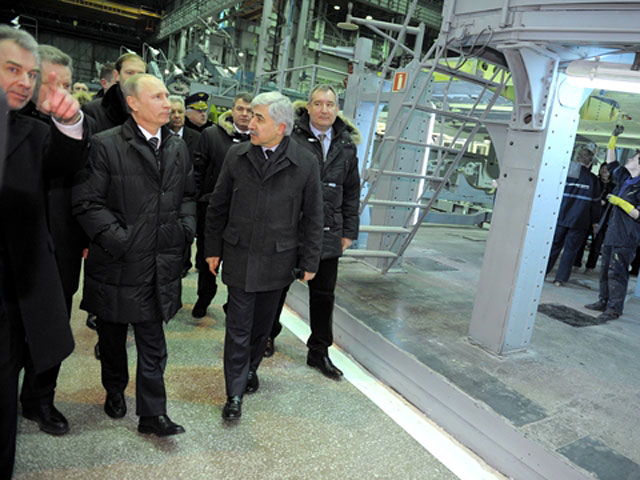
Putin Tours Aircraft Plant in Komsomolsk-na-Amure

This could be called “Putin and the OPK.”  The last five pages — more than 40 percent — of the Prime Minister’s election manifesto are about Russia’s defense sector.  It’s turgid and hard to digest.  

Putin’s website has a translation of the entire article. 

The tone and language at the end of the article differ from the rest.  Since not much has been accomplished in the OPK, Putin speaks in prescriptions, exhortations, platitudes, and imperatives.  Everything is “should” and “must.”  The text is rambling and somewhat unfocused.

Putin gives many non-specific mentions of:

  • “forming S&T capabilities”
  • “developing critical technologies for producing competitive products”
  • “reequipping the RDT&E infrastructure”
  • “investing in training specialists” 
  • “placing the Gosoboronzakaz for three-five, even seven years”
  • “a single organ for controlling ‘defense’ contracts”
  • “fair and sufficient prices”
  • “promoting competition in state purchases”
  • “driving forces of innovation growth”
  • “exchanging S&T information among those who can use it”
  • “streamlining manufacturing processes”
  • “increasing the prestige of defense industry occupations”

Shibboleths without concrete, prioritized, and achievable objectives won’t help the OPK after the election.

Let’s look for more coherent buried messages. 

Putin says up front:

“. . . we also have to talk plainly about [the OPK’s] accumulated problems.  It’s a fact that domestic defense centers and enterprises have missed several modernization cycles in the last 30 years.”

“We must fully overcome this lag in the next decade.”

The once-and-future President takes pains to stress that Russia’s OPK and scientific base, not those of other countries, will rearm the country’s forces.  While military-technical cooperation with partners is fine, Putin says Russia can’t depend on foreign arms or abandon self-reliance.  To the contrary, it needs to increase and support its own military-technological and scientific independence.

He writes:

“I am convinced that no amount of ‘pin-point’ purchases of military and scientific equipment can replace the production of our own weapons; these purchases can only serve as a source of technology and knowledge.”

Still, he warns:

“To increase the country’s defense capability in reality, we need the most modern, best equipment in the world, and not ‘absorbed’ billions and trillions.  It’s unacceptable for the Army to become a market for pawning off obsolete types of armaments, technologies, and RDT&E paid for at government expense.”

So Putin steers a path between those who say Russia can only rely on domestic arms producers, and those who say Russia’s defense sector is too decrepit and corrupt to supply the Armed Forces, so the military has to shop abroad.  But he definitely leans more toward the former view.

The once-and-future President sets a high bar for the OPK, probably ridiculously high considering how neglected the defense sector has been for 20 years:

“The activities of defense industry enterprises should concentrate on the mass production of high-quality weapons with the highest performance characteristics to meet both current and projected defense challenges.  Moreover, it’s only the latest weapons and military equipment that will enable Russia to strengthen and expand its foothold in the world arms markets, where the winner is the one who can offer the most advanced designs.”

“Reacting to present threats and challenges alone means being doomed to the role of someone who is always playing catch-up.  We must do our best to gain a technological and organizational edge over any potential adversary.  Such a stringent requirement should become the key criterion for us as we set targets for the defense industry.”

“The defense industry is in no position to calmly try to catch up with the latest developments.  We must facilitate breakthroughs and become leading innovators and manufacturers.”

So again, however realistic this goal may or may not be, Putin places a priority on Russia’s ability to export weapons and earn dollars.

He is sure rebuilding defense industry won’t be a back-breaking, Soviet-type burden on the country.  Still, he cautions:

“We must not repeat our past mistakes here.  The huge resources invested in the renewal of the defense industry and in the rearmament program must facilitate the modernization of the entire Russian economy.”

Another high bar.  A civilian economy of free, competitive, and self-sustaining industries can take good advantage of defense sector technology spin-offs.  It’s less clear how defense industry investments can help lagging sectors of Russia’s civilian economy.

Putin ominously warns corruption in the national security sphere is tantamount to state treason.  It’ll be interesting to see how the OPK reacts, and if or how he effects this declaration.

Despite years of state-controlled integration, the PM somewhat oddly says defense industry should be open to larger numbers of private enterprises and contractors.

And he opines that OPK pay should be equivalent to new higher pay in the Armed Forces.  This is probably true but it’s another costly promise.

He concludes the entire article saying Russia cannot fall behind and become vulnerable even if it costs a lot.  But the goal, he claims, is an army and defense industry that strengthens rather than exhausts the national economy.

Putin is many days late and many rubles short in fixing the OPK’s problems.  They should have been addressed before the current state armaments program (GPV) was launched.  The GPV cart was placed before the OPK horse for political reasons.

It’ll be interesting to see if this article serves as any kind of blueprint for the years that Putin serves, once again, as Russia’s chief executive.

It’s also interesting to see Putin return to the weakness theme.  And how avoiding real or perceived weakness is such a powerful motivation for him:

“. . . we should not tempt anyone by allowing ourselves to be weak.”

To reiterate, Putin says what needs defending are Russia’s natural resources.

One’s reminded of his address the day after Beslan more than seven years ago.  He said:

“We showed weakness.”

“And the weak get beaten.”

“Some want to rip ‘juicy’ pieces off us, others to help them.”

It’s basically what Stalin concluded about industrialization 81 years ago almost to the day:

“To slacken the tempo would mean falling behind.  And those who fall behind get beaten.”

“One feature of the history of old Russia was the continual beatings she suffered because of her backwardness.” 

“They beat her because it was profitable and could be done with impunity.”

“They beat her, saying:  ‘You are abundant,’ so one can enrich oneself at your expense.”

What Putin says is not so different.

Putin and the Army (Part II)

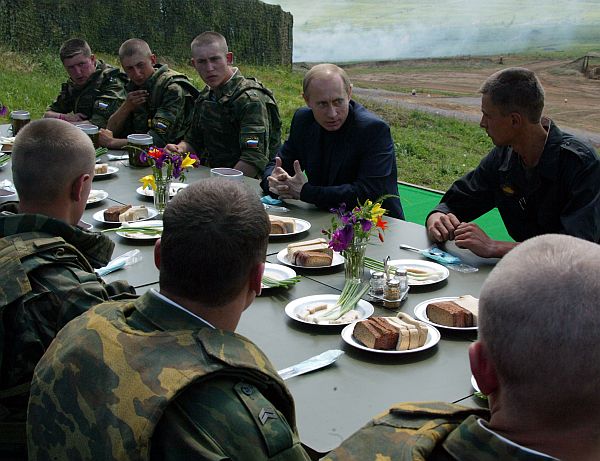
Putin Eating with Soldiers

Continuing with Prime Minister Putin’s latest pre-election article on the army . . . Russia Today published a translated version.

Describing the army’s “social dimension,” Putin says a modern army requires well-trained officers and soldiers on whom more demands can be placed.  And they, in turn, deserve pay commensurate with that of specialists and managers elsewhere in the economy.

Hence, the new pay system for officers this year which practically tripled their remuneration.

Putin mentions that military pensions were increased 1.6 times (60 percent), and he promises they will now increase annually by not less than 2 percent over inflation.

Retired or dismissed servicemen will get a “special certificate” good for further education or for retraining.

Then Putin tackles the painful military housing issue.  After recounting its history, he says, in 2008-2011, the army obtained or constructed 140,000 permanent and 46,000 service apartments.  But he admits:

“. . . despite the fact that the program turned out to be larger in scale than earlier planned, the problem still wasn’t resolved.”

He says the accounting of officers needing apartments was conducted poorly, org-shtat measures [dismissals] weren’t coordinated with the presentation of housing, and the situation has to be corrected.

Putin is, of course, alluding to the fact that maybe 30,000 or 80,000 of those 140,000 apartments the Defense Ministry acquired or built remain unoccupied.  But he’s not exactly tackling the problem head-on.

Putin says the “eternal” permanent and service apartment problems will finally be resolved in 2013 and 2014 respectively.

But in mid-December, in his “live broadcast,” Putin said his new deadlines were 2012 and 2013.  So, he’s just given himself an extra year on each.

Putin says the military’s mortgage savings program now has 180,000 participants, and 20,000 apartments have been acquired through it.

He also notes that regions and municipalities won’t have broken down military towns and infrastructure foisted upon them.

Next, manning. 

Putin gives the familiar figures–there are 220,000 officers and 186,000 sergeants and soldiers who now serve on contracts.  Over five years, the army will try to recruit 50,000 professional soldiers each year. 

Selection, Putin says, will be strict, and contractees will be trained in special centers and sergeant schools.

In the reported one-million-man Russian Armed Forces, 700,000 personnel will be professionals by 2017.  Conscripts will be reduced to 145,000 by 2020.

Putin says the mixed contract-conscript system of manning used for quite some time was just a compromise because Russia couldn’t afford an all-volunteer army.

However, politicians and generals always extolled the mixed system because it retained a universal obligation (at least theoretically) and kept the military from becoming “mercenaries.”

Putin endorses military police and priests in the ranks to keep order among remaining conscripts.  He also promises those who serve as draftees assistance with education and preferences in entering the government service.

The Prime Minister admits Russia lacks a concept for its national military reserve system, and developing one is a near-term task.

Although the course is set for a professional contract army, Putin still wants young men to prepare for service.  So don’t forget about military-patriotic indoctrination, military-applied sports, and DOSAAF.

And Putin indicates he supports Deputy PM Dmitriy Rogozin’s proposal for a Volunteer Movement of the National Front in Support of the Army, Navy, and OPK.

Part III will be the final five pages on the OPK.

Putin and the Army (Part I)

Putin Flanked by Green Suits (photo: Konstantin Zavrazhin)

Candidate Vladimir Putin’s election manifesto on the military and national security appeared in today’s Rossiyskaya gazeta.  The rambling 6,500-word essay reads like most campaign literature — a series of feel-good sound bites with inconvenient facts, details, and background left out.

But let’s get at it.

Putin says the changing world presents risks of an unpredictable nature.  He insinuates that Russia should expect challenges to its sovereignty over its natural resources.  It can’t tempt others by weakness.  Strategic nuclear deterrence preserved Russia’s sovereignty in the difficult 1990s as it does today.

Putin continues his habit of excoriating the long-ago 1990s but largely ignoring what he did or didn’t do during the 2000s.

He points right off to the GPV’s 19 trillion rubles to modernize the Armed Forces, and the coming FTsP’s 3 trillion for the OPK.  And, he says, he’s convinced the country can afford these expenditures.

Putin then turns to the nature of future war.  He wants the military to “look over the horizon” at the nature of threats in 30-50 years to determine what the army will need.

Deterrence has worked, and Russia keeps its nuclear “powder” dry.  But Putin points to the mass introduction of long-range, precise conventional arms becoming decisive even in a global conflict.

Someone tell Putin this is not news.  But there’s more.

Putin reveals that space and information (or cyber) warfare may be decisive in the future.  Beyond this, he continues, new beam, geophysical, wave, genetic, and even psychophysical weapons may be developed.  Their effects may be comparable to nuclear weapons but more acceptable politically.  So, expect the role of nuclear weapons in deterring aggression to decline.

He then segues wildly to responding quickly and effectively to other new challenges, and how Russia’s ODKB partners will help stabilize the “Eurasian space.”

OK.

Putin proceeds to a long-winded explanation of how the army saved Russia in the terrible 1990s.  As mentioned earlier, he doesn’t have a lot to say about the eight years he was Supreme CINC.

Putin claims he rejected a proposal (he attributes to then General Staff Chief Kvashnin) to move SSBNs from the Pacific and consolidate them in the Northern Fleet.  He says permanent readiness units with contractees were formed on all strategic axes, and, he claims, they allowed Russia to “force Georgia to peace” in August 2008.

No mention that the large-scale introduction of contract service failed miserably during this time.  Also no mention of “winning” the Second Chechen War by ceding federal control of that republic to a brutal young warlord.

Putin rightly notes the Soviet Army’s mobilization model made no sense for Russia, and there was no alternative to building a New Army [starting in late 2008 when he was not president, and after things went so well for the army in Georgia].  He admits there were difficulties and mistakes in this process, but goes on to describe his view of what’s been done in the army.

Full-up permanent readiness brigades have replaced old cadre units.  “Non-core, auxiliary functions” have been moved out of the army to maximize time for training.  And effective Defense Ministry sub-units responsible for the military order have to guarantee the effective formation of technical requirements for the development and production of arms and equipment.

Yes, but that’s not happening yet.

Putin lists other changes in the Russian military.  C2 organs cut by 50 percent.  Four districts with air, air defense, and naval forces subordinate to them.  Seven large air bases established.  Twenty-eight airfields renovated, and 12 more set for this year.  The share of modern ICBMs increased from 13 to 25 percent.  Ten more regiments to be reequipped with Yars or Topol-M.  Putin says Russia has accepted its new strategic ALCM.  Dolgorukiy and Nevskiy will soon enter the fleet.  The Navy’s renewed its presence on the world’s oceans.

Then the Prime Minister turns to tasks for the next ten years — rearmament:  nuclear forces, VKO, comms, recce, C2, EW, UAVs and unmanned strike systems, transport aviation, individual soldier systems and protection, precision weapons and defense against them.  And he reemphasizes, new generation precision weapons need development and a larger place in Russia’s future doctrine.

Putin seems to say Russia’s happier with the capability of defeating any missile defense than trying to develop its own.  He again promises effective, asymmetrical steps to counter any U.S. MD.

Then, a ten-year acquisition laundry list from candidate Putin:

  • 400 ICBMs and SLBMs.
  • 8 Borey SSBNs.
  • About 20 multipurpose submarines.
  • More than 50 surface ships.
  • Nearly 100 military satellites.
  • More than 600 aircraft.
  • More than 1,000 helicopters.
  • 28 regimental sets of S-400.
  • 38 battalions of Vityaz SAMs.
  • 10 brigades of Iskander-M.
  • More than 2,300 tanks.
  • About 2,000 SP artillery systems.
  • 17,000 military vehicles.

The tanks are really surprising.  And the list doesn’t really even match the ten-year tasks Putin set out.

Look for the second half later.  It covers army social issues and the OPK.

The Russian Threat

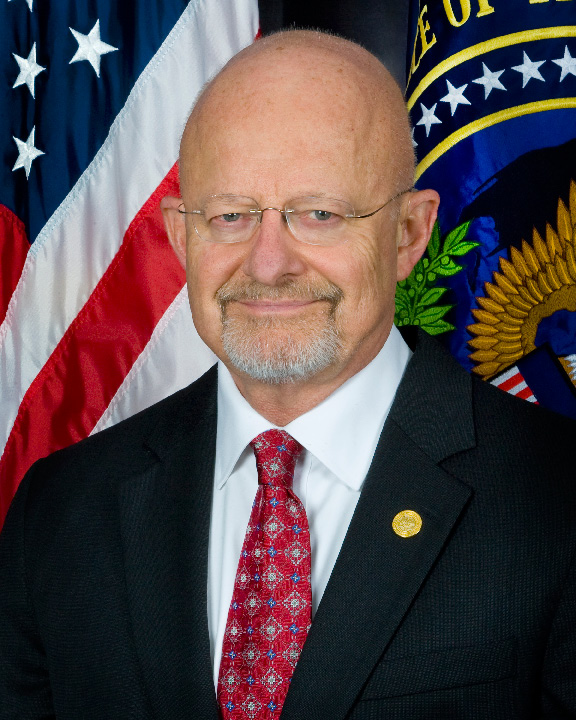
DNI James Clapper

Ahhh, the annual testimony . . . and a story based mainly on English sources for a change.  Thanks to VPK.name for picking up the Vzglyad piece which printed a few lines on what Director of National Intelligence James Clapper’s unclassified Worldwide Threat Assessment testimony to the SSCI had to say about the state of the Russian military.  Otherwise, this would have been overlooked.

A few preliminaries . . . Clapper is a tall septuagenarian reared professionally in the Cold War who manages to keep on climbing the career ladder.  His bulbous dome once prompted underlings to dub him “the Martian” (although it’s known he’s actually from Remulak).  But analysts liked him (at least long ago) because he really seemed to listen to them.

Now on to his testimony, or statement for the record.  Clapper didn’t write it, nor did his staff.  It’s carefully crafted compromise language melding the views of CIA analysts mostly, and DIA analysts and others a little.  One guesses the text hasn’t changed too much from previous years.  A comparison of changes (especially adverbs) from year to year might be more revealing than what the document says.

Thanks to the Washington Post for printing the DNI’s sanitized testimony.  Unlike the impression you’d get from the Russian media, Clapper’s statement isn’t all about the Russian threat.  It definitely isn’t 25 years ago when the USSR was front and center throughout.  Russia appears first on page 7 as a state-based cyber threat and page 8 as an economic espionage threat.  Then it retires to page 20 where a mainline discussion of the country finally begins.

Domestic politics gets one-third of a page; foreign policy (you can read it yourself) gets two-thirds.  The document boldly predicts “more continuity than change” under once-and-future president Vladimir Putin “at least during the next year.” 

But that’s just the problem, isn’t it?  Putin can’t change his fragile system of rule without toppling the entire shaky edifice.

The reader’s also told (shockingly) that Putin’s unlikely to be an “agent of liberalization,” will continue protecting his wealthy cronies, and will try to placate the masses (though Russia’s moderate economic growth rates won’t support this). 

This straightline type of assessment is easy and safe to stick with, especially for one year.  Continuity is always the baseline scenario with a sufficiently short timeframe.  

Good thing the document didn’t have to judge whether Putin will complete his third term in office, the conditions under which he could be forced out, or who might take his place. 

One might have even settled for the simple conclusion (that many Russians are making):  Putin’s regime has exhausted its potential after 12+ years.  It’s unlikely to last another six, let alone another 12, even if it’s impossible to foresee exactly what Putin’s undoing will be.

Maybe the real answers are in the classified testimony.  No, not likely.

The next page has 3 paragraphs, two-thirds of the page, at last, on the Russian military.  The first is lost to a largely factual effort to explain the military’s reforms since late 2008.  The second sensibly concludes that:

“. . . funding, bureaucratic, and cultural hurdles—coupled with the challenge of reinvigorating a military industrial base that deteriorated for more than a decade after the Soviet collapse—will complicate Russian [rearmament and force modernization] efforts.”

One could say deteriorated for nearly two decades, and there are many Russian observers who believe it can’t be revived.  Surprising nothing’s said about buying weapons and arms technologies abroad.  Again, perhaps in the secret version. 

But at least this testimony doesn’t assume the military and OPK will automatically and absolutely get every ruble and every system talked about in the context of GPV 2011-2020.

The third paragraph tries to say what all this means.  Russia will have the military might to dominate the post-Soviet space (already largely true for the past 20 years) but not to threaten NATO collectively. 

Which raises an interesting point.  Is this document insinuating  Moscow might try to threaten one NATO member individually to test the alliance’s reaction and cohesion?

But, in the end, the text says until improvements in conventional capabilities really reach Russian troops, the Kremlin will continue looking to its nuclear forces to offset its weaknesses vis-a-vis potential opponents with stronger militaries.

You can read on yourself for more on Central Asia, the Caucasus, Ukraine, and Belarus.