Tag Archives: GOZ

Defense News

Some Russian defense news from Friday, April 13, 2012 . . .

An Interfaks-AVN headline:

  • Rogozin says new Armata tank will reach troops in 2017.

RIA Novosti reports Rogozin saying UVZ will start producing Armata in 2015.

ITAR-TASS reports burned Delta IV-class SSBN Yekaterinburg will arrive at Zvezdochka to begin repairs this summer.

An OPK source tells the news service the sub will return to the fleet in summer-fall 2014.  Fire destroyed its sonar system and seriously damaged the rubber coating of its outer hull.  Yekaterinburg was under minor repair following a collision with a tug when it caught fire in the dry dock at Roslyakovo in January.  The SSBN had been scheduled for a patrol before it collided with its escort.

ITAR-TASS reported Rogozin remarking that the GOZ may not be fully in place by tomorrow’s deadline.

Today’s Kommersant says the problem (once again) is agreement (or lack thereof) on the price for new Borey-class SSBNs.

The Winner Is . . .

Putin, politics, and industrial policy.

One loser, for sure, defense policy.

Putin got his 63 percent.  He didn’t need fraud to get 50+ percent and avoid a second round, but he (or someone) wasn’t willing to take that chance.  The cheating should have drawn a flag for piling on or unnecessary roughness.  That it happened says something about Putin’s fear of being out of power.  But we digress.

Politics won over policymaking, not least of all in defense policy.

Yes, Russia is not the only place this happens.  It happens in most of the world’s democratic states.  This doesn’t prove Russia’s a democracy; it just proves Russia has politics.  But so did the USSR.  It had fights between industry and the military.

But back to our story.

Promises and populism secured votes for Putin in Russia’s industrial centers where they’ve waited years for serious defense orders.  He’d have won here without writing checks his treasury might not be able to cash.  But the once-and-future Supreme CINC made pledges he may hope factory workers forget before 2018.

If they don’t, working class disgruntlement may mingle with urban, middle class discontent in an increasingly flammable political mixture.

The case in point here is tanks and Uralvagonzavod in Nizhniy Tagil.  Did Putin court anyone, or any defense enterprise, more than the General Director of UVZ Oleg Siyenko?  Did anyone get comparable preelection attention?

The closest we get is Putin’s intervention between the Defense Ministry, OSK, and Sevmash to solve their submarine pricing dispute last fall.  But industry didn’t exactly get everything it wanted in that case.
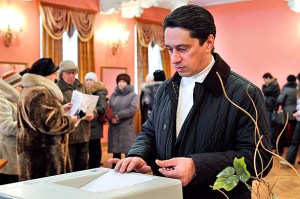
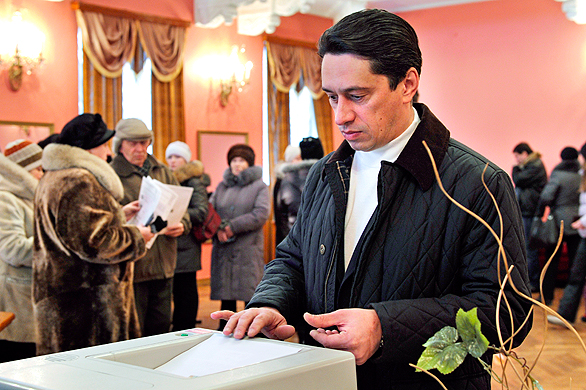
Siyenko Casts His Ballot

In an election day press-release, this industrial chieftain all but admitted his employees were ordered to vote for Putin.  Most probably never entertained the thought of doing otherwise.  UVZ likely didn’t have to organize “carousels,” but  “corporate voting” might have occurred.

On February 20, Putin declared 2,300 “new generation” tanks will be produced (by UVZ) under GPV 2020.

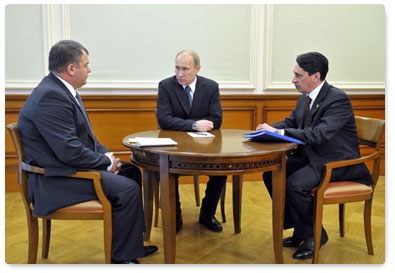
It was just February 15 that Putin had a meeting with Defense Minister Serdyukov and Siyenko.  It was actually more of a beating, for Serdyukov.
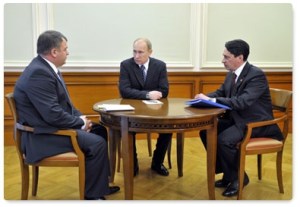
Putin With Serdyukov and Siyenko

The Defense Minister had to back down publicly from everything he’s said about tank acquisition over the last couple years.  He acknowledged, as Putin said, there will be a new tank from UVZ in 2013 that will enter series production in 2015.  And, for good measure, Serdyukov said the manufacturer will receive 100 percent advance payment on the GOZ.

As recently as January, the Defense Minister was lamenting huge stocks of old tanks and repeating his willingness to wait for fundamentally new armor rather than “new” T-72 or T-90 models.  In mid-2011, he criticized tank makers (UVZ) for dressing up old ideas, and said the army would just settle for updating its existing armor inventory.

Yes, everything changed sometime between then and now.

It was just prior to this Putin-Serdyukov-Siyenko session that General Staff Chief Nikolay Makarov again criticized the tanks offered to the army and argued for the military’s predominance in weapons procurement decisions.  Deputy PM Dmitriy Rogozin objected fiercely to Makarov’s public airing of dirty linen, and declared himself chief of acquisition.

All official doubts and complaints about Russian tanks heard in 2009, 2010, and 2011 were swept away in a stroke by Putin’s announcement.

It seems the Ground Troops — its supporting industry actually — were feeling left out of the GPV and GOZ.  Tanks were never one of Russia’s  priorities as enumerated by former armaments chief Vladimir Popovkin.

What do 2,300 tanks mean for the world’s largest country?  One that once measured sufficiency in tanks by the tens of thousands?  Is staving off a NATO ground attack really a top concern?  Would Moscow entertain putting most of its new tanks opposite China?  There’s been plenty written (including by Russians) about the end of the tank era.

What do these tanks mean for the GPV?  If they cost 200 million rubles per, the cost of the production run (if it actually happens) will cost close to 500 billion of the GPV’s 19 trillion rubles for procurement.  It’s a lot for one system.  The Putin-brokered sub deal in November was worth only 280 billion rubles.

So to return to the original point of this meandering post, these tanks are about industrial policy, updating the human and technical capital to make them, keeping a significant industrial center quiescent, and retaining the capability to sell tanks abroad.  There are, after all, other armies possibly facing big tank battles in the future.

When politics and defense intersect, the latter yields.  Nothing shocking in that, one admits.

One last thing.

Siyenko’s an interesting character.  The 46-year-old former bike racer and past President of the Russian Cycling Federation spent most of the 2000s as General Director of Gazprom subsidiary Gazeksport (Gazprom Eksport), selling natural gas to the Europeans.  From 2003, he was a deputy chairman of the shady gas intermediary Itera.  Itera Chairman Vladimir Makeyev too is a one-time world-class rider who succeeded Siyenko as the cycling federation’s head.

But suddenly in 2009, Siyenko changed tracks, and went to Sverdlovsk Oblast and UVZ in Nizhniy Tagil.  There must be a story explaining why he’d abandon gas for tanks and railcars.

Cosmic Corruption

Sergey Fridinskiy

Main Military Prosecutor Sergey Fridinskiy gave Interfaks an interview several weeks ago in which he described generally improved crime statistics in the Armed Forces.  But he also called the scale of corruption in the military nothing short of “cosmic.”

Fridinskiy told the news service the army’s crime situation is stable and even improving.  Crimes by servicemen are down 16 percent, and there are fewer crimes committed by officers.  There’s a constantly growing number of military units where no legal violations law are registered.  Last year fewer soldiers suffered violence at the hands of their fellow soldiers.  But the army’s top law enforcer doesn’t think he’ll run out of work any time soon:

“In particular areas, for example, like saving budget resources allocated for military needs, or corrupt activities, the crime level, as before, is significant.  And we’re still far from ridding ourselves of nonregulation relations.”

More than 1,000 military officials were prosecuted for corruption, including 18 general officers — one-third of whom received jail time.  Since January 2011, the GVP’s prosecuted 250 bribery cases, many more than in 2010.  Fridinskiy singled out the GOZ and commercial firms outsourcing for military units as areas where problems are “not small.”  He puts annual Defense Ministry losses to corruption at 3 billion rubles.

This is, interestingly, the same figure he cited in early 2010.

Asked about the types of corrupt schemes in the military, Fridinskiy responded:

“Mainly untargeted use of budget resources, violating the rules and requirements of conducting auctions, competitions, and contractor selection, paying for work not really performed, significant inflating of prices for military products.  There are also multifarious kickbacks, bribes, and misuse.  Generally, the banal sharing out of budget resources.  Devotees of living on state funds especially go for violations of the law.  Their scale now is simply stratospheric, I would even say, cosmic.”

Fridinskiy said the GVP’s been active in checking high-level Defense Ministry officials’ asset and property declarations.  He said called the scale of violations here “impressive.”  More often, he continued, the GVP finds evidence of servicemen and officials engaged in illegal entrepreneurship and commercial activity.  He mentioned an unnamed deputy Northern Fleet commander who failed to disclose his wife’s assets, and a Rosoboronpostavka bureaucrat who simultaneously serves as general director of a corporation.

The GVP Chief then shifted gears to talk about barracks violence which he said was down by 20 percent in 2011, with cases involving “serious consequences” declining a third.

Lastly, Interfaks asked about military police, of which Fridinskiy’s skeptical.  He emphasized military prosecutors will continue supervising army investigations, but he doubts MPs are ready to run criminal inquiries.  He repeated his familiar assertion that they aren’t a panacea; their existence won’t change the social factors behind crime among servicemen.

Would have been interesting if the news agency had asked if this year’s higher pay for officers will cut army crime in 2012.

A Fuller Picture of the GOZ

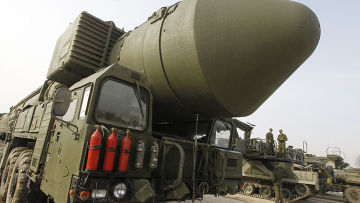
Yars ICBM (photo: RIA Novosti / Ilya Pitalev)

It’s been customary for some time to get press information on what the Russian military expects to acquire each year.  Rare, however, are occasions when we receive a report on what they procured to compare with the plan from the year before.

This year is one of those occasions.

Why is anybody’s guess.  But the release of this information — which came from the new armaments tsar First Deputy Defense Minister Aleksandr Sukhorukov — could be a Defense Ministry weapon in its running skirmish with the OPK.  Information on how the defense sector performed could bolster the ministry’s somewhat beleaguered position on what it buys, from whom, and for how much.

RIA Novosti covered Sukhorukov’s remarks on GOZ-2011 yesterday.

According to him, in 2011, the military received 30 Topol-M and Yars ICBMs, two special designation satellites, 21 aircraft, 82 helicopters, one proyekt 22380 Steregushchiy-class corvette, and 8,500 KamAZ and Ural vehicles.

The price for GOZ-2011 was about 550 billion rubles.

Now, for comparison, in mid-March, Lenta.ru recapped Defense Minister Serdyukov’s statement to RIA Novosti on 2011 procurement plans.  He said the military planned to obtain 36 ballistic missiles, two SSBNs, 20 strategic ALCMs, five satellites, 35 aircraft, 109 helicopters, three SSNs, one surface ship, and 21 SAM systems.  The media outlet itself noted the submarine plans sounded garbled since two SSBNs and an SSN were more likely.

So what was acquired very roughly approximates what was anticipated.  And these are just high-profile systems rather than an exhaustive list.  As indicated at the outset, it’s a fuller picture not a full one.  There could be an official assessment later of what percentage of GOZ-2011 was completed.   

Sukhorukov also said late last year a contract for Bulava SLBM production out to 2020 was signed, but no acceptance date for the missile or the first Borey-class SSBN was established.

He added that 84 contracts worth 42 billion (8 percent of the money) were not fulfilled, and the Yasen-class SSN schedule was not met.  And defect claims reached 7,100, up from 6,800 in 2010.

Barabanov’s Top 20

Defense commentator Mikhail Barabanov published his annotated list of the top 20 military stories of 2011 in yesterday’s Voyenno-promyshlennyy kuryer.

Some we’ll just note, but Barabanov’s provided interesting details for others.

1.  The continuation of military reform.  The start of the next phase of reforming the Air Forces and Navy.

Barabanov says Air Forces’ reform included the formation of VVKO and the enlargement of Russian air bases.  The reform of the Navy started December 1 and it will soon be restructured into a “new profile.”

2.  Establishment of VVKO.

He comments, “The given construct essentially looks fundamentally like a return to Soviet Voyska PVO Strany (National Air Defense Troops) in the form of a separate service [well, branch] of the Armed Forces.”

3.  The new pay system effective this year.

4.  GPV 2011-2020.

5.  The increase in the Gosoboronzakaz.

Barabanov puts GOZ-2011 at 460 billion rubles, 570 if RDT&E is added.  This was 20 percent more than GOZ-2010, and allowed for the series production of weapons and equipment.

6.  The war between industry and the Defense Ministry.

7.  Development of the PAK FA.

8.  Large helicopter procurement.

Apparently a post-Soviet record.  About 100 new helos, including Mi-28N, Ka-52, Mi-26, and Mi-24 (Mi-35M), were expected to reach the troops.

9.  Bulava began to fly.

10.  OSK “megacontracts” for submarines.

About 280 billion rubles for modernized proyekt 885 and 955.

11.  Ending serial procurement of many ground systems and equipment.

The Defense Ministry said it didn’t need the T-90, BMP-3, or BMD-4 (!?).  Development of an entire spectrum of new armored vehicle platforms began for procurement after 2015.

12.  Domestic space sector failures.

They evidenced the decline of the OPK’s production capability in the space sector.

13.  “Tsentr-2011” exercises.

They checked the “new profile,” and the greatly enlarged military districts.

14.  Importing arms.

Mistral, Rheinmetall’s training ground in Mulino, foreign sniper rifles, and Israeli UAVs.

15.  Continued growth in Russian arms sales.

$11 billion as opposed to 2010’s $10 billion.  This despite the revolutions in the Arab world.  Rosoboroneksport’s order portfolio is $36 billion.

16.  Arab revolutions.

17.  NATO intervention in Libya.

18.  Military actions in Afghanistan, American troops leave Iraq.

19.  Deadend in missile defense negotiations.

20.  Start of reduced U.S. military spending.

Serdyukov Year-Ender (Part I)

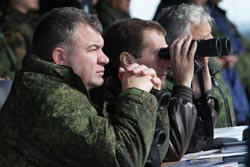
Serdyukov Watches Troops with President Medvedev

Defense Minister Anatoliy Serdyukov gave a two-part interview to Rossiyskaya gazeta this week.  It covers some contentious issues, but the questions aren’t exactly hard-hitters, and there’s no follow-up on his answers.  Nevertheless, Serdyukov as always puts out a steady and consistent message on what he, the government, and military are trying to accomplish.  Much of the first part of his interview concerned this year’s GOZ problems and the Defense Ministry’s difficulties coming to terms with defense sector enterprises.

Serdyukov says he’s been occupied for two years with reaching agreement on prices, deadlines, and quality for arms and other military equipment.  But, he says, now producers have no reason to complain because they’re receiving 80-100 percent advance payments for their work.  Some contracts for ships, aircraft, and strategic missiles are long-term ones extending to 2017-2020.  He adds:

“The fact is we are completely forecasting the entire future activity of a company for many years to come.  This allows for planning for expenses and receipts, training personnel, introducing new technologies, reequipping the production base.”

Regarding the tussle over OPK prices, Serdyukov says he’s told enterprises to give the Defense Ministry their production cost [себестоимость], and the military department will make production profitable for them.  Producers can have a profit margin of 20-25 or even 30-35 percent, but, he says, component suppliers will be limited to a one-percent mark-up.

Many producers (Sevmash for one) blame their suppliers for their own high costs, but it seems likely that limiting sub-contractors to a 1 percent profit is a formula for failure.

But Serdyukov has one condition for profits of 30-35 percent over the cost of production:

“The difference [10 percent?] has to go toward the technical reequipping of the enterprise, the purchase of new technologies and licenses.  And this will lead to lower costs or improved technical characteristics and combat potential of this or that weapon in the future.”

Later Serdyukov noted the Defense Ministry will compensate producers for annual inflation but production cost and timeframe will remain fixed. 

Then questions turned to the issue of foreign weapons.  Serdyukov said the Defense Ministry can’t buy Russian arms that aren’t up to world standards in price and quality.  Russia, he said, is interested in foreign systems so it can understand where it lags or has already fallen behind.  He described cooperative ties with foreign producers, buying licenses, and organizing joint production of entire systems or components in Russia as a way to get domestic industry up to date.  Serdyukov said foreign characteristics and prices are always part of the discussion of price formation with OPK enterprises.

Serdyukov told RG he doesn’t believe the Russian defense sector’s potential has dissipated despite the economic and financial difficulties of the last 15 years.  But now, with a 10-year GPV in hand, Russia has to restore the volume of defense production to the level of the 1980s.

He said foreign purchases were mainly small numbers of samples for the Defense Ministry to investigate.  It bought Iveco armored vehicles for explosive testing, after which Russia proposed to produce them jointly with Italy in Voronezh.

Year Two

This blog completed its second year yesterday.  There were 288 posts in year two (a few less than last year).  Just a couple to go to reach 600 posts since December 10, 2009. 

One hopes the reading was half as worthwhile as the writing.  But frustration lingers.  It’s impossible to follow everything.  Adding Twitter provided a “release valve” for overflowing news.  Still there’s tension between posting short items and writing more detailed pieces drawing together many different sources. 

In 2011, Defense Minister Anatoliy Serdyukov and General Staff Chief Nikolay Makarov had plenty of interviews, official appearances, and other public utterances to cover.  There were a large number of high-level personnel changes, retirements, and dismissals to report.

Serdyukov eased a little on cutting the officer corps.  The Defense Ministry readied its new higher pay system while scandal plagued the stopgap premium pay scheme.  Military housing remained a major headache as always.

Moscow hit a wall on manpower and had to accept undermanning.  After acknowledging there aren’t enough potential draftees, the military is starting over (yet again) with an effort to create professional enlisted and NCOs through contract service.

This year began with questions about the GPV’s feasibility, but devolved into immediate problems with GOZ-2011.  The Russians threw money at the OPK without looking at the defense sector’s (and the procurement bureaucracy’s) capability to turn financing into the kind of weapons and equipment the military requires.  Difficulties ramping up production of naval and missile systems occupied media attention.  The public debate over the relative merits of buying Russian or foreign weapons made several headlines.     

So where is Russia’s military?

To this observer, the Russian Armed Forces are improving and beginning serious rearmament.  But the hour is late.  Significant future problems could derail recent positive changes.  These include new and old, unsolved economic, budgetary, social, demographic, and possibly even political challenges.  Not to mention purely military obstacles to modernizing the army and navy.

Your visits and page views grew significantly in year two.  Page views are about 400 a day, 2,000+ a week, and 9,000-10,000 a month.  We’ll see if this is the ceiling for this rather specialized topic.

Your views, opinions, and arguments are always appreciated.  Those sharing or highlighting data and evidence on issues are particularly valuable.

Defense Ministry Collegium

Serdyukov Flanked by Makarov and Pankov

November’s the time for year-end evaluations in the Russian military, and the Defense Ministry had its collegium yesterday.  Mil.ru printed Defense Minister Serdyukov’s introductory remarks.

First on his mind was complete fulfillment of the State Defense Order next year, and signing all GOZ-2012 contracts next month.  He said all responsibility for ordering will be transferred to a “Federal Procurement Agency.”

Some media sources assumed this means Rosoboronpostavka.  This author thinks it could be something new.  It’s important, so here’s exactly what Mil.ru says he said:

“Next year the functions of the ordering organ are being fully transferred to the Federal Procurement Agency.”

If that means Rosoboronpostavka, why not just say Rosoboronpostavka?  ITAR-TASS actually replaced Serdyukov’s words “Federal Procurement Agency” with Rosoboronpostavka.  At the very least, not everyone’s working from the same sheet of music.  But continuing with Serdyukov’s remarks . . .

Unlike large-scale strategic exercises of recent years, the coming year will stress tactical-level training.  But Southern MD exercises will test the new Armed Forces command and control system.

He noted establishment of VVKO by December 1, and said it will “intercept any targets right up to hypersonic speeds, both in the air and in space.”

Military police will start working in the troops in 2012, according to Serdyukov.  They are still occupied at present with selecting personnel, writing regs, etc.  Serdyukov earlier said they’d be functioning in 2011.

The Defense Minister indicated all service functions in the Armed Forces will be outsourced next year.

Without much fanfare, he said the new system of enlisted contract service will start in 2012.

Serdyukov said stimulus pay for officers will continue alongside their newly-approved higher pay.

First Deputy Defense Minister, Chief of the General Staff Nikolay Makarov delivered the collegium’s main report, but the press wasn’t invited to stay.

Meanwhile, today NG sources “don’t exclude” that Anatoliy Serdyukov could soon leave the Defense Ministry to become Finance Minister.  There’s talk Russia’s NATO Permrep Dmitriy Rogozin could succeed him as Defense Minister [because he toured the 58th Army with Medvedev this week].

There are always rumors like these.  Recently it was said Makarov would be “sacrificed” as an electoral offering to military men who don’t like him.  Sometimes the rumors bear out, sometimes not.  More important are the reasons behind any personnel changes. 

Is Putin or Medvedev likely to find a more effective steward of the military than Serdyukov?  Probably not.  The fiery politician Rogozin would be a dramatic change from the retiring technocrat Serdyukov.  The former would inspire and appeal to the troops more than the latter, but not do a better job.  Of course, we shouldn’t assume capability is the leadership’s most important criterion in picking a Defense Minister.

Suit, Countersuit Over GOZ

Kurganmashzavod (photo: Nakanune.ru)

This story should be of particular interest to those following the VDV, Ground Troops, and their combat vehicles.  The specific problems of KMZ illustrate general dilemmas of the GOZ.  The GOZ money trail is slippery.  And it explains why modern, or at least new, weapons and equipment aren’t produced or delivered, and the GOZ is only partially fulfilled. 

RIA Novosti (via Vedomosti) reports the Defense Ministry filed suits against Kurganmashzavod (KMZ), of “Tractor Plants” Concern, for breaking GOZ contracts.  KMZ, in turn, entered three countersuits seeking 1.5 billion rubles from the Defense Ministry for violating its contracts.

KMZ claims the Defense Ministry stopped accepting its products in fall 2010, causing the factory to fail to meet its obligations.  RIA Novosti reports First Deputy Defense Minister Aleksandr Sukhorukov said KMZ would be fined 3 billion rubles for breaking its 2010 contract to produce the BMP-3.  Two billion has also been cited.  The first hearing will be next week.

Nakanune.ru indicates KMZ had no GOZ contracts for 2011, during which the plant counted on 12 billion rubles worth of production.  Instead, it produced only 4.7 billion worth for the first eight months of the year.

In May, Main Military Prosecutor Sergey Fridinskiy pointed to KMZ as a prototypical failure of the GOZ.  The factory got an advance of 350 million rubles but, instead of sending money to its sub-contractors, it used it on internal needs.

Academy of Military Sciences Professor and PIR-Center Conventional Arms Program Director Vadim Kozyulin says:

“I understand that the enterprise’s leadership could have its own reasons.  The plant has many problems which could look more important and pressing from a local viewpoint.  But some way or other the resources to fill the order for the supply of armored equipment for the VDV came in, but went for something else.”

Kozyulin says they have the same problem in other enterprises, “but ‘Kurganmashzavod’ fell right under the chop.”  He says it won’t go well for KMZ, and the Defense Ministry may refuse to give the factory future orders. 

Nakanune also cites CAST analyst Dmitriy Vasiliyev who agrees this isn’t just KMZ’s problem, but a problem of the Gosoboronzakaz as a whole.  Igor Korotchenko suggests KMZ has little chance of winning its case, and needs to seek an out-of-court settlement.  But perhaps it’s too late already. 

It may be that KMZ is being made into a convenient example because others want to take it over.  It is an area of the OPK that could stand some consolidation.

Kozyulin suggests troubled KMZ should merge with Uralvagonzavod (UVZ).  UVZ and Russian Machines are apparently after KMZ parent “Tractor Plants” Concern.  They’ve approached Vnezhekonombank, which owns 100 percent of its shares, about managing “Tractor Plants” Concern, but the choice of a managing firm has been put off until 2012.

It certainly sounds like KMZ is headed downhill.  The dueling law suits, the untangling of KMZ’s management, and, at some point, the reorganization and restoration of its production capability will take time.  This means possibly years of delays in filling armored vehicle orders for the VDV and Ground Troops.

You may recall United Russia member Igor Barinov excoriated KMZ earlier this year for its poor handling of GOZ funds.  VDV Commander, General-Lieutenant Vladimir Shamanov also blamed KMZ for delays in getting the first BMD-4Ms for his troops. 

MER and SP Doubt GOZ Prospects

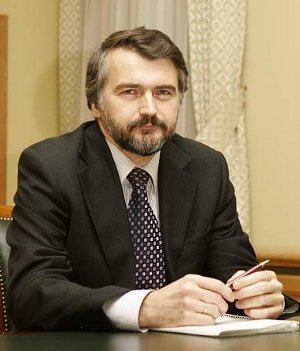
Andrey Klepach

Yesterday the Ministry of Economic Development (MER) and the Audit Chamber (SP) expressed serious doubt about the government’s ability to fulfill the state defense order in 2011 and 2012.  Speaking to a Duma hearing on the draft budget for 2012-2014 covered by RIA Novosti, Deputy Minister Andrey Klepach said:

“Our Gosoboronzakaz won’t be substantially fulfilled this year and it’s highly probable it won’t be fulfilled next year.”

Deputy SP Chairman Valeriy Goreglyad also told the parliamentarians that expenditures on the army and national defense are:

“. . . not only the least transparent, but also the least effective from the point of view of using state resources, particularly those connected with the Gosoboronzakaz.”

“Therefore, in the first place, a different system of contracting is needed in this area, like in no other [area], a transfer to a federal contracting system where the entire technological cycle [planning to contract fulfillment] is supported.”

Other media outlets largely repeated RIA Novosti while adding a little background.  They reviewed President Medvedev’s comments on the failure of GOZ-2010, and on GOZ problems this spring, as well as repeated government and industry failure to meet Prime Minister Putin’s deadlines for completing all GOZ-2011 contracts.

These outlets also mishandled Defense Minister Serdyukov’s statement from last week about having only 20 billion of 581 billion rubles in GOZ-2011 funds remaining to obligate.  Several news sources inaccurately called it GOZ-2012 money.  As ARMS-TASS reports, the government’s Military-Industrial Commission won’t start reviewing the draft GOZ-2012 until mid-November, and no contracts for next year have been negotiated or placed.

To make things just a bit worse for the government, ex-Finance Minister Aleksey Kudrin repeated his budget priorities to a U.N. Millennium Development Goals conference yesterday in Moscow.  According to Utro.ru, Kudrin said:

“I already expressed my position that the increase in military expenditures in Russia is creating a threat to increasing and supporting programs in the area of health and education.  I would give less of an increase in money now for military needs than for health.”