Tag Archives: Nikolay Makarov

Kramnik on Vostok-2010 and Military Reform

This is complete finally.

Ilya Kramnik’s RIA Novosti piece about the exercise has been quoted by others, but it hasn’t gotten attention as a whole on its own.

So what does Kramnik think?  He cites Makiyenko to the effect that Vostok-2010 showed that reform has been positive for the army, but there are, of course, problems.  Troops aren’t uniformly well-trained, and the failure of contract service has really hurt.  But Kramnik gives Defense Minister Serdyukov a lot of credit, on the order of being a 21st century Milyutin.  But back to the problems again.  Things like contract service, tension over officer cuts and premium pay, military education cuts, and the failure to deliver new weapons have to be fixed.  But Kramnik believes Serdyukov is the kind of guy who’ll go back and fix what he didn’t get right or get done.  Then Kramnik shifts to the type of conflict the military reform is preparing the Russian Army to fight.  Obviously [?] not a nuclear one, but rather, again turning to Makiyenko, a Central Asian local war scenario that might threaten the RF’s internal stability.  The conclusion is that, if reform stays on track and occurs quickly, the army will be able to meet this challenge.  Some, however, might well argue that even a properly and rapidly reformed Russian Army might not be enough to contain and damp down the kind of conflagration Makiyenko describes.  Finally, Kramnik concludes that even the U.S. front isn’t secure; an American regime in 2012 or 2016 might take to renewed active support of new ‘color revolutions’ in Moscow’s back (or front) yard.

Here’s a verbatim text:

“The official results of the just ended ‘Vostok-2010’ exercise are still being reckoned, and this will be done by the Defense Ministry.  Meanwhile, it’s already possible to make some conclusions.” 

“‘Vostok-2010’ was the largest of all in the post-Soviet period of Russian history.  More than 20 thousand men, 75 aircraft, 40 combat and auxiliary ships took part on the ground, in the air, and at sea in maneuvers conducted from Altay Kray to Vladivostok.”

“The aim of the exercise was to check the three-level command structure — operational-strategic command – operational command – brigade, and other new elements in the Armed Forces command and control and support system, and to uncover deficiencies needing correction.  An expert of the Russian Center for the Analysis of Strategies and Technologies Konstantin Makiyenko expressed his opinion on the recent maneuvers:  ‘The recent maneuvers fully refuted the propagated myth about how the army is being destroyed as a result of the actions of the current Defense Ministry leadership.  It’s obvious the army is alive and developing.  Units participating in the exercise demonstrated their combat capability, despite the fact that they are not in the ranks of the best military districts, and scarcely armed with the most modern equipment.'”

“‘It’s especially worth focusing on the good morale of the officer personnel — it’s not possible to speak of general enthusiasm, of course, but I didn’t see dim eyes among the officers.  As a group, they are interested in the success of the current reform and hope for its success.'”

“While agreeing with this point of view, one has to note that the situation with soldiers looks a little different, both RIA Novosti’s reviewer [Kramnik] and Konstantin Makiyenko have also noted this.  Very much depends on the branch of troops and the basic training of the soldiers themselves.  Contract-servicemen in a ‘Tochka-U’ operational-tactical missile launch battery look and are trained much better than conscript-soldiers in motorized rifle units.  In the words of motorized rifle officers up to the battalion commander level, the reduction in the number of contractees has negatively affected platoon and company training.  Ideally, the service term of a specialist-soldier (mechanic-driver, weapons system operator, etc.) needs to be three years, that is achievable only on the contract manning principle for these positions.”

“Speaking about the attainability of the announced goals of the reform, one can say the following:   the will of the military leadership which certainly exists, is the main component of success, a firm understanding of the goal is also obvious, and the possession of authority — it’s not possible to doubt this.  As a result, the current Defense Ministry leadership needs only time to realize its ideas.  Overall, the military reform being conducted is the most significant event of Russian history in the last ten years — since the suppression of the separatist rebellion in the North Caucasus.  The Serdyukov-Makarov reform in the military sphere is the most radical and deepest since the time of Mikhail Frunze’s reforms in the 1920s, if not since Dmitriy Milyutin in the 1860s and 1870s.”

“As proof, it’s possible to note the fact that the Defense Ministry leadership is constantly searching and ready to correct those steps which, when checked, turn out to be incorrect or unattainable in real political-economic conditions.  So, the current principles of manning the army will undergo a serious correction:  it’s obvious that neither the organization of contract service, nor, even more, the existing format of conscript service corresponds to the demands of the time.”

“Evaluating the correspondence of the Defense Ministry leadership to its missions, it’s possible to say, that at present Russia has the most appropriate military leadership since the collapse of the USSR.  At the same time, it’s obvious that the radicalism of the reform, the compressed time of its implementation, unavoidable resistance in the environment and hard economic conditions didn’t allow for avoiding a large number of mistakes and excesses.  Among the most fundamental failures it’s possible to name the collapse of the army’s transition to the contract manning principle, serious social tension arising in connection with the rapid reduction of officer personnel, the ambiguous situation with the scale of servicemen’s complaints after the introduction of the differential pay system [premium pay or Serdyukov’s Order No. 400?], the hurried and not completely thought out reform of military education and many, many other things.  It’s  particularly worth focusing on the implementation of the state armaments programs which fail one after another, not being executed in a significant part.  As a result, the lag of Russia’s Armed Forces behind the most developed countries in the level of  technical equipping continues to grow such that in conditions of a quantitative lag it could become very dangerous.  All these mistakes have to be corrected, since they impact on rudiments of the army’s combat capability.”

“For what type of wars does Russia’s new army need to prepare?  Obviously, the time of long wars between the great powers has gone into the past — nuclear weapons haven’t left chances for such a development of events.  The most probable type of conflict in which the Russian Army will be involved is a local conflict on Russia’s borders and the territory of the former USSR, in the course of which there could be clashes with the most varied enemy:  from a regular army to many bandit formations and terrorist groups.”

“In Konstantin Makiyenko’s opinion, Central Asia presents the greatest danger in the future of a possible hot conflict with Russia’s direct participation:  ‘The U.S. and NATO, obviously, are less and less controlling the Afghanistan situation, and it’s not excluded that in the foreseeable future they may have to abandon this country.  The return to power in Afghanistan of the ‘Taliban’ movement looks most realistic in the event of such a development of events.  The arrival of Islamic radicals in power would unavoidably be a catalyst for conflicts on the territory of former Soviet republics of the region already riven by contradictions.  Weak authoritarian regimes in Tajikistan, Turkmenistan and Uzbekistan, not to mention what’s become the ‘failed government’ in Kyrgyzstan, could be easy prey for the Taliban.  As a result, Russia might be forced to consider the likelihood of a large Asian conflagration which it would have to prevent, or if it didn’t succeed — extinguish, at a minimum with the aim of preserving its own internal stability.  One very much wants to believe that the reform will bear fruit before the described situation becomes a reality.'”

“Besides the described scenario it follows to study also the probability of another development of events:  as experience has shown, on the territory of former USSR republics, the rise of openly anti-Russian regimes with external support at their disposal can’t be excluded.  For today, such a situation is a low probability due to the fact that the current administration in the U.S. — the main sponsor of ‘colored revolutions,’ is clearly not inclined to continue the policy of George Bush.  However by 2012, if President Obama loses the election, the situation could change, and this risk is even greater in 2016 when the administration will change in any case.  Meanwhile, you have to note that even the Democrats remaining in power in the U.S. is not a guarantee of a peaceful life:  Obama’s point of view on a coexistence format with Russia is hardly shared by all his fellow party members.  In the worst case, a return to the next variant of Cold War and new spiral of the arms race isn’t excluded.”

“The coming decade isn’t promising Russia an easy life.  The success of military reform is all the more important.”
Testing Army Reforms in Vostok-2010

Readers seem eager for anything they can get on Vostok-2010.  Here’s something. 

Russia’s largest maneuvers of the year, Vostok-2010, began June 29, and continue until July 8.  This broad-scale operational-strategic exercise (OSU or ОСУ) encompasses the Siberian and Far East MDs, as well as the Pacific Fleet—in other words, what will reportedly become the new Far East MD or operational-strategic command (OSK or ОСК) before the end of 2010.  

General Staff Chief, Army General Nikolay Makarov talked to RIA Novosti and ITAR-TASS at length about Vostok-2010 recently.  He said the Far East was chosen for its broad expanses, limited infrastructure, and difficult weather and climate.  Eleven combined arms, 3 air forces, and 4 naval training ranges will be used.  Makarov noted up to 20,000 soldiers, 2,500 weapons systems and pieces of equipment, 70 aircraft, and 30 ships will take part in the exercise. 

Makarov said Vostok-2010 will be a logical continuation of last year’s large training events.  Beyond Defense Ministry forces, operational groups and sub-units from the MVD, FSB, FSO, MChS, and FSIN will participate.

As is customary, Makarov said the maneuvers:

“. . . are not directed against any real country or military-political bloc.  They have an exclusively defensive orientation for ensuring the security and defense of the state’s interests on the Far East border against a notional enemy.”

And the exercise’s theme is:

“. . . preparation and employment of formations [military units] in a new TO&E structure to fulfill missions in isolated sectors to ensure the Russian Federation’s military security.”

Makarov said the maneuvers will:

  • Check the effectiveness of the newly-created three-level system of troop command and control;
  • Evaluate the readiness of new TO&E formations and military units to  conduct combat actions in isolated sectors in a constantly changing situation, as well as their mobility and combat possibilities;
  • Resolve training and command and control issues at the operational-strategic and operational level while conducting combat actions;       
  • Organize coordination of military command and control organs with the troops and military formations of other federal ministries and departments, and also local organs of executive authority in resolving joint missions; and
  • Investigate the capabilities of a unified system of material-technical support (MTO) which was created during the structural reformation of the army and fleet.

The exercise will include special operations, air defense and ship combat firings, and air and amphibious assaults.  Makarov said the RVSN will join the exercise play, but no ICBM training launches will occur.  Military transports will bring independent sub-units from the Moscow and Volga-Ural MDs to join the exercise, but they will draw their weapons and equipment from Siberian and Far East storage bases.

Makarov noted the participation of an unidentified number of Su-24M and Su-34 aircraft arriving from Central Russia during a direct flight with aerial refueling.   Black Sea Fleet flagship Slava-class CG Moskva and Northern Fleet Kirov-class CGN Petr Velikiy also completed long-range cruises to participate.

Makarov said new operational and operational-strategic level command and control posts will be used in the exercise, as will ‘fifth generation’ radio communications gear and future soldier systems under development at Sozvezdiye.  Iskander operational-tactical missiles and Russian-made UAVs will also be employed.

Siberian MD Commander, General-Lieutenant Vladimir Chirkin told Krasnaya zvezda the exercise will focus on defensive operations, but also special operations to localize and destroy irregular armed formations in several RF regions.  He said there will be more than a little new given that new combat regulations will be used.  He added:

“We’re moving away from linear tactics, from large-scale front operations.  As the experience of local wars and armed conflicts in recent years shows, there’s no need to utilize a massive quantity of forces and means to conduct front and army operations.”

In Nezavisimaya gazeta, Vladimir Mukhin focused on the logistics of Vostok-2010.  He noted Rear Services Chief, General-Colonel Dmitriy Bulgakov’s expectation that President Medvedev will soon issue a decree combining the jobs of Chief of Armaments and Chief of Rear Services.  And leaving First Deputy Defense Minister Popovkin’s old job vacant could be a hint of this.  After Vostok-2010, Mukhin expects a new deputy defense minister for material-technical support (MTO), presumably Bulgakov, to be appointed.

A lot of the activity before Vostok-2010 has apparently involved trying out new combat service and support arrangements.  A special logistics exercise tested the new MTO system.  And this year, according to Mukhin’s information, ten MTO brigades will be formed, one for each combined arms army.  The Railroad Troops will reportedly be downgraded to a directorate and each MD (OSK) will absorb the Railroad Troops units on their territory.

Krasnaya zvezda described these exercises.  Rear Services troops used 4,000 men, 30 units of different sizes, and 1,000 pieces of equipment in a pipeline-building exercise, training to repair damaged bridges over the Aga River, and refueling a brigade before its Onon River crossing.

General-Colonel Bulgakov talked about the new MTO regiments and the exercises.  He said they are permanent combat readiness units which have all necessary troops support structures and sub-units.  This was the first test of the new TO&E structure for logistics.  Based on the results, Bulgakov thinks this year the army can move from material support regiments (PMO) to material support brigades.  In every district (OSK), there will be a minimum of two, according to him.  Unlike regiments, material support brigades (BMOs?) will have repair and maintenance battalions.  Brigades were chosen to conform as much as possible to the prevailing three link ‘district-army-brigade’ command scheme.

Trud’s Mikhail Lukanin put Vostok-2010’s most difficult missions this way:

  • Moving troops great distances, including Siberian river crossings;
  • Supplying fuel, ammunition, and food to the area of combat actions;
  • Conducting an amphibious assault under enemy fire.

Prominent commentators view Vostok-2010 as a test of the success of Defense Minister Serdyukov’s army reforms.  Trud talked to independent defense analyst Aleksandr Khramchikhin who said:

“Military reform has gone on already for more than a year and a half, but there’s still no answer to the main question:  what have we gotten from it?  That is, after radical cuts in the officer ranks, the reorganization of military command and control organs, turning former divisions into combined arms brigades, are the Armed Forces capable of conducting modern combat actions.”

Anatoliy Tsyganok believes the army made a hash of Zapad-2009, with only 30 percent  of Russia’s maneuver brigades receiving good evaluations, most only satisfactory, and a handful unsatisfactory.  Presumably, he doesn’t expect to be more impressed by Vostok-2010.

OSK Commanders Will Directly Control Navy and Air Forces

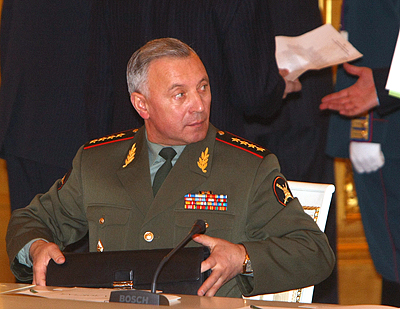
Army General Makarov

Russian General Staff Chief, Army General Nikolay Makarov briefed the Federation Council’s Defense and Security Committee today, and, according to Interfaks, he has made the decision to replace Russia’s six military districts with four that will function as operational-strategic commands (OSK).  He said:

“We will propose on the base of six military districts to establish four military districts, to the commander of which all forces and means deployed on their territory, including Navy, Air Forces and Air Defense, will be subordinate.  And subordinate not operationally, but directly.”

“Ground-, sea- and air-based nuclear deterrence forces will remain under the General Staff.”

“Our proposal on establishing four operational-strategic commands is now with the country’s president and I think that this issue will be favorably resolved soon.”

Infox.ru cited Makarov on the creation of three additional combined arms armies for several strategic axes: 

“We conducted a careful analysis of current threats and challenges and came to the conclusion that it’s necessary to create additional combined arms armies on several strategic axes.  There will be three in all.”

Makarov added that one army would be based in Chita, and six additional motorized rifle brigades will be formed to flesh out the newly created armies.

And Makarov wasn’t done . . .

According again to Interfaks, Makarov told these members of Russia’s upper house of parliament that ten combined air (8) and naval air (2) bases will be established in Russia.  Until recently, the military had been talking about new “first- and second-rank air bases” that were basically Air Forces’ equivalents of Ground Troops’ brigades.  This approach may have been abandoned in favor of a smaller number of larger air bases.  The choice of the word ‘combined’ [объединённые] makes these things sound like they’re now equivalent to armies.

Makarov explained that Russia has 245 airfields:

“The approximate cost of using one airfield is 1 billion rubles per year.  This amount is prohibitive, therefore we took a decision on enlarging air bases.”

After this change, Russia will only have 27 airfields, according to the General Staff Chief, and the combined air and naval air bases will be spread out over Russia in cities like Voronezh, Chelyabinsk, Domna (near Chita), and Komsomolsk-na-Amure.

Makarov said the goal was not only excellent conditions for fulfilling flight missions, but also for the everyday lives of servicemen and their families:

“We’re doing everything so that our pilots and their families can live in human conditions.”

Makarov told the assembled lawmakers that Russia will complete contract to buy Mistral from the French:

“Concerning Mistral, the contractual obligations are practically ready.  I think we’ll buy this ship.”

“We need such a ship.  In the Far East, it’s simply essential.”

He went to say, it’s needed around the Kurils which “generally have nothing to defend them.”  And he elaborated:

“Earlier there was an army there.  There’s no one there to cover them, we need mobile means so at the necessary time we can deliver a landing force quickly.”

He repeated his past comments to the effect that Mistral is 4-5 times bigger than Russia’s largest amphibious ship, the Ivan Rogov class.

Tomorrow it’s Serdyukov’s turn to speak to the Federation Council, so prepare for some more news.

Sharp Cut in Contract Soldiers Coming

In the wake of General Staff Chief Makarov’s February admission that professional contract service had failed, a Defense Ministry source told Interfaks last week that contractees in noncombat positions will be sharply cut.  According to Newsru.com:

“It’s planned that by 1 July of this year only those specialists affecting combat readiness of military sub-units will remain in contract positions.”

He said this means combat vehicle commanders, driver-mechanics, gunner-operators, and other specialists, and civilians or conscripts will fill other contractee posts.  Lenta.ua noted the source didn’t specify how many contractees would be released or how many would remain.

Some of data cited referred back to a Vedomosti editorial about two weeks ago.  It said, under the 2003 Federal Targeted Program “Transition to Manning by Servicemen Conducting Military Service on Contract in Some Formations and Military Units” for 2004-2007, professional contract soldiers in permanent readiness units were to increase from 22,000 to 147,000 by 2008, and from 80,000 to 400,000 in the armed forces overall.  But in reality, there were only 100,000 in permanent readiness units by 2008, and only 200,000 in the Defense Ministry overall.  Meanwhile, the effort cost 84 billion rubles.  Vedomosti concluded:

“It seems the generals could not fulfill (or sabotaged) the directives of the country’s highest political leadership in peacetime.  Who will guarantee that the generals’ disobedience won’t be repeated in an emergency situation?”

“The Defense Ministry could not organize or make professional service in the army attractive and it sees as a way out stuffing the developing hole with a growing number of conscripts.  It’s understandable that the quality of these one-year draftee soldiers will be lower than that of contractees.”

“The abandonment of the move to a professional army promises many dismal consequences for Russia’s future.  Drafting 27-29-year-old higher educational institution graduates, who are in professional demand, could deliver significant damage to the economy and scratch the country’s modernization.”

So what is to be done?

This spring the Defense Ministry floated several trial balloons to answer its manpower problems.  As Parlamentskaya gazeta reported, the chief of the Genshtab’s GOMU, Vasiliy Smirnov told the Federation Council last month that he wants to increase his conscription base by reducing student deferments, raising the upper limit of the call-up age from 27 to 30, lengthening the semiannual callup until it becomes almost perpetual, and requiring young men to report to voyenkomaty without a summons.  Reportedly, the Kremlin has approved some or all of these proposals.

The Genshtab has proposed cutting the number of VUZy with the right to provide students deferments.  Even though deferments were trimmed in the recent past, Russians still have 21 legal ways to postpone their military service.  Smirnov claimed over 2 million draftees, more than 60 percent of the overall number, legally ‘dodge’ the army with deferments, the vast majority of which are educational deferments.  He continued:

“The number of higher educational institutions in which study is a basis for the right to a draft deferment from military service has to be reduced in stages.  Already this year it would be advisable to cut the number of VUZy having the right to a deferment in half or even by 70 percent, keeping that right only for educational institutions having a state order.  An alternative option could be having students perform conscripted service after the first or second year of studies.  The Education Ministry made this study and sees no negative consequences.”

Noting that voyenkomaty have been unable to notify 200,000 men to report, Smirnov concluded:

“Thus, the existing system of holding citizens liable who for some reason are not fulfilling military service obligation is ineffective today.  We have to change the system of notifying citizens.  In case a person does not receive the notice from the military commissariat, it is proposed that he go to the induction center on his own on the date indicated in the certificate of a citizen subject to call-up for military service.  This procedure functions in many states.”

Summing up, Smirnov said:

“A General Staff analysis of capabilities for manning the state’s military organization with conscripted servicemen showed that the needs of the state’s military organization for a draft contingent will not be supported as early as the end of 2010.”

In other words, the ‘demographic hole’ created by the sharp reduction in male births during the early 1990s is beginning to have its inevitable effect.

Deputy Defense Minister, State Secretary Nikolay Pankov and Main Directorate for Socialization Work Chief Yuriy Dashkin appeared at a Duma roundtable on 31 May to discuss conscription and conscript life.  According to RIA Novosti, Dashkin told Duma members, “Today the armed forces, dealing with a large number of tasks, are forced by the state’s economic condition, by resource provision, to rely still on a conscript army.”  Pankov said he could not give percentage figures on the future mix of conscripts and contractees in the Russian Army.  Soldiers’ Mothers Committee chair Svetlana Kuznetsova expressed doubt that the army will be able to induct 270,000 men as planned this spring.

Trud recently published a number of open letters to President Dmitriy Medvedev, one of which came from Soldiers’ Mothers’ founder Valentina Melnikova.  She asked Medvedev to end conscription, writing:

“Dear Dmitriy Anatolyevich, explain, please, why the Defense Ministry buried the idea of creating a professional army in Russia.   Back in 2003 the government adopted a special Federal Targeted Program on the full manning of all permanent readiness units with contractees.  All together, it was proposed by 2008 to bring into the forces 147,000 professional sergeants, for this 79 billion rubles was allocated.  The Defense Ministry reported that it was managing the task, and promised to increase the number of contractees in the army, and reduce the share of conscripts.  But in the end everything turned out exactly opposite.  At the beginning of this year the military officially stated that the task of building a professional army is being put off for indefinite long term.  As regards conscription into army units, the Defense Ministry intends to take it to 700,000 per year.  It’s simply impossible in Russia to find so many boys fit for military service according to the state of their health.  Almost a third of all conscripts that end up in the army have serious illnesses.  They’ll make just as many young citizens serve who have parents who can’t work.  End conscription and force the generals to create an army not of boys, but of professionals.  And don’t believe the generals when they say Russia doesn’t have the money for a professional army.  Independent experts believe that the state, if all expenditures are considered (pay for voyenkomat doctors, medical evaluation in hospitals, transporting conscripts to their service locations, assistance to soldiers’ wives, etc.), spends 150 billion rubles every year on conscription.  It seems to me that for this money it would be fully possible to maintain a fully contract army in a worthy condition.”

Step Closer to Four OSKs Instead of 6 MDs

ITAR-TASS reports today that the reform of the operational-strategic level of command and control has entered its final phase.  According to the Genshtab’s plan, on 1 December 2010 military districts (MDs) will shrink from 6 to 4.  A Genshtab source told ITAR-TASS that 4 MDs and operational-strategic commands (OSK or ОСК) will be formed–Western, Southern, Central, and Eastern, with their commanders having operational control over all (or most) of the troops (forces) of the armed forces and other militarized structures located on their territory.  

The Genshtab representative says the Western MD/OSK, based in Piter, will include the Moscow and Leningrad MDs, with Baltic and Northern Fleets, VVS, VDV, and other militarized structures operationally subordinate to it.  The Southern MD/OSK in Rostov-na-Donu will have the North Caucasus MD, with the Black Sea Fleet and Caspian Flotilla operationally subordinate.  The Central MD/OSK in Yekaterinburg will have the Volga-Ural MD and the western part of the Siberian MD.  The Eastern MD/OSK in Khabarovsk will have the eastern part of the Siberian MD and the Far East MD, with the Pacific Fleet operationally subordinate to it.

The question of subordinating units and formations of the RVSN, naval strategic nuclear forces, LRA, and the Space Troops hasn’t been decided.  According to the source:

“This issue is now under long-term study, Genshtab Chief Army General Nikolay Makarov is personally occupied with it.”

The Genshtab source said the new MD/OSKs will be tested out during the Vostok-2010 operational-strategic exercise at the end of June.

ITAR-TASS said this major command change will not involve officer cuts, but there will be a redistribution of the officer corps to new service locations.

So there’s more smoke from a fire somewhere, presumably.  If this pans out, it will be the culmination of a command and control change long talked about, and even tried out piecemeal at times.  After many waves of reform since late 2008, one has to wonder whether this is the time for more disruption.  Maybe it is since things are already disrupted.  Which generals will be the winners or losers?

It will be hard to judge the value of this effort just from the name changes or the movement of a major combined formation from one order-of-battle column to another.  A lot will depend on what the exact terms of ‘operational subordination’ are when it comes to the fleets and other major militarized formations outside the Defense Ministry’s administrative control.  The four MD/OSK commanders will certainly have more responsibility, and they must be hoping and working to get the real authority they need to go along with it.

Medvedev Can Wait for His BSF Basing Report

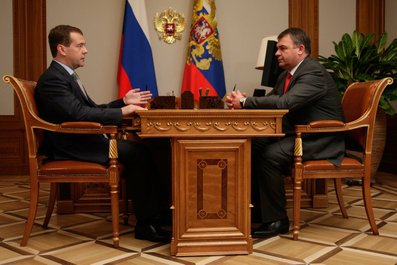
Medvedev and Serdyukov Meeting on 1 May

Whatever the complaints of some Ukrainians, the 21 April deal extending Russia’s basing privileges in Sevastopol is a good deal for Kyiv.  It’s now using the relatively meaningless Russian Black Sea Fleet (BSF) presence to secure a valuable 30 percent discount on Russian natural gas supplies.  

Moreover, in one suited for the ‘be careful what you wish for’ file, Moscow is also left holding the bag when it comes to the economy and infrastructure of Sevastopol, and much of Crimea as well, instead of Kyiv having to worry about assuming responsibility in a few short years. 

On 1 May, President Medvedev ordered Defense Minister Serdyukov to prepare a plan for developing the BSF’s naval base in Sevastopol, and to conclude an agreement with Ukraine on its social infrastructure.  According to Kremlin.ru, Medvedev said: 

“. . . today I want to touch on an issue with you which has taken on particular acuteness for our country in recent times.” 

“We need to think about the social arrangements for this base, that is very important to us, so that our sailors live in modern, full-fledged human conditions, have the chance for recreation and other opportunities a base is supposed to provide.” 

“So we’re agreed that our base will conclude a corresponding agreement with the Ukrainian side, with Sevastopol.  In accordance with this agreement, special support, social-economic support will be rendered to a series of Sevastopol city programs.” 

“This city is really not foreign to us and we need to think in what way to participate in these programs both along Defense Ministry lines and along the lines of other executive organs and business structures.  That’s the task.” 

Medvedev said Serdyukov should present his plan for approval in a month, and the latter responded that he would. 

Curiously, on 7 May, General Staff Chief Nikolay Makarov told RIA Novosti

“A working group’s been created which will evaluate the real condition of the basing point in Sevastopol and make its proposals.  I think this will take not less than two months.” 

“Practically nothing’s been invested there in recent years.” 

One wonders, would Makarov have unilaterally announced that Putin, when he was president, would have to wait an extra month or longer for the plan he ordered? 

Makarov said the Genshtab has no plans to freeze development of other basing points:   

“The fleet has to be.  The more basing points, the better.  And Novorossiysk is one of the key basing points.  And we intend to develop it.” 

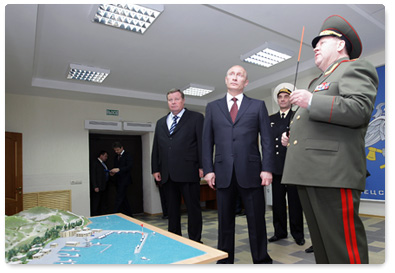
Without elaboration, he said the Defense Ministry has modernization plans for the fleet’s ships, submarines, and aircraft to 2020.  Makarov was with Prime Minister Putin visiting the construction work at Novorossiysk.  

Putin Briefed on Novorossiysk

On 24 April, Anatoliy Tsyganok told RIA Novosti conditions at Novorossiysk are not particularly well suited for major base.  He noted it’s only 25 percent complete, and its price tag is continuously rising. 

Nevertheless, Putin reaffirmed Moscow’s commitment to Novorossiysk.  He acknowledged only 13 billions rubles have been spent, and he’s looking at an ultimate cost of 92 billion.  The base is slated for completion by 2020. 

But Moscow, Medvedev, and Putin may need to worry more about new ships and submarines than about infrastructure when it comes to the BSF. 

On 2 May, Anatoliy Baranov in Forum.msk pointed out that there’s practically no fleet there; a minimum of 2 more first rank ships and a submarine are needed for an adequate order-of-battle.  He says the social infrastructure’s not so bad, but 40- and 50-year-old civilian engineers and technicians have to go out with fleet units to conduct training.  What will the Navy do when they retire?  

Rosbalt.ru described a wave of new officer and civilian dismissals in the BSF, which occurred simultaneously with the new agreement with Kyiv.  The fleet, it says, is nothing more than a mixed force division’s worth of units and personnel.   Viktor Yadukha concludes: 

“NATO’s gracious reaction to the BSF lease extension didn’t surprise politicians more.  But if Western special services knew about real plans for its reinforcement, the reaction would have been very severe.” 

Lastly, in today’s Nezavisimaya gazeta, Aleksandr Khramchikhin says: 

“. . . renting empty piers for a great amount of money is not a mistake, but thoughtless, considering how many ships and how well-outfitted a base in Novorossiysk this money could build.” 

He calls today’s BSF a unique collection of floating antiques.  Even if the oldest units were dropped, most BSF ships would still be 20- to 25-years-old.  It will be impossible to avoid sending ships from the 1960s and 1970s off for scrap soon, as has been officially acknowledged.  Khramchikhin recommends placing what’s left at Novorossiysk as a ‘water area security’ (OVR or ОВР) brigade.

Second Half of General Staff Chief’s Interview

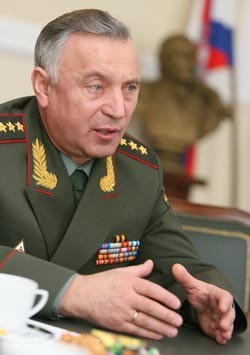
General Staff Chief Makarov (photo: Viktor Vasenin)

Rossiyskaya gazeta published the second, less substantial, half of Nikolay Makarov’s interview yesterday.

On speculation that the one-year conscription term will be raised, Makarov said:

“No one intends to increase the conscript service term.  But in the Defense Ministry they are thinking of measures to tighten accountability for evading military service.  Today no serious sanctions are applied against evaders.”

Regarding the supply of young men for the army:

“. . . after the transition to 12-month conscript service the callup increased about two times.  But from 2012 the complex demographic situation in the country will add to the problem of manning the armed forces.”

So this is why the military is thinking about clamping down on evasion, which Makarov puts at about 200,000 for all draft-age men.

Asked about measures to make the life of military school and institute cadets more like that of other students, Makarov said changes in the order of the day will have cadets go to classes and exercises in the mornings, and they will be free in the afternoons.  He continues:

“Why do we have to lock cadets in the barracks?  We understand if a person consciously picked the military profession, this means he will study.  If he’s not sure of his choice, he’ll simply get filtered out.”

Makarov indicated the Defense Ministry is looking at having its new state-owned rear services corporation Oboronservis supply militarized security guards for garrisons.  Privatized security companies would relieve servicemen of all guard duty functions and allow them to stop taking personnel away from combat training.  He cites U.S. and Israeli experience in using hired security for these purposes.

Makarov reaffirmed that only professional contract soldiers will serve in Abkhazia and South Ossetia.  He added:

“Even brigades in immediate proximity to the borders will be manned by professional soldiers to the greatest degree.”

That’s a lot of confidence to express in a professional contract service program that he’s deemed a failure.

Makarov indicated the ranks of generals have been trimmed from 1,200 to about 700, but he insisted all combined arms brigades with 3,000 personnel would be led by general-majors, not colonels.  He said generals had been cut in the Defense Ministry’s central apparatus, its main and central directorates, including the Genshtab, and the main commands of the services.  He concluded, “Now to become general, you need to serve with the troops.”

Makarov discussed the evolving training and promotion system for officers:

“Now a system has been built out where an officer after [commissioning] school can occupy at most a company commander position without supplementary training.  They can only be appointed higher through specialized courses.  Candidates for promotion need to complete them, take corresponding examinations.  And then they will pick the best on a competitive basis.  They will appoint them to higher positions.”

Under the old Soviet and Russian system, mid-career education and training didn’t usually come into play until an officer had commanded a battalion and was preparing to move into regimental command or staff positions.

Makarov said the new specialized courses might run 3 weeks for battalion chief of staff positions, or maybe several months for other positions.  He said the army would not be looking at keeping officers in certain posts for obligatory periods.  Some might master their duties in one year, others might not in five, he said.

Asked about whether Russia would accept French helicopter carrier Mistral as a ‘shell’ without weapons and electronics, Makarov said:

“The country’s leadership and the Defense Ministry have an absolutely clear position on this subject.  If a final decision on Mistral is made, then we’ll accept this ship only in a fully equipped form–with all command and control systems, navigation, and armaments.  The only exception is helicopters.  They will be ours.  Everything else must be done to their standards in full form.”

Asked whether the army would conduct reservist assemblies and even callup reservists for short periods, Makarov said no, conscripts are covering Russia’s manpower requirements, and reservist training assemblies would be kept at the level of about 10-15,000 men for the whole country.

Makarov Describes the Army He’s Building

Nikolay Makarov (photo: Viktor Vasenin)

Today’s Rossiyskaya gazeta interview with General Staff Chief Nikolay Makarov has lots of questions and answers on the state of U.S.-Russian negotiations on a new strategic arms treaty, and on missile defense.  If you’re interested in those, you’ll need to read for yourself.

If you’re interested in the other things Makarov said, read on.

Asked isn’t it strange that Russia’s army would be cut when NATO is drawing closer to its borders, Makarov answers:

“We proceeded from the fact that the world has changed to a significant degree in the last 15-20 years.  Russia needs armed forces capable of reacting promptly to any threats and challenges.  Our army, if you take the first Chechen campaign, couldn’t cope with these functions.  To fulfill missions we were forced to man military units with, as a rule, untrained soldiers and officers in the course of combat actions.”

Makarov goes on, saying, after 1996, the army manned 13 percent of its regiments at 80 percent of their wartime complement, so they would be ready for action in a few days if needed.  The remaining 87 percent stayed at cadre level, with equipment and supplies in storage.  So Russia kept a big army that ate up enormous resources, but couldn’t carry out missions. Officers and warrants were almost 50 percent of personnel, and there weren’t enough soldiers.  Possible variants for the best structure were considered and the brigade was selected.  And today any brigade can be ready for action in only one hour, according to Makarov.

Makarov says, in Afghanistan and Chechnya, battalions were reinforced with reconnaissance, artillery, air defense, logistics, and repair units before they deployed for combat.  But battalion commanders weren’t so good at commanding these attached units not normally in their TO&E.  So, says Makarov, it was decided to add these units to battalions, so their commanders can learn how to employ them.  And three battalions organized as such and fully manned comes to 4,500 or 5,000 men–a ‘half division’ rather than a regiment.  And, he notes, battalions can operate independently or as part of brigade tactical groups.

He goes on to explain the Russian Army’s changed outlook:

“In the past we fought with multimillion-man groupings of troops, the basis of which were fronts.  The experience of military conflicts of the past decades showed that such a war was possible, but unlikely.  In the future, troops will go over to actively maneuvering actions.  The actions of inter-service groupings on the entire depth of the enemy’s force structure are replacing frontal battles.  The sides will try to destroy critically important objectives, and also conduct noncontact combat actions.”

The interviewer asks Makarov why only 2 tank brigades in 85 Ground Troops brigades, doesn’t the infantry need armored support?

Makarov answers that, like cavalry in the new age of automatic weapons, today the tank’s role is becoming secondary.  But what’s causing the change? He says it’s the information and artificial intelligence inside equipment, highly accurate weapons used as part of a single information space, and weapons that ‘see’ and ‘know’ everything and can be used against troops and targets in automatic mode.  But he calls robot-tanks with highly accurate weapons a thing of the future at this point.  And Makarov adds that no one is forsaking tanks:

“Here you’re talking only two brigades. Actually we are filling motorized rifle brigades with a great number of tanks.”

Makarov explains the advantages of modular brigades and battalions. Modularity means freedom in structuring battalions and brigades.  If we need a fist of motorized rifle and tank battalions and artillery batteries, we make it.  Commanders in the past didn’t have this freedom.  The entire army force structure was laid out for the conduct of a large-scale war.

Makarov explains modularity as a reaction to Chechnya and even World War II where C2 and force structure was created out of troop units that weren’t coordinated [неслажённые –a difficult one in English, troops that weren’t previously trained and melded together into a cohesive unit or formation].

Asked if there aren’t place in the RF where one can fight with divisions, Makarov says the Russian Army hasn’t gone completely away from divisions [but almost].  But he goes on to insist that their modular nature allows brigades to be used just as well as divisions in Siberia or the Far East, just as well in a large-scale war as independently.

Asked how the army can be trained to fight in a new way, he says:

“The last twenty years there was no intensive combat training in the Russian Army, graduates of commissioning schools and academies didn’t reinforce their theoretical knowledge with practical actions.  And like a foreign language–if there’s no practice, in 2-3 years it’s forgotten.  At the same time, officers without such practice rose in position and rank, some even served to the point of commanding armies.”

“Two tasks stood before us.  First of all, to change the mentality of commanders and their views on war.  It certainly wouldn’t be the one they were taught in the past.  Troop actions, capabilities and forms of their employment have become absolutely different.”

“In order to get to a common understanding, a common methodology is needed.  We are beginning to introduce it, but we are dedicating the current year to individual training of servicemen and combat coordination [слажевание]  of brigades.  From January to February 2010 at the base of the Military Academy of the General Staff we conducted supplementary courses with military district, fleet, and army commanders and their deputies.  Officers ranking from general-colonel to colonel serve in these positions in the armed forces.  Special demands are made on them as organizers, directors, those directly responsible for teaching and training subordinate military command and control organs and troops.”

“We’ve built a training chain, but we understand that this is just the first step.  Everything that officers study in theory still needs to be assimilated in practice.  For this in the second half of May we plan to conduct an operational assembly on the base of one of the units of the Moscow Military District where we are developing a single methodology of training in brigades and below.”

Makarov says 148 new ‘programmatic-regulation documents’ have already been developed.  The Kavkaz, Zapad, and Ladoga exercises last year showed some problems with them, but working groups from the Center for Military-Strategic Research and the Main Combat Training Directorate are reworking them.  The revised regulations will be used in Vostok-2010.  The goal is to have a new combat training program and new combat manuals before 1 October.  Once approved, they’ll be used to organize training starting in 2011.

Makarov also takes this opportunity to expound on his views of netcentric command and control.  He mentions that the U.S. war in Iraq showed that former canons about needing to have 2-3 or 5-6 times superiority in forces and means for military victory no longer necessarily apply.  He says Moscow has the ambitious goal of achieving netcentric command and control in 2-3 years, but the future system is being established in the SKVO this year.

The last issue raised for part one of Makarov’s interview–contract service.  Makarov says the media claimed he had recognized the failure of military reform, when what he really addressed were the miscalculations in contract service over a period of several years.

He says 6-month conscripts were forced into contracts just to meet the [previous] Genshtab’s dictate to have not less than 95 percent contractees in permanent readiness units.  He says these guys were not professionals, but rather just highly [well, not terribly highly] paid conscript soldiers who left the army at the end of their two years anyway.  So, Makarov concludes, it’s no surprise that contract service became a fiasco.

But he adds, we aren’t turning away from it.  A fully contract army would be the very best variant if Russia could afford it [can’t it?], but it can’t according to Makarov.  So he continues:

“Therefore we want to select as professionals only those who’ve served in the army [as conscripts], and only for positions determining the combat capability of military units, related to the operation of complex and expensive equipment.  In the Navy, practically all positions are such.  In motorized rifle brigades not less than 20 percent of the TO&E will be contractees–tank, antiaircraft, and artillery system drivers, gunner-operators, some other specialties.  Plus sergeants.”

“Moreover, if a sergeant is a professional, has served 10-15 years and the level of his training is higher than a new lieutenant, he should get more than the young officer.  We understand that the pay of a contract soldier has to guarantee the attractiveness of military service.  All this will be put into the new pay system.”

Asked about housing for contractees, Makarov says professional soldiers and sergeants need to live like officers in service apartments or dormitories.

More on the Unified Tactical Level Command and Control System

On 7 March, Russkiy Newsweek spent some time on Sozvezdiye [Constellation], aka the Unified Tactical Level Command and Control System (YeSU TZ).  The system is sometimes called by the name of its manufacturer–Sozvezdiye.  General Staff Chief Makarov in February said the system would be ready by November.

Russkiy Newsweek concludes, if it actually appears, it will be a technological revolution.  One Defense Ministry interlocutor said it now takes a day for orders to reach field commands from Moscow, but they will go practically in real time with this system.

The author, Viktor Poltavtsev, says NATO already operates in a netcentric fashion, and Makarov is quoted about how an Iraqi Army superior in tanks and artillery was defeated by smaller coalition forces that could see and forecast events, calculate variants, and receive possible solutions in real time.  Poltavtsev says, in the Genshtab, they believe the U.S. Army was 80 times more powerful than its opponent as a result of this information advantage.

But back to Sozvezdiye, Anatoliy Tsyganok thinks this not-yet-fielded system is already obsolete.  He says:

“Every Defense Minister picks his toy.  Igor Sergeyev–Bulava, Sergey Ivanov–GLONASS.  The current minister–the command and control system.”

Despite willingness to entertain possible arms imports in many areas, there is a fear of imports when it comes to command and control systems. Aleksandr Golts notes that Russia lacks a component base–it can’t produce chips or circuit boards, but doesn’t want to buy them abroad either.

The Georgians’ U.S.-made Harris system reportedly performed magnificently in 2008.  One Sozvezdiye associate said that, when the smoke of that little war cleared, it was obvious the Russian Army had no communications, old or new, and things began to stir in the Genshtab.  But Sozvezdiye’s testing has brought mixed results.  YeSU TZ was tested last summer during Kavkaz-2009.

Poltavtsev gives a little explanatory background.  Akatsiya, around since the mid-1990s, is a Genshtab-Military District level comms system that was produced by Sistemprom.  But it didn’t make too much sense without a tactical system to reach brigades-battalions-companies and individual soldiers.

Enter Sozvezdiye.  The Voronezh NII of Communications (aka Sozvezdiye) has worked since 2000 on a tactical level system.  Its specialty heretofore had been satellite radio comms.

Sistemprom awaits the completion of Sozvezdiye’s system so it can connect the two, to create a single command and control system.  As Poltavtsev describes it, generals will sit at Akatsiya stations and command divisions or brigades that have Akveduk.  Brigade commanders will use Akveduk to command their battalions and companies in real time using fast, well-protected channels.

So YeSU TZ is supposed to be the computer network that unites the battlefield–people, equipment, artillery, etc., like a computer game.

Battalion and company commanders are supposed to be able to use digital channels to get reconnaissance photos, video, and other data, to give commands to troops, and to connect to higher staff elements.  Today the commander still has to scream into the radio, but tomorrow he might send soldiers orders to their hand-held devices.

But this is still theoretical.  Everything will depend on the reliability of the equipment and comms channels.  And the system can be blocked if the RF spectrum is suppressed.  The system might not work against a modern, well-equipped enemy that can do this.

Poltavtsev says Russian EW (or REC) systems were used against Sozvezdiye during testing in December at Alabino.  And mobile phones, Internet, radios, and even some hospital equipment in the area stopped working as a result.  A Sozvezdiye rep says their system was jammed on the Taman brigade’s range, but they can get around this by changing transmitters.

The main thing, according to him, is developing algorithms for use in combat that everyone understands.  Users say Sozvezdiye is complex and difficult to use, and it will take a while for commanders to sort out its arrows and symbology.

The Defense Ministry has acknowledged that YeSU TZ needs significant reworking, but there’s no other way.  General Staff Chief Makarov said everyone built their own C2 systems in the past; there were 16 military C2 systems in Soviet days.  Now a common one is being built.  However, Poltavtsev asked a PAK FA developer if his system is already integrated into Sozvezdiye, and he asked what it was, he’d never heard of it.

An interesting account of Sozvezdiye . . . it sounds a little like the story of Bulava, i.e. ‘we have to unify our different systems,’ ‘there’s no other way but to make it work,’ etc.  These are understandable, even commendable at times, goals and sentiments, but they don’t always lead to development of successful military systems.  Sometimes the primary goal has to be a system that works.  And sometimes designers and builders even have to start over.

Plug Pulled on Contract Service

On Friday, Interfaks said a source in the Federation Council’s Defense and Security Committee indicated the latest contract service program (the Federal Targeted Program (FTsP) for Manning Sergeant (Petty Officer) and Soldier (Sailor) Ranks with Contract Servicemen) has been scrapped.  The program was supposed to produce 64,000 contract NCOs by 2015. 

The financial resources for this 2009-2015 program have been slashed by 86 percent according to an Audit Chamber report given to the upper house of the Russian legislature.  A Defense and Security Committee representative says 22.4 billion rubles of the 26.6 billion ruble program were slashed.

This certainly sounds like losses have been cut to what’s already been spent on selecting and beginning to train a little more than 200 future sergeants at Ryazan.  The program was slow in starting, and of 2,700 candidates who came to Ryazan, only 239 were ultimately accepted.

General Staff Chief Makarov and Ground Troops CINC Postnikov recently admitted contract service had failed, but said the contract sergeant program would continue.  They didn’t say it would basically be limited to its current very small scale.

Infox.ru on Friday quoted Prime Minister Putin who, in 2008, called the contract sergeant program “the logical development of plans for the organizational development of a modern and highly professional Russian Army.”

On cutting conscription to 12 months, Putin said, “For this decision we went logically over the course of the last six years, developing a system to attract citizens to military service in a voluntary manner, on contract.”

He continued, “. . . the main load of servicing new weapons systems will be on contract-sergeants in coming years” and “forming the professional sergeant corps is an important step toward a more modern organization of combat training.”

Apparently, none of this will happen now, and the army will rely more on its conscripts and traditional conscript-sergeants with six, or more likely three, months of training.