Category Archives: Arms Sales

Fighters Flying Nowhere?

The first flight test of China’s ‘fifth generation’ J-20 fighter inspired Trud’s Mikhail Lukanin to address the subject.  If you’d like a translation of it, see Russia Today.

Lukanin notes China’s now third behind the U.S. and Russia to unveil a ‘fifth generation’ fighter, and he cites Ruslan Pukhov and Vitaliy Shlykov who conclude these future aircraft are little suited to modern wars, and are being developed exclusively to satisfy political ambitions.

About China’s “very raw prototype,” Pukhov says:

“According to its technological possibilities, China is still not ready to develop new generation aircraft, since even usual Chinese fighters are copies of foreign ones, mainly Russian aircraft.  The Chinese really still need at least ten years to get the J-20 to 5th generation fighter parameters.”

Lukanin recaps that Russia’s PAK FA, the T-50, started design in 2002, flew in 2010, and is looking for serial production by 2015.  He gives a quick, limited definition of 5th generation (that would horrify U.S. Air Force types):  supercruise, stealth, and 360° radar.

Shlykov tells Lukanin the T-50 and F-22 are unlikely to meet in battle, and employing a ‘superfighter’ in a small war like the Russian-Georgian one is senseless since today’s aircraft can handle such a conflict.  Shlykov calls the fifth generation fighter an “offspring of the arms race” created for a world war between superpowers.

Lukanin highlights the F-22’s exorbitant pricetag and the cut in its production run, and he puts the T-50’s price at $80-100 million, 4-5 times cheaper than the F-22 [perhaps it’s cheaper because it’s not a full-fledged 5th generation aircraft, at least by the USAF definition].

Finally, Lukanin returns to Pukhov, who says:

“For China and Russia, 5th generation fighters are first and foremost political projects, necessary for assuring themselves that they are leading world economies.”

Pukhov says the lion’s share of T-50 aircraft will be exported.

There are at least two interesting issues Lukanin might have addressed here, but didn’t. 

First, is it possible that China might actually be uncomfortably close to Russia in technological capabilities?  Is the J-20 really ten or more years behind the T-50?  Or how about this — is the T-50 anywhere close to the F-22?

Second, fifth generation aircraft could also become passe quickly if the U.S. moves on to a sixth generation unmanned, robotic aircraft.

There are a couple additional articles today worthy of attention.  Argumenty nedeli calls the J-20 a fifth generation Frankenstein, with the nose of the F-22, and the body of the old MiG 1.44 design.  AN says the J-20 lacks an engine [possibly also true of T-50].  The Chinese unveiling might just an elaborate PR show.

Vedomosti isn’t quite as dismissive, and says the J-20 might push Russian development faster.  The paper notes questions about what’s really inside the aircraft, and concludes the flight may have been timed for the U.S. Defense Secretary’s trip to China.

It cites Konstantin Makiyenko to the effect that, for Russia, the J-20’s first flight means it’s essential to increase the financing and pace of the T-50 program, both to preserve the military balance, and to preserve Russia’s competitiveness as an exporter.

Once again, maybe it is all about prestige and exports.
Government Credit for Two New Almaz-Antey Factories

In a 29 December interview on Vesti’s Rossiya-24 program, Deputy Prime Minister Sergey Ivanov addressed modernization, development, arms sales, and defense industry.  He said international demand for Russian air defense systems has led the government to take a decision to extend credit for Almaz-Antey to build two new factories.

As written in an earlier post about shortfalls in productive capacity in the OPK, this possibility has been under discussion since at least last February.

Military Parity picked up additional RIA Novosti coverage of Ivanov’s remarks:

“This year we decided on additional support to ‘Almaz-Antey’ and the allocation of credit for the construction of two more factories.”

Ivanov explained that most of Almaz-Antey’s production is going to satisfy the Russian Army’s requirements, and:

“Now they don’t have production capacity for large volume exports.  But this good, if it’s possible to call it that, is in great demand on the international market.”

A bit from the video . . . Ivanov’s interviewer asks about the state of military-technical cooperation (i.e. arms sales), and aviation’s role in it.  Ivanov says it got along “not badly” in 2010.  Arms sales exceeded $10 billion for the first time.  This, he says, attests to the competitiveness of, and demand for, Russian equipment, and so, in many areas, the defense sector isn’t doing badly.  Aviation represents more than a third of arms sales, or more than $4 billion.  He thinks military transport aviation sales have a good future, and, of course, buyers stand in line for Almaz-Antey’s PVO systems.  Thus, with internal and external demand, the need for two completely new factories.

Of course, saying they’ve decided for two factories is not the same as actually building them and starting new production lines.

More on Mistral

Vedomosti’s Aleksey Nikolskiy published an informative piece on Monday.

He says the announced deal for the first two Mistral helicopter carriers, built in France, includes spare parts and training for a grand total of €1.3 billion (52 billion rubles).  The deal reportedly includes the option to build two more units in a Russian shipyard.  While the deal’s sealed, the final contract is still being worked between France’s DCNS and Russia’s OSK.

Nikolskiy said the Elysee website said the Mistral package would provide 4 years of work for 1,000 French shipbuilders (5 million man-hours) at STX in Saint-Nazaire.

Paris is selling Moscow the SENIT 9 combat information system aboard Mistral, but apparently without license rights.

The contract for unit one is worth €700 million, and €600 million for unit two.

OSK maintains Russia will get a 20 percent share of the work on unit one, fabricating some sections for the ship in Russia.  Its share of the work on the second unit could be more, according to analyst Mikhail Barabanov.

An OSK representative told Nikolskiy the main goal of this deal is to get modern technology, and a possible Russian builder for the optional units hasn’t been determined.

Nikolskiy juxtaposes two views on Russia’s need for Mistral.  He quotes Barabanov:

“Why does the Russian Navy need this ship which was designed for the French Navy’s overseas expeditions?”

And he repeats General Staff Chief Makarov’s statement from June that the first Mistral will go to the Pacific Fleet to transport forces where they might be needed, particularly the Kuril Islands.

As post-script, Nikolskiy gives a snapshot of what 52 billion rubles for two Mistrals could buy:

  • 2 Borey-class (proyekt 955) SSBNs, or
  • 3 proyekt 11356 frigates (Talwar– / Krivak IV-class), or
  • 50 Su-30 fighters, or
  • 800 T-90 tanks, or
  • 50,000 apartments for servicemen.

Of course, you can generally double these alternative purchases if Russia builds a third and fourth Mistral.

Cablegate on the Mistral Sale

In case you missed it in Wikileaks, the U.S. Defense Secretary discussed many important topics with his French counterpart in early 2010, and France’s plan to sell the Mistral to Russia among them, though it may have been one of the less urgent issues.

What you read is the dialogue of allies respectfully sharing differing views of the situation and its significance.  It’s interesting for Defense Secretary Robert Gates to say it’s not Russia’s capability the U.S. worries about, but about sending the wrong signal to new allies on Moscow’s doorstep.  His French counterpart argues for Mistral as a tangible sign of the benefits of Russian partnership with the Western allies.  He concedes the ship is intended for power projection, but argues this single ship [well, two plus the plans for two more] won’t change Russia’s capabilities much given the poor condition of its naval production infrastructure.

————–Russia/Mistral                                                                                                                           ————–

18. (S/NF) SecDef expressed U.S. concerns about the Mistral sale to Russia.  He told Morin that because of Sarkozy’s involvement in brokering a ceasefire in Georgia, which Russia was not fully honoring, the sale would send the wrong message to Russia and to our Allies in Central and East Europe.

 19. (S/NF) Morin told SecDef pointedly that he had pushed hard for the sale.  He conceded that it was indeed a warship for power projection.  But Morin asked rhetorically how we can tell Russia we desire partnership but then not trust them.  Morin told SecDef that he understood the U.S. position on considering Central and East European Allies’ concerns about the perceived threat from Russia.  Morin argued, however, that this single ship would not make any difference with respect to Russian capabilities, as Russia’s naval production ability was severely degraded.

 20. (S/NF) SecDef replied that U.S. concerns were not about military capacity but about messaging.  Some allies, because of their past experiences, are still very concerned with Russia and are not sure how much to trust the West.  SecDef observed that Russian democracy has disappeared and the government was an oligarchy run by the security services.  President Medvedev has a more pragmatic vision for Russia than PM Putin, but there has been little real change.

Makarov on Iran, Lasers, Deferments, and Bulava

Attending today’s OPK modernization meeting in Ramenskoye, General Staff Chief, Army General Nikolay Makarov talked to the press, and said:

“A decision not to supply Iran with the S-300 was made, it, of course, falls under the sanctions.  The leadership made a decision to stop the supply process, we are fulfilling it.”   

He wouldn’t say the contract to supply them has been broken.  Apparently asked if the missiles could be provided in the future, Makarov said:

“We’ll see, this will depend on Iran’s conduct.”

Unnamed official sources put the price of the Iranian S-300 contract at hundreds of millions of dollars.

ITAR-TASS reiterated Defense Minister Serdyukov’s 20 August comment on providing Iran the S-300:

“We aren’t supplying anything.  There’s no decision on supplying them.”

Makarov’s comments coincided with President Medvedev’s ukaz implementing UNSCR 1929 from 9 June.  The ukaz expressly listed the S-300 as an item not to be transferred from Russia to Iran. 

Asked about Russia’s military laser program, Army General Makarov said development is on-going:

“Work on a combat laser goes on throughout the world, including here.”

He added that it was premature to talk about the characteristics of Russia’s laser system.

Answering another question, Makarov said student draft deferments won’t be abolished:

“The possibility of ending deferments for students is not being considered.  This issue is too socially significant.”

“There are many other measures which will allow us to resolve the situation [with the draft].”

He added that he expects Serdyukov to talk about the draft at Friday’s Defense Ministry collegium.

Asked if compulsory military service will be increased from 12 months, he said, “I don’t know if there’s sense in this.”

But Makarov went on to vent his frustration about conscription:

“Today not more than 13 percent of young people are called up, the rest aren’t called up for health reasons.  We need to understand what is happening .  It can’t be that only 13 percent of our young people are healthy.  Among people getting a deferment or exemption from the army on health grounds, 40 percent of them had documents either purchased or manufactured in some way.  In other words, there’s an issue, and we need to toughen monitoring in this area.”

Thirteen percent is really low.  And the corruption rate when it comes to health exams in commissariats is at least 40 percent.  We need to explore his numbers and math.  These are startling figures.

Makarov paid a little respect to Serdyukov’s fledgling effort to ‘humanize’ conscript service:

“A number of measures to reduce the load on prospective conscripts are being reviewed.”

Finally, press questions turned to the pending Bulava SLBM tests.  Makarov said:

“The missiles which we’re preparing to launch were produced from beginning to end under strict monitoring by military acceptance, the Defense Ministry, and the Military-Industrial Commission.  A great deal will depend on these launches.  If the launches are unsuccessful, then we have to shake up fundamentally the entire cycle of missile production.”

On the timing of the next Bulava test, Makarov contradicted Serdyukov’s last statement by saying:

“It’s doubtful this will happen in September.”

Defense Industry’s Last Warning

Popovkin in a Suit

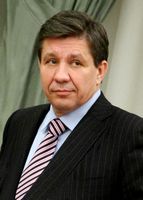
Last Friday’s NVO printed an interesting editorial that discussed arms exporter irritation with Deputy Defense Minister, Armaments Chief [former Commander of Space Troops and ex-General-Colonel] Vladimir Popovkin for publicly admitting the Defense Ministry’s dissatisfaction with many of the OPK’s products.  The exporters are obviously upset that Popovkin’s comments have, and will, cost them sales abroad.  But NVO concludes a greater danger would be trying to silence anyone–high-ranking defense official or independent defense analyst–who dares point out the OPK’s problems in the hope of remedying them.

NVO’s sub-title for the article is “The OPK’s systemic crisis threatens a breakdown in the supply of combat equipment to the Russian Army and a lack of export contracts.”

The Greeks have apparently called off a purchase of 420 BMP-3s for $1.5 billion (let’s call it $3.6 million per vehicle).  The deal had been 2 years in the making, and it wasn’t the state of the Greek economy that caused the halt.  According to NVO, the money was already in the defense budget.  Rather it was Popovkin’s specific criticism of the BMP-3 that folded the deal.

Popovkin is quoted:

“We very much need to protect our soldiers.  Today everyone rides on top of the BMP because no one wants to ride in this ‘coffin.’  We need to make a different vehicle.”

Greek journalists published his remarks, and opposition politicians turned them into a scandal:  how can you buy unsuitable equipment that even the country that makes it won’t buy?

Popovkin also complained about the T-90 that the Indians are buying, the tank support combat vehicle (BMPT) that Rosoboroneksport recently demonstrated at an arms show in Kuala Lumpur, and other equipment which the army won’t buy for one reason or another, but which is put forth for export and actively advertised there.

According to NVO, the arms exporters are terribly offended because the [ex-] general cost them several lucrative contracts.  But, in NVO’s estimation, his speech is very necessary.  It says:

“. . . the truth about the condition of the Russian defense-industrial complex, about those processes occurring there, about the systemic crisis in it and the inability of its various directors, including even the government’s Military-Industrial Commission [VPK], to correct the existing situation, is not a secret at all.  It’s been talked about more than once.  On the most varied levels.  Including even presidential.”

NVO says this truth is very important; it could help the powers-that-be uncover the problem areas, fix them, and produce the modern equipment needed for the defense of the country’s interests.  Without an honest discussion, the deficiencies can’t be fixed.  But the Kremlin, government, the legislature, executive organs, or the regions won’t undertake any serious measures against negligent managers.  Despite constant talk of state arms programs, federal programs of technical reequipping of defense enterprises, in reality, with the exception of aviation and air defense firms, nothing is really happening.  It’s moving at a snail’s pace.  Or is it?

Foreign buyers send in 33 warranty claims for every 100 Russian weapons systems exported.  And the scandal with the Algerian MiGs didn’t teach the OPK anything.

It would be possible to silence critics and protect military-technical cooperation with foreign countries and keep the profits coming to the budget and the manufacturers.  But won’t the low quality of these systems, their inability to meet the demands of modern war, really be a negative advertisement?  Does someone really think if they quiet the generals, together with the Moscow media, military analysts and experts then they can sell some kind of half-finished military goods to a serious buyer?  Naive views worked out for illiterate dilettantes.

NVO figures there are two ways out:  either give up, lose export orders, and accept the situation or sharply improve the quality and effectiveness of Russian weapons, reduce prices and defects, and strive to be on the leading edge of technology.  In other words, saving defense industry is in the hands of defense industry itself.  And no one else.  

When it comes to combat vehicles, sniper rifles, UAVs, assault ships, night sights, and armor, the international division of labor in defense industry isn’t such a bad thing after all.  It brings Russia closer to the ‘probable enemies’ of the recent past.  But when it comes to nuclear-powered submarines and strategic missiles we still don’t know how to do them ourselves and no one’s going to sell us those.  And [unless Russia remembers how and gets its OPK in order] it will remember national security the same way it remembers the long forgotten past. 

This is NVO’s way of telling the Putin-Medvedev regime it would be foolish to shut down this feedback channel that tells it what needs fixing in the OPK.

Viktor Litovkin on BSF

Writing in Friday’s Nezavisimaya gazeta, Viktor Litovkin talked about the procurement of proyekt 20380 corvettes from Piter’s Northern Wharf.  The second unit Soobrazitelnyy was just launched, and three more have been laid down, but it’s not clear when they’ll enter of the order-of-battle.  A total of 20 are planned, but the specialists say everything depends on financing.

Then Litovkin turns to last week’s reports of imminent decommissioning for Ochakov, Kerch, etc.  He says this’ll leave the BSF with about 40 ships (12 of which are either in repair or a ‘conservation’ status).  He puts the average age of the remaining fleet units at 25-30 years, and the youngest are its proyekt 1239 small air cushion missile ships.

As far as capabilities go, the BSF is still stronger than Ukraine and Georgia (at least), but there is a question as to whether it can defend the country’s interests.  But maybe it doesn’t have to be so powerful when the country still has the RVSN, and the BSF wasn’t really challenged in the August 2008 war with Georgia, and it can still show the flag in the Mediterranean, defend the country’s economic zones, and participate in antipiracy operations off the Horn of Africa.  No one would take it into their head to compare it with the U.S. 6th Fleet.

But still Litovkin wants to answer why the BSF reached its current state.  Because the ‘Orange Revolution’ Ukrainians wouldn’t permit Moscow to renew the BSF’s potential in ships, aircraft, or personnel.  And Moscow was busy trying to modernize and preserve parts of the military other than surface ships.  He says:

“It built them for India, China, Vietnam.  Only now is it beginning to launch new corvettes and frigates for the Navy.  But by a drop (by one) per year.  And this is for all four fleets and a flotilla.”

“According to experts’ assertions, in the coming 10-15 years there are no possibilities for renewing the composition of the surface fleet.  Despite even the fact that today two frigates for the distant naval zone are laid down (proyekt 22350), five corvettes of proyekt 20380, three small gun ships of proyekt 21630, large landing ship of proyekt 11711… But even if the program of their construction is successful, they won’t under any circumstances compensate for the ships withdrawn due to age.”

“Even the Mistral won’t help here.”

Ten Pantsir-S1s for Russia, or for UAE or Syria?

We all miss things, right?

In Friday’s NVO, Viktor Myasnikov published an insightful article on Pantsir-S1.  He hints that maybe the ten Pantsir-S1s ceremoniously delivered to the VVS aren’t actually for Russia’s VVS.  More interestingly, he provides numbers on the quantity really needed to rearm the Russian Armed Forces by 2020—500 for the VVS and 500 for the Ground Troops’ VPVO.

“‘Pantsir’ is one of the most talked about combat vehicles of the last 20 years.  Everything about it’s been heard, many have seen it at exhibitions, but it only began to come to the troops in recent days.  In the long years of design work (which began in 1990), testing, and disrupted contracts, ‘Pantsir’ received the honorary epithet ‘longsuffering.’”

“Now they’re talking about it again in superlative terms.  One could get the impression this is some panacea against all means of aerospace attack.  Actually, this is a close-range—up to 20 km—air defense system.  It exceeds hand-held ‘Igla’ and ‘Strela’ SAMs, but doesn’t approach the level of ‘Tor.’  And ‘Pantsir’s’ place in the order of battle has been designated perfectly concretely—it will replace ‘Tunguska,’ which in its time replaced ‘Shilka.’  True, it will really only replace ‘Tunguska’ when it gets on a tracked chassis.  For now this is a wheeled rear area variant designated to cover important targets—airfields, bases, air defense positions . . .”

“Initially ‘Pantsir’ was planned for tracked transport in as much as it needed to take the place of ‘Tunguska’ in tank columns to cover them against helicopters and other low flying enemy aircraft.  But the concept began to change due to underfinancing.  And a cheaper variant ‘Pantsir’ put on wheels, became positional as the last line of air defense for rear area targets.”

“The uniqueness of ‘Pantsir’ in the arms market is guaranteed by the fact that U.S., NATO, and Israeli armed forces are not threatened by cruise missiles, planned munitions and UAVs of the potential enemy [many would differ with this assertion].  It [Russia?  Arab states?] doesn’t have them in the necessary amount and won’t have them in the coming years.”

“In accordance with the State Program of Armaments to 2015 it’s planned to deliver 20 of such systems to the RF Armed Forces.  10 have already been received.”

“At the same time the Russian Air Forces’ demand is specified as a minimum of 100 systems of this type.  Incidentally, other specialists believe it’s essential to buy 200-250 systems by 2015 and 400-500 by 2020.  Besides that, the Ground Troops could buy 500-600 vehicles by 2020 for replacing ‘Tunguskas.’  They certainly could, of course, they could, but who will provide them?”

“Besides this, there’s no trusting official announcements that all overdue export contracts for the supply of ‘Pantsirs’ to the UAE and Syria have been fulfilled [actually it’s pretty clear supplies are just starting].  Therefore it’s strange that 10 vehicles suddenly turn out to be withdrawn from the export orders.  Suspicions immediately arise that the buyer has refused them or not accepted them due to complaints about quality.  Meanwhile, some anonymous sources from Tula defense industrial enterprises maintain that everything’s normal with the quality, but the vehicles are just taking a pre-sales run on normal asphalt road conditions.  After the [9 May Victory Day] parade the ‘Pantsirs’ will be repainted desert camouflage and handed over to the foreign buyer.  There’s no need to show them to anyone until the next parade.”

“There are suspicions that the ‘KamAZes’ for these ‘Pantsirs’ are not quite serial models.  ‘Cause in their build-out they are too close to the one in which Vladimir Chagin wins ‘Dakar.’  Would it make sense to have imported turbocharged engines on them?  Such capability of automotive equipment for covering stationary S-400 SAMs is a little unnecessary.  But it’s exactly right for the Middle Eastern or North African desert.”

“But there is another side to this.  It’s been announced that these 10 ‘Pantsirs’ will participate in joint exercises of Russia, Belorussia and Kazakhstan.  And also before the handover to the troops at the ‘Shcheglovskiy val’ enterprise an archpriest blessed them.  Such a ritual wouldn’t be arranged for a buyer from a Muslim state.”

Pantsir-S1 and the Priority on Arms Exports

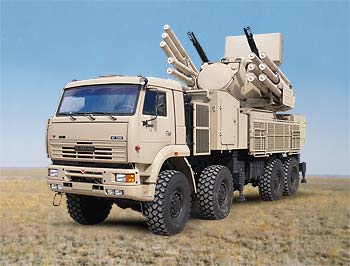
KBP's Pantsir-S1

Recent announcements about deliveries of the Pantsir-S1 highlighted the priority still enjoyed by arms exports over domestic procurement of weapons systems for the Russian Armed Forces.

On 18 March, the Russian Air Forces took delivery of their first 10 Pantsir-S1 antiaircraft missile-gun systems (ZRPK) from the Tula-based Design Bureau of Instrument-building (KBP).  These Pantsir-S1 systems will march on Red Square during the coming 9 May Victory Day parade, before heading to the Elektrostal-based 606th Guards Air Defense Missile Regiment that also has the S-400.  Some of the regiment’s Pantsir-S1s will participate in live-fire exercises at Ashuluk in April.

The Pantsir-S1 will replace the 1970s-era Tunguska-M1 in Russian air defense units.  A short- and medium-range missile-gun system, it provides point defense for civilian or military assets like S-400 SAMs.  VVS Deputy CINC for Air Defense, General-Lieutenant Sergey Razygrayev has said three Pantsir-S1 systems will be deployed around each S-400 launcher.

The Pantsir-S1 has 2 twin-barrel 30-mm 2A38M antiaircraft guns and 12 57E6-E SAMs.  It is reportedly effective against targets with a reflective surface of 2-3 square centimeters and speeds to 1,000 meters per second, at a maximum range of 20 kilometers and altitude of 15 kilometers.

The Pantsir-S1 can be mounted on various vehicles and ships, and General-Lieutenant Razygrayev has said it will become a standard air defense system for each of Russia’s armed services and combat arms in the future.

When the VVS got its 10 Pantsir-S1 systems, the KBP deputy general director announced that the Air Forces will receive more than 20 units in coming years.  An unnamed source told ITAR-TASS, the VVS would get 25 Pantsir-S1 by 2012.

Development of the Pantsir-S1 dates back to the early and mid-1990s.

The United Arab Emirates (UAE) signed a contract to buy 50 Pantsir-S1s for $734 million in 2000. Syria also contracted for 36 systems.  Ex-Defense Minister, now Deputy PM for the OPK Sergey Ivanov said in early 2008 that 24 systems would go to customers in 2008, from a total order book of 64 for the Pantsir-S1 (of course, 50 + 36 should be 86, not 64).  But the Pantsir-S1 didn’t finish development and testing until some time in 2008, and entered production later in 2008 or in 2009.

Pantsir-S1 deliveries to the UAE and Syria reportedly began in 2009, and the system is already supposedly operational in the UAE.  An OPK source told Interfaks that the first stage of Pantsir-S1 deliveries to these two countries had been successfully completed.

This month Moscow announced the sale of 38 Pantsir-S1s to Algeria for $500 million.  The systems are supposed to be delivered this year and next.  The Russians are reportedly close to a Pantsir-S1 export deal with Libya, and Saudi Arabia, India, and Belarus have been mentioned as other potential buyers of the system.

So these are pretty lucrative sales for KBP, roughly $13-15 million per unit.

Now back to the Russian Armed Forces which have only 10 newly-received Pantsir-S1 themselves.

In late 2007, the commander of Troop Air Defense for the Russian Ground Troops gave his opinion that Pantsir-S1 needed improvements before it could enter his inventory, specifically he wanted its size reduced and better performance against certain types of targets.  For its part, the VVS had been looking, and waiting, for Pantsir-S1 since at least 2002.  AVN reported in late 2008 that the VVS wants to buy more than 100 of the systems.

Even if the Defense Ministry paid $15 million (unlikely), 100 is still a modest buy of $1.5 billion against annual military procurement of about $40 billion these days.  But one can guess that the military is haggling with KBP over the price it’ll pay for the Pantsir-S1.  And this purchase has to fit with other defense procurement and KBP’s production for its foreign buyers.