Tag Archives: OSK

Tender for Helicopter Carriers May Just Be Formality

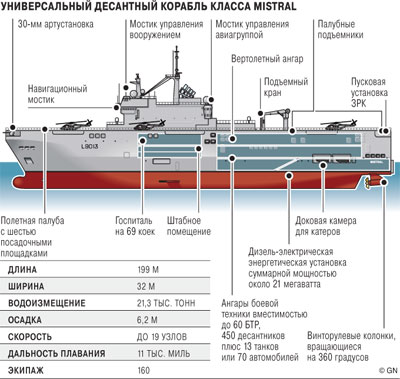
Mistral Schematic

Kommersant reports today that United Shipbuilding Corporation (OSK) has gotten the Defense Ministry’s permission to hold an open tender for procurement of helicopter carriers.  The paper concludes the Defense Ministry is refraining from a sole-source purchase of the French Mistral, and will consider similar proposals from OSK’s shipyards.  But the military [at least some military officials] haven’t hidden the fact that they prefer Mistral [but Defense Minister Serdyukov has always maintained they’ve been talking to other suppliers], so the tender could just be a formality. 

OSK President Roman Trotsenko says a special commission from the Ministry of Industry and Trade will conduct the tender, but details are sketchy.  A Defense Ministry source told Kommersant that, without a tender, a deal to buy a helicopter carrier [presumably Mistral] would be considered illegal.  So there won’t be a sole-source buy despite a year of government-to-government talks.

The paper reminds readers of OSK’s recent unsuccessful antimonopoly complaint in regard to the government’s consideration of Mistral.  Although the complaint was not reviewed, it must have had some impact on the decision to compete the helicopter carrier purchase.  Kommersant sources say OSK Board Chairman Igor Sechin also had something to do with it.

Trotsenko says far east shipbuilding plant ‘Zvezda,’ Petersburg’s ‘Admiralty Wharves,’ and Kaliningrad’s ‘Yantar’ will bid for the ships.  ‘Zvezda’ already has a joint venture in place with South Korea’s Daewoo – builder of the Dokdo helicopter carrier.  The OSK President says ‘Admiralty’ and ‘Yantar’ might work with ‘Northern’ shipyard or a foreign builder. 

Kommersant has a letter sent from Sechin to Prime Minister Putin this spring saying not only is Dokdo an alternative to Mistral, but Dutch and Spanish helicopter carriers are as well.

Trotsenko says OSK yards can build a helicopter carrier in 30 months for $500-700 million against a Mistral pricetag of €420-680 million.

Kommersant concludes the tender won’t end the conflict between OSK and the Defense Ministry.  Mistral will remain the latter’s priority.  The paper’s sources don’t know if the military wants to buy Mistral itself or place an order for a new unit in a French shipyard (STX).  OSK hasn’t been able to arrange a cooperative agreement with STX.

Mezhprombank-controlled ‘Northern’ and ‘Baltic’ shipyards will participate in the tender according to a representative of the bank. Kommersant’s sources think Mezhprombank, its owner Sergey Pugachev, and shipyards are the favorites among Russian contenders.  Pugachev was an early supporter of buying French, then building other units in his shipyards.  And, according to Kommersant, the Defense Ministry supports Pugachev.

Alongside Pugachev and Mezhprombank, OSK feels its chances to win the tender aren’t great.  Moscow Defense Brief analyst Mikhail Barabanov also says Mezhprombank yards are the favorites to build Mistral in Russia.  Such a deal’s been reached at a political level between Paris and Moscow, so the tender might just be a formality.  CAST’s Konstantin Makiyenko agrees.  But he thinks Mistral orders will go to ‘Baltic,’ since ‘Northern’ is loaded with frigate and corvette orders.  Meanwhile, OSK would like to buy both yards from Mezhprombank, but the sides haven’t reached agreement on a price.
Two New Armies for the Central Military District

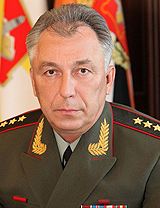
This week General-Lieutenant Vladimir Chirkin spoke to Krasnaya zvezda about several things.  Recall that Chirkin is acting commander of the troops of the ‘Combined Strategic Command of the Red Banner Central Military District.’  He has been commander of the SibVO until now of course.

His interview brought two things immediately into focus.  First, it appears that OSKs will actually be unified or combined strategic commands rather than ‘operational-strategic commands.’  Either way the acronym is OSK.  But combined strategic command connotes a couple significant things.  They may really unify all armed services and branches on their territory for warfighting.  Second, they are beyond the ‘operational-strategic’ level of warfare; they are intended to be strategic.

In this interview, Chirkin was asked and talked at length about the scale and scope of Vostok-2010 in Siberia, as well as the performance of his troops in the exercise.

Asked about the formation of the four new OSKs, Chirkin provided a short dissertation on why the Armed Forces command and control system is being overhauled:

“Recently the Russian Federation adopted a new National Security Strategy and Military Doctrine.  The Defense Ministry and General Staff put amendments in these documents.  Possible threats of wars and conflicts, basic forms and capabilities for fulfilling strategic missions were determined.  The National Security Concept of the Russian Federation proposes that the state could encounter real and potential threats.  I won’t reveal all the subtleties, but I will say one thing — the new system of command and control is being created accounting for the realities of the current time and changing international situation, so the state can independently confront possible threats to its security and the security of its allies, and achieve strategic goals.”

“Such a decision was predicated on the realities of our times and repeatedly  thought over by both the General Staff of the Armed Forces and the country’s leadership.  Reforming the system at all levels is the basis of military reform.  In a word, this decision strengthens the preceding results and gives the process a new turn.”

Chirkin says the formation of his new OSK is not interfering with planned combat training at the brigade level and below.

He says there shouldn’t be any concern about excess officers in his command:

“Officers who meet all requirements and wish to continue serving will be appointed to positions.  Firstly, the Combined Strategic Commands in Yekaterinburg and Khabarovsk [i.e. Eastern Military District] will require supplements of several hundred officers ready to serve in their directorates, departments, and services.  You understand the territories and quantity of troops are increasing.  And this means professional-administrators will be needed, and there are not just a few of these among SibVO officers.”

“Secondly, in Chita a combined arms army will be formed.  Officers and civilian personnel will also be required there.  Besides, in Transbaykal, several more formations and units will be formed, which must make up a large formation [i.e. объединение, an army].  And this, you understand, is hundreds more officer positions.  The main thing is an officer should be a qualified specialist, a master of his trade and have the desire to continue serving.”

Recall in early June, General Staff Chief Makarov told the Federation Council three new armies comprising six brigades would be formed, and so it looks like Makarov’s old home, the erstwhile SibVO, and its massive territory in its new Combined Strategic Command of the Central Military District incarnation, will receive two of the new armies.  Look for generals with a strong SibVO pedigree to command them.  No indication of where Makarov’s third new army will appear.  The Eastern Military District might be a good bet.

As a postscript, Chirkin noted that the SibVO has gotten 4,500 apartments to distribute to dismissed or retired officers.

Frontal, Army Aviation to OSK Commanders

Air Forces CINC, General-Colonel Aleksandr Zelin had many announcements yesterday on the eve of his service’s holiday, but none more interesting than the not-completely-surprising news that frontal and army aviation will transfer from the Air Forces to be directly subordinate to Russia’s four new ‘operational-strategic commands.’

Zelin said:

“The Air Forces will remain a service of the Armed Forces, its Main Command [Glavkomat or Главкомат] will continue functioning, the transfer of four Air Forces and Air Defense commands [i.e. armies] to the commanders of the new military districts — Western, Southern, Central and Eastern is planned.”

“Frontal and army aviation is transferring to the commanders of these districts and, accordingly, to the unified strategic commands.  As regards the aviation component of the RF strategic nuclear triad — Long-Range Aviation, it, like Military-Transport Aviation and the Operational-Strategic Command of Aerospace Defense [ОСК ВКО] will remain immediately subordinate to the Air Forces CINC.”

So what’s happened?

After years of lobbying, army aviation is leaving the Air Forces, but not exactly returning to the Ground Troops.  It is, however, returning to a Ground Troops-dominated environment in the OSKs.

The OSKs look more and more like U.S.-style unified, combatant commands, and the RF armed services like force providers.  

One supposes that the Air Forces, like the Navy, will have to continue playing a very large role in developing doctrine, tactics, acquisition, training, and operations and maintenance of frontal aviation at least, and probably army aviation as well. 

Zelin had more fragmentary comments on this subject.  The Air Forces CINC will retain:

“. . . immediate authority to direct combat training of all aviation and air defense forces, development of all directive documents, and also material-technical support.”

“This entire system is arranged just to optimize command and control and concentrate the main forces and means in the troops [i.e. OSKs].”

He added that these measures must:

“. . . prevent theft and waste of material and financial means and guarantee their strict centralization.”

One wonders how aspects of this ‘material-technical support’ (MTO) role for the Air Forces CINC will track with General-Colonel Bulgakov’s new MTO empire in the increasingly civilian Defense Ministry.

Disappearing Deputy Defense Minister Portfolios

Or who will answer for what?

On Tuesday, Kommersant and Rossiyskaya gazeta described, even if they can’t explain, Deputy Defense Minister portfolio changes.  The shuffling began in early July, when Grigoriy Naginskiy was ‘freed’ from his responsibilities as Chief of Housing and Construction but remained a Deputy Defense Minister.

According to a decree known, but not published, Medvedev removed General-Colonel Dmitriy Bulgakov from his post as Chief of Rear Services, while retaining him as a Deputy Defense Minister without specific duties.  It’s widely believed, of course, Bulgakov has taken charge of a new Material-Technical Support (MTO) empire that will encompass not only logistics but also arms and equipment supplies.

For his part, Defense Ministry Apparatus Chief Mikhail Mokretsov formally became a Deputy Defense Minister (no longer holding just informal ‘Deputy Minister status’).

Kommersant points out there are still eight Deputy Ministers (six are civilians).  A Defense Ministry source told the paper, however, that Bulgakov might be civilianized.  And his MTO organization will be part of the Defense Ministry’s ‘civilian component’ as opposed to its ‘military component.’  Kommersant says the ‘military component’ (planning and operational troop command and control) will just be the General Staff when the current Defense Ministry reorganization is complete.

Bulgakov has apparently indicated that MTO will have a planning and coordination department, a resource and transportation support department, Main Automotive-Armor Directorate (GABTU), and also repair-refurbishment and metrological directorates.  As announced elsewhere, ten new MTO brigades are to be established in the four new OSKs.  Recall that, in the same presidential decree on Naginskiy, Bulgakov’s rear services chief of staff Sergey Zhirov became Chief of the Planning and Coordination Department (read staff).

One should really look at Mil.ru’s ‘Leadership Structure’ page here.  In it, you’ll see Vera Chistova retains her clear responsibility for finance-economic work.  Bulgakov’s biography notes he became simply Deputy Defense Minister in July.  Naginskiy’s contains no similar notation though it could.  Then comes the oft-forgotten Dmitriy Chushkin who followed Defense Minister Serdyukov from the Federal Tax Service in late 2008.  He has no portfolio spelled out in his title, but his bio reads:

“Responsible for forming and conducting the Defense Ministry’s united military-technical policy in the information and telecommunications technology area which aims to increase the effectiveness of the command and control system, as well as supporting and developing its foundations.”

Mokretsov’s bio has a note that he added Deputy Defense Minister to his title in July.

The ultimate plan behind these moves isn’t clear yet.  But it does seem to go back to late June’s replacement of Kolmakov with Popovkin in one of the Defense Ministry’s two First Deputy slots.  More support functions were and are being consolidated under civilians, while purely military training, planning, and operations may now be more solidly under General Staff Chief, First Deputy Defense Minister Nikolay Makarov.

Will the Genshtab and OSKs Replace the Glavkomaty?

Writing in Vremya novostey yesterday, Nikolay Khorunzhiy claims the recently-concluded, largest post-Soviet exercise – Vostok-2010 – was intended to test the establishment of four operational-strategic commands (OSK or ОСК) in place of Russia’s six military districts, as well as the establishment of structural sub-units of the General Staff in place of the Main Commands (Glavkomaty or Главкоматы) of the Ground Troops, Air Forces, and Navy.

Khorunzhiy continues:

“It’s proposed that the army’s new structure will allow a sharp cut in the steps in passing commands from 16 levels to three, and increase their precision and reliability.  On 6 July, President Dmitriy Medvedev signed a decree establishing OSKs.  Part of the authority of central command and control organs, but also that earlier entrusted to the Glavkomaty, are going to the OSKs.”

The 6 July decree still hasn’t appeared publicly. 

Khorunzhiy notes that then-General Staff Chief Yuriy Baluyevskiy tested the transition to regional commands during Baykal-2006:

“Then he didn’t manage to break the resistance of district commanders who didn’t want to share their authority with OSK commanders.”

Khorunzhiy digresses to the precursors of OSKs, without calling them High Commands of Forces.  Former General Staff Chief Nikolay Ogarkov set out to reform the army’s command and control:

“The instrument of such a reform he considered main commands on strategic directions (theaters of military operations, in modern terminology) which would improve coordination between services and troop branches and would strengthen the unity of command in combat units (permanent readiness units).”

Ogarkov viewed the Soviet North-Western, Western, and South-Western main commands of troops from World War II as prototypes, but these Glavkomaty were only intermediate links between the Headquarters,  Supreme High Command [Stavka VGK] and the fronts, but received no authority, troops, or communications.  Khorunzhiy contrasts this to Vasilevskiy being sent to fight the Japanese in 1945; he had authority and troops.

Then, in 1978, Army General Vasiliy Petrov was sent out to establish the Main Command of Troops of the Far East, and he had authority up to appoint regiment commanders and arrange cooperation with neighboring states.  The situation of troops in the Far East sharply improved.

Ogarkov set off then to establish main commands on strategic directions, and improve command and control and readiness in yearly exercises (West, East, Autumn).  But in 1984, Ogarkov himself was sent off to be CINC of the Western direction in Legnica.  He failed to get enough authority for these commanders from the CPSU or Defense Ministry, and these main commands were eliminated in 1991.

But Khorunzhiy goes on to describe today’s OSK as an ultimate victory for Ogarkov over the ‘parochial interests of the army elite.’  He doesn’t seem to wonder whether it might be too soon to declare victory.

He finishes by looking at the KPRF’s call for a parliamentary investigation and special Duma session on how Serdyukov’s reforms are ‘disarming Russia.’  In particular, Khorunzhiy quotes the KPRF press-service:

“The system of military districts which has existed for centuries has just been eliminated.  In place of them incomprehensible strategic commands have been established according to an American template.  It’s obvious that this endless modernization of military structures is leading unavoidably to the loss of troop controllability.”

What’s it all mean . . . ?

The possible elimination of the Main Commands — the service headquarters — would be a big deal (no one mentioned what might happen to VDV, Space Troops, or RVSN branch commands).   

This would obviously greatly strengthen General Staff Chief Makarov, and really make him lord and master of the uniformed military.  It would strengthen the General Staff (except Serdyukov’s been cutting its personnel, like the rest of the Central Apparatus).

Would it give Makarov too much power?  Maybe, or maybe not if Serdyukov thinks he can fire him and get another general whenever necessary.

The possibility of eliminating service headquarters makes Navy CINC Vysotskiy’s reticence to talk about moving to St. Petersburg in the midst of a command and control reorganization make more sense.  Maybe he was telling us there’s a much bigger issue at work than just OSKs.

Perhaps in the most objective sense, getting rid of the Glavkomaty would reduce personnel and some resistance to new ideas.  But wouldn’t it also throw away yet another place where the regime should seek good alternative ideas, counterarguments, and feedback on its plans?

Vysotskiy’s Navy Day Interview

Press coverage of Navy Day (25 July) was replete with interesting stories of plans to revivify Russia’s Kirov-class CGNs and even the Orlan-class wing-in-ground effect vehicle.  There was more talk about moving the Neustrashimyy and Yaroslav Mudryy to the BSF.  Navy CINC Admiral Vladimir Vysotskiy’s interview with Ekho Moskvy, however, didn’t get a lot of attention beyond a couple RIA Novosti and ITAR-TASS sound bytes.

Discussing development of Russia’s fleet of the future, Vysotskiy emphasized the long lead time required to get it:

“Today it takes 10-12 years to get some kind of definite design.  We understand that we have to go according to some operational-tactical requirements, perhaps even operational-strategic ones in this design, of course.  So, it means the development or construction of a series is approximately another 5-7 years, up to 10 years.  Perhaps more, the service life of the design is 20 to 25 years.  In other words, if today we make a decision on constructing some full-scale fleet, then we have to understand we’ll receive this fleet in about 50 years.  Well, at a minimum, beginning from the main component in 35 years.”

Vysotskiy’s comments on Bulava were also captured by the wire services:

“Well, the question which we, military men bearing certain responsibility for this, of course, well, honestly speaking, we are already tired of answering because there is one cause — a deep, I underscore, failure of primary production technology for such expensive missile systems.”  

“We all very simply understand well:  when we began to arrange the process of our work incorrectly from the beginning, and here everything was not done as it needed to be.  Here, of course, we’ll get big problems in the process of the work itself.  This means, in my view, in the last 2 years, a serious move in the direction of us receiving this system has been made nonetheless.  But we need to understand that getting this system in its current form is not the final step of the work.  But we have a fair chance all the same to complete this work successfully, well, so we’ll say, in the course of the coming year.”

“When a systemic mistake is found, it’s simpler,  In this instance, an entire systemic mistake was found precisely in the lack of a system.  That is, to put it properly, forgive such a tautology or, on the other hand, a paradox.  But, what we’ve got is what we’ve got.”

And Vysotskiy said lots of other interesting things that went unnoticed.

He naturally supported Vice-Admiral Sidenko as Far East OSK Commander, saying it made sense and reflected the country’s maritime interests in the Pacific and Indian Oceans. 

He connected the acquisition of the Mistral to drawing down mobilization resources in favor of permanent readiness.  He said PR units could be put on Mistral and the ship could be a mobile command point for an OSK’s inter-service grouping.  He defended turning abroad by saying it would take Russian yards 1.5 to 3 years to even prepare to make such a ship if they started today.

Vysotskiy wants the BSF to pick up the antipiracy load so the distant fleets don’t have to send their ships.

He discussed Russia’s long-term search and rescue support program, and he emphasized rapid information transfer and international cooperation and combined training, like NATO’s Bold Monarch exercise, as essential ingredients for success.

On the loss of the Kursk ten years ago, Vysotskiy said the accident started with a technical cause — errors in handling a peroxide-fueled torpedo — but there was an accumulation of mistakes, including organizational and command ones, that led to the tragedy.

Russia is working on its organizational and technical problems in SAR, both buying equipment and learning to use it abroad.  Vysotskiy cited an ‘absolute understanding’ on cooperation with foreign partners.

He was evasive on moving the Navy’s headquarters to St. Petersburg, saying a remote command and control point is there, and other steps in this direction are being taken.  But the overall military C2 reform has to be completed this year before he can really answer questions.

Lastly, on foreign bases for the Navy.  He’d like to have them, and there’s movement in this direction, at least compared with the recent past.  The Navy is working with a number of states to arrange for simplified port access for its ships in some strategic places, and it’s almost like having a base.

Interim OSK Commanders Named

Late Thursday Interfaks learned that Defense Minister Anatoliy Serdyukov signed an order naming acting commanders of Russia’s four new military districts, or operational-strategic commands (OSKs).

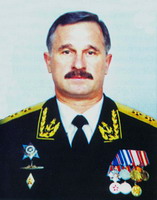
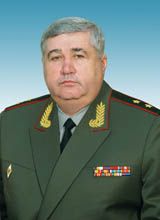
Volga-Ural MD Commander, General-Colonel Arkadiy Bakhin will be the interim commander of the new Western MD.  Siberian MD Commander, General-Lieutenant Vladimir Chirkin will temporarily head the new Central MD.  Pacific Fleet Commander, Admiral Konstantin Sidenko will command the new Far East MD for now.  And North Caucasus MD Commander, General-Lieutenant Aleksandr Galkin will head the the new Southern MD. 

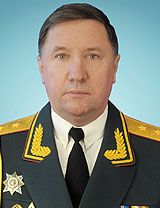
General-Colonel Bakhin

General-Lieutenant Chirkin

Admiral Sidenko

General-Lieutenant Galkin

Serdyukov wants the new command and control scheme operating from the start of the new training year on 1 December.

Kommersant noted general surprise that a naval officer was picked to head the Far East MD.  Ground Troops generals have always commanded the army-dominated MDs.  But a Navy Main Staff source said Sidenko is not new to commanding army units; he once commanded the combined Navy-Ground Troops force on Kamchatka.

Kommersant also said extramural Defense Ministry collegiums will evaluate the effectiveness of these reorganizations before the end of the year.

Makarov’s Guys Take Key Posts

Bakhin, Chirkin, and Galkin prospered under General Staff Chief Nikolay Makarov when he was Siberian MD Commander from 2002-2007.  Each of them served as an army commander, deputy MD commander, and chief of staff, first deputy MD commander under Makarov in Siberia (or immediately after his departure for Moscow).  Chirkin served as Bakhin’s chief of staff, first deputy commander of the Volga-Ural MD, before becoming Siberian MD Commander this year.

Sidenko is a submariner, and most of his career has been in the Pacific Fleet.  His experience as ‘Commander of Troops and Forces in the North-East’ is, interestingly enough, a little similar to Makarov’s late 1990s time as ‘Commander of Ground and Coastal Troops, Deputy Commander of the Baltic Fleet for Ground and Coastal Troops.’

Pressing the French on Mistral

Vladimir Socor has a good piece describing Russian shipbuilders’ complaints to the Federal Antimonopoly Service (FAS) about the Mistral purchase as another way to press Paris to finalize the deal on Moscow’s terms.  Socor says: 

“In line with the Russian government’s tactics, [Deputy PM and OSK Board Chairman] Sechin is signaling that Moscow could turn to other international shipbuilders, or ultimately to Russian shipbuilders, if France does not sweeten the terms of the Mistral deal for Russia.” 

“Thus, Sechin’s subsidiaries [Yantar and Admiralty] ostensibly seek anti-monopoly action in a case handled by Sechin himself for the Russian government.” 

This points up the bizarre circumstance in which Sechin is negotiating with the French, while his OSK subsidiaries complain about the potential deal. 

But, as Interfaks wrote on Wednesday, FAS says it lacks jurisdiction over the complaint from Yantar and Admiralty.  FAS also says there’s no basis for a complaint since no deal for Mistral has been reached. 

The shipyards argue they’ve been excluded from bidding to build amphibious assault ships for the Navy, and the terms of the competition weren’t publicly announced.  Their complaint seems to have merit since, from the outset, the Defense Ministry went directly after a specific ship and supplier, without issuing general requirements for a ship class. 

According to Interfaks, OSK supports Yantar and Admiralty, and calls the Defense Ministry’s actions ‘obscure.’ Its representatives periodically speak of Mistral like a done deal, but how the deal will proceed remains unclear.  An OSK source says, “And every time such statements deliver a blow to the self-esteem of domestic shipbuilders who know how to make these ships.”  

And, as Socor notes, talks continue also with the Dutch and Spanish [as Defense Minister Serdyukov has always pointed out] and now the possibility of a deal with the South Koreans has been thrown in, further roiling the waters. 

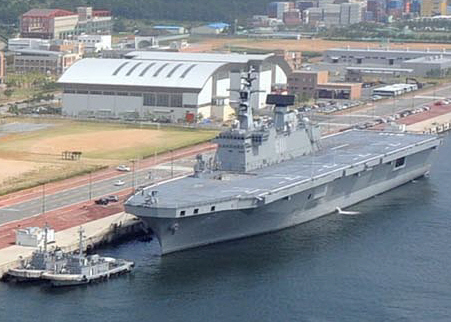
Izvestiya yesterday said OSK President Roman Trotsenko sent a letter to Defense Minister Serdyukov proposing a review of the military’s plans to acquire Mistral.  In its place, Trotsenko suggests building the South Korean Dokdo under license in a Russian shipyard.  He says he can build it in three years, and more cheaply than Mistral by one-third.  OSK has a joint production agreement with Dokdo builder Daewoo. 

Dokdo

The Defense Ministry insists Russian builders demurred when asked if they could build these ships.  Izvestiya doubts Trotsenko’s offer is realistic given the lack of available Russian buildingways.  But the paper concludes the appearance of the letter shows the struggle for the amphibious carrier contract isn’t over.

General Staff Chief Makarov’s Press Conference

Sound bites from General Staff Chief Nikolay Makarov’s press conference today dribbled out one at a time, as usual.

Makarov told reporters President Medvedev signed a decree establishing four operational-strategic commands (OSK) to replace the existing military districts on 6 July, but the text hasn’t been published.  Makarov also said arrangements putting the OSKs in place would be complete on 1 December.

Makarov talked more about the new “unified system of material-technical support (MTO)” also apparently covered in Medvedev’s decree.

Rear Services Chief, Deputy Defense Minister, General-Colonel Dmitriy Bulgakov, as expected, will head the unified MTO system, and new First Deputy Defense Minister Vladimir Popovkin will supervise the new state armaments program, 2011-2020, as well as coordination with military industries. 

Makarov stressed uniting transportation and supply functions under Bulgakov:

“We had a disconnect when all transport for supplies of material means to the troops was at the disposal of the Deputy Defense Minister for Rear Services, but he didn’t have anything he needed to move with this transport.  The other Deputy Defense Minister, on the other hand, had armaments, but no means for transporting them to the troops.”

“This is very important because now the management of transportation and armaments is concentrated in the hands of one man.  The correctness of the decision was confirmed by the recently completed ‘Vostok-2010’ operational-strategic exercise in the Far East.”

 “Now one official serving as a Deputy Defense Minister heads a unified system of material-technical support which has united rear services and armaments.  He alone personally answer for both the transport of supplies of material-technical means, and for these means themselves.  Now one man answers for the state of affairs with armaments and for their supply to the troops, who will also now be responsible for that.”

The way Makarov puts it, Popovkin be on the hook for product quality:

“He will work with defense-industrial complex enterprises to control their production of armaments and military equipment for the Armed Forces.”

Popovkin’s old job of Chief of Armaments, Deputy Defense Minister will disappear most likely.

Makarov told reporters Russia plans to move to netcentric command and control by 2015, once it equips its troops with new C3 systems united in one information space.  Such systems are now scarce, but he says, they are working hard so to install digital equipment everywhere.  Makarov calls this the main renovation that he’s giving all structures and troops starting in the fall of this year.  He says Russia’s new command posts unite reconnaissance, target designation, and troops and weapons to execute combat missions in real time.

It’s interesting that RIA Novosti took time to explain that the netcentric concept is an American creation more than 10 years old, and one not loved by those used to strictly centralized command and control.

Makarov told the press the army will begin forming light brigades, which it currently doesn’t have, this year.  They’ll have light combat vehicles of some type.  While not providing details, Makarov emphasized that light brigades will be built around a standard vehicle, so that, as in Vostok-2010, a brigade can fly in and its personnel can marry up with their normal vehicles in their place of deployment. 

Answering a question, Makarov said Russia will buy more Il-78 tankers in GPV 2011-2020, but he didn’t specify a number.

Makarov announced an intention to equip all Russian combat aircraft with new targeting-navigation systems over the next three years.  He said the new equipment will increase the accuracy of air strikes and allow the Air Forces to “abandon the previous practice of area bombing.”  He said the new system was tried on a Su-24M2 during Vostok-2010.  Installation of the targeting equipment on the Su-24M2 began in 2007.  Makarov said the VVS has nearly 300 Su-24 of all variants, and naval aviation about 60.

Stoletiye.ru had an interesting observation on Makarov and efforts to streamline command and control in the Russian Army.  It said the move to 4 OSKs and other steps are intended to reduce duplication of officer responsibilities and make 2-3 officers responsible for the fulfillment of combat missions.  It quoted Makarov, “We’ve eliminated the system of spreading responsibility throughout the Defense Ministry.”

Kramnik on Vostok-2010 and Military Reform

This is complete finally.

Ilya Kramnik’s RIA Novosti piece about the exercise has been quoted by others, but it hasn’t gotten attention as a whole on its own.

So what does Kramnik think?  He cites Makiyenko to the effect that Vostok-2010 showed that reform has been positive for the army, but there are, of course, problems.  Troops aren’t uniformly well-trained, and the failure of contract service has really hurt.  But Kramnik gives Defense Minister Serdyukov a lot of credit, on the order of being a 21st century Milyutin.  But back to the problems again.  Things like contract service, tension over officer cuts and premium pay, military education cuts, and the failure to deliver new weapons have to be fixed.  But Kramnik believes Serdyukov is the kind of guy who’ll go back and fix what he didn’t get right or get done.  Then Kramnik shifts to the type of conflict the military reform is preparing the Russian Army to fight.  Obviously [?] not a nuclear one, but rather, again turning to Makiyenko, a Central Asian local war scenario that might threaten the RF’s internal stability.  The conclusion is that, if reform stays on track and occurs quickly, the army will be able to meet this challenge.  Some, however, might well argue that even a properly and rapidly reformed Russian Army might not be enough to contain and damp down the kind of conflagration Makiyenko describes.  Finally, Kramnik concludes that even the U.S. front isn’t secure; an American regime in 2012 or 2016 might take to renewed active support of new ‘color revolutions’ in Moscow’s back (or front) yard.

Here’s a verbatim text:

“The official results of the just ended ‘Vostok-2010’ exercise are still being reckoned, and this will be done by the Defense Ministry.  Meanwhile, it’s already possible to make some conclusions.” 

“‘Vostok-2010’ was the largest of all in the post-Soviet period of Russian history.  More than 20 thousand men, 75 aircraft, 40 combat and auxiliary ships took part on the ground, in the air, and at sea in maneuvers conducted from Altay Kray to Vladivostok.”

“The aim of the exercise was to check the three-level command structure — operational-strategic command – operational command – brigade, and other new elements in the Armed Forces command and control and support system, and to uncover deficiencies needing correction.  An expert of the Russian Center for the Analysis of Strategies and Technologies Konstantin Makiyenko expressed his opinion on the recent maneuvers:  ‘The recent maneuvers fully refuted the propagated myth about how the army is being destroyed as a result of the actions of the current Defense Ministry leadership.  It’s obvious the army is alive and developing.  Units participating in the exercise demonstrated their combat capability, despite the fact that they are not in the ranks of the best military districts, and scarcely armed with the most modern equipment.'”

“‘It’s especially worth focusing on the good morale of the officer personnel — it’s not possible to speak of general enthusiasm, of course, but I didn’t see dim eyes among the officers.  As a group, they are interested in the success of the current reform and hope for its success.'”

“While agreeing with this point of view, one has to note that the situation with soldiers looks a little different, both RIA Novosti’s reviewer [Kramnik] and Konstantin Makiyenko have also noted this.  Very much depends on the branch of troops and the basic training of the soldiers themselves.  Contract-servicemen in a ‘Tochka-U’ operational-tactical missile launch battery look and are trained much better than conscript-soldiers in motorized rifle units.  In the words of motorized rifle officers up to the battalion commander level, the reduction in the number of contractees has negatively affected platoon and company training.  Ideally, the service term of a specialist-soldier (mechanic-driver, weapons system operator, etc.) needs to be three years, that is achievable only on the contract manning principle for these positions.”

“Speaking about the attainability of the announced goals of the reform, one can say the following:   the will of the military leadership which certainly exists, is the main component of success, a firm understanding of the goal is also obvious, and the possession of authority — it’s not possible to doubt this.  As a result, the current Defense Ministry leadership needs only time to realize its ideas.  Overall, the military reform being conducted is the most significant event of Russian history in the last ten years — since the suppression of the separatist rebellion in the North Caucasus.  The Serdyukov-Makarov reform in the military sphere is the most radical and deepest since the time of Mikhail Frunze’s reforms in the 1920s, if not since Dmitriy Milyutin in the 1860s and 1870s.”

“As proof, it’s possible to note the fact that the Defense Ministry leadership is constantly searching and ready to correct those steps which, when checked, turn out to be incorrect or unattainable in real political-economic conditions.  So, the current principles of manning the army will undergo a serious correction:  it’s obvious that neither the organization of contract service, nor, even more, the existing format of conscript service corresponds to the demands of the time.”

“Evaluating the correspondence of the Defense Ministry leadership to its missions, it’s possible to say, that at present Russia has the most appropriate military leadership since the collapse of the USSR.  At the same time, it’s obvious that the radicalism of the reform, the compressed time of its implementation, unavoidable resistance in the environment and hard economic conditions didn’t allow for avoiding a large number of mistakes and excesses.  Among the most fundamental failures it’s possible to name the collapse of the army’s transition to the contract manning principle, serious social tension arising in connection with the rapid reduction of officer personnel, the ambiguous situation with the scale of servicemen’s complaints after the introduction of the differential pay system [premium pay or Serdyukov’s Order No. 400?], the hurried and not completely thought out reform of military education and many, many other things.  It’s  particularly worth focusing on the implementation of the state armaments programs which fail one after another, not being executed in a significant part.  As a result, the lag of Russia’s Armed Forces behind the most developed countries in the level of  technical equipping continues to grow such that in conditions of a quantitative lag it could become very dangerous.  All these mistakes have to be corrected, since they impact on rudiments of the army’s combat capability.”

“For what type of wars does Russia’s new army need to prepare?  Obviously, the time of long wars between the great powers has gone into the past — nuclear weapons haven’t left chances for such a development of events.  The most probable type of conflict in which the Russian Army will be involved is a local conflict on Russia’s borders and the territory of the former USSR, in the course of which there could be clashes with the most varied enemy:  from a regular army to many bandit formations and terrorist groups.”

“In Konstantin Makiyenko’s opinion, Central Asia presents the greatest danger in the future of a possible hot conflict with Russia’s direct participation:  ‘The U.S. and NATO, obviously, are less and less controlling the Afghanistan situation, and it’s not excluded that in the foreseeable future they may have to abandon this country.  The return to power in Afghanistan of the ‘Taliban’ movement looks most realistic in the event of such a development of events.  The arrival of Islamic radicals in power would unavoidably be a catalyst for conflicts on the territory of former Soviet republics of the region already riven by contradictions.  Weak authoritarian regimes in Tajikistan, Turkmenistan and Uzbekistan, not to mention what’s become the ‘failed government’ in Kyrgyzstan, could be easy prey for the Taliban.  As a result, Russia might be forced to consider the likelihood of a large Asian conflagration which it would have to prevent, or if it didn’t succeed — extinguish, at a minimum with the aim of preserving its own internal stability.  One very much wants to believe that the reform will bear fruit before the described situation becomes a reality.'”

“Besides the described scenario it follows to study also the probability of another development of events:  as experience has shown, on the territory of former USSR republics, the rise of openly anti-Russian regimes with external support at their disposal can’t be excluded.  For today, such a situation is a low probability due to the fact that the current administration in the U.S. — the main sponsor of ‘colored revolutions,’ is clearly not inclined to continue the policy of George Bush.  However by 2012, if President Obama loses the election, the situation could change, and this risk is even greater in 2016 when the administration will change in any case.  Meanwhile, you have to note that even the Democrats remaining in power in the U.S. is not a guarantee of a peaceful life:  Obama’s point of view on a coexistence format with Russia is hardly shared by all his fellow party members.  In the worst case, a return to the next variant of Cold War and new spiral of the arms race isn’t excluded.”

“The coming decade isn’t promising Russia an easy life.  The success of military reform is all the more important.”