Category Archives: Command and Control

Mistral Contract Signing Today

The Elysee announced Sunday that French President Sarkozy and Russian Deputy Prime Minister Igor Sechin will sign the Mistral contract in Saint-Nazaire today.

InoSMI.ru and Militaryparitet.com provided the story from Le Point.

Sarkozy and Sechin will inspect the Mistral and Tonnerre, as well as the Dixmude, which is still under construction.

Le Point says the Mistral deal was originally entrusted to oligarch shipbuilder Sergey Pugachev and his holding company United Industrial Corporation (OPK), and rumors circulated about French and / or Russian middlemen receiving commissions for brokering it.  Ultimately, Russia’s United Shipbuilding Corporation (OSK) — headed by Sechin — took over negotiations with Paris.

Le Point claims the Russians asked the French to provide Link 11 and Link 16 combat information systems along with Mistral.  The French demurred, saying transferring these NATO systems required the agreement of all 27 alliance members.  Moscow reportedly persisted as recently as the NATO-Russia Lisbon Summit, saying this equipment would support its participation in joint operations with NATO.  Its request is formally being studied, but won’t be approved, according to Le Point.

The Results of Reform

Trud’s Mikhail Lukanin offered an interesting one last Wednesday . . . with help from other frequent commentators, he takes a swag at describing the results of Anatoliy Serdyukov’s nearly 4-year tenure as Defense Minister.

It’s interesting because it’s unclear if Lukanin’s article is intended to damn by faint praise, to be sarcastic, or was ordered by someone.  Maybe he intends to say these are just results, the good and the bad.

It’s easy to see some good in Lukanin’s first five, but his final three are pretty much unleavened.

The Army’s Become More Mobile

Lukanin quotes Vitaliy Shlykov:

“Until 2008, our army looked like fragments of the old, Soviet one, weighed down with heavy weapons, oriented toward global nuclear war with practically the entire world.”

He says even in the August war against Georgia the army was still “Soviet” — slow to stand up, with an archaic command and control structure.  But now the situation’s changed with mobile brigades that can answer an alert in 1 hour instead of days.

The Army’s Rid Itself of the Spirit of the Barracks

Valentina Melnikova tells Lukanin that the soldier’s life has changed cardinally under Serdyukov.  She says, until recently, one-third of soldiers were typically involved in nonmilitary work every day.  Now soldiers are gradually being freed from such duties as commercial firms take them on.

New Equipment Has Come to the Troops

Lukanin writes that finally a start’s been given to the largest rearmament of the army in post-Soviet times.  One that will take new weapons and equipment from about 10 percent of today’s inventory to 90-100 percent [official sources only claim 70 percent] by 2020.

Lukanin quotes Ruslan Pukhov:

“The Navy alone will receive 40 submarines and 36 new ships, and the Air Forces 1,500 aircraft in the next decade.”

Officer Pay Has Grown

Lukanin says lieutenants and majors made 14 and 20 thousand rubles per month respectively before Serdyukov’s reform,  but now 50 and 70 thousand if they receive premium pay for outstanding combat training results.  And from 2012, premium payments will be included in their permanent duty pay, and 50 thousand rubles will be the minimum base pay for officers.

Lukanin quotes Aleksandr Khramchikhin: 

“The officers of our army are actually comparable with the armies of developed countries in pay levels. “

They Didn’t Talk Reform to Death

Lukanin says experts think it’s good Serdyukov’s reform was pursued energetically, without lengthy discussion and debate.  Pukhov gives the cut from 6 to 4 military districts as an example:

“At one time, it would have taken years to transfer a huge quantity of officers and generals from place to place, but the Defense Ministry did this in just 4-5 months.”

They Stopped Training Officers

Lukanin refers to Serdyukov’s halt to inducting new cadets into officer commissioning schools until at least 2012.  He says 2010 graduates were either released or accepted sergeant positions.  This led to the departure of experienced instructors, and their replacement with younger officers lacking the necessary experience.

Sergeants Almost Ceased to Exist

Contract sergeants were dispersed in 2009-2010.  The Defense Ministry considers them poorly trained, and in no way superior to ordinary [conscript] soldiers.  Now it’s counting completely on conscripts with an even lower level of training.

There’s Nothing to Defend Against China

Here Lukanin notes that some results of reform have put people on guard.  Anatoliy Tsyganok tells him tank units have been practically eliminated: 

“Now only 2,000 tanks, old models at that, remain in the army.”

In Tsyganok’s opinion, tanks are still very relevant for the defense of Russia’s border with China.

What do we make of all this?

  • It’s good that the Russian Army was restructured into smaller, more combat ready formations, i.e. brigades, and sub-units. 
  • We really have no clear picture of the extent and success of outsourcing nonmilitary tasks in the army.  Meanwhile, the “spirit of the barracks” is alive and well when it comes to dedovshchina and violence in the ranks. 
  • The promise of another rearmament program shimmers on the horizon, but it’s not delivering much yet, and there are plenty of serious obstacles to completing it. 
  • The officer pay picture has improved, but the Defense Ministry has real work to do this year to implement a fully new pay system next year.  Meanwhile, several years of premium pay have caused divisions and disaffection in the officer corps. 
  • Moving out smartly on reform was a change over endless talk, but there are areas where more circumspection might have served Serdyukov well. 
  • The Defense Ministry definitely had to stop feeding more officers into an army with a 1:1 officer-conscript ratio.  We’ll have to see what kind of officers the remaining VVUZy produce when the induction of cadets restarts. 
  • Aborting contract service cut the army’s losses on the failed centerpiece military personnel policy of the 2000s.  But something will have to take its place eventually to produce more professional NCOs and soldiers. 
  • Russia is probably right to deemphasize its heavy armor.  It doesn’t appear to have much of a place in the coming rearmament plan.  And tanks really aren’t the answer to Moscow’s largely unstated security concerns vis-a-vis China anyway.

So what’s Serdyukov’s scorecard?  A mixed bag.  Probably more good than bad, but we’ll have to wait to see which results stand and prove positive over the long term.  Definitely superior to his predecessor’s tenure.  Expect more Serdyukov anniversary articles as 15 February approaches.

Zelin Out?

An Interfaks source in the Defense Ministry says Air Forces CINC, General-Colonel Aleksandr Zelin might be retiring on age grounds.  The rumor goes that Zelin’s Deputy for Aviation, General-Lieutenant Igor Sadofyev will relieve him, while Zelin moves into a defense industry job.  RIA Novosti reports the same story, citing several media outlets.  The Air Forces spokesman, meanwhile, says the VVS cannot comment because it doesn’t have any information to this effect.

RIA Novosti talked to defense commentator Igor Korotchenko, who expressed caution about the Zelin rumor, but said the move to four MDs / OSKs has diminished the service CINC’s influence:

“The role and place of the main commands of the services of the Armed Forces has been reduced accordingly.  Practically all aviation, except strategic, will be subordinate to the OSK commander.”

He says the story of Zelin’s possible departure may have surfaced because of the downgrading of the service CINCs.

It’s interesting that age was cited since Zelin’s only 57, and can serve until age 60 under the law.  He’s headed the VVS since May 2007. 

The three-star general was the subject of dismissal rumors in 2009 when the General Staff Chief and Defense Minister were allegedly unhappy with his insufficient command of air-space (aerospace) defense (VKO) issues.  See Newsru.com and Grani.ru for that story.

Trainer-in-Chief

Mil.ru made it official today.  General-Lieutenant Nikolay Bogdanovskiy, late of the Leningrad MD, is now the military’s trainer-in-chief.  According to the Defense Ministry website:

“On 1 December 2010, the Combat Training Directorate of the Ground Troops was transformed into the Main Combat Training Directorate (GUBP or ГУБП) of the Ground Troops, and given the function of coordinating the training of the RF Armed Forces services and troop branches.”

And Bogdanovskiy is now a Deputy Ground Troops CINC heading the new GUBP, according to the latest personnel decree.

General-Lieutenant Bogdanovskiy

We’re left wondering how far his new writ extends . . . just combined arms training, or to the VDV, RVSN, and Space Troops?  Recall also there was speculation that new Deputy General Staff Chief, General-Colonel Gerasimov, late of the Moscow MD, might be the main training supervisor.

A little background on Bogdanovskiy as long as it’s here. 

He was born in 1957.  He’s a graduate of the Moscow Higher Combined Arms Command School, the Frunze Military Academy, and the General Staff Academy.

He’s served as commander of a reconnaissance platoon, a company, chief of staff, then commander of a motorized rifle battalion in the Southern Group of Forces [i.e. Hungary], chief of staff of a fortified region, commander of a motorized rifle regiment, chief of staff of a motorized division, chief of a district junior specialist training center, chief of staff and commander of the 35th Army, Deputy Commander of the Far East MD, Chief of the Main Staff and First Deputy CINC of the Ground Troops, and Commander, Leningrad MD.

More Appointments, Dismissals, Etc.

Yesterday’s decree on military appointments, dismissals, etc., is extremely long.  It’s part of the process of redistributing staff personnel from 6 into 4 MDs.  The Southern and Eastern MD staffs, in particular, get fleshed out by it.  The outline of the new MD staff structure becomes visible with these changes.  And the breadth and depth of the rotation and change in personnel pretty much assures it’ll take a while for the commands of the new MDs to operate smoothly.

There are other individual notable points in this list.  There’s now a Main Combat Training Directorate (GUBP or ГУБП) inside the Ground Troops, instead of a directorate.  Maybe this is part of replacing the Defense Ministry-level GUBP.  The MDs have their own troop training directorates . . . it’s interesting that the 3rd Air-Space (i.e. Aerospace) Defense Brigade is subordinate to the Baltic Fleet rather than the Western MD . . . a 49th Army has popped up in the Southern MD . . . Ryadovoy.ru says it’s headquartered in the former RVSN communications institute in Stavropol . . . Air Defense Chiefs renamed Chiefs of Air Defense Troops and Aviation.

Here’s what the 9 January decree does.

Appoint:

  • Captain 1st Rank Ildar Ferdinandovich Akhmerov, Deputy Commander, Primorskiy Mixed Forces Flotilla, Pacific Fleet.
  • General-Major Vladimir Vladimirovich Derkach, Chief of Staff, First Deputy Commander, Space Troops, relieved of duty as Deputy Commander, Space Troops.
  • Colonel Sergey Borisovich Ryzhkov, Commander, 39th Independent Motorized Rifle Brigade, Eastern MD.
  • General-Lieutenant Nikolay Vasilyevich Bogdanovskiy, Deputy CINC, Ground Troops, Chief, Main Combat Training Directorate, Ground Troops, relieved of duty as Commander, Leningrad MD.
  • Colonel Yuriy Aleksandrovich Popov, Commander, 3rd Air-Space Defense Brigade, Baltic Fleet.
  • General-Major Viktor Borisovich Astapov, Chief of Staff, First Deputy Commander, 49th Army, relieved of duty as Deputy Commander, 41st Army.
  • General-Major Sergey Sergeyevich Bashkin, Chief, Air Defense Troops and Aviation, Southern MD, relieved of duty as Chief, Air Defense Troops, North Caucasus MD.
  • Captain 1st Rank Oleg Georgiyevich Gurinov, Chief, Naval Directorate, Southern MD.
  • Colonel Igor Vladimirovich Dashko, Chief of Reconnaissance, Deputy Chief of Staff for Reconnaissance, Southern MD, relieved of duty as Chief of Reconnaissance, Deputy Chief of Staff for Reconnaissance, North Caucasus MD.
  • Colonel Igor Mikhaylovich Yemelyanov, Chief, Radiological, Chemical and Biological Defense (РХБЗ) Troops, Southern MD, relieved of duty as Chief, Radiological, Chemical and Biological Defense Troops, North Caucasus MD.
  • Colonel Igor Gennadyevich Kovalenko, Deputy Chief of Staff, Southern MD.
  • General-Major Andrey Anatolyevich Kozlov, Chief, Railroad Troops Directorate, Southern MD, relieved of duty as Commander, 7th Territorial Command, Railroad Troops.
  • General-Major Andrey Nikolayevich Kolesov, Chief, Organization-Mobilization Directorate, Deputy Chief of Staff for Organization-Mobilization Work, Southern MD, relieved of duty as Chief, Organization-Mobilization Directorate, Deputy Chief of Staff for Organization-Mobilization Work, North Caucasus MD.
  • General-Major Sergey Vasilyevich Kuralenko, Commander, 49th Army, relieved of duty as Chief of Staff, First Deputy Commander, 5th Army.
  • Colonel Aleksey Pavlovich Lemyakin, Chief, Material-Technical Support Planning and Coordination Directorate, Southern MD, relieved of duty as Chief of Rear Services, Deputy Commander for Rear Services,  2nd Army.
  • Colonel Oleg Gennadyevich Maltsev, Chief, Automotive Service, Southern MD, relieved of duty as Chief, Automotive Service, North Caucasus MD.
  • Colonel Mikhail Yevgenyevich Mizintsev, Chief, Operational Directorate, Deputy Chief of Staff, Southern MD, relieved of duty as Chief, Operational Directorate, Deputy Chief of Staff, North Caucasus MD.
  • Colonel Sergey Mikhaylovich Panevchik, Chief, Personnel Directorate, Southern MD, relieved of duty as Chief, Personnel Directorate, North Caucasus MD.
  • General-Major Fraiz Fazlyakhmetovich Salyyev, Chief, Technical Support Directorate, Southern MD, relieved of duty as Chief of Staff, Armament, First Deputy Chief of Armaments, North Caucasus MD.
  • General-Major Vladimir Vladimirovich Samoylov, Deputy Commander, 49th Army.
  • General-Major Oleg Yuryevich Torgashev, Chief, Troop Training Directorate, Southern MD, relieved of duty as  Chief, Combat Training Directorate, Moscow MD.
  • Colonel Oleg Viktorovich Chernyavskiy, Chief, Armor Service, Southern MD, relieved of duty as Chief, Armaments, Deputy Commander for Armaments, 5th Army.
  • General-Major Aleksandr Nikolayevich Shvetsov, Deputy Commander for Material-Technical Support, Southern MD, relieved of duty as Chief, Rear Services, Deputy Commander for Rear Services, Leningrad MD.
  • Colonel Stepan Stepanovich Yaroshchuk, Chief, Missile Troops and Artillery, Southern MD.
  • Colonel Sergey Anatolyevich Bakaneyev, Chief, Missile Troops and Artillery, Eastern MD, relieved of duty as Commander, 39th Independent Motorized Rifle Brigade, Far East MD.
  • Rear-Admiral Yuriy Yuryevich Berdnikov, Chief, Naval Directorate, Eastern MD, relieved of duty as Deputy Commander, Troops and Forces in the North-East.
  • Rear-Admiral Vladimir Nikolayevich Vdovenko, Deputy Commander, Troops and Forces in the North-East.
  • Colonel Andrey Aleksandrovich Volkov, Chief, Radiological, Chemical and Biological Defense Troops, Eastern MD, relieved of duty as Chief, Radiological, Chemical and Biological Defense Troops, Siberian MD.
  • Colonel Vladimir Andreyevich Voropayev, Deputy Chief, Main Communications Directorate, RF Armed Forces, relieved of duty as Chief of Communications, Deputy Chief of Staff for Communications, Volga-Ural MD.
  • Colonel Aleksandr Vladimirovich Glushchenko, Chief, Automotive Service, Eastern MD, relieved of duty as Chief, Automotive Service, Far East MD.
  • General-Major Vladimir Vladimirovich Gorodnichiy, Deputy Commander for Material-Technical Support, Eastern MD, relieved of duty as Chief, Armaments, Deputy Commander for Armaments, Siberian MD.
  • General-Major Aleksandr Vladimirovich Dvornikov, Deputy Commander, Eastern MD, relieved of duty as Commander, 5th Army.
  • Colonel Sergey Anatolyevich Dolotin, Deputy Commander for Personnel Work, Chief, Personnel Work Directorate, Eastern MD, relieved of duty as Deputy Commander for Socialization Work, Far East MD.
  • Colonel Sergey Romanovich Yeger, Chief, Railroad Troops Directorate, Eastern MD.
  • General-Major Sergey Aleksandrovich Zhmurin, Chief, Air Defense Troops and Aviation, Eastern MD, relieved of duty as Deputy Chief for Training and Scientific Work, Military Academy of Troop Air Defense, RF Armed Forces.
  • General-Major Andrey Nikolayevich Serdyukov, Commander, 5th Army, relieved of duty as Deputy Commander, 5th Army.
  • General-Major Konstantin Georgiyevich Kastornov, Deputy Commander, 5th Army, relieved of duty as Commander, 70th Independent Motorized Rifle Brigade.
  • Captain 1st Rank Valeriya Pavlovich Kostin, Chief, Personnel Directorate, Eastern MD, relieved of duty as Chief, Personnel Directorate, Pacific Fleet.
  • Colonel Aleksey Vladimirovich Ostrovskiy, Commander, 70th Independent Motorized Rifle Brigade.
  • General-Major Aleksandr Vasilyevich Peryazev, Chief, Troop Training Directorate, Eastern MD, relieved of duty as Chief, Combat Training Directorate, Far East MD.
  • Colonel Pavel Vladimirovich Petrunin, Chief of Reconnaissance, Deputy Chief of Staff for Reconnaissance, Eastern MD.
  • Colonel Yevgeniy Valentinovich Poplavskiy, Chief of Staff, First Deputy Commander, 29th Army, relieved of duty as Chief, Operational Directorate, Deputy Chief of Staff, Volga-Ural MD.
  • General-Major Aleksandr Vladimirovich Romanchuk, Commander, 29th Army, relieved of duty as Chief of Staff, First Deputy Commander, 41st Army.
  • Colonel Vladimir Petrovich Ryzhkovich, Chief, Technical Support Directorate, Eastern MD, relieved of duty as Chief, Armaments, Deputy Commander for Armaments, 36th Army.
  • Colonel Konstantin Yevgenyevich Smeshko, Chief, Engineering Troops, Eastern MD, relieved of duty as Chief, Engineering Troops, Far East MD.
  • Colonel Valeriy Mikhaylovich Timoshenko, Chief, Armor Service, Eastern MD, relieved of duty as Chief, Armor Service, Far East MD.
  • Colonel Vladimir Viktorovich Trishunkin, Chief, Material-Technical Support Planning and Coordination Directorate, Eastern MD, relieved of duty as Chief of Staff, First Deputy Chief of Rear Services, Far East MD.
  • General-Major Sergey Valeryevich Chebotarev, Deputy Commander, 29th Army, relieved of duty as Commander, 7th Military Base, North Caucasus MD.
  • Colonel Aleksey Yuryevich Avdeyev, Deputy Commander, 41st Army, relieved of duty as Chief, Organization-Mobilization Directorate, Deputy Chief of Staff for Organization-Mobilization Work, Siberian MD.
  • General-Major Vladimir Ivanovich Ashitok, Chief, Troop Training Directorate, Central MD, relieved of duty as Chief, Combat Training Directorate, Volga-Ural MD.
  • Colonel Oleg Anatolyevich Bragin, Chief, Railroad Troops Directorate, Central MD, relieved of duty as Commander, 5th Territorial Command, Railroad Troops.
  • Colonel Andrey Zaurovich Gagloyev, Chief, Engineering Troops, Central MD.
  • Colonel Aleksandr Albertovich Glushchenko, Chief, Missile Troops and Artillery, Central MD.
  • Colonel Oleg Vitalyevich Demyanenko, Chief of Communications, Deputy Chief of Staff for Communications, Central MD.
  • General-Major Sergey Yuryevich Istrakov, Deputy Commander, Central MD, relieved of duty as Deputy Commander, Siberian MD.
  • Colonel Oleg Valeryevich Karpov, Chief, Rear Support Directorate, Central MD.
  • Colonel Aleksandr Nikolayevich Logachev, Chief, Armor Service, Central MD, relieved of duty as Chief, Armor Service, Volga-Ural MD.
  • General-Major Aleksandr Ivanovich Nesterov, Chief, Personnel Directorate, Central MD, relieved of duty as Chief, Personnel Directorate, Volga-Ural MD.
  • Colonel Oleg Olegovich Polguyev, Chief of Reconnaissance, Deputy Chief of Staff for Reconnaissance, Central MD.
  • General-Major Yuriy Aleksandrovich Svintsov, Deputy Commander for Material-Technical Support, Central MD, relieved of duty as Chief of Rear Services, Deputy Commander for Rear Services, Volga-Ural MD.
  • Colonel Mikhail Vyacheslavovich Smyslov, Deputy Commander for Personnel Work, Chief, Personnel Work Directorate, Central MD, relieved of duty as Deputy Commander for Socialization Work, Siberian MD.
  • Colonel Igor Petrovich Sokorenko, Chief, Operational Directorate, Deputy Chief of Staff, Central MD.
  • Colonel Yevgeniy Nikolayevich Tuchkov, Chief, Air Defense Troops and Aviation, Central MD, relieved of duty as Chief, Air Defense Troops, Volga-Ural MD.
  • General-Major Sergey Viktorovich Khokh, Chief, Technical Support Directorate, Central MD, relieved of duty as Chief, Armaments, Deputy Commander for Armaments, 2nd Army.
  • General-Major Eduard Anatolyevich Cherkasov, Chief, Radiological, Chemical and Biological Defense Troops, Central MD, relieved of duty as Deputy Chief of Armaments, Ground Troops.
  • General-Major Sergey Anatolyevich Chuvakin, Deputy Chief of Staff, Central MD, relieved of duty as Deputy Chief of Staff, Volga-Ural MD.
  • Colonel Leonid Vladimirovich Chumakov, Chief, Material-Technical Support Planning and Coordination Directorate, Central MD, relieved of duty as Chief of Staff of Rear Services, First Deputy Chief of Rear Services, Volga-Ural MD.

Relieve of duty:

  • Colonel Vadim Vladimirovich Karpovich, Deputy Chief, Missile Troops and Artillery, RF Armed Forces.
  • Colonel Sergey Vladimirovich Bibik, Chief, Armor Service, Armaments Directorate, Moscow MD.
  • Colonel Andrey Aleksandrovich Mityushkin, Chief, Rear Services, Deputy Commander for Rear Services, Moscow MD.
  • Colonel Vladimir Levontyevich Zharov, Deputy Commander for Socialization Work, Moscow MD.
  • Colonel Stepan Aleksandrovich Vorontsov, Chief of Rear Services, Deputy Commander for Rear Services, 41st Army.
  • Colonel Viktor Viktorovich Tarayev, Chief, Armaments, Deputy Commander for Armaments, 41st Army.
  • Colonel Zabit Sabirovich Kheirbekov, Chief, Armaments, Deputy Commander for Armaments, 35th Army.

Relieve of duty and dismiss from military service:

  • General-Major Mikhail Gennadyevich Krasnov, Chief, Serpukhov Branch, Military Academy of the RVSN.
  • General-Major Sergey Leonidovich Melnikov, Chief, Economic, Finance and Accounting Directorate, RF Federal Service of Special Construction.
  • General-Lieutenant Aleksey Nikolayevich Nemkov, First Deputy Director, Federal Agency of Special Construction.

Dismiss from military service:

  • General-Major Igor Alekseyevich Fedotov.
  • General-Major Yuriy Alekseyevich Gusev.
  • General-Major Aleksandr Grigoryevich Bondarenko.
  • General-Major Andrey Stepanovich Konyukhov.

New Year’s Peep Show (Part I)

Yes, the season of little or no news continues . . . but there’s always something to write. 

On 29 December, Krasnaya zvezda provided a little holiday treat — a year-ending issue filled with official views on a variety of topics:

  • Priorities of Armed Forces Organizational Development.
  • Armed Forces Manning.
  • State Program of Armaments.
  • Global Political-Military Situation.
  • Improving the Military VUZ System.
  • State of Military Discipline.
  • Transition to a Unitary System of Armed Forces Material-Technical Support.
  • Provision of Housing to Servicemen.

A cornucopia of data for discerning and careful readers.

Caught up in the joy of the holidays, many probably overlooked these articles.

Let’s have a look at the first one — Priorities of Armed Forces Organizational Development.

What’s interesting is we’re given a little peep show into a much more interesting, detailed, and lengthy document — “The Concept of Organizational and Force Development of the Armed Forces of the Russian Federation in the Period to 2020” — approved by President Dmitriy Medvedev on 19 April 2010, with absolutely no fanfare.

What we don’t know is how this little peek inside the document was edited.  We don’t know what was emphasized, or left out, and why.

A couple preliminaries.  First, the title in the vernacular is “строительства и развития Вооружённых Сил.”  We really don’t want to say “Construction and Development” or “Building and Development” or something like that.  We’re not talking a suburban Moscow water park here.  By the same token, “Organizational Development and Development” sounds dumb. 

What we’re really talking here is force structure planning and force development.  The emergence of this planning document isn’t surprising given that they got a new national security concept in 2009, and a new military doctrine in early 2010.  This article also makes the point that, besides this ten-year military organizational development plan, there are also five- and one-year plans.

We’re going to move quickly today.  So pay attention.

The priorities are:  strategic deterrence (SYaS and VKO); building inter-service groupings on strategic axes (as in OSKs); building a new command and control system; reequipping in line with GPV-2020; a new education and training system for officers and sergeants; and resolving ever-present issues of social defense [i.e. pay and benefits] of servicemen.

What does it mean for each service?

  • For the Ground Troops, get organized on the axes and prepare to be mobile. 
  • For the Air Forces, emphasize supporting the Ground Troops and Navy.  Improve VTA and airfields for strategic mobility.
  • For Navy, support personnel and combat readiness of naval SYaS.  Series construction of multipurpose nuclear submarines and surface ships.
  • For RVSN, preserve the structure of ground SYaS.  Complete rearmament with fifth generation missiles.
  • For Space Troops, deploy formations with future missile attack warning and space monitoring systems.  Complete the full orbital grouping with future satellite systems.
  • For VDV, improve training, especially inter-service training.  Reequip with armaments, military equipment, and specialized equipment.

Sounds like Ground Troops have to make do with the weapons and equipment they have.

Stay tuned for Part II.

New, Younger Face of the RVSN

The RVSN’s spokesman told ITAR-TASS today that his branch is entering 2011 with a completely new high command, and he gave some figures on a general youth movement in the RVSN:

“In 2010, the RVSN commander, all his deputies, missile army and division commanders were replaced.”

“The tendency toward rejuvenating command cadres was appropriate for the RVSN.  In the last three years, the average age of division commanders fell from 46 to 44 years, and regiment commanders from 40 to 38.  Over this period, 92 percent of regiment commanders were newly appointed.  Promising officers, who’ve gone through essential training and have the corresponding education, knowledge, and experience in leading military collectives, were appointed to leadership posts.”

“Officers of 61 nationalities serve in regiments and divisions, 98 percent of them have higher education and are professionals in their business.  The average age of officer personnel is less than 33, and 45 percent of officers are less than 30.”

This report basically sums the result of several years of winnowing the officer corps under Defense Minister Anatoliy Serdyukov.  Recall that he directed the officer corps to be transformed from a top-heavy, “bloated egg” into a pyramid with many fewer generals, colonels, lieutenant colonels, and majors.  Essentially all officers, including those in the RVSN, had to undergo a re-qualification [аттестация] process in which their service records were reviewed to see if they were fit to continue serving.  Serdyukov has also shown a tendency to send more officers into retirement immediately upon reaching the stipulated legal age limit.

Yes, we are in the throes of Russia’s holiday season and news is hard to come by.

Serdyukov’s Year-Ender

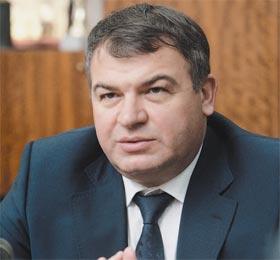
Anatoliy Serdyukov (photo: Izvestiya / Vladimir Suvorov)

ДОРОГИЕ ЧИТАТЕЛИ ! ! !

С НОВЫМ ГОДОМ ! ! !

Thanks for reading and commenting this year.

This one could have been entitled, The Army’s Great Scourge or Reform Isn’t Utopia or We Straightened Them Out.  Great quotes, but you’ll have to read to the bottom.

Defense Minister Anatoliy Serdyukov’s year-ending interview in Monday’s Izvestiya is a good read.  The paper asked some harder-hitting questions than Serdyukov normally gets.  And, though they aren’t necessarily new, his answers are pretty direct and revealing.  There are problems with a lot of them though.

Let’s look first at what Serdyukov said, then we’ll look at the deeper meaning of his answers.

Asked about this year’s command and control changes, the Defense Minister says:

“The most important thing is that we already changed the entire troop command and control system.  From one side, we tried to minimize the command and control levels; from the other side, to equip them technically.  Now the next task is before us – to tie it all into a single system so that every district commander answers not just for the ground, but also for the air, and air defense, and naval component.  The next step is we are trying to conduct exercises in such coordination between districts.  I think 2011 is key for us on this plane.”

On the decision to move to four unified strategic commands (OSKs) and cutting levels of command, Serdyukov said:

“This is the General Staff’s idea.  Before going to the president with such a proposal, we discussed this initiative since the end of 2007.  At the same time, we had conferences at various levels, consulted with experts, important military leaders, and studied international experience again – both American and NATO.  We tried to analyze the situation from every angle and arrived at the fact that this is really useful for various reasons.” 

“First and foremost, the transition to the OSK should be reflected in the controllability of the army.  A simple example:  at the beginning of the transformations, an order from me to a battalion commander had to go through 17 levels.  So you understand this influenced the speed of their transmission, and the content of the information itself.  Now we have three levels in all. If one wanted, it would be possible to calculate how much was saved both on communications nodes, and on communications systems themselves, and in speed.  And as a result – the army’s combat capability rose 50 percent.”

Asked about what will happen in combat situations now that more civilians occupy military support jobs, the Defense Minister says:

“Several factors converge into one point here, therefore, we came to the conclusion that we could and should divide directions of responsibilities – operational and support.  It’s not an accident that the Defense Minister has a first deputy – the Chief of the General Staff and a first deputy – a civilian who handles the direction connected with supporting the operational component.  Everything’s been thought out, and there won’t be any kind of failures.  Neither peacetime, nor wartime frightens us.”

On General Staff Chief Makarov’s assessment that the commander’s slovenliness caused 150 conscripts to get ill in Kemerovo, Serdyukov takes the opportunity to describe the pains he’s taken in establishing systems to monitor the implementation of military reform:

“Unfortunately, we are getting started.  Actually, when we launch any process, we try to organize the monitoring system and incentive system in the final result.  But this doesn’t always work.  We’ve established a series of structures for monitoring.  They are, for example, the financial inspectorate, which checks the use of budget resources.  Then the personnel inspectorate – occupied with the activity of every officer and civilian specialist.  There is the military inspectorate, which checks those measures which should go on in this or any military institution.  There is an organizational-inspector directorate occupied with checking fulfillment of all directives, orders, decrees, laws, etc.  This is that system of monitoring which gives the capability to influence internal army processes, and to move them.  Naturally, an entire system of regulations exists where the duties of every colleague, every sub-unit are strictly prescribed as is the corresponding period for fulfilling the orders.”

Asked about indicators of the fulfillment rate for Defense Ministry orders:

“All orders are being fulfilled.  The question is different:  are they on schedule?  And for the last half year, the picture generally doesn’t look bad.  The schedules we are establishing are holding on the whole.  Inside the ministry, we changed our entire workflow, accordingly this entailed a cut in signatories on this or that issue or project.  We are introducing electronic workflow which allows us at any stage to check how this or that directive or order is being fulfilled.”

“But there are also breakdowns.  Recently we had a collegium in Khabarovsk.  We listened to the report of an army commander who should have implemented 87 different measures, but implemented all of two.  What kind of combat readiness and discipline can you speak of if an officer doesn’t fulfill his own duties?”

“When we embarked on reform, both I personally, and many of my colleagues strove to understand:  what kind of problems really could be blocking the army’s development – housing, lack of money, lack of equipment, of soldiers?  Now there’s everything.  If you serve, then according to order 400 the money is very respectable.  We are providing housing.  There’s one hundred percent in equipment.  Almost one hundred percent – give or take one-two percent – in servicemen.  There you have it:  if you chose this profession, then serve.  But here we are stumbling over weak managerial discipline – the army’s great scourge.  And even here we’re trying, from one side, to stimulate work, and from the other – to severely demand fulfillment of service duties.”

Is Russia buying weapons abroad because the systems are really needed or is it being done out of political considerations:

“There is a certain requirement for foreign military equipment, because in a series of types of armaments, we, unfortunately, will fall behind.  Our models don’t meet the demands presented by the times.  It’s important also to understand how to formulate the tactical-technical tasks and characteristics of this or that essential production.  Therefore, we’re also trying to familiarize ourselves with those modern models of equipment and armaments which our partners have.  For this, in fact, we are buying equipment in small amounts – as in the case of UAVs.”

“However, besides equipment, it’s also necessary to have trained personnel, and a command and control system.  We don’t have many models of armaments, but to work on their development, spend time and money on their adoption is simply irrational, it’s simpler to buy, to study, and later begin to develop our own production.  Those Israeli drones gave a serious impetus to developing domestic industry.  Not long ago, the president was at the test range and there we showed him Russian models that are sufficiently reliable.  They are fully suited to us.”

“We don’t have ships like the Mistral.  We never built them.  But to try to catch up now is senseless.  We plan to buy the license and technical documentation for their production.  Moreover, there’s an agreement that, starting with the third ship, we’ll build the helicopter carriers in Russia.”

Doesn’t such an approach hurt Russia’s defense industry?  Wouldn’t it be better to finance and support our own enterprises:

“In the new state program of armaments, for four years, we laid out 600 billion rubles which will be allocated according to a new credit system for enterprises under a government guarantee.  Now  discussion is going quite actively on the subject of how this should happen, with what credit requirements and conditions.  This is one of the forms of financing which has a relationship not so much to support of enterprises as to the system of paying the state defense order itself.  It allows for transferring the load from the second half of the GPV to the first and vice versa.  Or to take off the peak load, meanwhile working out forms of active participation in financing by the Ministry of Finance and the banking system.  Incidentally, the reaction is fully positive, we already have trials with the largest banks – with Sberbank and VTB.”

On inter-ethnic conflicts in units and the possibility of creating nationality-based units:

“This isn’t today’s or yesterday’s problem.  If the commander fulfills his duties completely, then time and energy for conflicts simply won’t remain.  If they’re occupied with physical training for a minimum of four hours a day in every unit , and the remaining time is combat training, as it’s stipulated, then no kind of misunderstandings will arise.  It’s not important where you’re from, which nationality, and religion, if you just fall in your rack after exercises.  The problem again is in the commanders.  Some of them are simply estranged from working with personnel – they see that there are many physically strong, willful guys in the unit, and give over control of the barracks to them.  But those ones become abusers.”

What happens with commanders like these:

“We’ll dismiss them, get others.  An officer must be physically and morally very well prepared and engender only respect.”

Has the army rid itself of dedovshchina with the move to one-year service:

“We now are trying to get away from this term.  There is no longer such a phenomenon.  There is simply hooliganism, crude violation of the law.  If a man served three months, what kind of ‘ded’ is he?  The roots of dedovshchina are much deeper than commonly believed.  In Soviet times, when people served three-five years, then it was the rule:  a man just called up, and a man looking at demob in six months, have different training.  Here then is this phenomenon, really, and its origin.  Now this is pure hooliganism, legally punishable crime which we have fought and will fight without compromise.  Here it’s important that the commander in the sub-unit should fulfill his duties completely.  Then there can’t be any kind of conflicts by definition.”

Asked about accidents with munitions dismantlement over the last year, and how is the problem being resolved now, Serdyukov says:

“The problem is very serious.  For long years, munitions were stockpiled to excess, calculated for a multimillion-man army.  Besides, in the last twenty years, virtually no attention was given to combat training and firings, but the norms of munitions stockpiling remained as before.  As a result, so much ended up in excess that we have work for several years.  To dismantle them by industrial methods is quite complex – there aren’t enough enterprises.  Besides, this is very expensive and not safer than destruction.”

“Therefore, we’re now preparing special teams, certifying equipment, and selecting officers.  They mainly need to be combat engineers.  We’re picking ranges.  We’ve figured where, in what volume, and what we need to blow up, and worked out safe techniques.  We need at a minimum two, maybe three years of such work.  Yes, this will create some temporary discomfort and difficulties.  But it’s impossible to not do this.  If the entire arsenal at Ulyanovsk had blown up, the trouble would have been much more serious.”

Asked about demographic problems, a potential shortage of conscripts, and possibly cutting more deferments, the Defense Minister answered:

“We won’t revoke anything.  As far as demographic problems go, it goes without saying that they exist and we will take them into account.  How do we solve this problem?  I think if the country’s financial situation allows, then we will still try to return the issue of a contract army.  No one has revoked this program, we didn’t realize it because of a lack of resources.  We haven’t  rejected the idea itself.”

Serdyukov tells his interviewers flat out, there’s no longer opposition to his reforms in the army.  What happened to his opponents:

“We straightened them out.  Of course, this was difficult, especially at first.  Now a team of like-minded people has been laid down which itself is generating reform ideas.  Something’s already started to come from it.  People see this and understand:  reform is not utopia, but completely concrete matters.”

After four difficult years in the Defense Ministry, where does Serdyukov see himself:

“I still haven’t finished my service, so I can’t begin to talk about what’s been achieved and what hasn’t.  We’re now in a transitional phase.  There’s not a single direction of the ministry’s activity that modernization, the transition to a new profile wouldn’t affect.  We are working everywhere – in all spheres:  armaments, scientific-research activity, education, organization of daily service, military-technical cooperation.  I can’t say now what we’ll succeed in, and in which direction we’ll lag.  It seems to me that everything’s going pretty well.  We’re on schedule, there’s no deviating.”

Let’s deconstruct some of this shall we? 

Serdyukov and company seem to be obsessed with eliminating layers.  You know sometimes redundancy is good, and prevents making mistakes.  In a net-centric army, every layer sees the picture, but doesn’t necessarily have it for action.  It’s very hard to believe Serdyukov’s claim that just cutting command levels increased combat capability 50 percent when you look at everything that’s factored into the Russian definition of combat capability. 

Yes, we know operational and support stovepipes have been created.  But Serdyukov completely dodges the question of what happens when the combat tooth depends on a civilian tail.  There are obviously answers to this, but the Russians aren’t accustomed to this.  He brushes it off saying there just simply won’t be any failures.  That’s reassuring.

 On the soldiers in Kemerovo and slovenliness, Serdyukov goes a bit non-sequitur.  It’s great hearing about his monitoring system and the implementation of orders, etc.  One wonders, however, if electronic workflow in the Defense Ministry was as important as many things that needed to happen in the troops this year.  But then it gets really interesting.  We start to hear in Serdyukov’s words some of the animus he has for officers.  Why did he ever have such an army commander as the one he vilifies?  He really lays into officers, saying he’s given them everything they need now, they just need to do their jobs.

Serdyukov really avoids the question on buying arms abroad and hurting domestic producers.  He monologues about some convoluted credit provision scheme for paying out the GOZ.  This issue of real money for producers to make weapons and equipment is significant.  Even with the GOZ and a new GPV in place, all anyone can talk about is extending credit to the OPK in 2011.  Hmmm, interesting.

He blames commanders again for inter-ethnic conflicts in the army.  If they were doing their jobs, it couldn’t happen.  If they just wore the boys out properly, it wouldn’t occur.  There is some truth in this, yes, but it’s more complex than just that.  But saying any more might have taken the Defense Minister into a social and political minefield.

On dedovshchina, again Serdyukov blames officers for not taking care of the problem.  Serdyukov’s insistence on just talking about hooliganism makes some sense, yes, but there is still dedovshchina going on.  And, by the way, dedovshchina was never just purely hazing, making the juniors do the crappy jobs; it always had more violence, abuse, and crime in it than Serdyukov is willing to allow.

Serdyukov doesn’t say how he’s addressing the real civil-military relations problem he’s got in Chelyabinsk with regard to the explosions at Chebarkul.  But at least it’s a little like the problems his counterparts face in normal countries, and one has to credit him for taking on a lingering military problem all his predecessors simply ignored.

Wow, is Serdyukov cocky on vanquishing his opponents in the military!  He ought to watch it, it could come back on him.  But as we’ve seen, large-scale, public political demonstrations are going to come from other sources (i.e. the soccer fan bunt or pogrom).  The purely military ones (i.e. the Russian Airborne Union, etc.) tend to be more farcical.  But veterans and even serving officers could provide critical mass in a bigger social protest.  And there’s always the chance that some disaffected Kvachkov could fire a grenade at the Defense Minister’s limo.  Yes, yes, I can hear you — this is just by way of playing out one scenario on what could happen in the future.

One has to respect Serdyukov’s reticence to judge his legacy right now.  It may be possible he’ll leave the big marble building on the Arbat one day thinking how much he’s changed everything, thinking he’s a 21st century Dmitriy Milyutin.  And he may be, at least in comparison with any other choice.  He is making essential changes, and some progress.  More than this analyst thought he would back in early 2007.  But, on close inspection of the military, we may discover that less will actually have changed and improved than we think right now.

How much longer will Serdyukov continue in this burn-out job?  He’s pretty stoic, but he’s definitely more frayed than 4 years ago.  The issue probably comes down to the larger context of the Putin-Medvedev tandem and team — changes in high-level personnel could be more difficult now with every passing day.  Perhaps Serdyukov will remain through a fifth year, and the seating of the next Russian president.

It’s a great interview.  We got some real insight into the Defense Minister’s thinking.  Never could have gotten this 20 or 30 years ago.

More on Mistral

Vedomosti’s Aleksey Nikolskiy published an informative piece on Monday.

He says the announced deal for the first two Mistral helicopter carriers, built in France, includes spare parts and training for a grand total of €1.3 billion (52 billion rubles).  The deal reportedly includes the option to build two more units in a Russian shipyard.  While the deal’s sealed, the final contract is still being worked between France’s DCNS and Russia’s OSK.

Nikolskiy said the Elysee website said the Mistral package would provide 4 years of work for 1,000 French shipbuilders (5 million man-hours) at STX in Saint-Nazaire.

Paris is selling Moscow the SENIT 9 combat information system aboard Mistral, but apparently without license rights.

The contract for unit one is worth €700 million, and €600 million for unit two.

OSK maintains Russia will get a 20 percent share of the work on unit one, fabricating some sections for the ship in Russia.  Its share of the work on the second unit could be more, according to analyst Mikhail Barabanov.

An OSK representative told Nikolskiy the main goal of this deal is to get modern technology, and a possible Russian builder for the optional units hasn’t been determined.

Nikolskiy juxtaposes two views on Russia’s need for Mistral.  He quotes Barabanov:

“Why does the Russian Navy need this ship which was designed for the French Navy’s overseas expeditions?”

And he repeats General Staff Chief Makarov’s statement from June that the first Mistral will go to the Pacific Fleet to transport forces where they might be needed, particularly the Kuril Islands.

As post-script, Nikolskiy gives a snapshot of what 52 billion rubles for two Mistrals could buy:

  • 2 Borey-class (proyekt 955) SSBNs, or
  • 3 proyekt 11356 frigates (Talwar– / Krivak IV-class), or
  • 50 Su-30 fighters, or
  • 800 T-90 tanks, or
  • 50,000 apartments for servicemen.

Of course, you can generally double these alternative purchases if Russia builds a third and fourth Mistral.

Ivanov’s GLONASS Report

Today Deputy Prime Minister Sergey Ivanov reported to President Medvedev on the results of the investigation into the loss of 3 GLONASS satellites on 5 December.  As expected, the report points to mistakes in fuel calculations for the DM-3 booster stage. 

The Kremlin.ru account also says Vice-President, Chief Designer for Launch Vehicles, RKK ‘Energiya’ Vyacheslav Filin, and Deputy Director, Federal Space Agency (Roskosmos) Viktor Remishevskiy have been relieved of their duties.  Roskosmos Director Anatoliy Perminov received a reprimand.

Additional steps to strengthen administrative discipline at Roskosmos will be taken, at Medvedev’s direction.