Tag Archives: OPK

The GOZ Last Week (Part II)

We looked at last week’s news.  What’s it mean?  There wasn’t a lot of commentary about it, but there were two very good pieces.

To backtrack a little, if it looks like Defense Minister Anatoliy Serdyukov might be (just might be)  getting an upper hand on forcing defense producers to his prices instead of vice versa, then the commentaries give insight into what is happening (or may happen) if Serdyukov succeeds in driving hard bargains with the OPK.

Moskovskiy komsomolets’ Olga Bozhyeva asked a general who worked on the GOZ to comment on this year’s situation:

“The Defense Ministry now lacks an organ with responsibility for contracting work, beginning with formation of initial prices and ending with accepting the results.  In the past, the chief of armament’s apparatus performed these functions, currently it’s been transformed into a department with unintelligible functions.  Tax organ officials who’ve come into the Defense Ministry’s key financial posts can’t connect the price of a product with the characteristics of the model being produced and its contribution to the country’s security.  In the Defense Ministry in recent years, three basic methods of calculating the cost of a product have been introduced, but not one of them factors in the substantive part of the work.  They are all built on the principle:  I have a certain amount of money, I want to give you this much of it.  But putting it to concrete use no longer interests anyone.  And it turns out that the methods of calculating prices in the Defense Ministry and in VPK enterprises are different.  The people speak different languages . . . .”

Bozhyeva concludes:

“In a market economy, you have to survive somehow.  Here is not America, where work for the Pentagon brings a good profit.  With us, it only allows you to survive.  And that is if they allow it.  But they don’t let everyone.”

“Here not long ago the Defense Minister got indignant, for example, that shipbuilders [Sevmash] had become so brazen that they also put the cost of kindergartens and other “social benefits” into the price of a missile-carrier [SSBN].”

“I’m not a taxman, evidently, since I don’t understand:  but where can they put it?  Let’s take Severodvinsk here.  It is completely dependent on “Sevmashpredpriyatiye.”  Like it or not, the kindergartens, schools, hospitals, clinics, housing – the factory has to maintain all of it.  And, naturally, they put the upkeep into their production cost.  How can it be otherwise?  If there aren’t kindergartens – there aren’t missile-carriers.”

Editorializing in Nezavisimaya gazeta, Viktor Litovkin writes:

“What are the causes of such an ‘inability to agree?’  In the fact, in my view, that it’s impossible to marry purely administrative approaches to the imposition of concrete military department prices on defense enterprises with largely market relationships which exist for the defense sector today.  With achieving that degree of Gosoboronzakaz profitability in which enterprises have the chance not just to survive, but also develop.  Several defense NII and factory directors, undoubtedly following the example of MIT General Designer Yuriy Solomonov, have already even stopped ‘fearing’ to publicize their disagreements with the Defense Ministry in front of journalists.  General Director of NII Instrument-building named for Tikhomirov, Yuriy Belyy told me ‘in the ordering structures of the military department people have come, who, to put it mildly, don’t understand anything about production and price formation’ (this, by the way, also means Anatoliy Serdyukov. – ‘NVO’ No. 25).  ‘Still they always demand the reduction of invoiced expenditures, reduction of profits, of labor input.  And often arbitrarily disregard prices on final goods.’  This, in his words, is happening all over the defense sector.”

“’If we had the GOZ alone, the enterprise would have died long ago,’ Yuriy Belyy told me.  ‘There are practically no resources remaining for development after GOZ fulfillment.  It isn’t understood that wages take according to some kind of averaging principle.  Invoicing expenses also.  So goes the practical strangulation of the defense sector.  In the country’s leadership they say that the OPK’s profitability is the locomotive of industry, should be not less than 15%, but in fact it’s not more than 5-7%.  And, the main thing, not understood, is with whom to talk in the Defense Ministry.  Completely incompetent people have arrived.  Their mission is not the development of industry, not increasing the country’s defense capability, their mission is to save money by any means.’”

“An enterprise producing a final product, like ‘Dolgorukiy,’ which buys metals, nuclear reactors, various components at market prices from the monopoly producers of these products, can’t give away the good created by its workers lower or a little, one-two percent, higher than its own cost, or lower than its profitability level.  It can’t buy new machine tools, technology, reequip its production line, train and select new highly-qualified personnel, provide them housing . . . .  It can’t not think about tomorrow.”

“And from the other side, if it’s possible to pay the French one and a half billion Euros for ‘Mistrals’ we need or don’t need, then why does ‘Sevmash’ have to give away a strategic submarine extremely essential to the Navy and Russia for free?!”
Some World-Class Competitors

Despite problems with its state defense order and defense-industrial complex, Russia clearly has world-class defense producers.  This is apparent not just from their arms exports, but it’s also evident in their defense-related revenue.

Eight Russian companies just made the Defense News list of the Top 100 defense corporations worldwide.  They are Almaz-Antey, Helicopters of Russia, Sukhoy, Irkut, United Engine-building, Tactical Missiles, KB Instrument-building, and RTI Sistemy.

With 2010 defense revenue of nearly $4 billion, Almaz-Antey has appeared in the list since 2005 (Antey appeared alone prior to that).  Yet its revenue’s only about half that of Thales, a fourth of EADS, perhaps reflecting that those companies are more diversified in their defense and non-defense business. 

Helicopters of Russia vaulted into the middle of the Top 100 list with 2010 defense revenue of nearly $2 billion (a gain of 134.1% over 2009).  Consolidation of its helo design and manufacturing capabilities seems to have put Russia on the map (or at least on the Top 100).  Still, Helicopters of Russia has about half the defense revenue of Textron, and half as much diversification in its business.  The difference is more pronounced when comparing to United Technologies.

Sukhoy and Irkut need no introduction, but it’s a little surprising that their defense revenue was lower than Helicopters of Russia.

United Engine-building (ODK) is an interesting case.  Not huge defense revenue, but more diversified than other Russian corporations in the Top 100.

A number of Russian companies have fallen out of the Top 100 over the years.  They include submarine and shipbuilders Sevmash, Admiralty Wharves, and Northern Wharf (the United Shipbuilding Corporation — OSK — hasn’t appeared in their place), RSK MiG, Uralvagonzavod, and Aerospace Equipment.  It’s hard to say why they’ve fallen off; it could be their financial reporting — still sketchy at times — has made it hard to evaluate their revenue claims. 

Still, eight Russian companies in the Top 100 is a long way from 1999 when only Rosvooruzheniye (remember it?) made the list.

The Russian firms in the Top 100 are strong weapons and military equipment exporters, but the lesson for them from abroad seems to be that greater diversification and more civilian business makes a defense company more profitable.

Done Deal

Mistral Contract Signing

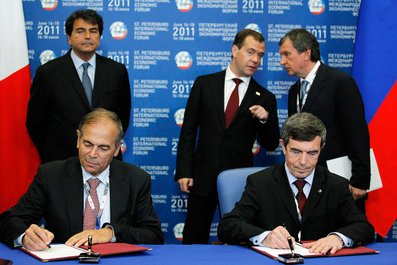
The deal for the first two Mistrals, that is.  With President Medvedev looking on, Rosoboroneksport’s Anatoliy Isaykin and DCNS’ Patrick Bouasie signed the contract at the Petersburg International Economic Forum.  RIA Novosti quoted Isaykin on the €1.2 billion price.  Work can begin after the Russians pay an advance (Versii.com repeated a rumor that the French wanted 80 percent prepayment). 

RIA Novosti also noted Isaykin saying the Russian Mistrals will be identical to French units except they’ll have reinforced hulls and flight decks to handle Russia’s northern waters, and its heavier helicopters.  Isaykin said Russia has an option for two more Mistrals to be built in Russia.  But it’s up to the Defense Ministry to get money for them in the Gosoboronzakaz.

ITAR-TASS made the point that the Senit 9 tactical command and control system, and its documentation, are part of the just-inked deal.  OSK General Director Roman Trotsenko told Rossiya-24, “The French side has gone to an unprecedented level of technology transfer and is transferring technologies, including the programming source codes for battle information-management systems, communications systems.”

Kommersant reported the first Russian unit is expected in 36 months, the second in 48, or 2014 and 2015 respectively.   It cited Trotsenko on Russia contributing up to 40 percent of the work on the two ships to be built at STX in Saint-Nazaire.

While the Mistrals will come with French electronics, the Russians will have the task of outfitting the ships with their own weapons, helicopters, amphibious assault craft, and other systems.

Radio Svoboda asked for some thoughts about the occasion.  NVO’s Viktor Litovkin opined that these expeditionary warfare ships don’t make much sense under Russia’s current military doctrine or in the context of defending the Kurils.  Pavel Felgengauer said the Mistrals may be appropriate for fighting enemies with weak air and naval forces, but Russia’s leadership hasn’t specified who they might be.  Viktor Alksnis complained that they are another stake in the heart of Russia’s dying OPK.  He calls for Russia to modernize its own arms production base instead of buying abroad.  He also fears the French could put an “off switch” in the ships’ C2 systems, effectively turning them into “target barges.”

Aleksandr Golts supports the deal because Russian shipbuilders will participate and get new technologies, but he also because he favors the emphasis on force projection rather than the Navy’s pro-SSBN mission.

Navy CINC, Admiral Vladimir Vysotskiy made some appropriately effusive comments about the capabilities and prospects for employing the Mistrals.

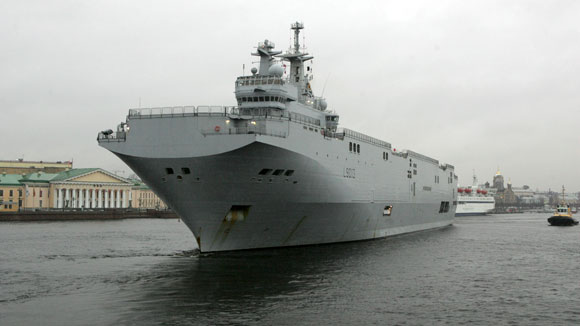
Mistral in Piter (photo: Izvestiya)

Defense Minister Serdyukov was less willing to elaborate saying:

“Let’s build them first, and then we’ll think about where to deploy them.  We have plans to employ them, when they’re closer to ready we’ll disclose them.”

In Moskovskiy komsomolets, Olga Bozhyeva writes that the Mistral deal does several things for Moscow.  An arms sale like this implies a level of acceptance by Europe, it divides old and new Europeans, and it serves as a wedge between the U.S. and its European allies.  She notes that Russian military leaders have kept pretty quiet about Mistral.  And Bozhyeva concludes, overall, it’s a bad deal for Russia.  It’s a high price tag for something that’s not a priority for the fleet.  Its missions are not well thought out.  A relatively old system like Senit 9 won’t help Russia catch up very much.  And Russia didn’t seriously consider Dutch, Spanish, or South Korean shipyards to drive the French price down, but:

“. . . we would have to exclude a certain corruption component, which, in the opinion of many experts, is included in the Russo-French contract (but it’s better to leave this subject to the procuracy).”

As is often the case, Nezavisimaya gazeta sums it all up best:

“The Glavkom [CINC] ought to specify the countries on which our Navy intend to ‘project the power’ of the LHD.  Judging by the fact that it’s intended to deploy the first two ships in the Pacific Fleet, for the defense of the Kuril Islands (can it really be that someone intends to attack them?), then Japan—ally of the U.S., China—our strategic partner or North and South Korea could be the object of this projection.  Again with Seoul it’s somehow uncomfortable.  It’s also an ally of Washington.  And don’t mention projecting power on Pyongyang, apparently, even the Americans aren’t risking doing this.”

“And not everything’s clear with our deck-based aviation for ‘Mistral.’  Our attack helicopters, Mi-24, Mi-28N, Ka-52, and naval Ka-27, Ka-28, Ka-31 are bigger (higher) in their dimensions than French ones, so it’s necessary to redesign the LHD’s hangar deck for them.  This means extra expenditures of financial resources, as well as a change of extremely weak armament for this ship.  Including even air defense.  There are also other problems.  Like the construction of a shore base for the deployment of ‘Mistrals’ on the country’s eastern shore, on the Pacific Ocean.  It still isn’t there.  But to keep such a huge hull tied up at anchor in Petr Velikiy Gulf or in other Far Eastern bays, like it was with domestic Proyekt 1123 class helicopter carriers ‘Moskva’ and ‘Leningrad,’ means to expend their service life in vain and kill it without reason.”

“In a word, the French LHDs, which should enter our Navy’s inventory in 2014 and 2015, could be not a reinforcement of our groupings of ships, which, by the way, also still need to be built up, but a headache for Russian admirals.”

Government Hour (Part II)

There was plenty of interesting media coverage of the Defense Minister’s meeting with the Duma on Wednesday, and plenty of criticism of what he said or didn’t say.  Plenty worth covering in a Part II, especially regarding Serdyukov’s effort to shift the blame for another failing GOZ.

Radio Svoboda quoted KPRF deputy Vladimir Ulas putting all the blame for the army’s current state right at Anatoliy Serdyukov’s feet:

“The public clearly understands that the situation in the Armed Forces is far from favorable.  Constant scandals which rock this department, the morale-psychological situation in which personnel, first and foremost, the officer corps, find themselves, both the material condition, and the lack of modern armaments – all these problems are completely real.  I also hoped to hear answers to questions, how the Defense Ministry intends to solve them, from the minister.  But, to my greatest regret, the biggest, in my view, problem of today’s Armed Forces is the absolutely dense incompetence of the military leadership.  With people like Serdyukov still heading our Armed Forces, and he, unfortunately, is far from the only one, hoping for some kind of positive shifts is absolutely senseless.”

There was plenty more to be said about problems with the GOZ, the OPK, and the VPK and Defense Ministry blaming each other for what looks like a failing GOZ-2011.

KPRF deputy Anatoliy Lokot told Nakanune.ru:

“I have the impression that these sessions are ‘closed’ to hide the bitterness of the questions and negative results of the work of Military-Industrial Commission (VPK) and Defense Ministry leaders.”

United Russia’s Igor Barinov reiterated what he said he told President Medvedev a year ago:

“I noted then that the lack of competition and incomprehensible system of price formation in the VPK is a deadend path.  We’re reaping the fruits of this now.  Judge yourself:  one, well, a maximum of two enterprises produce this or that type of our armament or military equipment.  Meanwhile, enterprises getting money from the federal budget dispose of it as they wish.  Prices simply come from the ceiling.  No one bears any responsibility for quality.  No one invests money in improving types of military equipment, in the end it goes that even in infantry weapons we’ve fallen behind.  Our legendary automatic weapon Kalashnikov, the value of which everyone recognized before, now lags the best Western types in tactical-technical characteristics.  And so it is in almost every area, with rare exceptions in the areas of missiles and some aircraft.”

“The Defense Ministry announced it won’t buy airborne combat vehicles [BMDs] and infantry combat vehicles [BMPs] from ‘Kurganmashzavod.’  This enterprise was one of the guilty in breaking the Gosoboronzakaz.  And here’s the thing in this.  ‘Kurganmashzavod’ is part of the United ‘Tractor Plants’ Corporation.  Budget money is shared out with ‘Kurganmashzavod’ in a targeted way for the purchase of equipment, but the corporation’s directors dispose of it according to their discretion, and, naturally, BMP and BMD production is the last thing of concern for the owners of this holding company.”

“If they understand that they can be deprived of budget resources, then this enterprise will be forced to invest in quality, and in cutting defects, and in the improvement of product types.  In addition, strict supervision is needed.  Money was allocated but no one asked anyone about this money, and the result was zero.”

The KPRF’s Lokot also dwelled on the GOZ:

“It’s obvious that if the Gosoboronzakaz isn’t formed in the first half of the year, then nothing will be accomplished in the remaining part of the time since money will only begin coming in at the end of the year.  Serdyukov acknowledged that today 13.4% of all contracts in the plan have been formed.  Some time ago, Sergey Ivanov gave us other numbers.  But I think that this number juggling was caused by competition between the Defense Minister and the Military-Industrial Commission.  Ivanov lumps all the blame on the Defense Ministry, Serdyukov – on the defense-industrial complex.  He even began his [Duma] speech with this, saying that the military-industrial complex is guilty of everything.  They have poor qualifications, technology losses, poor production and so forth.  But really at a minimum the Defense Ministry itself bears 50% percent of the responsibility for such a situation.”

“I have given the example of Novosibirsk proving the obvious guilt of the Defense Ministry in breaking the order.  One of the enterprises – the Lenin Factory, which puts out very important products for infantry weapons, became a victim of Defense Ministry officials.  In January this year, Serdyukov opened a state order tender with his signature, but closed it in March.  Now half the year is gone, and there are no results.  The enterprise isn’t working, products aren’t coming out, 211 million rubles spent on reequipping won’t bring any returns, and now they’re generally talking about cutting part of the work force.

“Right in Novosibirsk at the Comintern Factory the S-400 surface-to-air missile system is being produced on the enterprise’s own money, and not with government resources.  Serdyukov says:  ‘I don’t see anything terrible in this, let the enterprise do it on its own money.’  But where does it get its capital resources?  What world is Serdyukov living in?”

Vedomosti talked to a former Defense Ministry official who basically said the threat of arms purchases abroad really didn’t scare anyone.  And, according to him, although Serdyukov considers defense industry leaders lazy and prone to stealing, everyone understands imports can never replace domestic production.  Finally, a source close to the PA told the business daily that Serdyukov himself opposes the Mistral acquisition because of the large expenditures required to build its base infrastructure.

Kicking the Defense Ministry and OPK

President's Meeting on the OPK

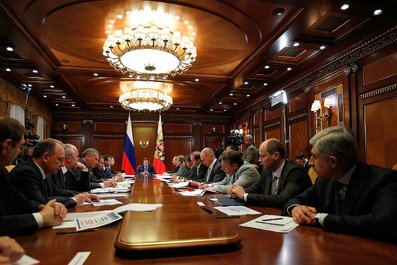
President Medvedev is irritated as ever that the Defense Ministry and OPK aren’t moving out smartly to rearm and reequip the Armed Forces.  He’s trying to kick them into gear, but can he get results where his predecessors either didn’t care or simply failed?

According to Kremlin.ru, Medvedev met this afternoon in Gorki with a host of government officials and industrial chiefs.  They included, inter alia, Sergey Ivanov, Anatoliy Serdyukov, Vladimir Popovkin, Nikolay Makarov, Denis Manturov, Yuriy Borisov, Sergey Chemezov, Sergey Nikulin, Mikhail Pogosyan, and Roman Trotsenko.

Medvedev’s opening monologue enumerated what’s been done for defense industry — providing a full state defense order and financial support, creating integrated development and production structures [OSK, OAK], etc..

Then the President says:

“However, despite all adopted measures, the state of defense production cannot be called good, all attending understand this.  There are objective reasons:  the deterioration of enterprises’ basic capital is nearly 70 percent (on average), in some enterprises it’s all much worse.  We still have not even managed to establish effective mechanisms to attract innovation and off-budget resources to the defense-industrial complex.”

Medvedev goes on to say that all relevant documents, including the GPV 2011-2020, have been signed, but the assembled group still needs to think about how to implement the GPV.  He reviews how he talked at the Defense Ministry Collegium in March about balancing producer and buyer interests, about justifiable and understandable prices.

But in many areas, says Medvedev, this has already become moot, and he intends to increase responsibility for the fulfillment of these obligations.

First, he wants a Federal Goal Program for OPK Development in 2011-2020.  Its focus is to be “real readiness” of the OPK to produce actual weapons and equipment.

Second, he wants the Defense Ministry to finish placing GOZ-2011 completely by the end of May, and advance payments issued to producers in accordance with the 2011 and 2012-2013 plans.

Work to date, he says, is going poorly and slowly.  He reminds the assembled that he told them about the failure of previous state armament programs:

“Today I want to hear from all present why this happened:  both from government leaders, and from industry leaders, who was punished for this and how.  Report proposals to me, if they still aren’t implemented, with positions, with the types of responsibility, completely concretely.  If such  proposals aren’t reported, it means [industrial] sector leaders and government leaders have to answer for it.”

It’s unacceptable, he says, that high-level decisions have been made, money allocated, but a product isn’t supplied.  He recalls his late 2009 Poslaniye in which he said 30 land- and sea-based ballistic missiles, 5 Iskander missile systems, nearly 300 armored vehicles, 30 helicopters, 28 combat aircraft, 3 nuclear submarines, one corvette, and 11 satellites would be delivered in 2010.  

Everyone here, says Medvedev, agreed with this, so why wasn’t it done.  He is, he says, waiting for an answer, and:

“. . . we have to answer for the duties we’ve taken on ourselves, we look simply in this sense absolutely unacceptable.”

Medvedev finishes by saying he knows military production is profitable, and it’s possible to attract strategic investors.  He says he wants to talk about how to stimulate investment.  The goal for the day is concrete reports on what’s been done on the level of those responsible for organizing work and correcting the situation in defense industry.

Where’s this leave things?

Not exactly throwing down the gauntlet, just another warning that he’s getting serious.  But it’s doubtful the government or defense industry will take Medvedev seriously until he fires a minister, other high-ranking official, or an important enterprise director.  And it’ll probably take more than a couple dismissals to get anyone’s attention.  Medvedev is running out of time on this account (as well as others).  Those he’d like to make responsible or punish will just take the tongue-lashings and wait him out.

GPV, Exports, and OPK Capacity

New Sub at Admiralty (photo: RIA Novosti)

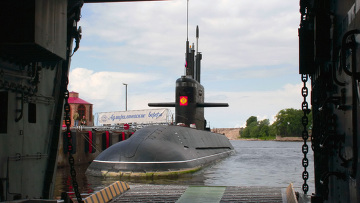
This morning RIA Novosti reported on a familiar topic — the conflict between planned acquisition embodied in the State Program of Armaments, 2011-2020, and the Russian OPK’s capacity and capability to deliver it.  In this case, new diesel-electric submarines from St. Petersburg’s Admiralty Wharves.  Also familiar is one reason for the bind — a lingering priority on production for sale abroad.

A highly-placed OPK source tells the news agency that the GPV’s plan for conventional submarine deliveries might not be fulfilled due to Admiralty’s heavy load of orders.  The Russian Navy is reportedly supposed to get 20 new diesel-electric boats by 2020, and Russia also has ten foreign deliveries scheduled.  The OPK source notes that Admiralty has become a sole source for conventional subs, and he calls for shifting some sub production to Nizhniy Novgorod and Komsomolsk:

“In view of the large volume of new submarine construction for the Navy, and also for export, it’s essential to diversify production, utilizing, for example, the capacity of ‘Krasnoye Sormovo’ Shipbuilding Plant in Nizhniy Novgorod and the Amur Shipbuilding Plant in Komsomolsk-na-Amure.  Otherwise the state program in the diesel submarine construction area could be disrupted.”

RIA Novosti notes “Krasnoye Sormovo” built plenty of Soviet submarines, 280 in all, including 25 nuclear-powered ones.  Its last boat was a diesel-electric for China in 2005.  The plant also outfits Russian Navy and export subs with torpedo- and mast-related equipment.

The article also speculates that construction of French-designed Mistral helicopter carriers could be problematic if Admiralty is selected.  The shipyard is reportedly planning on new construction space on Kronshtadt for this reason.  The OPK source says Mistral would be Admiralty’s main concern, and occupy its main capacity and personnel.  So, he continues, it’s logical to send some orders (i.e. submarines) to other factories that have the capabilities.

Igor Korotchenko tells RIA Novosti “Krasnoye Sormovo” could provide extra buildingways if Admiralty can’t meet all its export contracts.  He says Admiralty is now building five subs under the GOZ, six for Vietnam, and:

“In the event new contracts are signed for sub construction with Venezuela and Indonesia there will be an obvious problem with inadequate buildingway space, and then a backup could be required.”

RIA Novosti notes rather dryly along the way that no Russian GPV has been fulfilled completely because of the country’s insufficient modern industrial capacity.

One wonders what, if any, work and investment would be required to bring “Krasnoye Sormovo” and Amur back into the sub-building business.

Postnikov on the Army and OPK (Part I)

Ground Troops CINC, General-Colonel Aleksandr Postnikov really stirred up the hornet’s nest on Tuesday.  Russia’s defense sector – its OPK or oboronki – feeling offended recently, is abuzz about his comments.  Postnikov told a session of the Federation Council’s Defense and Security Committee:

“Those models of weapons that industry produces, including armor, artillery and infantry weapons, don’t correspond to NATO’s or even China’s models in their characteristics.”

The military hadn’t criticized the domestic OPK’s heavy armor and artillery systems to this point.

Insulting Russian tanks is the particular point here.  According to Newsru.com, Postnikov apparently called the much-praised, newest T-90 in actuality just the 17th modification of the Soviet T-72.  And, at the current cost of 118 million rubles per tank, he suggested:

“It would be simpler for us to buy three ‘Leopards’ [German tanks] for this money.”

Newsru.com counters that Rosoboroneksport is proud of the T-90, its sales, and continued interest abroad, but admits it is weak against third generation ATGMs, modern sub-munitions, and “top attack” weapons.  The news outlet also notes that the Russian Defense Ministry has eschewed procurement of the T-95 and BMPT.

In its editorial entitled “Import Generals,” Vedomosti takes Postnikov to task, saying it’s not sure whether he means new or used Leopards, but the German tanks probably come in at $7.5 million a piece at least, against the T-90 at $4 million [i.e. only part of one Leopard for 118 million rubles].  And, says Vedomosti, comparing Russian tanks to Chinese ones is lamer still on Postnikov’s part.

According to the business daily, these criticisms of Russian armaments usually come with calls to buy the same systems abroad.  But the 2008 war with Georgia showed Russia’s deficiencies lay in soldier systems, comms, recce, C2, and some types of infantry weapons rather than in armor.  When Russia doesn’t make something like Mistral or it has inferior technology like UAVs, it’s understandable to buy foreign, but when it’s something like armor, it raises a lot of issues, according to Vedomosti.  Uralvagonzavod certainly needs tank orders.  The idea of large-scale foreign purchases is utopian, says Mikhail Barabanov.  The paper believes thoughts of buying Leopard tanks and Mistral mean Russia’s generalitet has plans beyond local wars.

BFM.ru says Postnikov put the Ground Troops’ modern arms and equipment at only 12 percent of its inventory at present with, again, the goal of 70 percent in 2020.  At the end of this year, the army will get its first brigade complement of the newest automated C2 (ASU) system [i.e. presumably YeSU TZ]:

“In November of this year, we plan to conduct research on the newest  ASU and hand down our verdict.”

According to BFM.ru, he said NATO and China already have analogous systems:

“But for us it is still the future.”

Nezavisimaya gazeta focused on Postnikov’s comments on Ground Troops brigades.  He said he now has 70, but plans for 109 by 2020, including “future type” brigades:

“There will be 42 brigades of the future type, in all there will be 47 military formations of the future type, including military bases abroad which will be built on the same principle.”

The Glavkom didn’t say how the new brigades will be different from the old.

Parsing what he’s talking about is a little tough.  At the end of 2008, the army talked about having 39 combined arms, 21 missile and artillery, 12 signal, 7 air defense, and 2 EW brigades for a total of 81, rather than Postnikov’s current 70.  One might guess a dozen arms storage bases in Siberia and the Far East could be fleshed out into maneuver brigades.  But where does the manpower come from?  Maybe some of the 70,000 officers cut and now being returned to the ranks by Defense Minister Serdyukov. 

Postnikov elaborated some on heavy, medium, and light brigades.  Heavy will have tanks and tracked armor.  NG concludes there won’t be a new tank.  Tanks in storage will get new electronics and Arena active defense systems.  According to Postnikov, medium brigades will get [among other things?] the Bumerang amphibious BTR now in development.  This, says NG, is the first time anyone’s heard Bumerang.  But if it isn’t successfully developed or produced in sufficient numbers by 2020, the army will just buy armored vehicles abroad since there’s already ample precedent for this.

Light brigades will have vehicles like the Tigr or the Italian LMV (Lynx), licensed production of which could begin in Russia this year.  One special Arctic brigade will be created at Pechenga. 

Several media outlets quoted Postnikov to the effect that there’s no plan to change 1-year conscription, but he noted:

“In the transition to one year military service, military men received only a headache.”

There’s lots more reaction to Postnikov’s statements, but it’s too much for one day.

Rosoboronpostavka Understaffed, Ineffective?

This author has written several times that Rosoboronpostavka – the Federal Agency for Supplies of Armaments, Military, Special Equipment and Material Resources – is supposed to be key to making the GOZ and GPV work.  It’s supposed to take responsibility for negotiating, contracting and taking deliveries out of the hands of military men, so they aren’t tempted by bribes and kickbacks from manufacturers, and can concentrate on the specific requirements for weapons and equipment that needs to be made and bought.

In mid-2010, erstwhile Putin ally Viktor Cherkesov (who once warned of infighting and corruption among high-ranking security service veterans) was unceremoniously booted from Rosoboronpostavka.  President Dmitriy Medvedev criticized the agency (and Cherkesov) for not accomplishing much, and he moved it under the Defense Ministry, declaring that it would become a reinvigorated part of the effort to rearm the Armed Forces during the next decade.

Nadezhda Sinikova

With great fanfare, Defense Minister Serdyukov’s confidant, Nadezhda Sinikova took over at Rosoboronpostavka.  This all fit pretty well with Serdyukov’s general intent – to establish strict control over the Defense Ministry’s “financial flows,” and to civilianize Defense Ministry functions that aren’t clearly military in nature.

It’s seemed that Sinikova’s Rosoboronpostavka has remained stillborn, much like it was prior to mid-2010.  At least, nothing was heard from or about it until a 3 March article in Rosbalt.ru.  Now we have to be wary — Cherkesov’s wife, Natalya Chaplina is Rosbalt’s General Director.  Be that as it may, the article seems pretty solid.

According to Rosbalt.ru, Rosstat published data on salaries in the federal executive organs, and experts were surprised the highest average paychecks — 135,000 rubles per month or more than 1.6 million rubles per year — are in Rosoboronpostavka, an organization not even really functioning.  The average 12-month federal salary is 728,000 rubles, about 60,000 per month.
 
Rosoboronpostavka is working only in a technical sense.  The different power ministries and departments haven’t hurried to hand over authority to conclude contracts for them, and they’ve tried to sabotage the agency’s work, according to Igor Korotchenko. 

Rosoboronpostavka’s supposed to have 1,100 professional employees, 980 in the Moscow headquarters.  A source close to Rosoboronpostavka claims that, prior to mid-2010, not more than 10 people worked for the agency, and it didn’t have its own office.  They worked in a room in Rosoboroneksport on Moscow’s Ozerkovskiy Embankment. 

The Rosstat data says Rosoboronpostavka has the lowest staffing level of any executive structure, only 15.5 percent or 152 people against an authorized level of 980.
 
Before the mid-2010 changes, Rosoboronpostavka salaries had been 50-70,000 per month; the director got 70,000 and he reported to Prime Minister Putin.  Now, with its status downgraded and reporting to the Defense Minister, the agency’s pay has increased several times.
 
Experts think the pay’s kept high because the country’s leadership wants to deter corruption in the state defense order (GOZ), but deputy editor-in-chief  the journal “Armaments and Economics,” Professor Sergey Vikulov says this high pay comes “from the naive belief of our leaders that high pay will deter bureaucrats from bribery.” 

One notes Vikulov’s journal is the professional publication of the 46th TsNII, not exactly an objective voice since it used to form the GOZ (and probably collect the bribes) pretty autonomously before Rosoboronpostavka was established.
 
Korotchenko believes even bureaucrats who earn millions will be tempted to “saw off” part of the billion-ruble contracts they oversee.  He goes on to say  corruption in the Defense Ministry directorates occupied with the GOZ and the OPK already caused the failure of the two previous state programs of armaments (GPVs).
 
Rosbalt.ru also claims the Audit Chamber has said GOZ-2009 was only 50 percent completed.  Then it cites NG‘s (Mukhin’s) 70 percent fulfillment figure for GOZ-2010.

Although one expert hopes higher pay at the agency is tied to greater productivity in processing contracts, a Rosbalt.ru source says as before only a small number of contracts are being completed.  The expert is just about ready to give up searching for a logical explanation for the lack of elementary order in Russia’s management structures. 

But Korotchenko thinks it might be early to judge Rosoboronpostavka, since it’s still establishing itself.  Perhaps at the end of this year or the beginning of next, it will take over all power ministry arms and equipment procurement contracting, he says.

Nikolskiy on GOZ-2010 Failures

On Tuesday, Vedomosti’s Aleksey Nikolskiy wrote about breakdowns in last year’s State Defense Order (GOZ).  He notes that concern about failures started with Roskosmos, but it isn’t limited to that part of the defense sector.

Nikolskiy recounts Deputy Prime Minister Sergey Ivanov’s session with the Roskosmos collegium.  The space industry only produced five of 11 satellites specified in GOZ-2010, and 6 civilian launches were postponed.  The three GLONASS satellites lost to a “childish mistake” [in filling the rocket’s tanks] cost 2.5 billion rubles.  But we’ll return to Russia’s space woes another day. 

A Defense Ministry source tells Nikolskiy GOZ failures are constant. 

Bulava SLBM delays kept Yuriy Dolgorukiy from entering service [remember the new SSBN itself had to return to Sevmash for work while it awaits the next Bulava test].  Introduction of the new Severodvinsk SSN has been put off until much later because of construction defects.  A United Shipbuilding Corporation (OSK) source tells Nikolskiy the Defense Ministry has stopped financing completion of a proyekt 677 diesel-electric sub, and work on two others laid down at Admiralty Wharves is in question.

Nikolskiy says the Air Forces’ assimilation of Yak-130 trainers is delayed by last March’s crash.  And there’s a serious delay in the testing of the Su-35 fighter, according to a Defense Ministry officer [Sukhoy was reportedly testing two Su-35s last August].  One enterprise manager claims reforms in the Defense Ministry purchasing system are holding back contracting for aircraft deliveries this year. 

CAST’s Konstantin Makiyenko says government and Defense Ministry criticism of industry for its GOZ failures could be followed by personnel changes.  In Roskosmos’ case, the situation is almost “overripe.”  But Makiyenko defends other Russian arms producers by noting that delivery delays are common even for U.S. and European manufacturers.

The Defense Sector’s Systemic Failure

In today’s Nezavisimaya gazeta, Vladimir Mukhin concludes the OPK’s “systemic failure” has left the military without new weapons.  His article also says a lot about the base upon which the Kremlin intends to build a modernized economy.  But perhaps the OPK is in worse shape than other sectors . . .

Defense Minister Serdyukov apparently sent President Medvedev a report explaining why some very important armaments and military equipment were not delivered in 2010.

According to Boris Nakonechnyy, Deputy Chief of the Directorate of State Defense Order Formation in the Defense Ministry’s Armaments Department, Serdyukov proposes that the Supreme CINC use “measures of administrative effect against enterprise directors who have violated the timeframe for fulfilling the Gosoboronzakaz.”  He doesn’t say if this means fines, arrest, etc.  Specifically, Nakonechnyy said, in 2010, a proyekt 20380 corvette, two proyekt 955 submarines, one proyekt 885 submarine, 3 of 9 planned Yak-130 trainers, and 73 of 151 expected BMP-3s  were not delivered.

Mukhin calls this an obvious failure, and estimates at least 30 percent of the 2010 GOZ wasn’t realized.  He contrasts this with President Medvedev’s Poslaniye, in which he said he was sure defense expenditures in the 2011-2013 budgets would allow the Armed Forces to buy the new armaments they need.

Speaking to defense enterprise directors in Sverdlovsk Oblast, Nakonechnyy said the cause of failure in the Gosoboronzakaz is poorly organized work by enterprises and designers:

“Signing contracts . . .  an enterprise director assumes quite serious obligations.  And, signing such a state contract, he is correspondingly bound to meet these obligations.”

But, he says, in a number of OPK enterprises, this isn’t happening.

Mukhin turns to the directors’ side of the story.

Military plant directors in the Urals unanimously announced that “contracts are concluded in such a way that we will always be in extremis.”  They say they’ve made proposals about contracts, but none of them are considered.  They also point to the Defense Ministry’s significant indebtedness to enterprises for completed work.  This supposedly amounts to 228 million rubles in the Urals.  Most of all, managers worry about uncertainty in this year’s GOZ, and about the Defense Ministry’s intention to pay 2009 prices this year.

The head of the Sverdlovsk producers’ group says:

“To this point, there are no agreements, no money.  All this pushes us toward emergency work in the future.  The pricing policy is driving us into a corner.”

Another general director complains of low profitability in the OPK.  Only 6-7 percent, according to him.  The Defense Ministry is allowing growth in materials costs of not more than 1 percent this year, and this will erode profitability further.

Military analyst Vladimir Dvorkin says a third of defense enterprises are really bankrupt.  Investment in R&D is ten times lower than in developed countries.  Investment in basic capital and personnel training is five times lower.  He continues:

“Fixed capital assets at OPK enterprises are two-three times, and labor productivity five-ten times lower than in developed countries.  More than 70% of technologies supporting production demands are worn-out or obsolete.  More than half the machine tool inventory is 100% worn-out.  The average age of OPK workers is more than 50, in defense NII [scientific-research institutes] it approaches 60.”

Dvorkin thinks the Armed Forces can’t be brought to the level of the world’s leading armies without extraordinary efforts.  Priorities need to be set for the armaments development system in order to concentrate efforts on a limited list of systems.

Mukhin thinks it might be too late since Medvedev’s already signed GPV 2011-2020.  But whether its priorities will be met is another thing.  So far in post-Soviet history, not one GPV has been fulfilled, Russia’s defense industry continues to decline, and global restructuring in military production still hasn’t been noticed in Russia.